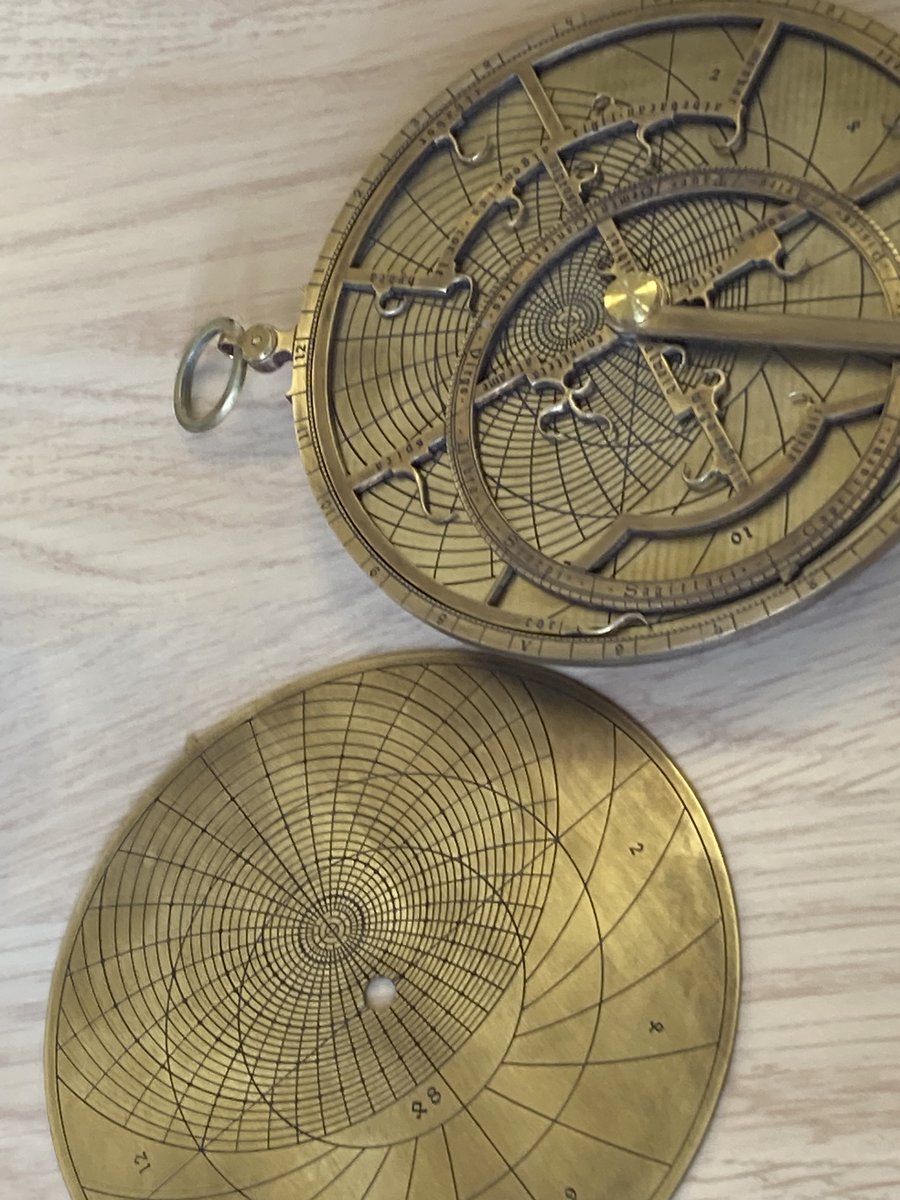
Our final #teachingcodex presentation for this panel is from Laure Miolo on 'Teaching with manuscripts and instruments'. She's brought an astrolabe with her!
Laure is a historian of late medieval Europe, specialising in manuscript studies and history of early libraries with a special focus on scientific books #teachingcodex
Those who specialise in medieval instruments tend to come from scientific background; those who work on MSS tend to be trained in history. Corresponding differences in teaching #teachingcodex
#teachingcodex Scientific manuscripts and astrolabes were used in conjunction.
#teachingcodex
#teachingcodex
#teachingcodex astrolabe and quadrant were most disseminated instruments
#teachingcodex instruments are required to model in 2/3D the motion of celestial bodies. It's easier for beginners to comprehend on sphere than in 2D
#teachingcodex Use manuscript evidence to show varied uses of astrolabe. Then use medieval instrument replica in class to e.g. work out sun's position on the ecliptic on 31 Jan.
Combination of MS and replica instrument in class facilitates better understanding #teachingcodex
#teachingcodex @mertonlib has the oldest surviving equatorium (from c.1350)! A treatise may correspond to it, preserved in two MSS, and edited by @Seb_Falk in 2016
@mertonlib @Seb_Falk #teachingcodex
@mertonlib #teachingcodex this diagram reproduces the same motions as the equatorium
@mertonlib #teachingcodex Teaching with MSS and instruments is necessary for history of science and to contextualise MSS. Sheds light on many aspects of medieval scientific practice. Introduce students to science of stars and scientific MSS
@threadreaderapp please unroll
• • •
Missing some Tweet in this thread? You can try to
force a refresh

Finally we're hearing from @HLaehnemann, Professor of Medieval German, who says her first paper after arriving in Oxford was at the first #teachingcodex colloquium – and it was on the meeting of material and digital, so we've come full circle
Started me reaching out beyond Oxford, having students reflect digitally. Covid cohort in particular! #teachingcodex
That was borne out of pandemic necessity, but it started us making the Oxford holdings available to a much wider audience. We could invite experts from all around world! #teachingcodex
Now we're hearing from Andrew Honey, book conservator at the @bodleianlibs #teachingcodex
You don't need to be able to *read* the text in order to understand books as objects #teachingcodex
What do we mean by hybridity? The idea of 'mixed character' seems of most interest. The composite nature of the items studied and complexity that brings out? How to get students to think beyond presenting something *as a text* #teachingcodex
Now it’s time for our #teachingcodex round table feat @HLaehnemann @olde_bookes @MatthewHolford, Andrew Honey, and chaired by our co-founder Tristan Franklinos
First up @olde_bookes is showcasing Trinity College MS 29 #teachingcodex, a universal history of the world in Middle English and Latin, compiled in C15
@olde_bookes #teachingcodex Hybridity is relevant in that it's compiled from MS and print sources. Transition from MS to print culture is not one-directional.
Our next presentation is from our own @DowsMillerSeb and it's called 'Don't mention the punctuation! Introducing materiality to text-based teaching contexts'. Seb works primarily on Old French. #teachingcodex
#teachingcodex Hybridity today: approaches to teaching texts which are found in MSS and printed editions
We need to think about how we're teaching texts. Teaching context isn't set up with awareness of materiality. It's OUR fault when students think that punctuation should be commented on in medieval texts #teachingcodex