Good morning from New York.
After clearing the courtroom, the judge threatened to oust Trump’s first (and maybe only) substantive witness for his “contemptuous” conduct—and strike his testimony.
Will Bob Costello avoid that fate now?
Follow my live coverage from the room. 🧵
After clearing the courtroom, the judge threatened to oust Trump’s first (and maybe only) substantive witness for his “contemptuous” conduct—and strike his testimony.
Will Bob Costello avoid that fate now?
Follow my live coverage from the room. 🧵
If you missed what the transcript revealed about Costello's dressing down on Monday, @Lawrence laid it out vividly — with a true sense of what it felt like inside the courtroom — at the beginning of @TheLastWord last night.
https://x.com/TheLastWord/status/1792872973218574630
Trump and his entourage are now in the courtroom.
For the first time all trial, Don Jr. is here. Proceedings kick off after the judge enters the courtroom, and the attorneys register their appearances.
For the first time all trial, Don Jr. is here. Proceedings kick off after the judge enters the courtroom, and the attorneys register their appearances.
Robert Costello returns to the witness stand, and Justice Merchan cordially reminds him that he's still under oath.
"Let's get the jury, please," the judge says.
"Let's get the jury, please," the judge says.
Assistant DA Josh Steinglass requests that the judge ask the jury about their availability next Wednesday.
"I will," Merchan says.
"I will," Merchan says.
"All rise."
The jury enters, and the judge wishes them good morning.
Prosecutor Susan Hoffinger continues her cross.
The jury enters, and the judge wishes them good morning.
Prosecutor Susan Hoffinger continues her cross.
Hoffinger begins by noting that Cohen ultimately retained another attorney.
"That's correct," Costello says.
She shows him another email offered into evidence. It's accepted.
"That's correct," Costello says.
She shows him another email offered into evidence. It's accepted.
Email from Cohen to Costello and partners, dated Aug. 8, 2018.
"Please cease contacting me as you do not and have never represented me in this or any matter."
"Please cease contacting me as you do not and have never represented me in this or any matter."
Costello acknowledges that Rudy Giuliani went to his wedding—and he acknowledged that he told Cohen the ex-NYC mayor "could be very very useful for you."
An email shows Costello saying just that to Cohen.
An email shows Costello saying just that to Cohen.
An email shows Costello telling his partner Jeff Citron:
"All the more reason for Cohen to hire me because of my connection to Giuliani, which I mentioned to him in our meeting."
"All the more reason for Cohen to hire me because of my connection to Giuliani, which I mentioned to him in our meeting."
Costello is shown his infamous "friends in high places" email to Michael Cohen and confirms what has long been apparent:
"'Friends in high places,' definitely refers to President Trump, yes."
"'Friends in high places,' definitely refers to President Trump, yes."
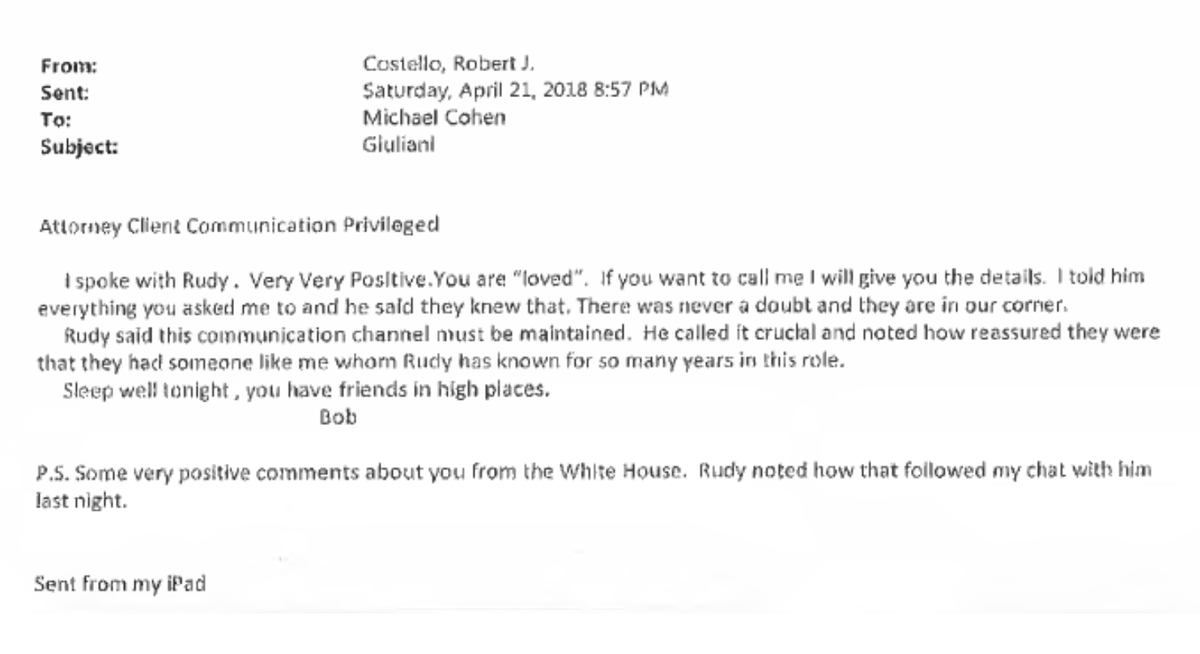
Context:
Costello previously tried to pass "friends in high places" off as a reference to the Garth Brooks song "Friends in Low Places" in an interview with The Daily Beast, before acknowledging he meant Trump to me in 2019.
My old coverage courthousenews.com/i-meant-trump-…
Costello previously tried to pass "friends in high places" off as a reference to the Garth Brooks song "Friends in Low Places" in an interview with The Daily Beast, before acknowledging he meant Trump to me in 2019.
My old coverage courthousenews.com/i-meant-trump-…
Hoffinger confronts Costello with this email, seeking "anything you wanted to convey" to his "friend."
The prosecutors asks whether it shows Costello asking Cohen for anything he wants to convey to Trump through Guiliani.
Costello only acknowledges the "friend" is Giuliani.
The prosecutors asks whether it shows Costello asking Cohen for anything he wants to convey to Trump through Guiliani.
Costello only acknowledges the "friend" is Giuliani.
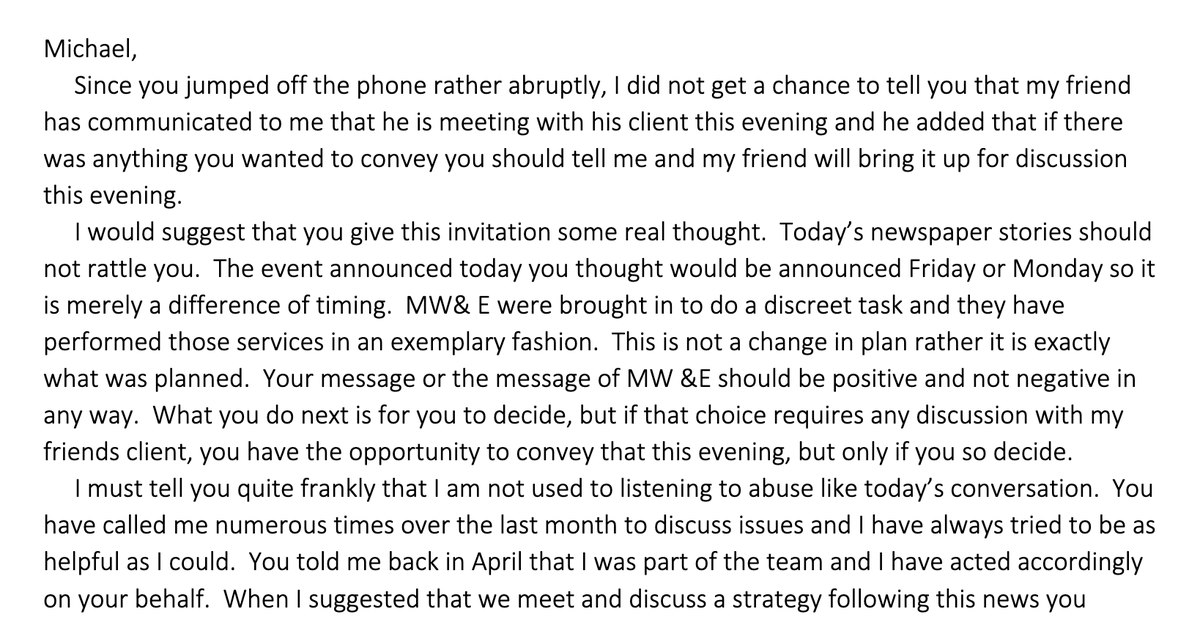
In the June 13, 2018, email, Costello wrote: "I hope I am wrong but it seems to both Jeff and I that perhaps we have been played here."
The prosecutor asks Costello a series of questions about his belief he got "played."
Read the email here pdfs.nycourts.gov/PeopleVs.DTrum…
The prosecutor asks Costello a series of questions about his belief he got "played."
Read the email here pdfs.nycourts.gov/PeopleVs.DTrum…
Hoffinger asks Costello about his testimony that he only had Cohen's interests in mind, not Trump's.
Costello stands by his testimony.
The prosecutor enters another email into evidence.
Costello stands by his testimony.
The prosecutor enters another email into evidence.
Email from Costello to his partner on June 22, 2018, subject line "Michael Cohen."
"Cohen has to know this yet he continues to slow play us and the President-is he totally nuts???
[...] What should I say to this asshole? He is playing with the most powerful man on the planet."
"Cohen has to know this yet he continues to slow play us and the President-is he totally nuts???
[...] What should I say to this asshole? He is playing with the most powerful man on the planet."
Asked whether this email speaks for himself, Costello agrees that it does.
The prosecutor asks whether Costello lost control of Michael Cohen, Costello disputes the premise.
The prosecutor asks whether Costello lost control of Michael Cohen, Costello disputes the premise.
Costello keeps denying that he had any animosity toward Cohen or didn't have his best interests at heart, even after being confronted with that email, as cross draws to a close.
Trump's attorney Emil Bove is back up to try to rehabilitate the witness.
Trump's attorney Emil Bove is back up to try to rehabilitate the witness.
Costello provides his narration of why he wrote that Cohen may have "played" him.
He says Cohen wasn't signing the retainer agreement.
Q: Were you concerned that you were representing Michael Cohen but he wouldn't sign the retainer agreement?
A: Yeah, sure.
He says Cohen wasn't signing the retainer agreement.
Q: Were you concerned that you were representing Michael Cohen but he wouldn't sign the retainer agreement?
A: Yeah, sure.
Bove notes that Costello's "friends in high places" email begins "Attorney Client Communication Privileged."
Costello confirms that he believed that was true, and Cohen didn't dispute the characterization in a follow-up email, before cutting ties with him.
Costello confirms that he believed that was true, and Cohen didn't dispute the characterization in a follow-up email, before cutting ties with him.
Hoffinger offers a volley of objections after the next series of questions to the witness. First, it's sustained, but the latest drew a sidebar.
"Approach," Merchan told the attorneys.
"Approach," Merchan told the attorneys.
Q: Did you ever pressure Michael Cohen to do anything?
A: I did not.
Q: Did you ever have control over Michael Cohen?
Costello says he did not.
A: I did not.
Q: Did you ever have control over Michael Cohen?
Costello says he did not.
Prosecutor Hoffinger has a brief recross, confirming Cohen never signed the retainer agreement.
Costello's testimony wraps and the witness leaves the courtroom.
Blanche: "Your honor, the defense rests."
Costello's testimony wraps and the witness leaves the courtroom.
Blanche: "Your honor, the defense rests."
Justice Merchan excused the jury until Tuesday — and the rest of us are in recess until 2:15 p.m. today, for the pre-charge conference.
That's where they hash out the law for jury instructions.
That's where they hash out the law for jury instructions.
It's in the weeds, but important — follow along this afternoon.
From the Trump trial press pool:
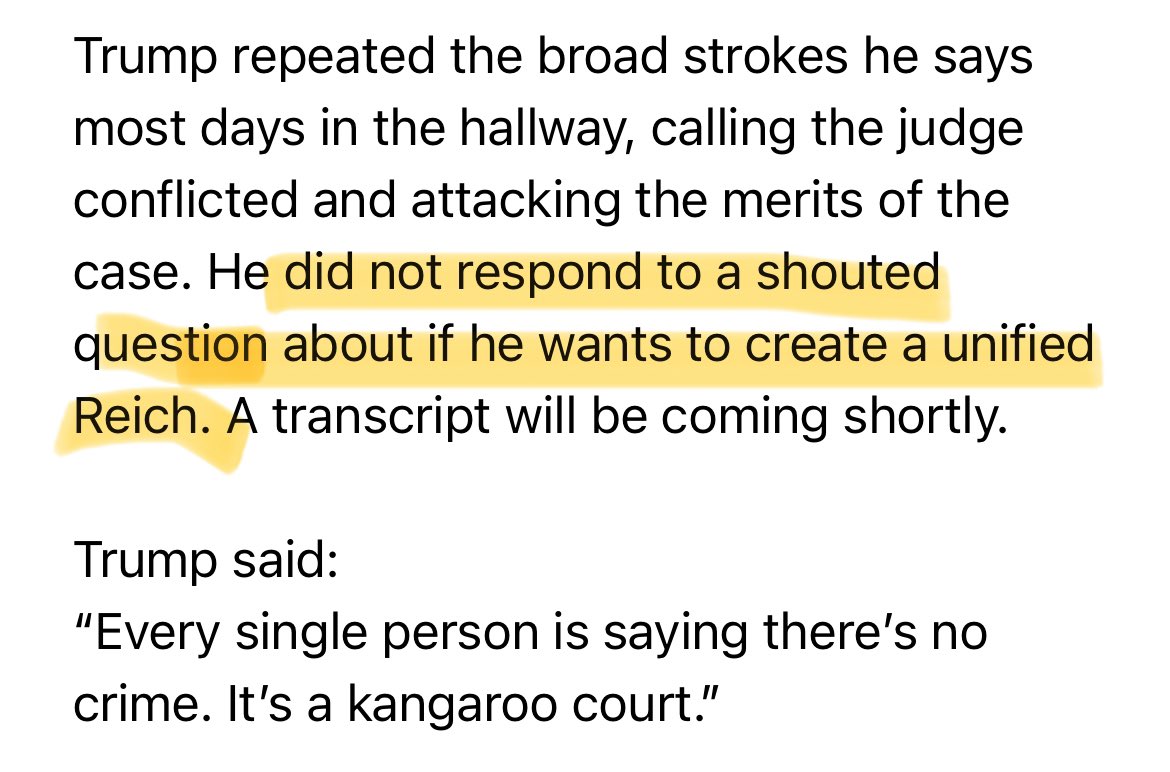
“He did not respond to a shouted question about f he wants to create a unified Reich.”
“He did not respond to a shouted question about f he wants to create a unified Reich.”
Across from the court at Collect Pond Park, protesters supporting and opposing Trump shout cheers and jibes.
A supporter shouts: “Trump for emperor,” and others chant: “We love Trump.”
Competing chant: “Lock him up.”
It’s a small crowd, but one waves a very large Trump flag.
A supporter shouts: “Trump for emperor,” and others chant: “We love Trump.”
Competing chant: “Lock him up.”
It’s a small crowd, but one waves a very large Trump flag.
Good afternoon.
The pre-charge conference has begun, and the parties are arguing election law, the set of instructions most likely to be hotly disputed by Trump's legal team.
The pre-charge conference has begun, and the parties are arguing election law, the set of instructions most likely to be hotly disputed by Trump's legal team.
Trump's attorney Emil Bove is arguing for the defense.
Assistant District Attorney Matthew Colangelo is arguing for the prosecution.
Assistant District Attorney Matthew Colangelo is arguing for the prosecution.
Justice Merchan says he'll reserve decision on the issue of "willfulness."
Trump's legal team wanted an instruction that there is no limit on a candidate's own contribution to his campaign, but the judge rejects the proposal, saying the defense can argue it during summations.
Trump's legal team wanted an instruction that there is no limit on a candidate's own contribution to his campaign, but the judge rejects the proposal, saying the defense can argue it during summations.
Justice Merchan moves on to another disputed instruction: the press exemption to federal election laws.
One of the phrases under dispute: "normal and legitimate press function," in a case deeply tied to tabloid empire AMI.
One of the phrases under dispute: "normal and legitimate press function," in a case deeply tied to tabloid empire AMI.
The defense wants a broader definition.
"There's evidence in the record that AMI wanted to resolve these things and move on," Bove says, noting that AMI published articles by Karen McDougal pursuant to their agreement.
"There's evidence in the record that AMI wanted to resolve these things and move on," Bove says, noting that AMI published articles by Karen McDougal pursuant to their agreement.
Justice Merchan says he's inclined to hew to the usual Criminal Jury Instructions (CJI) for New York State:
"Where there's standard [issue] jury instructions, I don't deviate."
"Where there's standard [issue] jury instructions, I don't deviate."
Trump's attorney seeks to deviate from those standard instructions for "intent to defraud," the judge says.
Prosecutor Colangelo argues for an instruction about the falsifying business records statute, specifically the language about making or "causing" a false entry.
"The defendant causes false entry when he sets the scheme in motion," Colangelo says.
nycourts.gov/judges/cji/2-P…
"The defendant causes false entry when he sets the scheme in motion," Colangelo says.
nycourts.gov/judges/cji/2-P…
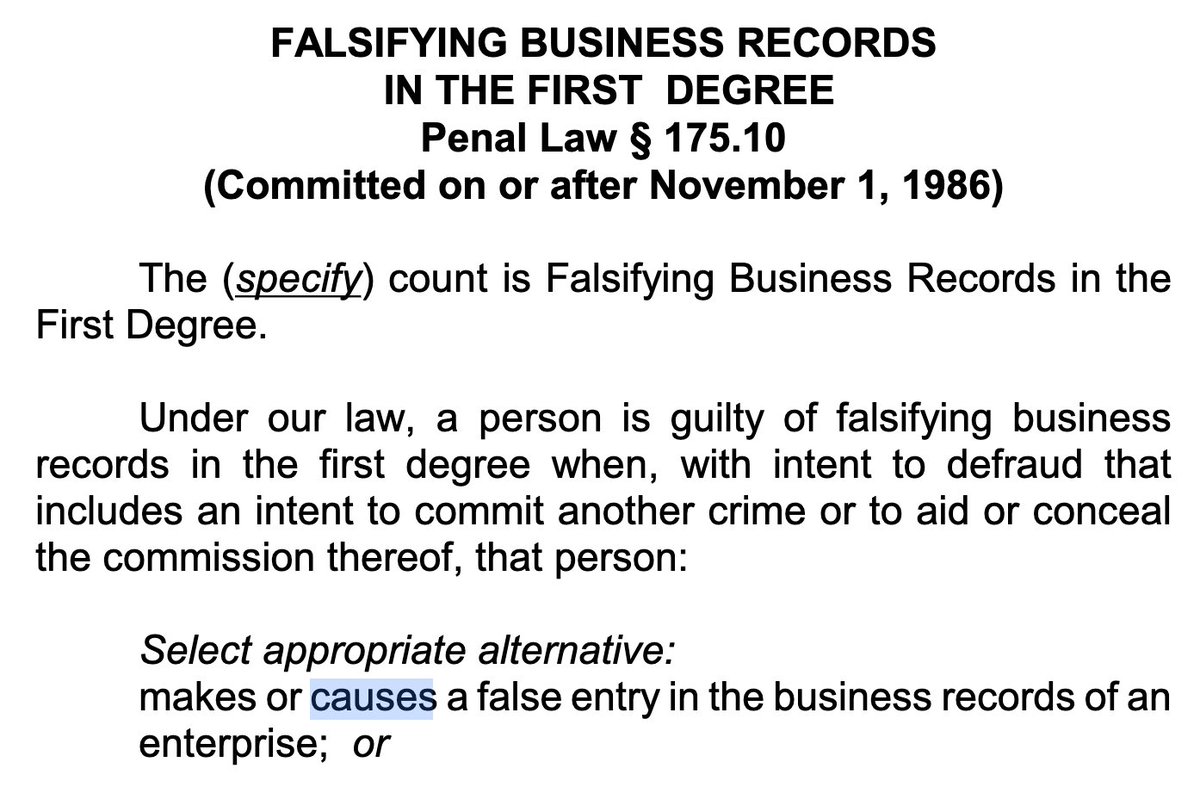
Justice Merchan reserves decision—but appears inclined to hand the particularly disputed language here to the defense.
"Right now, my inclination is to strike that language from the final charges," the judge says.
"Right now, my inclination is to strike that language from the final charges," the judge says.
Colangelo says that the prosecution's language for "intent to defraud" and "intent to commit another crime" are on solid footing.
"This is not argument. Every sentence we cite here is anchored in the court's rulings."
"This is not argument. Every sentence we cite here is anchored in the court's rulings."
The defense wants language distancing Trump from others who admitted to campaign-related crimes: "Evidence that President Trump was present when others agreed to a crime does not mean that President Trump engaged in that conspiracy."
Quick note:
Much of these arguments relate to written briefings that the press and public does not have, complicating seasoned legal journalists' ability to follow what the attorneys are wrangling about.
Much of these arguments relate to written briefings that the press and public does not have, complicating seasoned legal journalists' ability to follow what the attorneys are wrangling about.
https://x.com/eorden/status/1793000857417511078
Trump's lawyer Emil Bove invokes the "importance" of the case and what he describes as the unprecedented use of the statutes.
Assistant DA Colangelo counters: "Your honor, the importance of the case is not a reason to deviate from the standard application of the law."
Assistant DA Colangelo counters: "Your honor, the importance of the case is not a reason to deviate from the standard application of the law."
After the break, Justice Merchan says he's done with his topics, and he invites the parties to bring up others.
Bove says: "We don't have controversial arguments about too many of them."
He has a request for a Trump-specific instruction on bias.
Bove says: "We don't have controversial arguments about too many of them."
He has a request for a Trump-specific instruction on bias.
Assistant DA Steinglass says it's covered by the standard Criminal Jury Instructions charge, but he doesn't think a bias charge is necessary.
Justice Merchan agrees, without yet ruling, "that's not an instruction that's normally given."
Justice Merchan agrees, without yet ruling, "that's not an instruction that's normally given."
The judge says he will include the People's version of the bias instruction, as a concession to the defense, "even though that's something I don't normally do."
Justice Merchan dresses down Bove about the advice of counsel defense, calling it "disingenuous" of him to keep raising the issue after he rejected it.
"The jury will not hear that instruction from the bench, nor are you allowed to make that argument."
"The jury will not hear that instruction from the bench, nor are you allowed to make that argument."
Bove responds to the "disingenuous" remark, trying to "explain" himself, but the judge shuts it down."
"This is an argument that you've been advancing for many, many months," Merchan points out, adding later: "It's denied. Please don't raise it."
"This is an argument that you've been advancing for many, many months," Merchan points out, adding later: "It's denied. Please don't raise it."
Next topic:
Team Trump wants a spoliation instruction about the evidence gleaned from Michael Cohen's devices, in order to suggest info may be lost or deleted.
The prosecution suggests such an instruction would be based on an "imaginary" record spun by the defense.
Team Trump wants a spoliation instruction about the evidence gleaned from Michael Cohen's devices, in order to suggest info may be lost or deleted.
The prosecution suggests such an instruction would be based on an "imaginary" record spun by the defense.
Bove cross-examined the forensic expert who authenticated the electronic evidence at issue, and the judge praises his work.
"You did a very effective job of cross examining that witness," Merchan says, but he denies the spoliation instruction.
That's for defense summations.
"You did a very effective job of cross examining that witness," Merchan says, but he denies the spoliation instruction.
That's for defense summations.
The pre-charge conference is no over, and we await the transcript (and hopefully, the release of the written briefings) for more details.
Check out some impressions on this and the end of the defense case tonight on @TheLastWord with @Lawrence tonight at 10 p.m. ET.
Check out some impressions on this and the end of the defense case tonight on @TheLastWord with @Lawrence tonight at 10 p.m. ET.
Merchan signaled he would try to release the jury instructions on Thursday, without committing to that date.
For now, the court appears to be in recess through the Memorial Day weekend.
For now, the court appears to be in recess through the Memorial Day weekend.
• • •
Missing some Tweet in this thread? You can try to
force a refresh