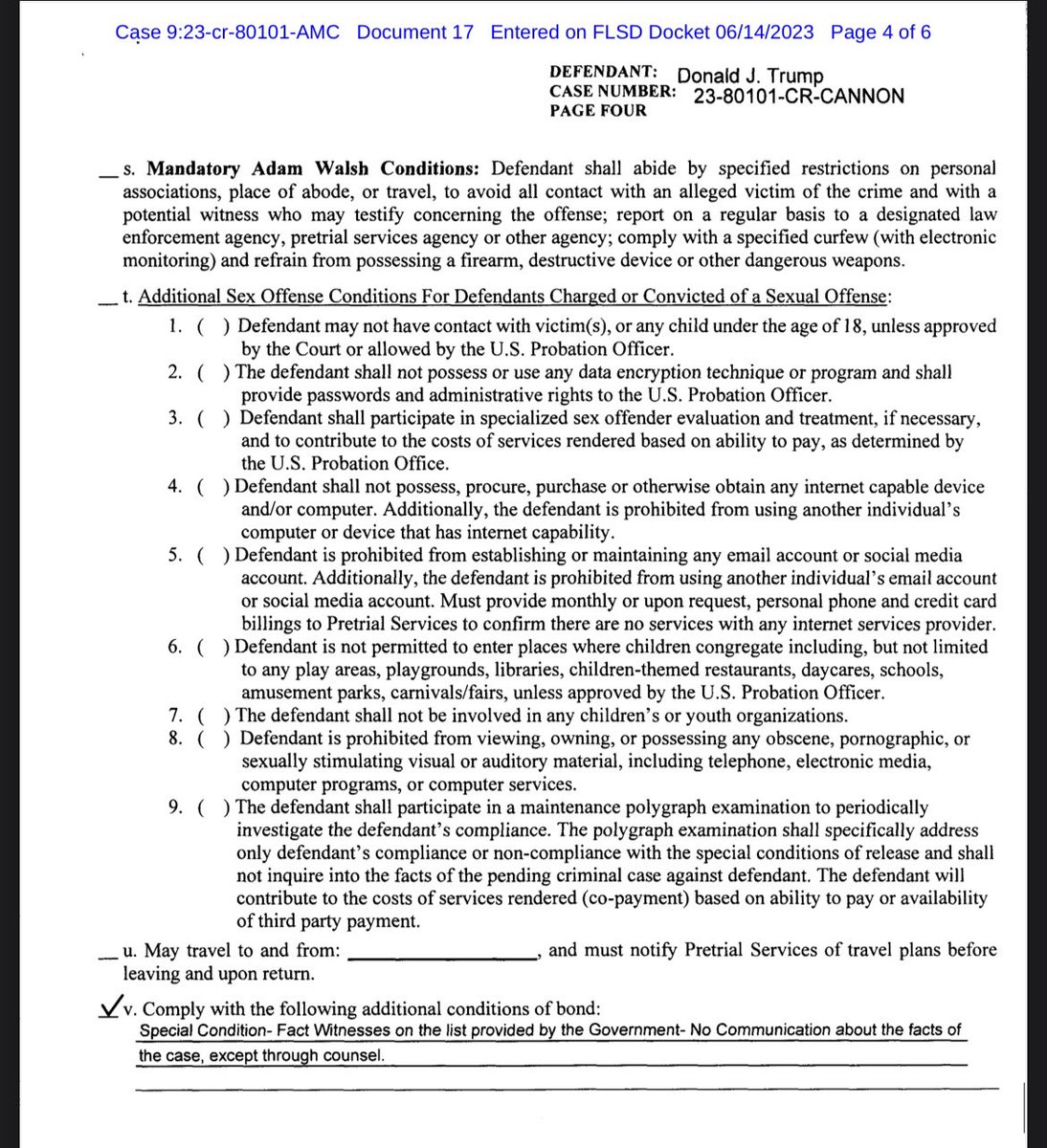
NEW: Tonight, concerned that Trump’s escalating rhetoric about the standard instructions attached to the MAL search warrant will result in violence against law enforcement, the Special Counsel’s office is asking not for a gag order, but to modify Trump’s conditions of release. 1/
That matters because when Trump was first indicted, his bond — which he signed — made clear that his continued release was conditioned on his compliance with certain terms. 2/
For example, Trump’s order not only prohibits him from violating any federal, state or local law while on release but also precludes his speaking to any fact witnesses on a list shared with his lawyers about the facts of the case, except through their respective lawyers. 3/
But in asking to modify Trump’s conditions of release to prohibit his making statements that pose a “significant, imminent, and foreseeable danger” to law enforcement involved in the investigation and prosecution of the MAL case, the Special Counsel is upping the ante. 4/
Why? Because where a defendant violates a condition of his release, the consequences can include “the immediate issuance of a warrant for the defendant’s arrest, a revocation of release, and order of detention,” as well as a prosecution for contempt. 5/
But perhaps most importantly, if Judge Cannon denies this motion, it is immediately appealable to the 11th Circuit under federal statute, which provides in relevant part:
NEW: DOJ sent Congress a six-page “report,” as required by Section 3 of the Epstein Files Transparency Act. But DOJ’s list of “government officials” and “politically exposed persons” included in the produced materials is, like the redactions themselves, too much and not enough. 1/
On one hand, the letter is missing multiple boldfaced names — like former Norwegian Prime Minister Thorbjorn Jagland and Steve Tisch — who are under fire because of their dealings with Epstein. 2/
And on the other? The inclusion of pop cultural figures who died decades ago, including Elvis Presley, Marilyn Monroe, and Michael Jackson. 3/
NEW: As the FBI executes a search warrant at a Fulton County board of elections office, it's worth remembering that there is existing litigation between DOJ and Fulton County over DOJ's attempt to obtain records pertaining to the 2020 election. 1/
In October, and at the request of the Georgia Election Board, DOJ issued a subpoena to Fulton County for "all used and void ballots, stubs of all ballots, signature envelopes, and corresponding envelope digital files from the 2020 General Election in Fulton County." 2/
In its December 2025 civil lawsuit, DOJ claims it sought these records due to "unexplained anomalies in vote tabulation and storage related to the 2020 election.” justice.gov/crt/media/1420…
NEW: Folks have been asking why Attorney General Pam Bondi, in her letter to Tim Walz, fixated on DOJ’s obtaining MN’s voting data. The answer may lie in Trump’s public statements—and MN’s last three elections. 1/
On Jan. 9, Trump met with oil and gas executives at the White House in a meeting his administration then posted to YouTube. Roughly 54 minutes in, Trump was asked about the feds’ failure to share evidence of Renee Good’s killing with state officials. 2/
Trump started by criticizing Gov. Walz and complaining about the “$19 billion” fraud uncovered in MN and mostly, according to him, perpetrated by Somali immigrants. But within a minute or so, he was talking about the elections. 3/
NEW: Comey moves to dismiss on grounds of multiple alleged instances of grand jury misconduct, stating that because the two-count indictment was never presented to the full grand jury, there was no actual indictment within the five-year statute of limitations for the two charged crimes.
This is hardly Comey's only effort to dismiss the indictment. He has two fully briefed and already argued motions to dismiss: one on grounds of selective/vindictive prosecution and the other due to Lindsay Halligan's allegedly unlawful appointment.
Some expected that Comey would wait for Judge Michael Nachmanoff to decide whether, as a magistrate judge previously ruled, he should get the transcripts and other grand jury materials.
NEW: In order to prove vindictive prosecution, a defendant has to show they have been charged due to a genuine animus toward them on account of their exercise of constitutional or statutory rights. That's usually a very tough road to hoe. 1/
Enter Tish James (and her legal team, led by Abbe Lowell). Their brief tonight cites to an Exhibit A, a 112-page compilation of 360 of Trump's public statements dating back to the day after she opened her investigation of the Trump Org and him. 2/
That exhibit reflects a LOT of work but everything in it was already public. What I don't recall seeing before is Exhibit G, an August 2025 letter to Lowell from DOJ's "special attorney for mortgage fraud" Ed Martin. 3/
As I was looking for information about the appointment of Kelly Hayes, the U.S. Attorney for the District of Maryland, I found an interesting DOJ press release. It describes how U.S. Attorney vacancies should be filled. 1/
Specifically, it explains: “Pursuant to the Vacancy Reform Act, 28 U.S.C. § 546, the Attorney General has the authority to name a U.S. Attorney to serve on an interim basis for up to 120 days.” 2/
The press release continues, “After that time, if a successor isn’t nominated and confirmed, it falls to the district court to appoint a U.S. Attorney to serve until the confirmation of his or her successor.” 3/