1/10. Mouse wrote, "Increased CO2 does not increase the yield of maize or corn."
Wrong:
Even though I've seen it over and over, it still seems strange to me that climate activists just make things up like that. Surely you must realize that the benefits of elevated CO2 for corn/maize have been measured, right? So why do you do that??
Wrong:
Even though I've seen it over and over, it still seems strange to me that climate activists just make things up like that. Surely you must realize that the benefits of elevated CO2 for corn/maize have been measured, right? So why do you do that??
https://twitter.com/ncdave4life/status/1707074962337444017
@Anymous84861064 @joe51du @Willard1951 @Rabs1958 @HalBeowa @SpudNielsen @TheDisproof @rln_nelson @Veritatem2021 @GillesnFio @Anvndarnamn5 @MartinDn1001 @3GHtweets @MarcEHJones @tonyjsargeant @ammocrypta @JohnWil12363553 @DenisDaly @AristotleMrs @S_D_Mannix @Camburnclimate @ozzorro1 @bomac_macbo @BenKoby1911 @Devonian1342 @GAJAJW @Jaisans @bulkbiker @Climatehope2 @Data79504085 @Mark_A_Lunn @Michael_D_Crow @Hji45519156 @waxliberty @priscian @SuperFoxyLoxy @ChrisBBacon3 @JaapTitulaer @wjack76995 @Rocky35418823 @NobaconEgbert @balls95652097 @BointonGiles @SeekerTheGreat1 @ubique60 @EthonRaptor @RMcgillss @paligap17 @MaggieL @PeterGleick 2/10. The "nutrition scare" is also a red herring. I discussed it at length in this thread:
en.rattibha.com/thread/1674312…
en.rattibha.com/thread/1674312…
https://x.com/ncdave4life/status/1674312716545040384
3/10. Although C4 plants are better at scavenging CO2 from the air at low levels than are C3 plants, the most important C4 crops, corn & sugarcane, have been found to benefit dramatically from higher CO2 levels.
(That's probably because they grow so fast. On a still, sunny day, a healthy corn field can deplete the CO2 in the air by noon, at which point it stops growing. With a higher starting level, it can grow longer before running out of CO2.)
(That's probably because they grow so fast. On a still, sunny day, a healthy corn field can deplete the CO2 in the air by noon, at which point it stops growing. With a higher starting level, it can grow longer before running out of CO2.)
https://twitter.com/ncdave4life/status/1707075188439884166
4/10. Taylor & Schlenker (2021) reported:
"We find large fertilization effects in the US: a 1 part per million (ppm) increase in CO2 equates to a 0.4%, 0.6%, 1% yield increase for corn, soybeans, and winter wheat, respectively"
doi.org/10.3386/w29320
"We find large fertilization effects in the US: a 1 part per million (ppm) increase in CO2 equates to a 0.4%, 0.6%, 1% yield increase for corn, soybeans, and winter wheat, respectively"
doi.org/10.3386/w29320
5/10. Additionally, if average temperatures increase due to more CO2, it will mean that crops like corn can be planted earlier (roughly 5-6 days earlier per 1°C in the American Midwest). At high latitudes, that may increase the growing season enough to enable the use of higher yield, slower maturing cultivars, or even to make corn a viable crop where otherwise it would not have been viable.
ourworldindata.org/crop-yields
sealevel.info/ourworldindata…
ourworldindata.org/crop-yields
sealevel.info/ourworldindata…

6/10. Even in hot climates, where temperatures might sometimes get above optimum, more CO2 is a very big win for corn/maize. Here's a paper which reported the effects of CO2 and O3 (ozone) on corn & broad bean yields in Egypt:
Akram Ali (2008). Factors Affecting on Response of Broad Bean and Corn to Air Quality and Soil CO2 Flux Rates in Egypt. Water Air and Soil Pollution, 195(1-4), 311–323. doi:10.1007/s11270-008-9748-2link.springer.com/article/10.100…
Akram Ali (2008). Factors Affecting on Response of Broad Bean and Corn to Air Quality and Soil CO2 Flux Rates in Egypt. Water Air and Soil Pollution, 195(1-4), 311–323. doi:10.1007/s11270-008-9748-2link.springer.com/article/10.100…
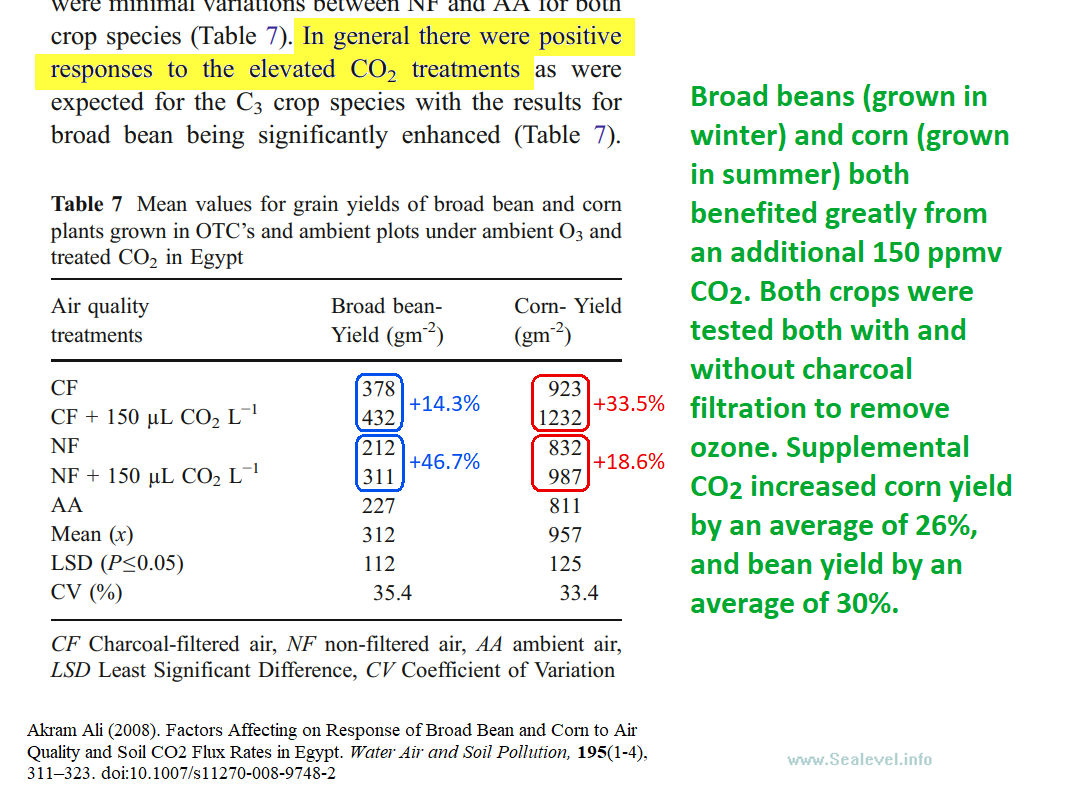
7/10. This table is from that paper; I added the colored annotations (and I corrected an obvious formatting glitch):
As you can see, an additional 150 ppmv of CO2 increased corn yields by an average of 26%.
They reported +33.5% without ozone air pollution, and +18.6% with ozone air pollution. Fortunately, most places where corn is heavily grown don't have Egypt's air pollution problem, so the larger improvement is probably more typical.sealevel.info/Ali2008_Table7…
As you can see, an additional 150 ppmv of CO2 increased corn yields by an average of 26%.
They reported +33.5% without ozone air pollution, and +18.6% with ozone air pollution. Fortunately, most places where corn is heavily grown don't have Egypt's air pollution problem, so the larger improvement is probably more typical.sealevel.info/Ali2008_Table7…

8/10. Elevated CO2 is especially beneficial for corn in dry conditions, because it improves water use efficiency and drought resilience. Here's a paper about that:
Chun JA et al (2011). Effect of elevated carbon dioxide and water stress on gas exchange and water use efficiency in corn. Agricultural and Forest Meteorology, Vol 151, Issue 3, pp 378–384. doi:10.1016/j.agrformet.2010.11.015
Excerpt: “There have been many studies on the interaction of CO2 and water on plant growth. Under elevated CO2, less water is used to produce each unit of dry matter by reducing stomatal conductance.”sciencedirect.com/science/articl…
Chun JA et al (2011). Effect of elevated carbon dioxide and water stress on gas exchange and water use efficiency in corn. Agricultural and Forest Meteorology, Vol 151, Issue 3, pp 378–384. doi:10.1016/j.agrformet.2010.11.015
Excerpt: “There have been many studies on the interaction of CO2 and water on plant growth. Under elevated CO2, less water is used to produce each unit of dry matter by reducing stomatal conductance.”sciencedirect.com/science/articl…
9/10. Every important crop has been tested. Every one of them benefits from elevated CO2, including corn. There are no exceptions, not even C4 or CAM crops.
Here's another paper about it how elevated CO2 benefits corn:
tandfonline.com/doi/abs/10.108…
Here's another paper about it how elevated CO2 benefits corn:
https://twitter.com/ncdave4life/status/1674163642865004546
tandfonline.com/doi/abs/10.108…
10/10. Among agronomists, the fact that elevated CO2 is very beneficial for agriculture has been settled science for over a century.
@ThreadReaderApp @Rattibha @threaddotblue unroll
@reSeeIt save thread
So the real question is: why are you willing to risk catastrophic famines, just to prop up the parasitic climate industry?sealevel.info/learnmore.html…
@ThreadReaderApp @Rattibha @threaddotblue unroll
@reSeeIt save thread
So the real question is: why are you willing to risk catastrophic famines, just to prop up the parasitic climate industry?sealevel.info/learnmore.html…
• • •
Missing some Tweet in this thread? You can try to
force a refresh