Today is a small thread about the great artist Liudmyla Semykina (1924-2021). I think I've never posted here any of her works. She was part of the Sixties movement and a friend of Alla Horska, Victor Zaretskyi, and Liubov Panchenko.
She was born in 1924 in Odesa. Her father held a high position in the local organization of the Communist Party, but refused to participate in the organization of the artificial famine, the Holodomor, and in 1932 he left the party. Then he worked as a carpenter.
In the early 1960s, she worked in paintings and participated with Alla Horska in creating the Creative Youth Club. With Horska expelled from the Union of Artists because of this artwork, Shevchenko here was considered a "nationalistic"
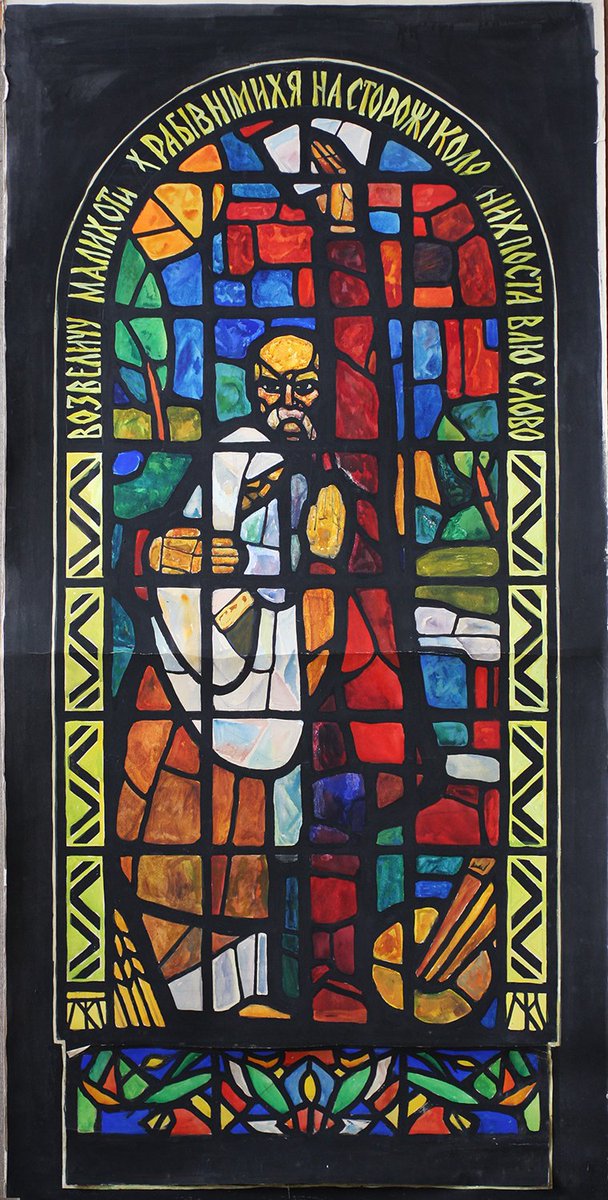
In 1968, she was expelled again for signing a letter protesting the repression of dissidents. This time, the actual ban on the profession lasted for two decades. Semykina could no longer receive government orders, participate in exhibitions, or earn money by painting.
Then, like many women artists who didn't want to be a part of the system, she found another way for her talent. She started to work as a fashion designer and costume artist for movies and theater.
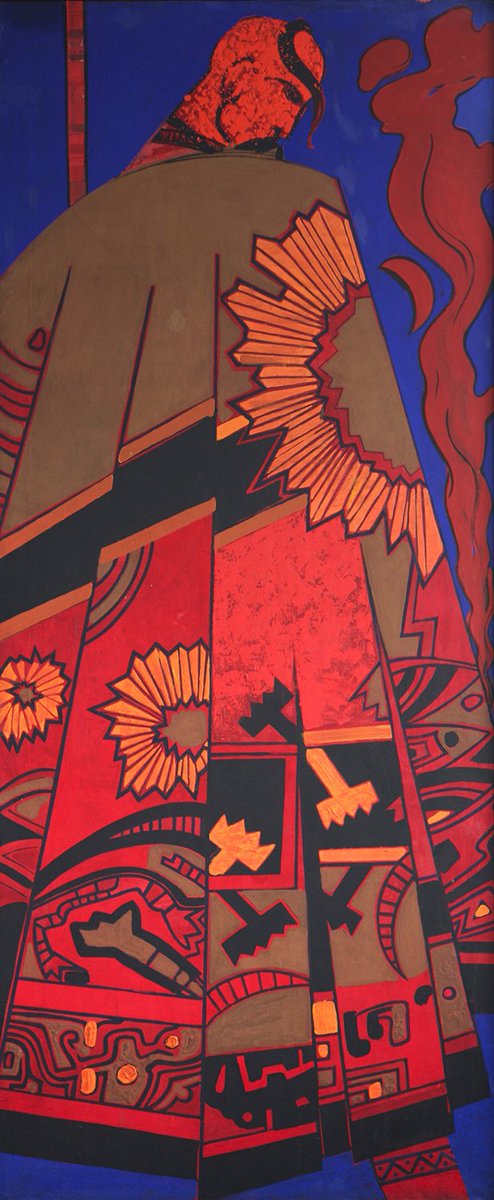
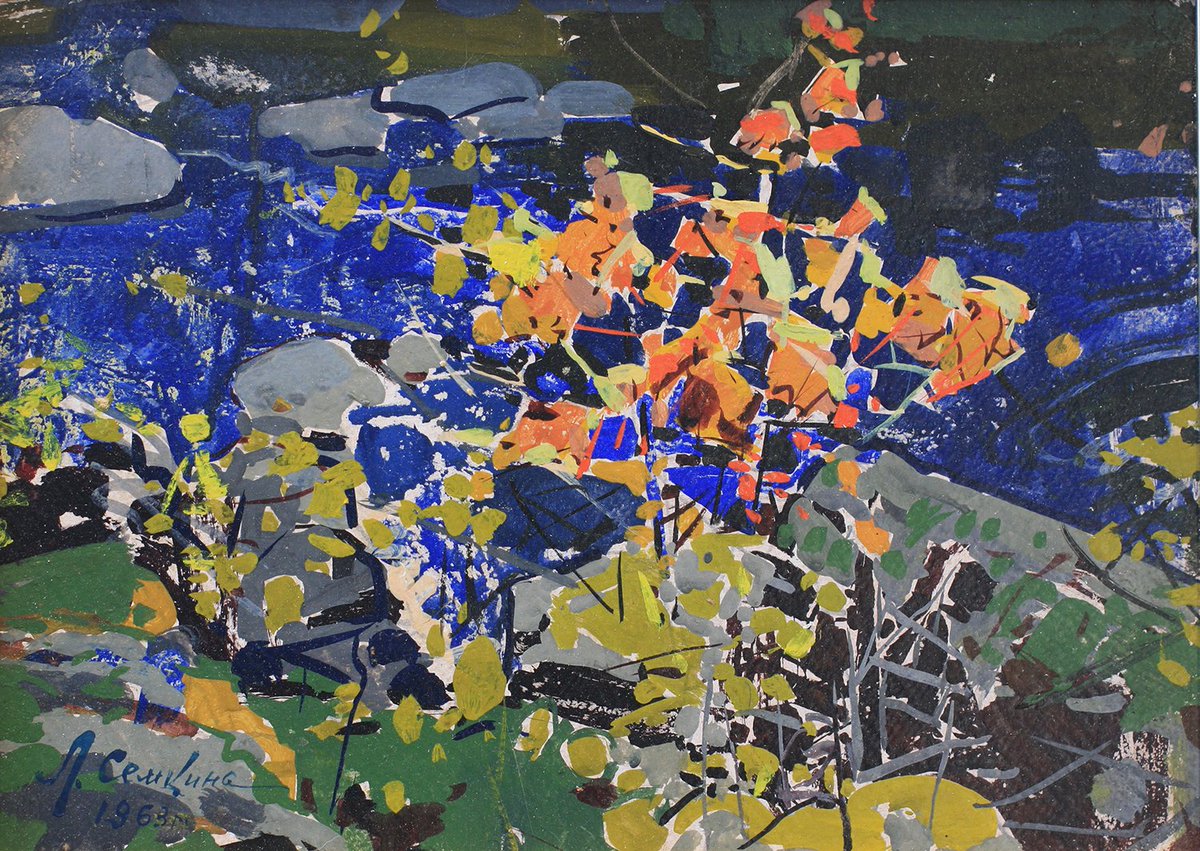
And, like many Ukrainian women artists, you will not find much information about her. Hopefully one day all the stories and art will be heard and seen. This is one of my favorite artworks made by Semykina – a landscape from Polissya. She won Shevchenko Prize only in 1996.
• • •
Missing some Tweet in this thread? You can try to
force a refresh

People say they don't see my posts anymore in their feed. I hate algorithms. Even though I didn't post much, I want to continue to show you 🇺🇦 art. For today – a thread about Mykhailo Zhuk (1883-1964) 🧵
Zhuk was born in Nova Kakhovka, Kherson oblast (now occupied). His father was a painter, and since childhood began to help his father. At the age of 13, Mykhailo was already studying at the Kyiv Drawing School of Mykola Murashko.
He did not manage to enter St. Petersburg Art Academy, but he was accepted to the Kraków Academy of Arts, from which he graduated in 1904 with a silver medal. From 1905 to 1916, Mykhailo Zhuk taught at various schools in Chernihiv.
181 years ago, Illya Rypin (Repin) was born. He is one of the most famous realist artists. Rypin was a teacher of many artists and undoubtedly influenced the history of world art. But many people still do not know that Rypin is a Ukrainian artist. 🧵
The future artist was born in Chuguiv, in the Kharkiv region, into a Cossack family. His father traded horses, and his mother organised a small school for adults and children. Ilya Rypin's cousin first brought watercolour paints.
At the age of 11, he was sent to study drawing and became a student of the local icon painter Ivan Bunakov. Rypin worked as an icon painter for a long time, until in 1863 he collected all the money he had earned and went to St. Petersburg to study at the academy.
Today is the remembrance day of Lyubov Panchenko (1938-2922), a great artist from the Sixties generation. She died after the occupation of her hometown, Bucha. I've noticed that I made a small thread in 2022. This is a bigger one about her life and art 🧵
Lyubov Panchenko has a typical story for Ukrainian female artist born in village: her parents were against her drawing, but they allowed her to study something more practical. So Lyuba took up embroidery. Then the soviet system censored. For a long time, the artist was forgotten.
The future artist was born in the village of Yablunka, which is now part of the city of Bucha, near Kyiv. Her mother taught little Lyuba to embroider. It was not only a way to decorate the house, but also to earn money.
Since childhood, Lyuba loved to draw.
Today, 100 years ago, in Bilopillya, Sumy region, Viktor Zaretskyi was born – a great 🇺🇦 artist from the Sixties generation, one of my favourite artists. I post his artwork very often here, but it's never enough. So here is his story 🧵
He spent his childhood in the Donetsk region. In 1947, he became a student of the Kyiv Art Institute. At the institute, he met his future wife and co-author of the mosaics – the outstanding artist and leader of the Sixties circle, Alla Horska.
At the beginning of his career, Zaretsky worked, like other artists of that time, in socialist realism, creating paintings on mining themes. But in the early 1960s, he travelled to Chornobyl Polissya, and that trip changed everything.
It's been two months since I wanted to share this artist and her story with you; I don't know why I've been postponing it. But here we go – Olena Kulchitska (1877-1967), artist, feminist, teacher 🧵
Olena was born in the city of Brezhany, in the Ternopil region. The girl loved to draw from an early age, and her father did everything he could to encourage her daughter's passion. Her first art education was at Lviv Art School.
She graduated from the School of Applied Arts in Vienna — the same one where Gustav Klimt studied and the only one at the time that accepted girls. For 5 years, she studied painting, ceramics, sculpture, enamel, the basics of book graphics, engraving and etching.
Ukrainian artist Margit Selska-Raich (1900-1980) deserves many threads about her life and art, so here we go 🧵
Margit Reich was born in Kolomyia to a Jewish family. Since childhood, Margit was encouraged to study, so at 18, the girl entered the private Free Academy of Arts in Lviv, later studying art in Krakow and Vienna. She often visited Paris.

It was in Lviv that she met her future husband, who was also an artist, Roman Selsky. In 1924, she visited Paris and fell in love with modern art. She drew a lot from paintings in the Louvre, visited modernist exhibitions, and was fascinated by cinema and photography.