Finally, more information on Diamondback!
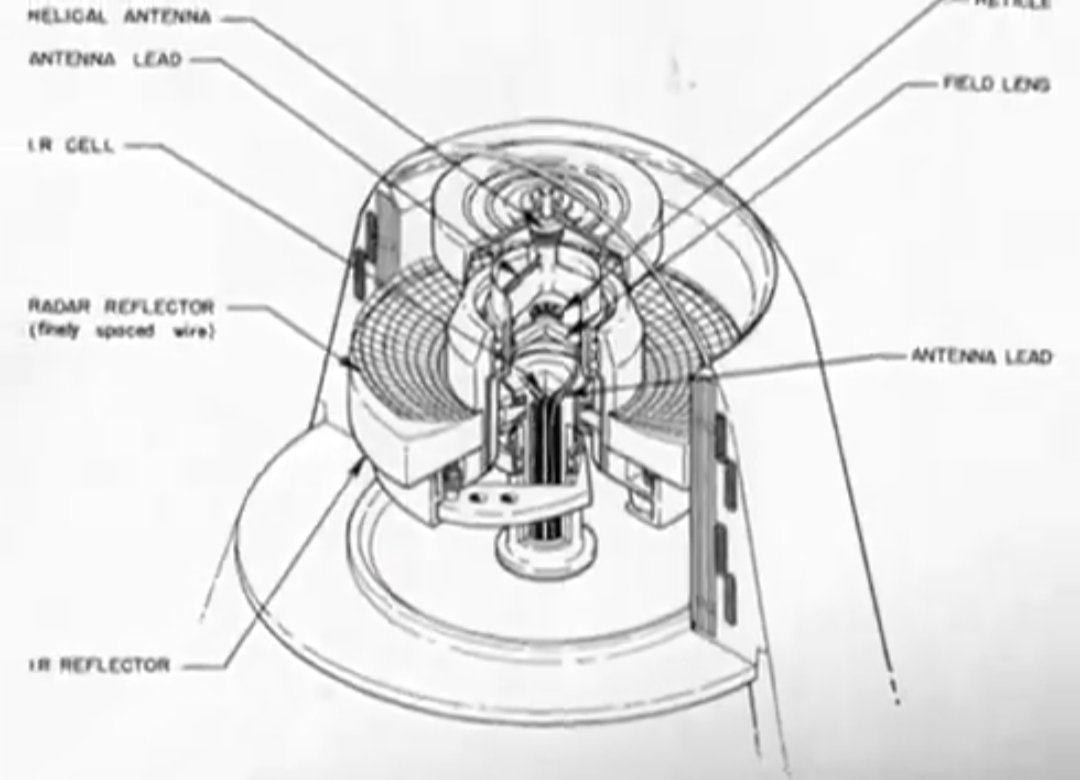
There are a few frames in here which display the seeker design. This is fascinating. A short thread to describe what's going on:🧵
In short, this is another fantastic design out of China Lake. This is a dual mode seeker, likely using the lower error or stronger of the two returns at a given point in time, which allows for long range guidance over radar and short range, more accurate guidance over IR.
The mesh used for the radar reflector would have to be very thin wire, so as not to disrupt the IR signal. However, mesh makes for a very good radar reflector material. The radar reflector was likely angled to create a conical scan, like that of AIM-9C.
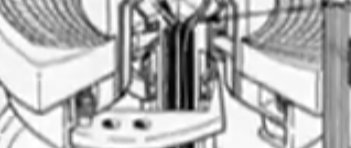
You can see the angle depicted from this shot, the left side of the mesh is higher up off the IR reflector than the right side.
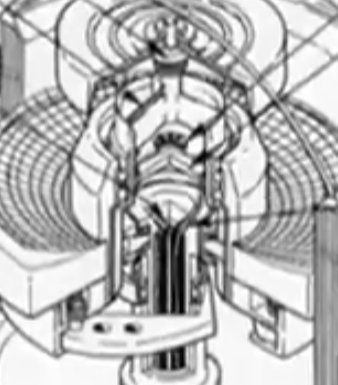
One sticking point here is that I don't understand the "helical antenna". That looks more like a spiral antenna, and I don't understand the purpose of using it. From a few other frames shown in the video, perhaps this had something to do with nuclear warhead arming? Just a guess.
Since IR conical scan was in its infancy at the time this was developed, the IR system likely used the same spin scan mechanism as the normal Sidewinder, meaning that THIS reflector had no offset from center.
This also appears to have used most of the rest of the seeker components from Sidewinder, including the precession coils.
The drive coils, however, appear to have been underneath the IR reflector like with the 9C's gyro assembly.
The early F-106's Airborne Moving Target Indication (AMTI) system was an unusual method for dealing with the threat of Soviet bombers flying at low altitudes to avoid detection by radar. Though no pictures or official explanations exist, I think I can describe this system.🧵
First, I must admit that AMTI is only a partially correct method of describing the "clutter" function on the F-106's MA-1.
While it provided MTI based on target Doppler shift, it did so with a "coherent on receive only" system rather than a fully clutter-referenced MTI system.
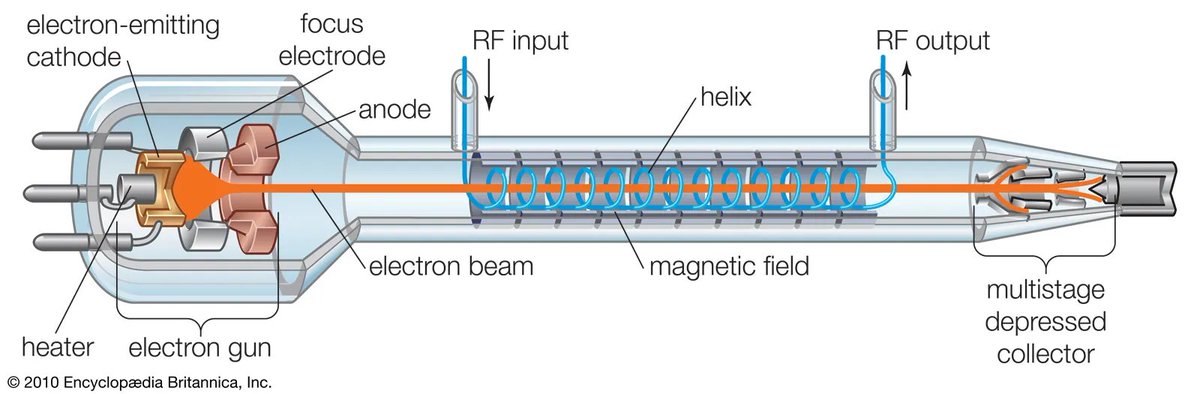
Radar coherency is critical to Doppler processing. A fully coherent radar has a single, frequency-stable, continuous oscillator generating the frequency to be used by the radar. This is then amplified to produce the output power by a Klystron or Traveling Wave Tube. (Image: TWT)
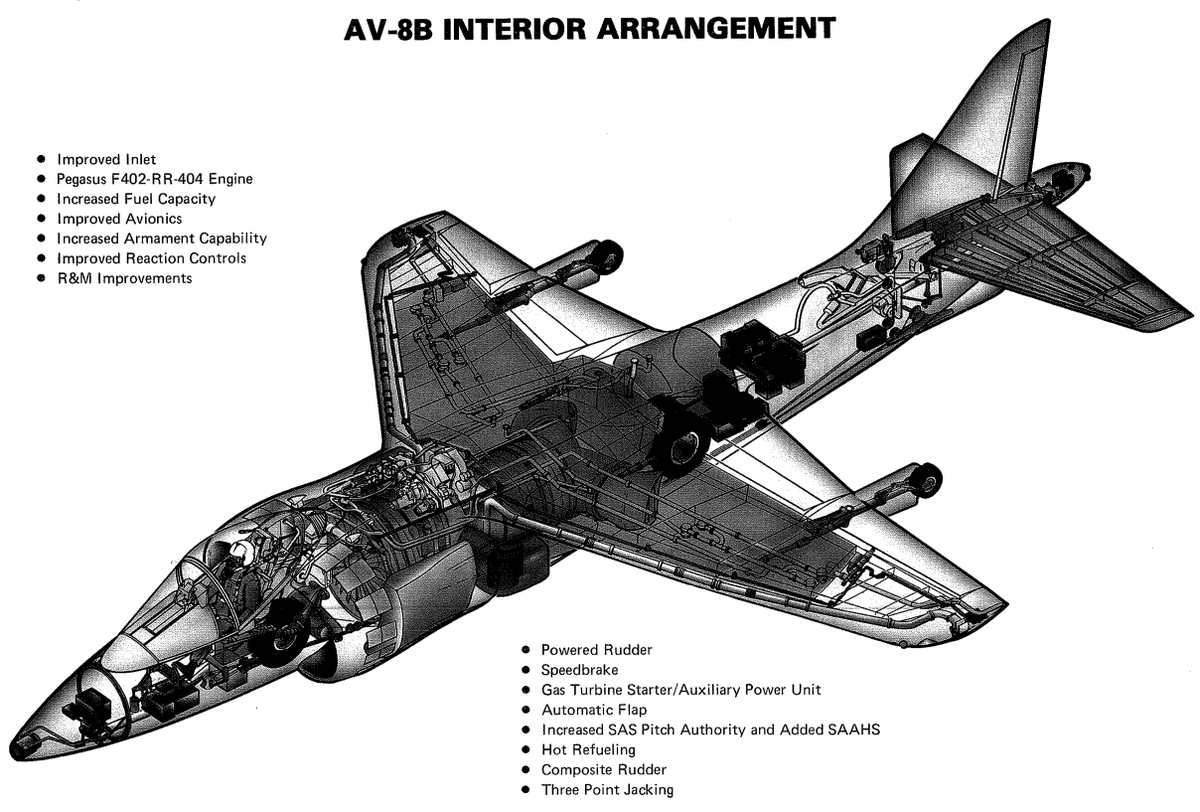
I've mentioned previously that I prefer the AV-8B to the earlier Harriers. This will be a short overview of the changes and improvements compared to the AV-8A. 🧵
The first thing to consider is the point of the Harrier II. The USMC appreciated the flexibility that the Harrier I provided, but was concerned about low payload, short range, outdated avionics, and a poor safety record.
The Harrier II solved these issues.
Like usual, we're gonna start at the front with this one.
At the tip of the nose, the AN/ASB-19 Angle Rate Bombing system is covered by a glass dome. Right behind this, the aircraft computer is mounted, and the airframe structure is designed for but not with an APG-65 radar.
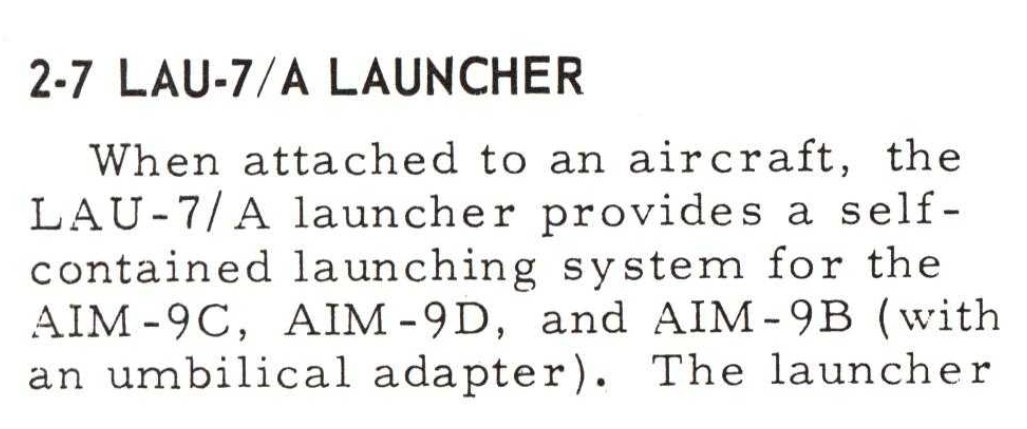
A short thread on a less appreciated part of air-to-air missiles, the launchers. In this case, the LAU-7/A launcher for the AIM-9, as applied to the D/G/H. 🧵
LAU-7/A had everything you needed for an AIM-9D. A power supply, a retaining assembly, fire control system tie-ins, a tone generator, safety devices, and most importantly, compressed gas.
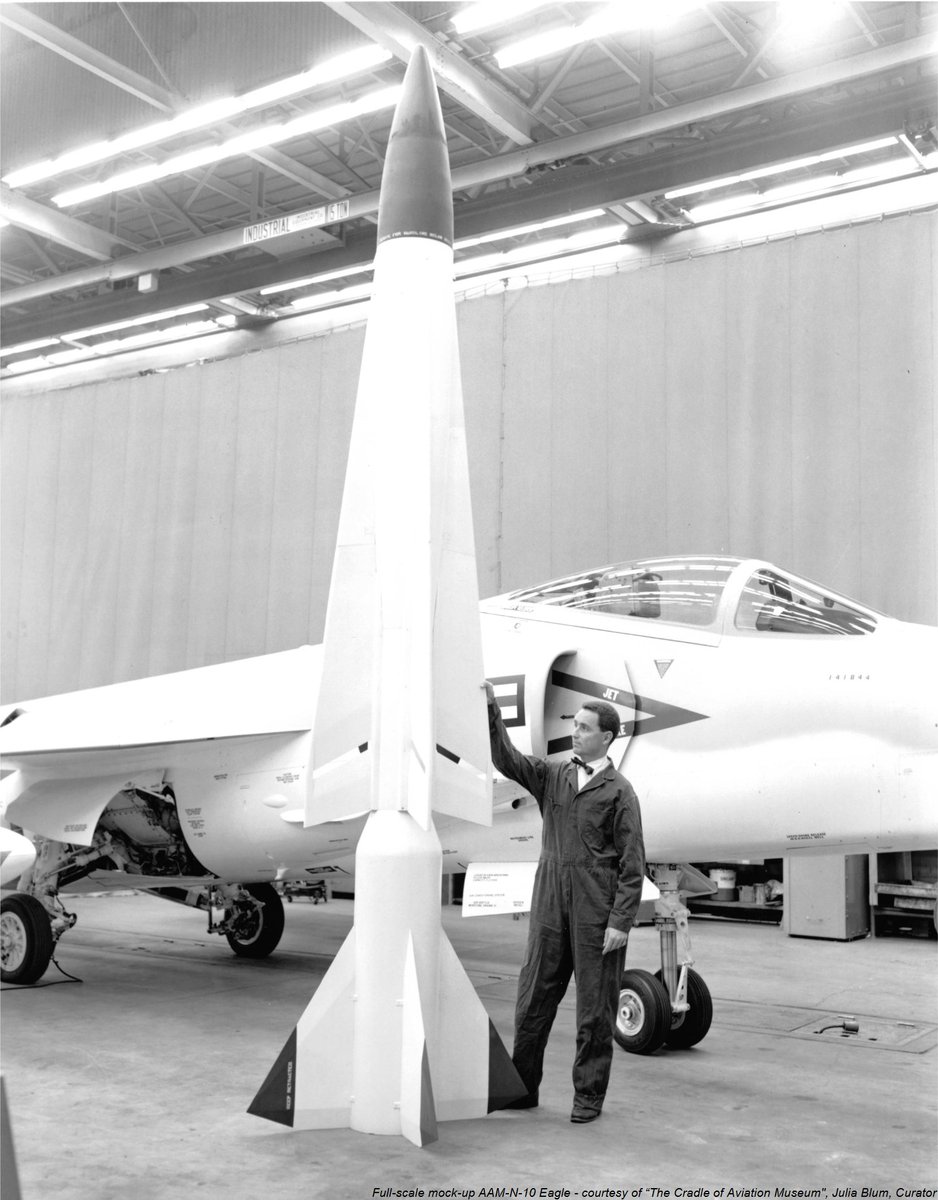
In 1958, the US began to search for an interceptor capable of shooting down bombers up to 100 nautical miles away. This eventually led to the F6D Missileer system program, built around an already-designed long-range missile.
This was the Bendix XAAM-N-10 Eagle.🧵
Admin note: this is the first of the Eagle/APQ-81 threads, which will cover this missile and the radar and the F6D they were all supposed to go on. This will tie into the ASG-18/GAR-9/AIM-47 Falcon thread (much) later. You'll see.😉
The Eagle was a complicated missile, through and through. For the time period, it was by far the most ambitious missile, especially when combined with APQ-81, the colossal track-while-scan radar that the Eagle was paired with.
In 1960, the Broad Jump program to upgrade the US Air Force's newest interceptor's radar, the F-106's MA-1 Automatic Weapon Control System, began. This would be a notable overhaul and improvement of the MA-1 system, giving it exceptional Electronic Protection capabilities.
The first systems added under Broad Jump were anti-chaff devices. One of these such devices was the leading/trailing edge range gate tracker. Normally a range gate operates as an evenly split gate, as described below.
A leading-edge range tracker sacrifices some range accuracy for electronic attack resistance. A trailing edge tracker works the same way, but in reverse.
A short thread on a poorly understood AIM-9 variant, the AIM-9B FGW.2, or in US nomenclature, AIM-9F. This was a German improvement program for the AIM-9B that entered service in 1969. (9F on the right) 🧵
The 9F was a license-produced variant of the Sidewinder, designed to improve the seeker performance and reliability of the normal 9B. It did so in three ways: optical filtering, Carbon Dioxide cooling, and solid-state electronics.
To explain the CO2 cooling decision, we're going to need to cover a little bit of photovoltaic detector physics.
A photovoltaic detector produces a small current when it is exposed to a wavelength in its sensitive band. In the rear-aspect AIM-9s, this was Lead Sulfide.