"We were tasked in Jan 2023 to deliver BMD capability to 🇺🇦..the training occurred at Fort Sill, and in April we conducted a validation exercise in 🇵🇱. #PATRIOT was transferred to protect Kyiv in late April & at 02:30 AM [May 04] it engaged the first ALBM " Col Rosanna Clemente
"We parachuted a [ADA] team into 🇺🇦..and they did an assessment in December of 2021..They took some of our #PATRIOT folks/planners. They spent some time with the Ukrainians and looked at the problem set that..2 months later they were absolutely facing" BG Maurice Barnett
"If you want to see some place that's already doing composite go to any major city in 🇺🇦..You all will probably see this in the news in the next few months or so..the team has done a phenomenal job of moving the ball [on integration]" BG Maurice Barnett
"They have probably a #PATRIOT Bn [worth].. Some of this is being used to protect static sites.. others are being moved around and doing some really historic things..One of them is a #SAMbush.. stretching the very edges..to engage the first A-50 system back in Jan"
(🎥US Army)
"In order for #PATRIOT engage ballistic missiles, it has to have other systems around it to engage other targets..the Norwegian defense attaché..he kind of looked at the 🇳🇴#NASAMS as the knight that protects king #PATRIOT" ( 🎥US Army)
"The German trainers woke up that Ukranian battery in the middle of the night and made them march order emplace, fight an air battle and..take off somewhere..A month later they conducted some of their first #SAMBUSH..shooting down SU-27's along the 🇷🇺 border." (🎥US Army)
" The tactical control officer that shot down that first #Kinzhal #Killjoy was 23 years old. " (🎥US Army)
The full exchange from the 2024 Fires Symposium can be viewed at the US Field Artillery Association's page ⤵️ vimeo.com/951587661
..A newly unearthed video from a recent U.S. Army symposium reveals the truth behind one of Kyiv’s most important aerial victories of the war—but also clarifies the depth and evolution of the Russian air and missile threat. aviationweek.com/defense-space/…
"Speaking on a panel at the US Field Artillery Association’s Fires Symposium 2024 Col. Rosanna Clemente confirmed that the first A-50 fell to a German-provided Patriot system, in what she described as a “SAMbush,” twz.com/land/u-s-army-…
• • •
Missing some Tweet in this thread? You can try to
force a refresh

Setting the accuracy of 👇 aside, I just love the 'VHF counter-stealth' debate online. It’s always: 'VHF detects it, passes it to UHF, passes it to another band, then... Boom.' I love the hustle energy, but you are describing a series of technical miracles. Maintaining a kill chain across that many handoffs isn't trivial. If that is what it's going to take, 'stealth' has already done its job.
My point isn't to dismiss 'counter-stealth' research, but to emphasize the sheer scale of the technical challenge. Developing a resilient counter-LO capability requires mastery across dozens of disciplines. Even then, you’re risking building a fragile kill chain that must be defended against an opponent’s own 'counter-counter' capabilities and TTPs. This isn't plug-and-play. You can't just pair a Chinese VHF radar with a legacy S-series system from Russia and claim a credible capability to thwart an overwhelming VLO force. A brittle kill chain is same or worst than no kill chain at all.
The dismissal of Chinese 'counter-stealth' in the context of export hardware is one thing . The integrated capability they are building in the Pacific is quite another. There is a massive gulf between a mobile VHF radar in 🇻🇪 and the land, sea, air, and space-based 'System-of-Systems' the PLA is maturing. The USAF and DoD take this threat very seriously. They aren't investing billions into next-gen stealth and resilient space architectures for nothing. We are in a race to stay ahead of a peer adversary that is building its own 'technical miracles'.
Why Is the US Air Force investing in a family of high speed weapons when it is also producing tens of thousands of much lower cost JASSM-ER and low-cost cruise missiles? 🧵👇 goes into this in a bit more detail. 1/7 #HighSpeedStrike #Hypersonic
First, let’s look at why high-speed weapons are useful. The 📸👇 captures the challenge. Strike weapons need to deliver range, overcome challenges associated with time and track custody, and be survivable against modern integrated air defense systems. The balance between these three main requirements drivers is crucial. This is why, no single class of weapons can solve all problems. 2/7
Subsonic missiles are very efficient and offer one of the most cost-effective way to achieve long range strike. Their lack of speed, time-of-flight, and depending on the weapon, survivability against sophisticated IADS will always remain a challenge. Cheaper and simpler high speed weapons like modified ground launched ballistic missiles (for Air Launch) or ALBMs offer high speed, mid-long range performance but are still vulnerable against BMD systems. Highly advanced boost glide systems are expensive, technically challenging to develop and produce affordably, and fly slower than traditional ALBMs. But their ability to operate at lower altitudes makes them significantly more survivable. Likewise, air—breathing hypersonics are significantly more efficient, package better (smaller / lighter and easier to carry for tactical platforms) but pose technical challenges in development and testing across the envelope and scaling to longer ranged systems. The threat, to a large degree, dictates the portfolio of capabilities needed. 3/7
Something I’ve been calling for here for at least half a decade if not more. This is the correct way to signal intent to industry and Congress and secure funding for production ramp. 👍
This 4x ⬆️ in the acquisition objective for the PAC-3 MSE also puts into perspective the recent US Army interest in qualifying a second seeker into missile system. With 13,000+ missiles being the objective, the Army can affordable recompete the seeker.
As I have noted before, PAC-3 MSE's kinematic performance exceeds the ability of legacy PATRIOT radar & limits engagement to sub 1,500 km ranged TBMs. This is changing with MSE being integrated into THAAD, MSEs block V seeker, and IAMD & LTAMDS radar.
The administration's 2026 defense budget request includes procurement funding for the AIM-260A missile marking the first time the Joint Advanced Tactical Missile procurement funding has been publicly reported. The PB26 budget includes $368 Million procurement funding for #JATM.
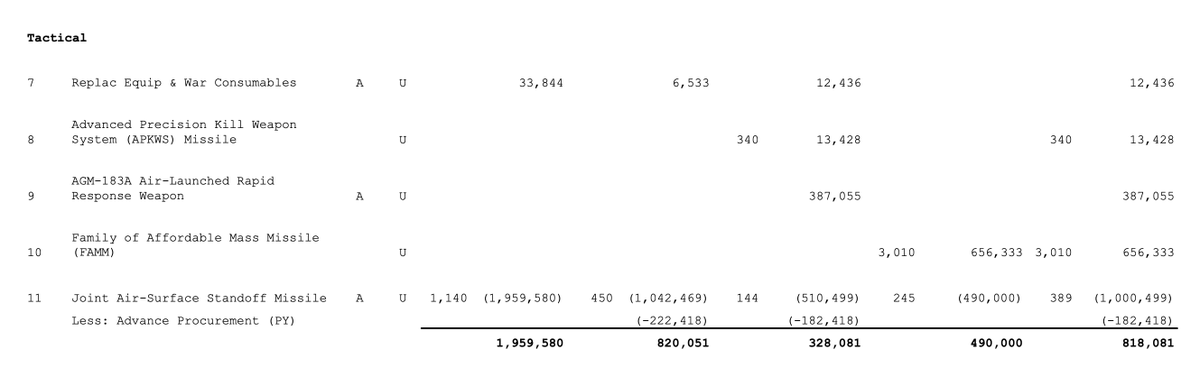
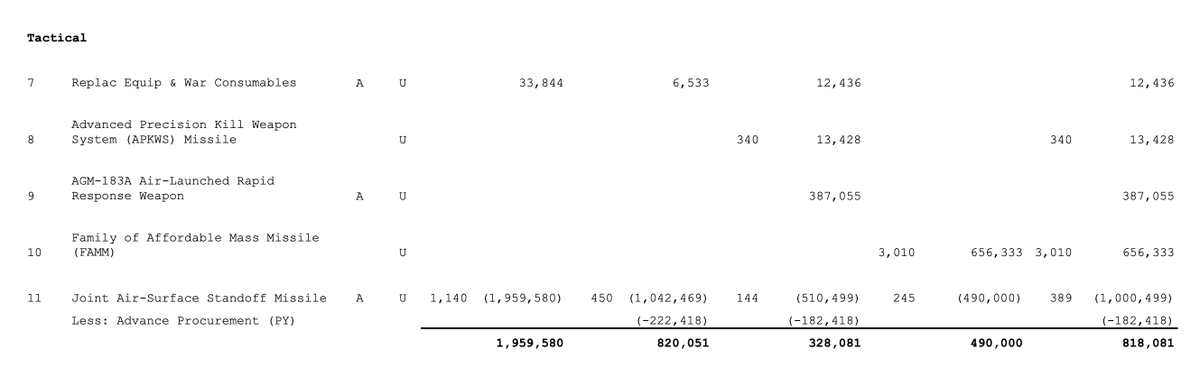
As noted and reported previously, the administration has also requested procurement funding for the AGM-183A #ARRW #Hypersonic missile system. The budget request includes $387 Million funding to begin buying the ARRW missile system.
The administration has also included $600+ Million in funding for the Family of Affordable Mass Missile (FAMM). This procures more than 3,000 missiles.
I'm often asked, why ⤵️costs $100K. Coyote includes features that are highly desirable for its intended role of protecting fixed/semi fixed sites (large OCONUS installations). If all we want is a cheap point defense solution look no further than the standard or L3/TSC upg APKWS.
Its actually quite sensible to have options across the performance & cost spectrum against G2 and 3 threats while focusing more on EW, DEW or gun based solutions for smaller G1 drones. Fielding layered capabilities is highly desirable.
There are genuine needs that cannot be met with a one size fits all solution or just fielding more guns/CIWS or similar systems. Considerations include launcher emplacement, areas of an installation you don't want to engage (or even fly) targets over & having the speed and range
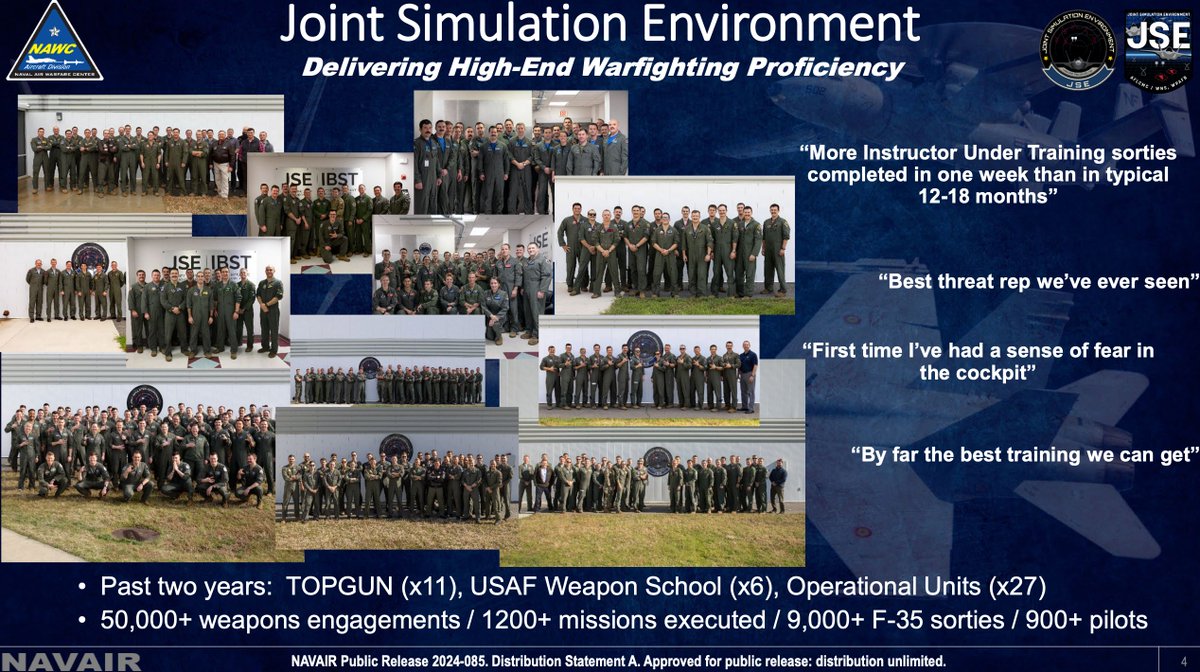
The Joint Simulation Environment #JSE is DOD’s next-gen digital test & training range made up of cockpits, domed simulators & a/c software. It enables pilots to fly wartime scenarios in a near-exact virtual environ & a/c developers to push systems to extreme limits.. ~ US Navy
Navy and AF pilots will begin training together in NAWCAD’s JSE this summer, and the JSE is now part of the DOD’s formal curriculum for its tactical weapons schools. This includes the Navy’s TOPGUN & Air Force’s 6th Weapons Squadron ~ US Navy
NAWCAD will incorporate additional test & training cockpits including the F/A18 Hornet, EA18 Growler, and E-2 platforms in its Patuxent River facility, and deploy its second training system onboard a Navy carrier, USS Abraham Lincoln (CVN 72), this year.