
What is the significance of the number 10^10^10^34?
🧵 1/n
🧵 1/n

The number 10^10^10^34 is known as Skewes' number. When Skewes defined this number in 1933 it was the largest "useful" number that had been defined. What was it useful for?
2/n
2/n
It has to do with the prime number theorem.
The function π(x) is the number of primes less than or equal to x. The prime number theorem says that π(x) is asymptotically equal to li(x).
3/n
The function π(x) is the number of primes less than or equal to x. The prime number theorem says that π(x) is asymptotically equal to li(x).
3/n

You may have seen the prime number theorem states as π(x) is asymptotically equal to x/log(x). That's true too, but li(x) converges to π(x) faster than x/log(x) does.
4/n
4/n
For large x, π(x) approximately equals li(x). But does li(x) under-estimate or over-estimate π(x)? That is, what can we say about the sign of π(x) - li(x)?
5/n
5/n
For all values of where π(x) has been computed, π(x) > li(x). But J. E. Littlewood proved that π(x) - li(x) changes sign infinitely often.
So if π(x) - li(x) changes sign, where does it first change sign?
6/n
So if π(x) - li(x) changes sign, where does it first change sign?
6/n
Skewes proved in 1933 that the first change of sign in π(x) - li(x) occurs at some x less than Skewes' number, assuming the Riemann hypothesis.
7/n
7/n
In 1955, Skewes gave another upper bound on the location of the first crossing, this time not assuming the Riemann hypothesis.
8/n
8/n
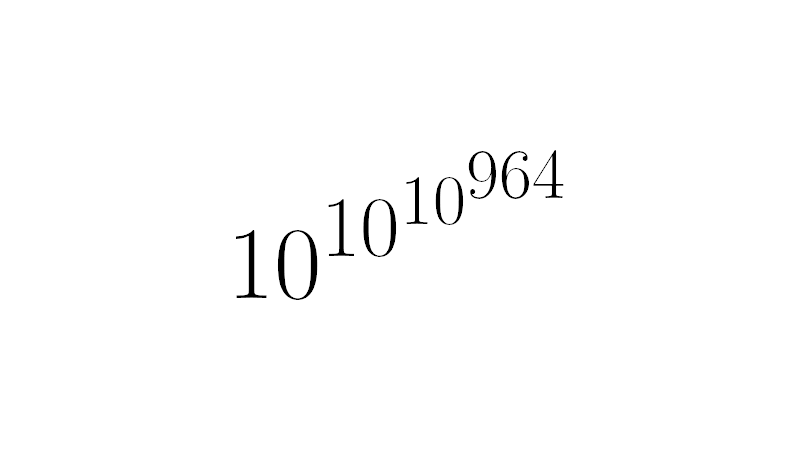
There is no known value of x for which π(x) > li(x), but if the Riemann hypothesis is true, then there exists such an x on the order of 10^316.
9/9
9/9
@threadreaderapp unroll
• • •
Missing some Tweet in this thread? You can try to
force a refresh







