🧵RESOURCE: AUDIO & TRANSCRIPT OF INTERVIEW WITH SENATOR RAND PAUL
June 13, 2024 (~9:15 - 9:55 AM EDT)
@DrJBhattacharya and I were joined on today's @X space by @RandPaul to discuss the COVID cover up.
This post contains the complete audio, see below for transcript.
(1/4)
June 13, 2024 (~9:15 - 9:55 AM EDT)
@DrJBhattacharya and I were joined on today's @X space by @RandPaul to discuss the COVID cover up.
This post contains the complete audio, see below for transcript.
(1/4)
(2/4) ***GENERATED BY NOTTA - MAY CONTAIN TRANSCRIPTION ERRORS, PLEASE CHECK VIDEO ABOVE TO CONFIRM***
Senator Rand Paul 00:00
Good morning, guys. Glad to be with you.
Bryce Nickels 00:03
Good morning. Um, so I have already given you an introduction. So I wanted to kind of just jump right in because I know we have a limited amount of time with you. Um, we were just talking about Anthony Fauci.
Bryce Nickels 00:15
Um, I don't know if you heard a little bit of that and I wanted to begin by asking you what you thought about the Fauci hearing that we had on the third of June.
Senator Rand Paul 00:27
You know, I think he gave us very little new information, but what I was struck most by was that he immediately, through his assistant of 20 years, his special adviser of 20 years under the bus, you know, this David Marens, and when asked about Marens, he says, I barely knew him.
Senator Rand Paul 00:43
He didn't come to meetings. He wasn't part of the policy team. He didn't have access to my office, and furthermore, he didn't even have an office in my building. And so I think when someone protests that much, you wonder if the protestations are to the distancing has a purpose, you know, if he's really worried about being caught up in David Marens' web.
Senator Rand Paul 01:07
And Marens was pretty explicit. He's pretty much dead to rights in the sense that he said to many people, don't use my government email, use my Gmail, use my private phone, if you need to get messages to Tony Fauci, I can hand carry them like a courier, and I can give him notes, I can call his private phone.
Senator Rand Paul 01:27
I've talked to the FOIA lady, the FOIA lady's explained to me how to delete searches even after they've been requested legally. He changed people's names. They used to take Christian Anderson's name and change one of the vowels to a dollar sign, which I think there's a certain irony there, but all of this Marens' testimony was so damning that Fauci felt necessary to completely disassociate himself from that.
Senator Rand Paul 01:51
And I guess the conclusion I took from this, that if I were in charge of this hearing, and my private advice has been to those in charge of the hearing, I would ask Marens to come back in. And it can be done as a private deposition, but the main reason I'd ask him to come back in is that he basically is out on an island by himself.
Senator Rand Paul 02:07
Fauci pretty much says, you know, I don't know the guy, I never did any of those things, I didn't delete any of my emails. So if Marens now doesn't like Fauci calling him a liar, maybe they get better testimony from Marens on a second go round.
Senator Rand Paul 02:20
I've also suggested that the FOIA lady be brought in, and I think she is scheduled for a deposition. And the idea that someone whose job is to facilitate Freedom of Information Act and to comply with it was actively teaching people how to evade the Freedom of Information Act and to destroy evidence.
Senator Rand Paul 02:39
These are felony crimes. And I think if you really had a prosecutor worth their salt, Marens would have already been indicted and charged, and the FOIA lady in all likelihood would. But from that, you might be able to get the truth of the matter about Fauci.
Senator Rand Paul 02:55
I don't think he's been honest. I don't think he's telling the truth. I think in all likelihood, yes, emails were deleted. The main question I would ask the FOIA lady is, I suspect someone like Fauci didn't take the time to delete his emails, but I would ask her point blank, under oath, did you facilitate or help him to delete emails?
Senator Rand Paul 03:14
The thing about the deleted emails, were they any big deal? Well, you have emails from David Marens, Fauci's assistant, saying, well, I think we're safe now. I deleted all those earlier emails. I think we're safe now.
Senator Rand Paul 03:27
And it's like, that sounds like the whole language of people committing crimes. I mean, that sounds incredibly indicting of his behavior. So I don't know that Fauci necessarily told as much. He did deny all the allegations, though.
Senator Rand Paul 03:41
So I guess the only way we know if he is lying is either to subpoena his records, which I would have done a year ago, his private phone records and his private email records, because I don't think I've taken at face value that he didn't conduct business on his private email.
Senator Rand Paul 03:55
I think it should be, we should check that to see if he's telling the truth.
Bryce Nickels 04:00
Jay, before you ask a question, just to follow up on that, it's interesting you mentioned the David Morin's piece. Is that the piece that you think will resonate the most with the public, that he threw his long -term close associate under the bus?
Senator Rand Paul 04:18
I think it resonates only if Marens were indicted. I think the Democrats, the Democrats on the committee, though, were very hard on Marens. They played kid gloves with Fauci and still treat him as a saint, and that was another striking aspect of the hearing is that to a person, the Republicans were pretty hardcore in drilling down on Fauci and malfeasance and cover -up, and to a person, the Democrats were all bending the knee, kissing the ring, and extolling his greatness.
Senator Rand Paul 04:50
It wasn't the same for Marens. They all criticized Marens pretty much, and so you would think that the best chance of getting further to the truth is that Marens doesn't like being the fall guy, but then again, he's still sort of – they say he's on unpaid leave.
Senator Rand Paul 05:07
Some people say he's on paid leave. They really won't give us a direct answer, but the fact that he hadn't been fired and he maintained that he's been absolved by the investigation over there makes us think that there needs to be a housecleaning from a new president, because if the NIH thinks the things he did were okay and that he doesn't – he just gets a slap on the wrist, I hope that's not the NIH's conclusion, but if it is, we've got bigger problems at the NIH.
Jay Bhattacharya 05:34
I mean, it's striking that you have an environment at the NIH that seems to applaud this kind of hiding of basic functions. I remember there was a FOIA of the 2020 research agenda of the NIAID, Fauci's organization.
Jay Bhattacharya 05:52
And literally every single page of that document, which should be a public document, was blanked out with a B4, B5 redaction for FOIA so the public can't know what the NIH was up to or planning to do in 2020.
Jay Bhattacharya 06:07
And just as a member of the public, it's extremely frustrating. We taxpayers pay the taxes, we pay for David Moran's time, we pay for Tony Fauci's time, and they're acting as if they are above the law.
Jay Bhattacharya 06:22
And I also, Senator Powell, just that makes no question, why is it that the Democratic Party seems to be so much like the protective of Tony Fauci rather than critical? Like it seems so clear and obvious that he has important things he should be saying.
Jay Bhattacharya 06:41
And I mean, I'm so glad to see that the hearing you're gonna have next week is joint with Senator Peters. Cause I think this really should be something that's beyond partisan politics. It's something that the pandemic has affected every single human life.
Jay Bhattacharya 06:58
How can it be that one political party wants to not look into it?
Senator Rand Paul 07:04
You know, it is perplexing. The Democrats historically, as a party, have been a party that's always interested in anything that leads to death. You know, pollution, plastic in your baby bottles, plastic in, you know, but all kinds of things that might cause cancer might be a problem.
Senator Rand Paul 07:22
Democrats, we wanna investigate them to in excess, probably. But here, we have a million people died in the United States from a virus. There's a lot of evidence that came from a lab that we were funding, and yet there's a complete disinterest.
Senator Rand Paul 07:34
We've gotten a little bit of cooperation, mostly with a little bit of duress, frankly. We trade things back and forth. We trade approval of other pieces of legislation for signatures to get records, and so we pushed on and on.
Senator Rand Paul 07:48
But to give you an example of the resistance, you mentioned a document. We have two 250 -page documents that are completely redacted, and we can't get a copy of them. Even though the Senate and the House voted unanimously to declassify everything, the problem is these aren't even classified, and yet they refuse to give them to us.
Senator Rand Paul 08:05
To me, the most important bit of information that they've refused to give us is concerning the determination of whether or not the research in Wuhan was gain of function. So under the law, it should have gone to a safety committee called the P3CO committee, but it never made it there.
Senator Rand Paul 08:22
And so the P3CO committee would have made the judgment whether it was gain of function or not. But in committee, when I challenged Fauci on this, Fauci responded and said, all of my scientists up and down the line, they have all said it's not gain of function.
Senator Rand Paul 08:36
And so my question to them is, we'd like to see the deliberations. There's a meeting, and we only know this because of Freedom of Information Act, but there's a weekly meeting called the Dual Use Research of Concern slash gain of function meeting.
Senator Rand Paul 08:49
So there are discussion of these projects. We'd like to hear the arguments because we think they made a grave error that let's say there were three scientists on one side and two on the other. Let's hear their arguments for the scientists who believed it was gain of function.
Senator Rand Paul 09:03
And if they thought it wasn't, let's hear the arguments for why it wasn't. And the reason why this is a grave error is that the virus in all likelihood did leak out and all likelihood was gain of function and caused a pandemic that 15 million people died from.
Senator Rand Paul 09:18
So that's not a small error. You would think it would be primary among the things we would wanna know would be what were the deliberations? What were the arguments? Because the people who made those arguments now need to be challenged and those arguments need to be challenged and then the process needs to be challenged.
Senator Rand Paul 09:36
So we have gotten some cooperation now from Chairman Peters, Democrat. He's allowing some of these investigations to go forward. And our hope is we've written a bill that we've sent to him. Our hope is to have a bill that sets up a commission, presidential commission that oversees all gain of function research, classified, unclassified, throughout all of government, throughout all the agencies.
Senator Rand Paul 10:00
Because this stuff is hidden under bushel and basket throughout the entire six trillion dollar government. There's a lot of places you can be doing this research including classified areas. But this commission would overlook all of that and we would define what gain of function is and then it would be their job and their ability to reach out and into any portion of government to look for this research.
Senator Rand Paul 10:25
The big reform is the people doing this would not be the people dispensing the funds. There's too much of a cozy relationship between the recipient of the funds and the dispensers of the funds. And so those people cannot make objective decisions anymore.
Senator Rand Paul 10:41
And it's got even worse at NIH. Now that they get $450 million from Moderna, how can NIH be objective with determining things with regard to grants that involve Moderna since they're recipients of so much money?
Senator Rand Paul 10:56
So there's a lot of things that have to be done. We think the bill would go a long way towards this. I think why the resistance from the Democrats is perplexing but I think the Democrat philosophy in general is that central planning is acceptable, that healthcare would be better dispensed if we had like a czar or a king or a dictator of health.
Senator Rand Paul 11:16
And they just don't have a problem with that. They think that experts know better than the common man. They think the common man is not smart enough to make a decision whether they get a vaccine or not.
Senator Rand Paul 11:26
And frankly, I reject all of that. And I'll give you one quick example before we get to the next question. For the most part, over age 65, vaccines were voluntary. If you were still working with the government or in the military, it wasn't voluntary.
Senator Rand Paul 11:37
But over 65, most people is voluntary. It's like 97% of people voluntarily chose to get it over 65. Because they read the newspaper and they saw the people dying were over 65. The people under age 15 that have gotten this vaccine, it's like three or 4%.
Senator Rand Paul 11:53
People are a lot smarter than you think. They've, you know, moms have addressed and dads have addressed the risk of the vaccine versus the risk of the disease for a kid. And 80 -year -olds have made this risk assessment.
Senator Rand Paul 12:04
And by and large, the voluntary assessments, I think are actually pretty smart. But the government doesn't want that. The government wants to mandate that your six -month -old kid take three vaccines, which I think is actually malpractice.
Senator Rand Paul 12:15
But it is a philosophy of difference where we respect the individual and think the individual can make rational, reasonable decisions and should be allowed to voluntarily. And the other side, which really doesn't care much for individual freedom, medical freedom, and thinks that experts know best.
Senator Rand Paul 12:31
And because of that, I think they've defended Fauci to the bitter end.
Bryce Nickels 12:37
Can I sort of, there's a lot to unpack there. I guess what I would ask is you seemed actually to be adopting, and you even mentioned this, you're really adopting what I consider a classical democratic position of protecting the public from the dangers of scientific research.
Bryce Nickels 12:55
So in a way, there has been a bit of a pivot in a sense where Republicans are favoring issues that would be traditionally democratic issues. I do actually think that there will be cooperation. I mean, you are working now with bipartisan hearing and with respect to what happened in the House, the Democrats remarkably did come together to defund eco -health.
Bryce Nickels 13:23
So in a way, I think this is a remarkable opportunity for a lot of bipartisan initiatives because it's sort of a flipped situation. Are you, I guess, can you just state your view of the NIH? Because I think a lot of, you know, my perception from talking to staffers, Republican staffers is that they're all very supportive of science.
Bryce Nickels 13:48
They just want the truth. Is that, what is your vision for a future of the NIH?
Senator Rand Paul 13:57
I think that there needs to be more transparency. I'm troubled by an NIH director, Francis Collins, who basically sent an email to Fauci saying, take them down, and referring to Jay Bhattacharya and referring to, I think, Martin Koldorf and others, take them down.
Senator Rand Paul 14:14
The mafia, mafiosa kind of language, the idea that couriers go back and forth with handwritten messages to avoid discovery by the public, the idea of deleting emails now are safe. I mean, the whole thing doesn't sound like science.
Senator Rand Paul 14:30
The arrogance, as you mentioned earlier, of someone saying that they are the science. Some of that is tenure, and I think the length of tenure goes to the head of that person sometimes. So having one person there for 40 years is a huge mistake, and I have actually written an op -ed comparing Fauci to J.
Senator Rand Paul 14:49
Edgar Hoover and the abuses. And I think really the abuses of civil liberties are similar, and the arrogance of his long reign is apparent, the problems of it. So I would actually take Fauci's position and divide it into three.
Senator Rand Paul 15:05
It's allergy, immunology, and infectious disease. I'd have three people take that position instead of one, and I would term limit them all, either two four -year terms or two five -year terms, so they don't last generation after generation.
Senator Rand Paul 15:20
I think he just accumulated too much power, and he became above all of it. And so those are some of the reforms that have to happen at NIH. I also have a bill that did pass unanimously with bipartisan support in committee, and that is to put on their financial release form for all the NIH scientists and all these people populating these vaccine committees.
Senator Rand Paul 15:41
They're going to have to release their royalties. And this was probably one of the most insulting things, responses from Fauci was that when he responded to me is, I don't have to tell you, we don't have to tell you, it's basically none of your business, the law protects us, we don't have to reveal royalties.
Senator Rand Paul 15:58
That to me is a smugness that I will not let go and will not let go until they are finally forced to put this on their disclosure agreements. There's no way you should be on the vaccine committee voting for Pfizer or Moderna's vaccine if you're receiving royalties from those companies.
Senator Rand Paul 16:14
I don't know that they are, but if they aren't, they should have immediately released. I mean, if I'd have been charged those committees, so the committees would not be besmirched and they would not be criticized, if nobody on there was receiving royalties, I would put a press release out the same day.
Senator Rand Paul 16:28
But the fact that they respond that they don't have to tell us makes us think they have something to hide. I don't know what we'll find, whether any of them are getting royalties from those two companies, but it is pretty important.
Senator Rand Paul 16:39
The decision making, look, the committees essentially recommended, the FDA committee and I think the CDC committee recommended that people at risk take a booster. And that's not an unreasonable thing, particularly if it's voluntary.
Senator Rand Paul 16:55
Over 65 take a booster. I have no real object to the advice. But then it was changed by Rochelle Walensky, a Biden appointee, and she changed it to everybody above six months and older should get a booster.
Senator Rand Paul 17:08
And so that kind of thing, we've really got to do something about that. And there have to be reforms about who runs the NIH, what are the checks and balances, there needs to be more transparency, is my contention that the NIH is at least as secretive, if not more secretive, than the CIA.
Senator Rand Paul 17:27
That's crazy. They will not release thousands of pages of documents, but specifically, I want the NIH deliberations on what is or is not gain of function with regard to specific experiments in Wuhan and otherwise, and they will not give that to us.
Senator Rand Paul 17:43
And that is something that, you know, if we had a good appropriations process, if Congress had any kind of spine, they should zero them out tomorrow and say, don't get another penny. Everything stops, your salaries, everything will stop until you send us the documents and we'd get them in a week.
Senator Rand Paul 17:58
That's the power of the purse, but we don't use it. And the appropriators just are there, they think their job is appropriating, not, you know, refusing to appropriate. So we really don't have the leverage.
Senator Rand Paul 18:09
Typically, in times past, Republicans and Democrats in the legislature were united to get information out of an executive branch. But now it's become much more partisan and Democrats in Congress defend the Biden administration.
Senator Rand Paul 18:24
And I keep telling them, this is nothing about the Biden administration. Most of the information I want actually happened during the Trump administration, not by political appointees, by long term people who are at the NIH.
Senator Rand Paul 18:35
But there are real problems and something's going to have to change.
Bryce Nickels 18:39
But just to be clear, you do support the NIH because I, my impression is you do, but I like the anger, your rightful anger at the lack of transparency is something that I've been equally angry about as someone that receives NIH funding, but you do think it's a valuable entity for the country, correct?
Senator Rand Paul 19:00
I'm a senator who's voted for very very little federal spending, but I have voted for NIH funding So that tells you something because I have a high degree of scrutiny for what we do But yes, I have voted for NIH funding and would say that I'm generally supportive But I'm so unhappy with what they're doing now that if I had my druthers I wouldn't give them another penny in fact, I'd zero them out completely I'd say you get nothing not that that's the end result you get nothing until you cooperate with the investigation and You know I haven't decided to get involved in the presidential race But ultimately when I do talk to Donald Trump part of whether I not not I get involved in that is going to be whether or not he's going to release every scrap of paper and Appoint someone to be head of NIH and HHS that will reveal all the documents and will have an honest appraisal of whether there was a Cover -up and heads will roll, you know, he talks about draining the swamp He's gonna need to drain the swamp but last time around he appointed Scott Gottlieb to be head of the FDA and the revolving door sent him right back to Pfizer and At Pfizer's perch on their board.
Senator Rand Paul 20:03
He's over there calling Twitter trying to take down anybody critical of vaccines And so that's the part of the swamp that didn't get adequately drained and needs to be drained the next go -round
Bryce Nickels 20:14
But there's another, okay, so, and I certainly want to work, actually, I've even told members of your staff, I really want to work on this issue about transparency. I've spoken to my colleagues about us as NIH funded researchers need to take accountability, need to, we need to clean our own house if we're going to expect to get more money.
Bryce Nickels 20:34
And I actually, I do, I understand very clearly, you're not the only one that said no more money for the NIH if they don't act in the best interest of the public and be transparent. I think we can fix that.
Bryce Nickels 20:48
Jay and I have talked about that, but I understand. I mean, I think it's actually perfectly reasonable, but I do feel that your efforts are pointing towards a future where we will get a much better NIH.
Bryce Nickels 21:00
Jay, did you have a question?
Jay Bhattacharya 21:01
I mean, just a quick note on that point, science requires transparency. If you're going to have science done in the public interest, if it's going to meet up to the name of what science is about, it absolutely requires transparency.
Jay Bhattacharya 21:13
So to that extent, when the NIH acts as if it should hide the activities it has doing, it is no longer really truly a scientific organization. It's science and public interest will show us that it's in public interest.
Jay Bhattacharya 21:27
And I totally understand, again, as an NIH -funded researcher myself, why the public distrust the NIH now. I share your outrage over this, Senator Paul. And to me, the key thing is checks and balances, oversight, transparency.
Jay Bhattacharya 21:44
Any legislation or pressure on the NIH to become the kind of organization it really should be, I think the entire scientific community should be welcome.
Senator Rand Paul 21:55
I think one of the things that could get this beyond sort of a partisan plane to recognize is I try to inform people that the debate over gain of function didn't start with COVID. It started really in 2010 or heated up in 2010 when the avian flu was purposely mutated to become more transmissible among mammals and to become aerosolized.
Senator Rand Paul 22:18
This is a virus, an animal virus, but in humans can be have as high mortality as 50% but fortunately is not very contagious like many animal virus doesn't transmit well from human to human. When they did that there was a huge debate and this had nothing to do with politics.
Senator Rand Paul 22:36
Many of the people, in fact I've met many of the people that argued against Anthony Fauci who was for the wild wild west and said basically even if a pandemic occurs the knowledge would be worth it but there were many many scientists on the other side most of whom are not Republicans.
Senator Rand Paul 00:00
Good morning, guys. Glad to be with you.
Bryce Nickels 00:03
Good morning. Um, so I have already given you an introduction. So I wanted to kind of just jump right in because I know we have a limited amount of time with you. Um, we were just talking about Anthony Fauci.
Bryce Nickels 00:15
Um, I don't know if you heard a little bit of that and I wanted to begin by asking you what you thought about the Fauci hearing that we had on the third of June.
Senator Rand Paul 00:27
You know, I think he gave us very little new information, but what I was struck most by was that he immediately, through his assistant of 20 years, his special adviser of 20 years under the bus, you know, this David Marens, and when asked about Marens, he says, I barely knew him.
Senator Rand Paul 00:43
He didn't come to meetings. He wasn't part of the policy team. He didn't have access to my office, and furthermore, he didn't even have an office in my building. And so I think when someone protests that much, you wonder if the protestations are to the distancing has a purpose, you know, if he's really worried about being caught up in David Marens' web.
Senator Rand Paul 01:07
And Marens was pretty explicit. He's pretty much dead to rights in the sense that he said to many people, don't use my government email, use my Gmail, use my private phone, if you need to get messages to Tony Fauci, I can hand carry them like a courier, and I can give him notes, I can call his private phone.
Senator Rand Paul 01:27
I've talked to the FOIA lady, the FOIA lady's explained to me how to delete searches even after they've been requested legally. He changed people's names. They used to take Christian Anderson's name and change one of the vowels to a dollar sign, which I think there's a certain irony there, but all of this Marens' testimony was so damning that Fauci felt necessary to completely disassociate himself from that.
Senator Rand Paul 01:51
And I guess the conclusion I took from this, that if I were in charge of this hearing, and my private advice has been to those in charge of the hearing, I would ask Marens to come back in. And it can be done as a private deposition, but the main reason I'd ask him to come back in is that he basically is out on an island by himself.
Senator Rand Paul 02:07
Fauci pretty much says, you know, I don't know the guy, I never did any of those things, I didn't delete any of my emails. So if Marens now doesn't like Fauci calling him a liar, maybe they get better testimony from Marens on a second go round.
Senator Rand Paul 02:20
I've also suggested that the FOIA lady be brought in, and I think she is scheduled for a deposition. And the idea that someone whose job is to facilitate Freedom of Information Act and to comply with it was actively teaching people how to evade the Freedom of Information Act and to destroy evidence.
Senator Rand Paul 02:39
These are felony crimes. And I think if you really had a prosecutor worth their salt, Marens would have already been indicted and charged, and the FOIA lady in all likelihood would. But from that, you might be able to get the truth of the matter about Fauci.
Senator Rand Paul 02:55
I don't think he's been honest. I don't think he's telling the truth. I think in all likelihood, yes, emails were deleted. The main question I would ask the FOIA lady is, I suspect someone like Fauci didn't take the time to delete his emails, but I would ask her point blank, under oath, did you facilitate or help him to delete emails?
Senator Rand Paul 03:14
The thing about the deleted emails, were they any big deal? Well, you have emails from David Marens, Fauci's assistant, saying, well, I think we're safe now. I deleted all those earlier emails. I think we're safe now.
Senator Rand Paul 03:27
And it's like, that sounds like the whole language of people committing crimes. I mean, that sounds incredibly indicting of his behavior. So I don't know that Fauci necessarily told as much. He did deny all the allegations, though.
Senator Rand Paul 03:41
So I guess the only way we know if he is lying is either to subpoena his records, which I would have done a year ago, his private phone records and his private email records, because I don't think I've taken at face value that he didn't conduct business on his private email.
Senator Rand Paul 03:55
I think it should be, we should check that to see if he's telling the truth.
Bryce Nickels 04:00
Jay, before you ask a question, just to follow up on that, it's interesting you mentioned the David Morin's piece. Is that the piece that you think will resonate the most with the public, that he threw his long -term close associate under the bus?
Senator Rand Paul 04:18
I think it resonates only if Marens were indicted. I think the Democrats, the Democrats on the committee, though, were very hard on Marens. They played kid gloves with Fauci and still treat him as a saint, and that was another striking aspect of the hearing is that to a person, the Republicans were pretty hardcore in drilling down on Fauci and malfeasance and cover -up, and to a person, the Democrats were all bending the knee, kissing the ring, and extolling his greatness.
Senator Rand Paul 04:50
It wasn't the same for Marens. They all criticized Marens pretty much, and so you would think that the best chance of getting further to the truth is that Marens doesn't like being the fall guy, but then again, he's still sort of – they say he's on unpaid leave.
Senator Rand Paul 05:07
Some people say he's on paid leave. They really won't give us a direct answer, but the fact that he hadn't been fired and he maintained that he's been absolved by the investigation over there makes us think that there needs to be a housecleaning from a new president, because if the NIH thinks the things he did were okay and that he doesn't – he just gets a slap on the wrist, I hope that's not the NIH's conclusion, but if it is, we've got bigger problems at the NIH.
Jay Bhattacharya 05:34
I mean, it's striking that you have an environment at the NIH that seems to applaud this kind of hiding of basic functions. I remember there was a FOIA of the 2020 research agenda of the NIAID, Fauci's organization.
Jay Bhattacharya 05:52
And literally every single page of that document, which should be a public document, was blanked out with a B4, B5 redaction for FOIA so the public can't know what the NIH was up to or planning to do in 2020.
Jay Bhattacharya 06:07
And just as a member of the public, it's extremely frustrating. We taxpayers pay the taxes, we pay for David Moran's time, we pay for Tony Fauci's time, and they're acting as if they are above the law.
Jay Bhattacharya 06:22
And I also, Senator Powell, just that makes no question, why is it that the Democratic Party seems to be so much like the protective of Tony Fauci rather than critical? Like it seems so clear and obvious that he has important things he should be saying.
Jay Bhattacharya 06:41
And I mean, I'm so glad to see that the hearing you're gonna have next week is joint with Senator Peters. Cause I think this really should be something that's beyond partisan politics. It's something that the pandemic has affected every single human life.
Jay Bhattacharya 06:58
How can it be that one political party wants to not look into it?
Senator Rand Paul 07:04
You know, it is perplexing. The Democrats historically, as a party, have been a party that's always interested in anything that leads to death. You know, pollution, plastic in your baby bottles, plastic in, you know, but all kinds of things that might cause cancer might be a problem.
Senator Rand Paul 07:22
Democrats, we wanna investigate them to in excess, probably. But here, we have a million people died in the United States from a virus. There's a lot of evidence that came from a lab that we were funding, and yet there's a complete disinterest.
Senator Rand Paul 07:34
We've gotten a little bit of cooperation, mostly with a little bit of duress, frankly. We trade things back and forth. We trade approval of other pieces of legislation for signatures to get records, and so we pushed on and on.
Senator Rand Paul 07:48
But to give you an example of the resistance, you mentioned a document. We have two 250 -page documents that are completely redacted, and we can't get a copy of them. Even though the Senate and the House voted unanimously to declassify everything, the problem is these aren't even classified, and yet they refuse to give them to us.
Senator Rand Paul 08:05
To me, the most important bit of information that they've refused to give us is concerning the determination of whether or not the research in Wuhan was gain of function. So under the law, it should have gone to a safety committee called the P3CO committee, but it never made it there.
Senator Rand Paul 08:22
And so the P3CO committee would have made the judgment whether it was gain of function or not. But in committee, when I challenged Fauci on this, Fauci responded and said, all of my scientists up and down the line, they have all said it's not gain of function.
Senator Rand Paul 08:36
And so my question to them is, we'd like to see the deliberations. There's a meeting, and we only know this because of Freedom of Information Act, but there's a weekly meeting called the Dual Use Research of Concern slash gain of function meeting.
Senator Rand Paul 08:49
So there are discussion of these projects. We'd like to hear the arguments because we think they made a grave error that let's say there were three scientists on one side and two on the other. Let's hear their arguments for the scientists who believed it was gain of function.
Senator Rand Paul 09:03
And if they thought it wasn't, let's hear the arguments for why it wasn't. And the reason why this is a grave error is that the virus in all likelihood did leak out and all likelihood was gain of function and caused a pandemic that 15 million people died from.
Senator Rand Paul 09:18
So that's not a small error. You would think it would be primary among the things we would wanna know would be what were the deliberations? What were the arguments? Because the people who made those arguments now need to be challenged and those arguments need to be challenged and then the process needs to be challenged.
Senator Rand Paul 09:36
So we have gotten some cooperation now from Chairman Peters, Democrat. He's allowing some of these investigations to go forward. And our hope is we've written a bill that we've sent to him. Our hope is to have a bill that sets up a commission, presidential commission that oversees all gain of function research, classified, unclassified, throughout all of government, throughout all the agencies.
Senator Rand Paul 10:00
Because this stuff is hidden under bushel and basket throughout the entire six trillion dollar government. There's a lot of places you can be doing this research including classified areas. But this commission would overlook all of that and we would define what gain of function is and then it would be their job and their ability to reach out and into any portion of government to look for this research.
Senator Rand Paul 10:25
The big reform is the people doing this would not be the people dispensing the funds. There's too much of a cozy relationship between the recipient of the funds and the dispensers of the funds. And so those people cannot make objective decisions anymore.
Senator Rand Paul 10:41
And it's got even worse at NIH. Now that they get $450 million from Moderna, how can NIH be objective with determining things with regard to grants that involve Moderna since they're recipients of so much money?
Senator Rand Paul 10:56
So there's a lot of things that have to be done. We think the bill would go a long way towards this. I think why the resistance from the Democrats is perplexing but I think the Democrat philosophy in general is that central planning is acceptable, that healthcare would be better dispensed if we had like a czar or a king or a dictator of health.
Senator Rand Paul 11:16
And they just don't have a problem with that. They think that experts know better than the common man. They think the common man is not smart enough to make a decision whether they get a vaccine or not.
Senator Rand Paul 11:26
And frankly, I reject all of that. And I'll give you one quick example before we get to the next question. For the most part, over age 65, vaccines were voluntary. If you were still working with the government or in the military, it wasn't voluntary.
Senator Rand Paul 11:37
But over 65, most people is voluntary. It's like 97% of people voluntarily chose to get it over 65. Because they read the newspaper and they saw the people dying were over 65. The people under age 15 that have gotten this vaccine, it's like three or 4%.
Senator Rand Paul 11:53
People are a lot smarter than you think. They've, you know, moms have addressed and dads have addressed the risk of the vaccine versus the risk of the disease for a kid. And 80 -year -olds have made this risk assessment.
Senator Rand Paul 12:04
And by and large, the voluntary assessments, I think are actually pretty smart. But the government doesn't want that. The government wants to mandate that your six -month -old kid take three vaccines, which I think is actually malpractice.
Senator Rand Paul 12:15
But it is a philosophy of difference where we respect the individual and think the individual can make rational, reasonable decisions and should be allowed to voluntarily. And the other side, which really doesn't care much for individual freedom, medical freedom, and thinks that experts know best.
Senator Rand Paul 12:31
And because of that, I think they've defended Fauci to the bitter end.
Bryce Nickels 12:37
Can I sort of, there's a lot to unpack there. I guess what I would ask is you seemed actually to be adopting, and you even mentioned this, you're really adopting what I consider a classical democratic position of protecting the public from the dangers of scientific research.
Bryce Nickels 12:55
So in a way, there has been a bit of a pivot in a sense where Republicans are favoring issues that would be traditionally democratic issues. I do actually think that there will be cooperation. I mean, you are working now with bipartisan hearing and with respect to what happened in the House, the Democrats remarkably did come together to defund eco -health.
Bryce Nickels 13:23
So in a way, I think this is a remarkable opportunity for a lot of bipartisan initiatives because it's sort of a flipped situation. Are you, I guess, can you just state your view of the NIH? Because I think a lot of, you know, my perception from talking to staffers, Republican staffers is that they're all very supportive of science.
Bryce Nickels 13:48
They just want the truth. Is that, what is your vision for a future of the NIH?
Senator Rand Paul 13:57
I think that there needs to be more transparency. I'm troubled by an NIH director, Francis Collins, who basically sent an email to Fauci saying, take them down, and referring to Jay Bhattacharya and referring to, I think, Martin Koldorf and others, take them down.
Senator Rand Paul 14:14
The mafia, mafiosa kind of language, the idea that couriers go back and forth with handwritten messages to avoid discovery by the public, the idea of deleting emails now are safe. I mean, the whole thing doesn't sound like science.
Senator Rand Paul 14:30
The arrogance, as you mentioned earlier, of someone saying that they are the science. Some of that is tenure, and I think the length of tenure goes to the head of that person sometimes. So having one person there for 40 years is a huge mistake, and I have actually written an op -ed comparing Fauci to J.
Senator Rand Paul 14:49
Edgar Hoover and the abuses. And I think really the abuses of civil liberties are similar, and the arrogance of his long reign is apparent, the problems of it. So I would actually take Fauci's position and divide it into three.
Senator Rand Paul 15:05
It's allergy, immunology, and infectious disease. I'd have three people take that position instead of one, and I would term limit them all, either two four -year terms or two five -year terms, so they don't last generation after generation.
Senator Rand Paul 15:20
I think he just accumulated too much power, and he became above all of it. And so those are some of the reforms that have to happen at NIH. I also have a bill that did pass unanimously with bipartisan support in committee, and that is to put on their financial release form for all the NIH scientists and all these people populating these vaccine committees.
Senator Rand Paul 15:41
They're going to have to release their royalties. And this was probably one of the most insulting things, responses from Fauci was that when he responded to me is, I don't have to tell you, we don't have to tell you, it's basically none of your business, the law protects us, we don't have to reveal royalties.
Senator Rand Paul 15:58
That to me is a smugness that I will not let go and will not let go until they are finally forced to put this on their disclosure agreements. There's no way you should be on the vaccine committee voting for Pfizer or Moderna's vaccine if you're receiving royalties from those companies.
Senator Rand Paul 16:14
I don't know that they are, but if they aren't, they should have immediately released. I mean, if I'd have been charged those committees, so the committees would not be besmirched and they would not be criticized, if nobody on there was receiving royalties, I would put a press release out the same day.
Senator Rand Paul 16:28
But the fact that they respond that they don't have to tell us makes us think they have something to hide. I don't know what we'll find, whether any of them are getting royalties from those two companies, but it is pretty important.
Senator Rand Paul 16:39
The decision making, look, the committees essentially recommended, the FDA committee and I think the CDC committee recommended that people at risk take a booster. And that's not an unreasonable thing, particularly if it's voluntary.
Senator Rand Paul 16:55
Over 65 take a booster. I have no real object to the advice. But then it was changed by Rochelle Walensky, a Biden appointee, and she changed it to everybody above six months and older should get a booster.
Senator Rand Paul 17:08
And so that kind of thing, we've really got to do something about that. And there have to be reforms about who runs the NIH, what are the checks and balances, there needs to be more transparency, is my contention that the NIH is at least as secretive, if not more secretive, than the CIA.
Senator Rand Paul 17:27
That's crazy. They will not release thousands of pages of documents, but specifically, I want the NIH deliberations on what is or is not gain of function with regard to specific experiments in Wuhan and otherwise, and they will not give that to us.
Senator Rand Paul 17:43
And that is something that, you know, if we had a good appropriations process, if Congress had any kind of spine, they should zero them out tomorrow and say, don't get another penny. Everything stops, your salaries, everything will stop until you send us the documents and we'd get them in a week.
Senator Rand Paul 17:58
That's the power of the purse, but we don't use it. And the appropriators just are there, they think their job is appropriating, not, you know, refusing to appropriate. So we really don't have the leverage.
Senator Rand Paul 18:09
Typically, in times past, Republicans and Democrats in the legislature were united to get information out of an executive branch. But now it's become much more partisan and Democrats in Congress defend the Biden administration.
Senator Rand Paul 18:24
And I keep telling them, this is nothing about the Biden administration. Most of the information I want actually happened during the Trump administration, not by political appointees, by long term people who are at the NIH.
Senator Rand Paul 18:35
But there are real problems and something's going to have to change.
Bryce Nickels 18:39
But just to be clear, you do support the NIH because I, my impression is you do, but I like the anger, your rightful anger at the lack of transparency is something that I've been equally angry about as someone that receives NIH funding, but you do think it's a valuable entity for the country, correct?
Senator Rand Paul 19:00
I'm a senator who's voted for very very little federal spending, but I have voted for NIH funding So that tells you something because I have a high degree of scrutiny for what we do But yes, I have voted for NIH funding and would say that I'm generally supportive But I'm so unhappy with what they're doing now that if I had my druthers I wouldn't give them another penny in fact, I'd zero them out completely I'd say you get nothing not that that's the end result you get nothing until you cooperate with the investigation and You know I haven't decided to get involved in the presidential race But ultimately when I do talk to Donald Trump part of whether I not not I get involved in that is going to be whether or not he's going to release every scrap of paper and Appoint someone to be head of NIH and HHS that will reveal all the documents and will have an honest appraisal of whether there was a Cover -up and heads will roll, you know, he talks about draining the swamp He's gonna need to drain the swamp but last time around he appointed Scott Gottlieb to be head of the FDA and the revolving door sent him right back to Pfizer and At Pfizer's perch on their board.
Senator Rand Paul 20:03
He's over there calling Twitter trying to take down anybody critical of vaccines And so that's the part of the swamp that didn't get adequately drained and needs to be drained the next go -round
Bryce Nickels 20:14
But there's another, okay, so, and I certainly want to work, actually, I've even told members of your staff, I really want to work on this issue about transparency. I've spoken to my colleagues about us as NIH funded researchers need to take accountability, need to, we need to clean our own house if we're going to expect to get more money.
Bryce Nickels 20:34
And I actually, I do, I understand very clearly, you're not the only one that said no more money for the NIH if they don't act in the best interest of the public and be transparent. I think we can fix that.
Bryce Nickels 20:48
Jay and I have talked about that, but I understand. I mean, I think it's actually perfectly reasonable, but I do feel that your efforts are pointing towards a future where we will get a much better NIH.
Bryce Nickels 21:00
Jay, did you have a question?
Jay Bhattacharya 21:01
I mean, just a quick note on that point, science requires transparency. If you're going to have science done in the public interest, if it's going to meet up to the name of what science is about, it absolutely requires transparency.
Jay Bhattacharya 21:13
So to that extent, when the NIH acts as if it should hide the activities it has doing, it is no longer really truly a scientific organization. It's science and public interest will show us that it's in public interest.
Jay Bhattacharya 21:27
And I totally understand, again, as an NIH -funded researcher myself, why the public distrust the NIH now. I share your outrage over this, Senator Paul. And to me, the key thing is checks and balances, oversight, transparency.
Jay Bhattacharya 21:44
Any legislation or pressure on the NIH to become the kind of organization it really should be, I think the entire scientific community should be welcome.
Senator Rand Paul 21:55
I think one of the things that could get this beyond sort of a partisan plane to recognize is I try to inform people that the debate over gain of function didn't start with COVID. It started really in 2010 or heated up in 2010 when the avian flu was purposely mutated to become more transmissible among mammals and to become aerosolized.
Senator Rand Paul 22:18
This is a virus, an animal virus, but in humans can be have as high mortality as 50% but fortunately is not very contagious like many animal virus doesn't transmit well from human to human. When they did that there was a huge debate and this had nothing to do with politics.
Senator Rand Paul 22:36
Many of the people, in fact I've met many of the people that argued against Anthony Fauci who was for the wild wild west and said basically even if a pandemic occurs the knowledge would be worth it but there were many many scientists on the other side most of whom are not Republicans.
(3/4) ***GENERATED BY NOTTA - MAY CONTAIN TRANSCRIPTION ERRORS, PLEASE CHECK VIDEO ABOVE TO CONFIRM***
Senator Rand Paul 22:50
Frankly if you take a poll of NIH scientists I would say 90% are probably Democrats. They work in universities, they depend on taxpayer monies, they're just not Republicans. That just frankly is the truth and yet many of these people who don't identify with many of the policies I'm for were all adamantly and still are adamantly opposed to Anthony Fauci's perspective that you know whatever goes goes we're just going to be on the side of knowledge is always good and the thing is is that if you tell the common man that all knowledge is good or you tell him that gosh the Chinese are taking Ebola and they're aerosolizing it and I'm making this up but let's say this is the argument and so we need to aerosolize Ebola so we can figure out how to counteract aerosolized Ebola.
Senator Rand Paul 23:34
That's a death wish. One of the best people on this, one of the best essays written was from Kevin Esvelt who's a NIH grants. He's a really bona fide real scientist in this area, works at MIT, has written and compared it to nuclear weapons basically that this kind of stuff is as dangerous as nuclear weapons and may be more insidious and is sort of a gamble and a risk to civilization as we know it.
Senator Rand Paul 24:02
I mean those are big statements but I believe every bit of that and the reason why we do have concern and why there's a role for government is is that you can order the components of polio virus online now and you can create polio in your in your lab and not just you know a few labs.
Senator Rand Paul 24:19
He estimates as much as 60, 70 ,000 not only PhDs but technicians have the ability to create viruses in a lab and eventually you're going to get rogue actors in this and you may already have rogue countries in this but we do need to look at this and even more so than the NIH there's all kinds of classified research going on.
Senator Rand Paul 24:40
I have no idea they will not reveal it to me, they don't reveal it to the intelligence committees. These committees, people who are working on biological potentially biological weapons within our government have no oversight.
Senator Rand Paul 24:54
This should scare us all to death and they all may be well -intentioned. They may sit you know stand in front of the flag and salute the flag and they may be the greatest people in the world but there is a concern that they've lost track of what the true danger is to leaks and to give you one quick example of how common leaks are SARS -1 in 2002, 2003 probably came from nature.
Senator Rand Paul 25:17
We found it in animals, we found it in animal handlers and they found the source pretty quickly but once they had it in the lab the isolating people, quarantine people worked pretty well because it wasn't very contagious and it kind of died out but six times after it had died out it leaked from a lab in Beijing.
Senator Rand Paul 25:37
They have six separate examples of SARS -1 that has now died out in nature leaking then from the lab. Alison Young has written about these leaks. Leaks are pretty common even in very safe labs so you want to make sure it's as safe as possible but ultimately you know people say well what about the science obey the science.
Senator Rand Paul 25:57
I don't want to make the absolute rules. Our committee will be of scientists won't be me deciding what gain of function is ultimately we'll help to define it but deciding what is too dangerous to be done will actually be done by scientists in the field but they can't be the same ones receiving it.
Senator Rand Paul 26:13
So if I'm a world -famous coronavirus gain of function guy I can't be on the committee to approve the funds you know it's gonna or a woman it has to be somebody who is has a scientific background knows about it but it really shouldn't be limited to the people receiving it because that makes it very difficult to have objectivity.
Bryce Nickels 26:34
So you, sorry, before, I know you're going to go in a few minutes and I want you to comment on next week, but I want a very important thing you just said there about Ebola. Are you willing to sort of state for the record that you oppose the U .S.
Bryce Nickels 26:48
developing offensive bioweapons? Because I believe that, I'm reading between the lines, to me that's actually the critical thing. Is that something that you oppose or you're saying that we'd have to be very careful when thinking about developing bioweapons or an offensive, because there's no such thing as a defensive bioweapon?
Senator Rand Paul 27:08
I'm absolutely opposed to our government or any government developing offensive weapons.
Bryce Nickels 27:14
That is wonderful to hear. That is wonderful to hear.
Senator Rand Paul 27:17
same, and I think we need to go further. For example, we're talking about weapons. I'm against, I think our country should be explicit that we are not for the first use of nuclear weapons. And I don't think we really are, but we don't explicitly state that.
Senator Rand Paul 27:30
And I think we should explicitly state that to send message to other nuclear powers. We are not ever launching nuclear weapons unless in response to others. And even that would be a catastrophe for the world.
Senator Rand Paul 27:41
But I see no reason to weaponize viruses. But we have to be very careful because some of the research says, oh, we're just going to create a vaccine. But we have to make, let's say you have an animal virus, avian flu is a good example, not very contagious in humans.
Senator Rand Paul 27:57
And we want to develop a vaccine for humans. But in order to do that, we have to make it more contagious in humans. And that's what people think happened in Wuhan, is that the coronavirus, one, it was maybe deadly enough, but it wasn't infectious enough.
Senator Rand Paul 28:11
SARS -1 just wasn't infectious enough. So the creation of a new virus required it to become more infectious in order to develop a vaccine against it. In all likelihood, that's where it was benign. I don't have any animus, I don't particularly love the form of government, but I don't have a particular animus against the Chinese.
Senator Rand Paul 28:29
I actually do think it probably was an accident. They were trying to create a vaccine and an accident happened. But I meet with the Chinese officials from their government trying to stress that we need to rejuvenate the Biological Weapons Convention.
Senator Rand Paul 28:42
We need to participate in it. We need to talk in it because ultimately we have to come up with a definition that kind of works and then has scientists to interpret what that means to be gain of function.
Senator Rand Paul 28:52
But it has to be much more stringent than what we have on the books. But then we need internationally to begin talking again at the Biological Weapons Convention about trying to get countries voluntarily to adhere to a standard that says for goodness sakes we shouldn't try to open up and get smallpox out there and do a lot of research on smallpox as deadly as it is.
Jay Bhattacharya 29:17
Senator Paul, what can we expect next week from the hearing that you're running with Senator Peters? What long gain of function? What do you expect to come out of it? And what are the next steps you're planning to take sort of going forward on these issues that we were talking about?
Senator Rand Paul 29:34
The first hearing will be to examine the origins of COVID. We have Richard E. Bright from Rutgers, who's a molecular pathologist with 175 peer -reviewed papers, long academic history, an editor of scientific journals, but also a longtime advocate for more controls on gain -of -function research.
Senator Rand Paul 29:53
He'll be there. Stephen Quay is a scientist, but also a businessman who works in this field and has written extensively about. They'll both be talking about sort of evidence for why they believe that the evidence points towards the virus coming from a lab.
Senator Rand Paul 30:09
And then also the reason we have to have that debate is because if it just came from animals, all we have to do is test animals, which I'm not against that. We should have surveillance of animals and things like that.
Senator Rand Paul 30:18
But if it came from a lab, we have to look at what's going on in a lab. There also will be proponents who don't believe it came from the lab and think there's no way it came from the lab. Like Bob Gary will be in this committee hearing as well.
Senator Rand Paul 30:29
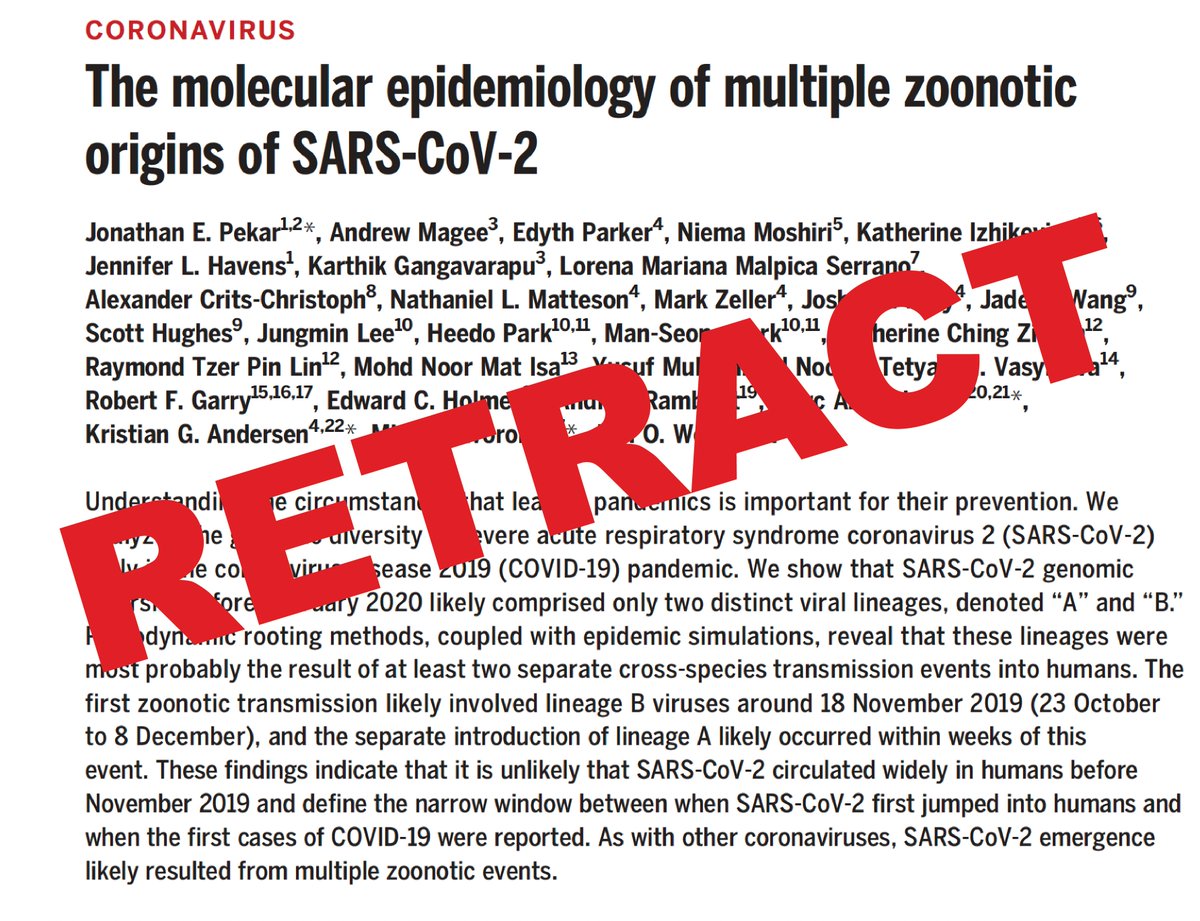
He was one of the authors of Proximal Origins that was the project instigated by Anthony Fauci, but instigated at a time where Bob Gary and others were all privately saying they think that the virus was manipulating and came from the lab.
Senator Rand Paul 30:44
And that's the extraordinary thing about this whole debate is that through freedom of information, we discovered that all the prominent scientists who wrote Proximal Origins, which concluded something more than most scientific papers usually say, they said unequivocally in the abstract that this virus is not a laboratory construct.
Senator Rand Paul 31:03
And I don't know of an objective scientist out there who really would say a statement that strong. Less likely, more likely, even myself who thinks this came from the lab, I can't tell you 100% certainty.
Senator Rand Paul 31:14
I can just say there's no evidence that typically has been found that it came from animals and there's a lot of evidence that it came from the lab, but it is a reasonability. It's sort of like 90%, 80%, but Bob Gary and the other authors of Proximal Origin were all privately saying they were pretty convinced and they're saying, that's not a conspiracy theory.
Senator Rand Paul 31:33
Look at this evidence. I'm worried. I stayed up late last night. They were all very concerned privately, but within a day or two became completely opposite and published a paper. So I think it'll be an interesting debate between those three.
Senator Rand Paul 31:45
And there's one more that a Democrat witnessed that's coming in. I don't have the name in front of me. Craig.
Bryce Nickels 31:51
Greg Koblenz is his name. I was going to say, are you... So with Bob Gary, of course, is somebody that even actually signed a letter to my work saying that I should be disciplined, but are you aware that he has actually had three papers retracted?
Bryce Nickels 32:09
I mean, speaking to his credibility, and that's not even the proximal origin one, which we've submitted two letters trying to get the editor to do something about it. For scientists, these journal publications are such a big deal.
Bryce Nickels 32:23
I know that for lawmakers, it may be difficult to understand the magnitude that or the power that these, just the presence of these in journals have. And but Gary, I didn't know, like, if you actually were aware that he had already a track record of, you know, scientific misconduct with three retractions, which I think is very noteworthy when considering his credibility as somebody to speak on the origins of COVID.
Bryce Nickels 32:48
So whereas, of course, Ebright has had zero, if you're wondering, but...
Senator Rand Paul 32:54
Yeah, I think what will definitely come to light is the contradictory statements, perhaps the papers being retracted, but the contradictory statements in private that Bob Gary was saying all along and in public.
Senator Rand Paul 33:06
You have to begin to worry when scientists are so absolute about something. It's sort of like, and he wasn't as signatory to the Lancet letter, but 27 scientists signed the Lancet letter. To tell you the truth, I wasn't paying as close attention.
Senator Rand Paul 33:19
I read the news report of it, and I kind of just accepted it. I knew the first SARS came from animals, and 27 scientists said that this one probably did too. And I was like, oh, well, they're probably right.
Senator Rand Paul 33:29
And then I discovered later on five or six of them are part of the funders of the Wuhan lab. And then I find out that the language, if you look closer, uses words like conspiracy theory. Well, I've never heard of a scientist who puts in any kind of, even a letter to the editor, the idea that the opponents on the other side of the argument are conspiracy theorists.
Senator Rand Paul 33:48
But it's also why it's important that people know that this began way before this. This began with the debate over avian flu being mutated in 2010, if not before. And so this really isn't, you know, the people who all of a sudden politicized this, you have to ask, why did they not appear to have come from a lab?
Senator Rand Paul 34:09
And I think it's culpability. Frankly, they felt guilty that they'd spent millions of dollars on this lab in Wuhan, and if it escaped from them, it would have looked like obviously poor decision making to have funded all that research.
Senator Rand Paul 34:21
And you know, when Anthony Fauci was asked about it, he says, and I think Francis Collins responded the same way. They were asked, do you do any special inspections of foreign labs to make sure they're up to par?
Senator Rand Paul 34:33
The answer was no. Do you have a way of accrediting labs overseas to make sure that they're safe? The answer was no. And did they personally know about it? They say, oh yeah, we approve all the grants, but we really didn't know a lot about these grants and what was going on.
Senator Rand Paul 34:47
And that's the real danger of this. There has to be more scrutiny on this kind of stuff.
Bryce Nickels 34:53
Well, so you did mention this is the first hearing you're going to have a subsequent hearing on gain a function. Is that coming up soon?
Senator Rand Paul 35:00
The first one is mostly about origins, but it will probably be wide ranging. The second one is going to be more about what we should do to reform. And we'll take, you know, a lot of the people that are testifying in the first are also people who have had ideas about reform.
Senator Rand Paul 35:14
There was a letter, I can't remember who the, where it was published, but 33 scientists, Jesse Bloom and others, David Realm and others have all signed a letter talking about reforms. We took that letter and suggestions for reforms and comments from E.
Senator Rand Paul 35:32
Bright, Quay and Esvelt at a previous subcommittee hearing. We took all these comments and tried to create a bill and we've begun showing the bill to the scientists because frankly, I don't want to be accused of, you know, while I'm a physician, I'm not a scientist in this area of saying, oh, I'm going to lord it over all the scientists.
Senator Rand Paul 35:49
I want to set up a system where it is better policed, but there still has to be some nuance of deciding, you know, because the other side will say, oh, you're going to prevent them from giving a bacteria gain of function to make insulin.
Senator Rand Paul 36:02
Well, no, I'm not, I'm not interested in that, but figuring out what to do and which viruses to contend with is still going to involve some human. It's not going to, we're not proposing a blanket ban on this.
Senator Rand Paul 36:13
Some have talked about a blanket ban, but I've been more that there needs to be a responsible committee, a better definition, a more inclusive definition, and then a more responsible committee, but also a committee that's able to reach into the corners of classified research.
Senator Rand Paul 36:27
The P3CO committee didn't have any power to look at research. They could only look at research that was given to them, and I think I was told during this period of time, they only looked at like three bits of research, and none of them were from Wuhan, and so we have to have a committee that has more power to look at it, and also if people lie to the committee, there has to be punishments.
Senator Rand Paul 36:47
If you lie to the committee, it has to be some self -referral. People will refer their grants, but the people on the committee can also look at grants that weren't referred, but then there'll be a penalty.
Senator Rand Paul 36:58
If you don't refer yours over, and you're going to be mutating avian flu or coronavirus in a gain -of -function research, there will be penalties for not referring your research over. I still suspect that we're only talking about maybe hundreds of projects.
Senator Rand Paul 37:15
I don't think we're talking about thousands of projects that would actually have to receive the scrutiny.
Bryce Nickels 37:21
When will you be introducing that bill? Will that be coordinated with the second hearing? Or making that bill public, I guess?
Senator Rand Paul 37:29
We're sending it around, and we'll even send it around to you guys to look at, because we want to hear comments from everybody. We've sent it to our Democrat counterparts. Nothing has a chance really of passing unless the Democrats agree to it.
Senator Rand Paul 37:41
So we have to get Chairman Peters to agree to it. He's open to looking at it. They're looking at it now. We've sent it to probably six or eight of the scientists who have been worried about gain of function and on basically the opposite side of Anthony Fauci from this.
Senator Rand Paul 37:57
But everybody's going to get to see it. And we don't want to put something forward that's not going to pass. We want to put something that helps the situation but also works. And like I say, it's going to have to have Democrat support.
Senator Rand Paul 38:09
And there is a possibility. I mean, we passed in committee requiring that they put forward their royalties unanimously. And so the new financial reforms, if we can get it out of the Senate and through the House, will simply require a lot of these people have to do financial reforms.
Senator Rand Paul 38:25
But it's going to be transparent. Right now, it's all secretive. And you can kind of request it. And sometimes you get it. Sometimes you don't get it. It will be on a website the same way mine is. All of my investments and all my assets are on a website.
Senator Rand Paul 38:36
You can Google my name somewhere and find out where my money is placed and where my income comes from. And that should be also true because this is a big business. This isn't just disinterested scientists who are not working for any money at all.
Senator Rand Paul 38:51
There's a lot of money involved in this now.
Jay Bhattacharya 38:54
Senator Paul, thank you for joining us. I really appreciate it. I know you have to run now, but it was a really informative discussion and I hope you wish you all the best in in this kind of oversight activity.
Jay Bhattacharya 39:04
I think it's really vital for the future of all humanity. Thank you for having me.
Senator Rand Paul 39:09
Thanks guys.
Senator Rand Paul 22:50
Frankly if you take a poll of NIH scientists I would say 90% are probably Democrats. They work in universities, they depend on taxpayer monies, they're just not Republicans. That just frankly is the truth and yet many of these people who don't identify with many of the policies I'm for were all adamantly and still are adamantly opposed to Anthony Fauci's perspective that you know whatever goes goes we're just going to be on the side of knowledge is always good and the thing is is that if you tell the common man that all knowledge is good or you tell him that gosh the Chinese are taking Ebola and they're aerosolizing it and I'm making this up but let's say this is the argument and so we need to aerosolize Ebola so we can figure out how to counteract aerosolized Ebola.
Senator Rand Paul 23:34
That's a death wish. One of the best people on this, one of the best essays written was from Kevin Esvelt who's a NIH grants. He's a really bona fide real scientist in this area, works at MIT, has written and compared it to nuclear weapons basically that this kind of stuff is as dangerous as nuclear weapons and may be more insidious and is sort of a gamble and a risk to civilization as we know it.
Senator Rand Paul 24:02
I mean those are big statements but I believe every bit of that and the reason why we do have concern and why there's a role for government is is that you can order the components of polio virus online now and you can create polio in your in your lab and not just you know a few labs.
Senator Rand Paul 24:19
He estimates as much as 60, 70 ,000 not only PhDs but technicians have the ability to create viruses in a lab and eventually you're going to get rogue actors in this and you may already have rogue countries in this but we do need to look at this and even more so than the NIH there's all kinds of classified research going on.
Senator Rand Paul 24:40
I have no idea they will not reveal it to me, they don't reveal it to the intelligence committees. These committees, people who are working on biological potentially biological weapons within our government have no oversight.
Senator Rand Paul 24:54
This should scare us all to death and they all may be well -intentioned. They may sit you know stand in front of the flag and salute the flag and they may be the greatest people in the world but there is a concern that they've lost track of what the true danger is to leaks and to give you one quick example of how common leaks are SARS -1 in 2002, 2003 probably came from nature.
Senator Rand Paul 25:17
We found it in animals, we found it in animal handlers and they found the source pretty quickly but once they had it in the lab the isolating people, quarantine people worked pretty well because it wasn't very contagious and it kind of died out but six times after it had died out it leaked from a lab in Beijing.
Senator Rand Paul 25:37
They have six separate examples of SARS -1 that has now died out in nature leaking then from the lab. Alison Young has written about these leaks. Leaks are pretty common even in very safe labs so you want to make sure it's as safe as possible but ultimately you know people say well what about the science obey the science.
Senator Rand Paul 25:57
I don't want to make the absolute rules. Our committee will be of scientists won't be me deciding what gain of function is ultimately we'll help to define it but deciding what is too dangerous to be done will actually be done by scientists in the field but they can't be the same ones receiving it.
Senator Rand Paul 26:13
So if I'm a world -famous coronavirus gain of function guy I can't be on the committee to approve the funds you know it's gonna or a woman it has to be somebody who is has a scientific background knows about it but it really shouldn't be limited to the people receiving it because that makes it very difficult to have objectivity.
Bryce Nickels 26:34
So you, sorry, before, I know you're going to go in a few minutes and I want you to comment on next week, but I want a very important thing you just said there about Ebola. Are you willing to sort of state for the record that you oppose the U .S.
Bryce Nickels 26:48
developing offensive bioweapons? Because I believe that, I'm reading between the lines, to me that's actually the critical thing. Is that something that you oppose or you're saying that we'd have to be very careful when thinking about developing bioweapons or an offensive, because there's no such thing as a defensive bioweapon?
Senator Rand Paul 27:08
I'm absolutely opposed to our government or any government developing offensive weapons.
Bryce Nickels 27:14
That is wonderful to hear. That is wonderful to hear.
Senator Rand Paul 27:17
same, and I think we need to go further. For example, we're talking about weapons. I'm against, I think our country should be explicit that we are not for the first use of nuclear weapons. And I don't think we really are, but we don't explicitly state that.
Senator Rand Paul 27:30
And I think we should explicitly state that to send message to other nuclear powers. We are not ever launching nuclear weapons unless in response to others. And even that would be a catastrophe for the world.
Senator Rand Paul 27:41
But I see no reason to weaponize viruses. But we have to be very careful because some of the research says, oh, we're just going to create a vaccine. But we have to make, let's say you have an animal virus, avian flu is a good example, not very contagious in humans.
Senator Rand Paul 27:57
And we want to develop a vaccine for humans. But in order to do that, we have to make it more contagious in humans. And that's what people think happened in Wuhan, is that the coronavirus, one, it was maybe deadly enough, but it wasn't infectious enough.
Senator Rand Paul 28:11
SARS -1 just wasn't infectious enough. So the creation of a new virus required it to become more infectious in order to develop a vaccine against it. In all likelihood, that's where it was benign. I don't have any animus, I don't particularly love the form of government, but I don't have a particular animus against the Chinese.
Senator Rand Paul 28:29
I actually do think it probably was an accident. They were trying to create a vaccine and an accident happened. But I meet with the Chinese officials from their government trying to stress that we need to rejuvenate the Biological Weapons Convention.
Senator Rand Paul 28:42
We need to participate in it. We need to talk in it because ultimately we have to come up with a definition that kind of works and then has scientists to interpret what that means to be gain of function.
Senator Rand Paul 28:52
But it has to be much more stringent than what we have on the books. But then we need internationally to begin talking again at the Biological Weapons Convention about trying to get countries voluntarily to adhere to a standard that says for goodness sakes we shouldn't try to open up and get smallpox out there and do a lot of research on smallpox as deadly as it is.
Jay Bhattacharya 29:17
Senator Paul, what can we expect next week from the hearing that you're running with Senator Peters? What long gain of function? What do you expect to come out of it? And what are the next steps you're planning to take sort of going forward on these issues that we were talking about?
Senator Rand Paul 29:34
The first hearing will be to examine the origins of COVID. We have Richard E. Bright from Rutgers, who's a molecular pathologist with 175 peer -reviewed papers, long academic history, an editor of scientific journals, but also a longtime advocate for more controls on gain -of -function research.
Senator Rand Paul 29:53
He'll be there. Stephen Quay is a scientist, but also a businessman who works in this field and has written extensively about. They'll both be talking about sort of evidence for why they believe that the evidence points towards the virus coming from a lab.
Senator Rand Paul 30:09
And then also the reason we have to have that debate is because if it just came from animals, all we have to do is test animals, which I'm not against that. We should have surveillance of animals and things like that.
Senator Rand Paul 30:18
But if it came from a lab, we have to look at what's going on in a lab. There also will be proponents who don't believe it came from the lab and think there's no way it came from the lab. Like Bob Gary will be in this committee hearing as well.
Senator Rand Paul 30:29
He was one of the authors of Proximal Origins that was the project instigated by Anthony Fauci, but instigated at a time where Bob Gary and others were all privately saying they think that the virus was manipulating and came from the lab.
Senator Rand Paul 30:44
And that's the extraordinary thing about this whole debate is that through freedom of information, we discovered that all the prominent scientists who wrote Proximal Origins, which concluded something more than most scientific papers usually say, they said unequivocally in the abstract that this virus is not a laboratory construct.
Senator Rand Paul 31:03
And I don't know of an objective scientist out there who really would say a statement that strong. Less likely, more likely, even myself who thinks this came from the lab, I can't tell you 100% certainty.
Senator Rand Paul 31:14
I can just say there's no evidence that typically has been found that it came from animals and there's a lot of evidence that it came from the lab, but it is a reasonability. It's sort of like 90%, 80%, but Bob Gary and the other authors of Proximal Origin were all privately saying they were pretty convinced and they're saying, that's not a conspiracy theory.
Senator Rand Paul 31:33
Look at this evidence. I'm worried. I stayed up late last night. They were all very concerned privately, but within a day or two became completely opposite and published a paper. So I think it'll be an interesting debate between those three.
Senator Rand Paul 31:45
And there's one more that a Democrat witnessed that's coming in. I don't have the name in front of me. Craig.
Bryce Nickels 31:51
Greg Koblenz is his name. I was going to say, are you... So with Bob Gary, of course, is somebody that even actually signed a letter to my work saying that I should be disciplined, but are you aware that he has actually had three papers retracted?
Bryce Nickels 32:09
I mean, speaking to his credibility, and that's not even the proximal origin one, which we've submitted two letters trying to get the editor to do something about it. For scientists, these journal publications are such a big deal.
Bryce Nickels 32:23
I know that for lawmakers, it may be difficult to understand the magnitude that or the power that these, just the presence of these in journals have. And but Gary, I didn't know, like, if you actually were aware that he had already a track record of, you know, scientific misconduct with three retractions, which I think is very noteworthy when considering his credibility as somebody to speak on the origins of COVID.
Bryce Nickels 32:48
So whereas, of course, Ebright has had zero, if you're wondering, but...
Senator Rand Paul 32:54
Yeah, I think what will definitely come to light is the contradictory statements, perhaps the papers being retracted, but the contradictory statements in private that Bob Gary was saying all along and in public.
Senator Rand Paul 33:06
You have to begin to worry when scientists are so absolute about something. It's sort of like, and he wasn't as signatory to the Lancet letter, but 27 scientists signed the Lancet letter. To tell you the truth, I wasn't paying as close attention.
Senator Rand Paul 33:19
I read the news report of it, and I kind of just accepted it. I knew the first SARS came from animals, and 27 scientists said that this one probably did too. And I was like, oh, well, they're probably right.
Senator Rand Paul 33:29
And then I discovered later on five or six of them are part of the funders of the Wuhan lab. And then I find out that the language, if you look closer, uses words like conspiracy theory. Well, I've never heard of a scientist who puts in any kind of, even a letter to the editor, the idea that the opponents on the other side of the argument are conspiracy theorists.
Senator Rand Paul 33:48
But it's also why it's important that people know that this began way before this. This began with the debate over avian flu being mutated in 2010, if not before. And so this really isn't, you know, the people who all of a sudden politicized this, you have to ask, why did they not appear to have come from a lab?
Senator Rand Paul 34:09
And I think it's culpability. Frankly, they felt guilty that they'd spent millions of dollars on this lab in Wuhan, and if it escaped from them, it would have looked like obviously poor decision making to have funded all that research.
Senator Rand Paul 34:21
And you know, when Anthony Fauci was asked about it, he says, and I think Francis Collins responded the same way. They were asked, do you do any special inspections of foreign labs to make sure they're up to par?
Senator Rand Paul 34:33
The answer was no. Do you have a way of accrediting labs overseas to make sure that they're safe? The answer was no. And did they personally know about it? They say, oh yeah, we approve all the grants, but we really didn't know a lot about these grants and what was going on.
Senator Rand Paul 34:47
And that's the real danger of this. There has to be more scrutiny on this kind of stuff.
Bryce Nickels 34:53
Well, so you did mention this is the first hearing you're going to have a subsequent hearing on gain a function. Is that coming up soon?
Senator Rand Paul 35:00
The first one is mostly about origins, but it will probably be wide ranging. The second one is going to be more about what we should do to reform. And we'll take, you know, a lot of the people that are testifying in the first are also people who have had ideas about reform.
Senator Rand Paul 35:14
There was a letter, I can't remember who the, where it was published, but 33 scientists, Jesse Bloom and others, David Realm and others have all signed a letter talking about reforms. We took that letter and suggestions for reforms and comments from E.
Senator Rand Paul 35:32
Bright, Quay and Esvelt at a previous subcommittee hearing. We took all these comments and tried to create a bill and we've begun showing the bill to the scientists because frankly, I don't want to be accused of, you know, while I'm a physician, I'm not a scientist in this area of saying, oh, I'm going to lord it over all the scientists.
Senator Rand Paul 35:49
I want to set up a system where it is better policed, but there still has to be some nuance of deciding, you know, because the other side will say, oh, you're going to prevent them from giving a bacteria gain of function to make insulin.
Senator Rand Paul 36:02
Well, no, I'm not, I'm not interested in that, but figuring out what to do and which viruses to contend with is still going to involve some human. It's not going to, we're not proposing a blanket ban on this.
Senator Rand Paul 36:13
Some have talked about a blanket ban, but I've been more that there needs to be a responsible committee, a better definition, a more inclusive definition, and then a more responsible committee, but also a committee that's able to reach into the corners of classified research.
Senator Rand Paul 36:27
The P3CO committee didn't have any power to look at research. They could only look at research that was given to them, and I think I was told during this period of time, they only looked at like three bits of research, and none of them were from Wuhan, and so we have to have a committee that has more power to look at it, and also if people lie to the committee, there has to be punishments.
Senator Rand Paul 36:47
If you lie to the committee, it has to be some self -referral. People will refer their grants, but the people on the committee can also look at grants that weren't referred, but then there'll be a penalty.
Senator Rand Paul 36:58
If you don't refer yours over, and you're going to be mutating avian flu or coronavirus in a gain -of -function research, there will be penalties for not referring your research over. I still suspect that we're only talking about maybe hundreds of projects.
Senator Rand Paul 37:15
I don't think we're talking about thousands of projects that would actually have to receive the scrutiny.
Bryce Nickels 37:21
When will you be introducing that bill? Will that be coordinated with the second hearing? Or making that bill public, I guess?
Senator Rand Paul 37:29
We're sending it around, and we'll even send it around to you guys to look at, because we want to hear comments from everybody. We've sent it to our Democrat counterparts. Nothing has a chance really of passing unless the Democrats agree to it.
Senator Rand Paul 37:41
So we have to get Chairman Peters to agree to it. He's open to looking at it. They're looking at it now. We've sent it to probably six or eight of the scientists who have been worried about gain of function and on basically the opposite side of Anthony Fauci from this.
Senator Rand Paul 37:57
But everybody's going to get to see it. And we don't want to put something forward that's not going to pass. We want to put something that helps the situation but also works. And like I say, it's going to have to have Democrat support.
Senator Rand Paul 38:09
And there is a possibility. I mean, we passed in committee requiring that they put forward their royalties unanimously. And so the new financial reforms, if we can get it out of the Senate and through the House, will simply require a lot of these people have to do financial reforms.
Senator Rand Paul 38:25
But it's going to be transparent. Right now, it's all secretive. And you can kind of request it. And sometimes you get it. Sometimes you don't get it. It will be on a website the same way mine is. All of my investments and all my assets are on a website.
Senator Rand Paul 38:36
You can Google my name somewhere and find out where my money is placed and where my income comes from. And that should be also true because this is a big business. This isn't just disinterested scientists who are not working for any money at all.
Senator Rand Paul 38:51
There's a lot of money involved in this now.
Jay Bhattacharya 38:54
Senator Paul, thank you for joining us. I really appreciate it. I know you have to run now, but it was a really informative discussion and I hope you wish you all the best in in this kind of oversight activity.
Jay Bhattacharya 39:04
I think it's really vital for the future of all humanity. Thank you for having me.
Senator Rand Paul 39:09
Thanks guys.
• • •
Missing some Tweet in this thread? You can try to
force a refresh