
Just back from a Gaza-focused trip to Egypt/Jordan/Israel.
Key takeaways 🧵:
- Aid push in March/April made progress against famine
- Rafah offensive then wiped out much of that progress
- Huge obstacles remain on access & last-mile distro
- Little progress on aid worker safety
Key takeaways 🧵:
- Aid push in March/April made progress against famine
- Rafah offensive then wiped out much of that progress
- Huge obstacles remain on access & last-mile distro
- Little progress on aid worker safety
.@JesCMarks and I conducted hours upon hours of extensive interviews with Palestinians who had fled Gaza and (remotely) with others still inside; with staff of aid agencies working in Gaza; with Israeli & Jordanian govts; and with USG humanitarian & diplomatic officials.
We heard credible firsthand accounts consistent with famine conditions in March/April.
But also that the uptick in food deliveries from late March thru April - following the @theIPCinfo famine analysis and ICJ order - then blunted the descent toward famine in the north.
But also that the uptick in food deliveries from late March thru April - following the @theIPCinfo famine analysis and ICJ order - then blunted the descent toward famine in the north.
Our interviews with Palestinians about conditions in the north in the spring confirmed telltale famine coping mechanisms, including households skipping meals, feeding kids rather than adults, and eating local grasses and animal feed in lieu of food.
Our interviews with doctors also indicated elevated mortality due to malnutrition.
In addition to outright starvation deaths, doctors reported patients dying of trauma wounds that would be survivable in a healthier patient, but were fatal due to sustained under-nutrition.
In addition to outright starvation deaths, doctors reported patients dying of trauma wounds that would be survivable in a healthier patient, but were fatal due to sustained under-nutrition.
One int'l doctor told us that he had brought bags of protein bars into Gaza on his deployment, because even he had no other way to obtain protein.
He ended up giving many of them to patients instead in the hopes of aiding their recovery (often without success).
He ended up giving many of them to patients instead in the hopes of aiding their recovery (often without success).
Conditions improved somewhat from April into May as flows increased. Aid convoys have begun entering the north more frequently, which appears to be helping.
The next famine analysis from the IPC is expected to show improvements in the north - although fragile.
The next famine analysis from the IPC is expected to show improvements in the north - although fragile.
Does this mean the famine projections were overblown? I don't believe so. What we heard about conditions in the spring was consistent with those projections, and if the aid trajectory from February had been sustained a much larger number of people would have fallen into famine.
Instead, aid flows began to increase in March after collapsing in February. March inflows were close to the level achieved during the brief November pause, and the April inflows exceeded that level.
This was having a meaningful impact...until early May.
This was having a meaningful impact...until early May.
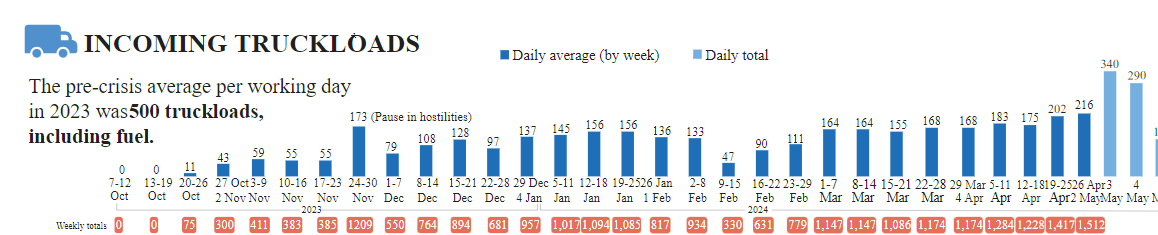
The Rafah offensive proved devastating, particularly the closure of the Rafah crossing following its seizure by the IDF. Inflows to south and central Gaza rapidly collapsed, even as flows into the north via Erez increased.

As widely predicted, the Rafah offensive also hugely disrupted humanitarian capacity. Rafah had evolved into the primary hub for aid operations - warehouses, logistical hubs, offices & residences, distribution operations. All taken offline by the IDF offensive.
Aid groups told us that it is now almost impossible to find warehouses for aid in Gaza today - the main ones in and around Rafah are now inaccessible or destroyed; other areas of Gaza have few remaining structures that are 1) suitable, 2) intact, 3) safely accessible.
And it is now much harder to access the population as well.
Up to May, aid groups and the bulk of the population were co-located in Rafah, and security there was manageable. Aid programs were much more straightforward.
Now displaced people are much harder to safely reach.
Up to May, aid groups and the bulk of the population were co-located in Rafah, and security there was manageable. Aid programs were much more straightforward.
Now displaced people are much harder to safely reach.
Nearly every aid movement must be coordinated in advance with the IDF, which hugely limits the ability of humanitarians to operate freely and safely.
And with the dispersion of displaced people out of Rafah, the logistics of reaching them is much more complicated.
And with the dispersion of displaced people out of Rafah, the logistics of reaching them is much more complicated.
So the net effect of the Rafah invasion has been hugely damaging to humanitarian efforts in south and central Gaza:
- Huge erosion in operational capacity
- Far less aid getting in
- Vulnerable population much harder to reach
- Increased obstacles to humanitarian movement
- Huge erosion in operational capacity
- Far less aid getting in
- Vulnerable population much harder to reach
- Increased obstacles to humanitarian movement
And this is very worrying re: the famine trajectory over the near/medium term.
Aid access & delivery matters a lot. When it collapses (as in Feb) or increases (as in March/April) there is a very direct impact on the population's well-being.
Aid access & delivery matters a lot. When it collapses (as in Feb) or increases (as in March/April) there is a very direct impact on the population's well-being.
Since early May aid flows are again collapsing. But this time the impact is greatest in the south and central Gaza, rather than the north.
And most of the population remains in south and central Gaza.
And most of the population remains in south and central Gaza.

So I remain incredibly worried about the trajectory of famine risk over the next few months.
Coping mechanisms are exhausted and the population is highly reliant on aid.
Conditions for the majority of the population are worsening since the Rafah invasion began.
Coping mechanisms are exhausted and the population is highly reliant on aid.
Conditions for the majority of the population are worsening since the Rafah invasion began.
The increased aid & commercial flows in March/April succeeded in deferring the worst outcomes - but that progress was temporary and is evaporating rapidly.
(Pausing thread here - will pick up again later with more findings on aid impediments and aid worker safety)
(Pausing thread here - will pick up again later with more findings on aid impediments and aid worker safety)
• • •
Missing some Tweet in this thread? You can try to
force a refresh




