T. Ryan Gregory Profile picture
Jun 18 24 tweets 5 min read Read on X
We have both continuous and continual SARS-CoV-2 variant evolution happening. What do I mean? 🧵
Viruses evolve at (at least) two levels: among hosts and within hosts. Among hosts, the main determinant of viral fitness (i.e., reproductive success and continued existence of that lineage) is getting into new hosts.
In very general terms, traits like transmissibility and infectiousness are under selection at the among-host (interhost) level. When there is some degree of immunity in the population, characteristics like immune escape also become very relevant to viral fitness.
Because there are huge numbers of hosts, because SARS-CoV-2 is *not* seasonal and is circulating at fairly high (or very high) levels year round, and because it is *not* running out of evolutionary space (see thread linked in next tweet), evolution at this level is continuous.
Continuous meaning ticking along pretty much non-stop at a fairly consistent rate with fitter mutations becoming more common over viral generations due to natural selection. That's how variant trackers have managed to predict with impressive accuracy which variants will take off.
This background, continuous, ticking-along-in-somewhat-predictable-ways is what happens within lineages that are evolving among hosts. Mutations over time, which is more or less a positive linear relationship.
In addition to continuous evolution at the interhost level, we have variants that evolve within individual hosts, either as they reproduce generation after generation during a persistent infection or by recombination between two variants that infect the same host simultaneously.
The traits that evolve within hosts may be different from what is under selection among hosts. Most obviously, getting into new hosts isn't under selection within a host. Things like being able to avoid that host's immunity or being able to infect multiple tissues might be.
(For evolutionary biology nerds, you'll note that intrahost evolution doesn't involve the massive transmission bottleneck that occurs every time a new host gets infected. So, less drift that way. But then there are differences of within-host vs. among-host/metapopulation sizes.)
Most of the variants that evolve within hosts never get into (m)any other hosts -- but some do. And most of those do not and manage to establish as a lineage at the host population level -- but some do. Those lineages then start evolving at the among-host level.
We might hope that variants derived from intrahost evolution or recombination would not compete well against variants that had been evolving among hosts the whole time, but we've seen several cases where only a few additional mutations made their descendants extremely successful.
This probably includes Omicron BA.1, and definitely includes both the XBB recombinant lineages and more recently the BA.2.86 (including its descendant JN.1*) lineage. Such variants end up being *very* divergent from, and go on to replace, what was there before. They may all be called "Omicron", but the lineages included are far more diverse and divergent than the others that received Greek letters in 2021.
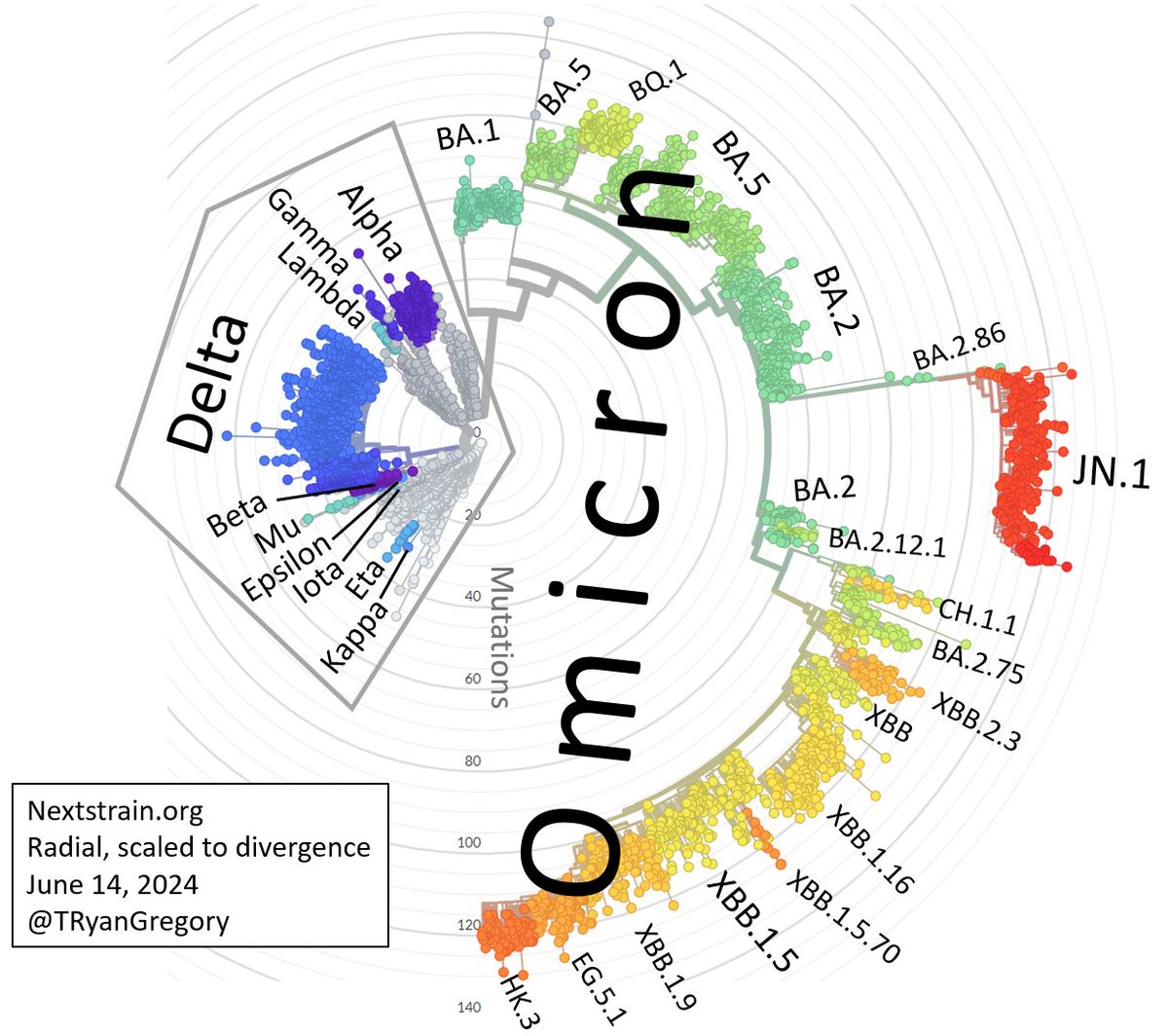
Thus, Omicron BA.1* replaced Delta. The XBBs replaced the previously dominant BA.2* and BA.5* lineages. And now JN.1* has replaced the XBBs. You may notice also note that this has corresponded to all three times thus far that an updated vaccine was deemed necessary.
Speaking of vaccines, one of the issues is the failure to aim ahead of continuous evolution. The first booster targeted wild type plus either BA.1 or BA.4/BA.5. There was no BA.1 by then. The second targeted XBB.1.5. Same issue.
The next vaccine update will target JN.1, which is already mostly gone, or its descendant KP.2 (a "FLiRT" variant), which is likely to be replaced soon by variants with other mutations.

Again, that's just missing *continuous* evolution, which can be predicted fairly well.
The arrival and takeover by new lineages is not the same thing as the continuous evolution involving the somewhat predictable accumulation of fit mutations within lineages. Instead, it involves one-off events that are rare but have major impacts on the variant landscape.
It's the difference between, say, evolution of beak shape in Darwin's finches on the Galapagos Islands vs. a meteor wiping out non-avian dinosaurs, which were ultimately replaced as the dominant terrestrial vertebrates by the evolutionary radiation of birds and mammals.
Major events happen repeatedly, but intermittently and less predictably. That is, they're continual rather than continuous. We don't usually see it happening day to day like we do with evolution within lineages among hosts, but when these divergent variants do show up it's major.
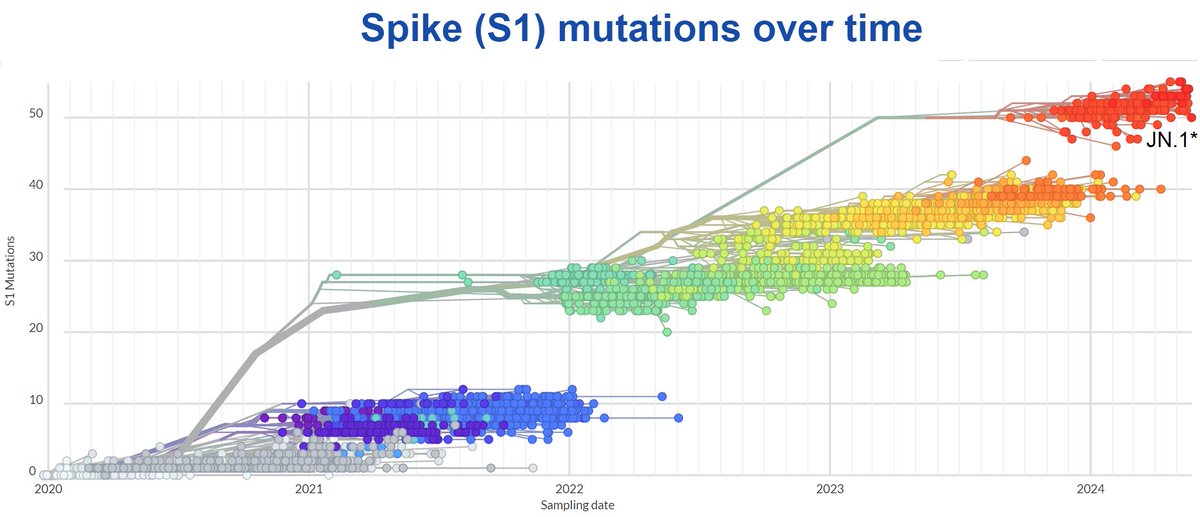
We can see the effects of continuous small-scale vs. continual large-scale evolution when we consider spike mutations specifically. Note the big jumps with the appearance of each new major variant lineage, followed by much smaller, more gradual change within those lineages. Spike mutations show a stair-like pattern with large jumps with each major new variant and mostly a plateau within each new lineage.
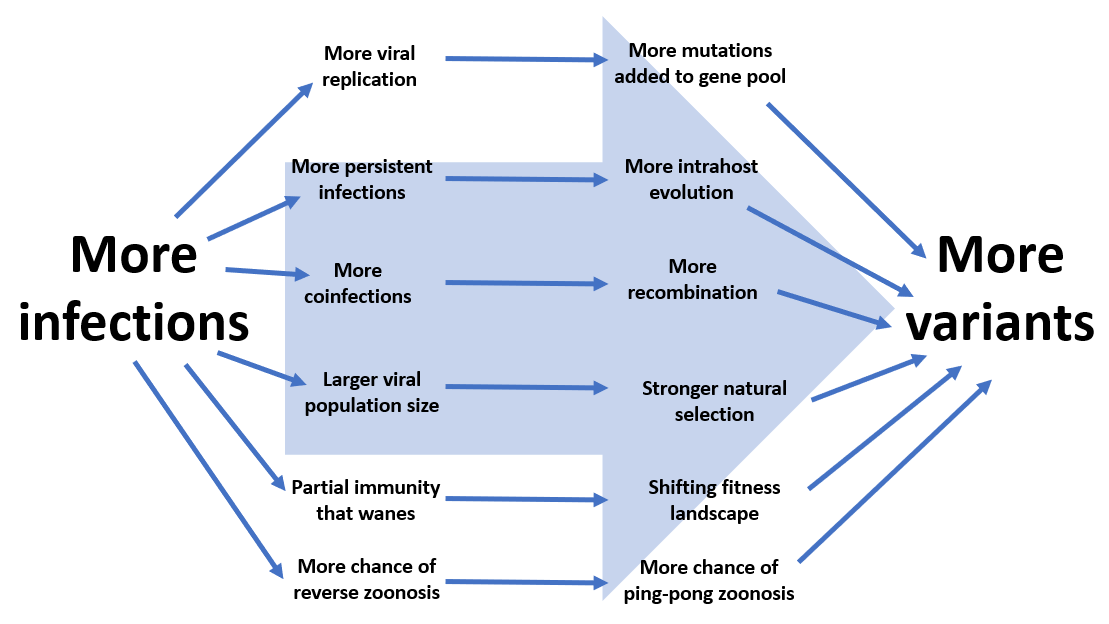
Here's the thing. The more transmissions there are to new hosts, the more continuous interhost evolution there will be. The more hosts are infected, the more persistent infections and coinfections there will be, and so the more continual intrahost evolution there will be.
Less virus, less evolution of new variants. More virus, more evolution of new variants. More infections means more variants.
* And most of those do not manage to establish as a lineage at the host population level -- but some do.
I make typos on my phone. Like COVID, you'll have to learn to live with it. 🙃

• • •

Missing some Tweet in this thread? You can try to force a refresh

 

Keep Current with T. Ryan Gregory

T. Ryan Gregory Profile picture

Stay in touch and get notified when new unrolls are available from this author!

Read all threads

This Thread may be Removed Anytime!

PDF

Twitter may remove this content at anytime! Save it as PDF for later use!

Try unrolling a thread yourself!

how to unroll video
  1. Follow @ThreadReaderApp to mention us!

  2. From a Twitter thread mention us with a keyword "unroll"
@threadreaderapp unroll

Practice here first or read more on our help page!

More from @TRyanGregory

Jun 15
Is SARS-CoV-2 running out of evolutionary space? Is variant evolution slowing down? Is immune escape unlikely anymore? Let's explore. 🧵
Here are some phylogenies (evolutionary trees) of the major SARS-CoV-2 variant lineages from . One is in radial format, the other unrooted, but they show the same information and are both scaled to divergence (number of mutations). nextstrain.org

Evolutionary tree of SARS-CoV-2 variants, radial format, scaled to divergence. "Omicron" variants are vastly more divergent and diverse than the other variants that received Greek letters in 2021.
Evolutionary tree of SARS-CoV-2 variants, unrooted format, scaled to divergence. "Omicron" variants are vastly more divergent and diverse than the other variants that received Greek letters in 2021.
And here are some plots of mutations over time, again from . There is no sign of this rate of accumulation of mutations slowing down (if anything, more recent variants are above the trend line). nextstrain.org
Mutations over time for SARS-CoV-2 variants.
Read 9 tweets
May 19
When you're accustomed to extreme privilege, feeling uncomfortable becomes feeling unsafe, and those feelings become more important than other people's lives.
And that's the most generous explanation for why one of these bothers some folks way more than the other. There are far more disturbing explanations, of course.
The pro-Palestine encampment at the University of Toronto
Destruction of a neighbourhood in Gaza
“I have almost reached the regrettable conclusion that the Negro’s great stumbling block in the stride toward freedom is not the White Citizens Councilor or the Ku Klux Klanner but the White moderate who is more devoted to ‘order’ than to justice.” - MLK

cnn.com/2022/01/15/opi…
Read 4 tweets
Apr 4
The best we get now is *relative* lows. Here are numbers of hospital patients with COVID in Canada. It's as low as it has been since the first Omicron wave (early 2022), on par with the relative lull of mid-summer 2023. But still much higher than summer 2020 and summer 2021. Hospitalizations in Canada
*Maybe* it will continue to drop as thr weather warms and if there are no new major variants that displace JN.1* in the meantime (fingers crossed, and wastewater signal is low), but the reality is that the baseline has never come back down in Canada post-Omicron.
Relative lows do not mean no risk, they mean less risk. If you've been putting off doing things while cases were higher, a relative low is a better (but again, not risk-free) time to do them than during a relative high, obviously.

Read 4 tweets
Mar 4
Let's be clear about what happened here. 🧵

1. Israeli real estate companies held Jews-only events to sell land in Israel and contested (Jerusalem) or occupied (West Bank) territories in Palestine.

1/
Note that some of the events are taking place in synagogues and some include properties that are within the illegally occupied West Bank. Other events have been held at public venues.

2/

2. Politicians preemptively labelled planned protests of events being held at synagogues as antisemitic.


3/
Read 14 tweets
Feb 7
Measles touted as an example of the effectiveness of working out one's immune system muscle.

A few reminders about measles...

🧵 "For some bugs, once you've fought it once, your muscles are so strong against it they may never need another work out to fend it off (e.g. measles, smallpox"
Measles has been known for 1,000 years and it still hasn't evolved to be benign.

pubmed.ncbi.nlm.nih.gov/36414136/
Measles can cause "immune amnesia", wiping out immunity to other pathogens.

(This was discovered only a few years ago. The measles virus was identified in 1954 and the disease has been described since the 9th century.)

bbc.com/future/article…
Read 7 tweets
Feb 4
Now that Pirola clan (BA.2.86 and descendants, most notably JN.1*) is the dominant variant lineage globally, the question arises as to whether it might undergo recombination with earlier XBB lineages.

Yep. Already has.

🧵
So far...

Pirola x Arcturus:
XDK = JN.1.1.1 x XBB.1.16.11

Pirola x Eris:
XDD = JN.1 x EG.5.1.1
XDS = JN.3.2.1 x EG.5.1.3

Pirola x Kraken:
XDN = JN.1. x JD.1*
XDR = JN.1.1 x JD.1.1.1

Pirola x Hyperion:
XDP = JN.1.4 x FL.15
Reminder of how recombination occurs.

Read 8 tweets

Did Thread Reader help you today?

Support us! We are indie developers!


This site is made by just two indie developers on a laptop doing marketing, support and development! Read more about the story.

Become a Premium Member ($3/month or $30/year) and get exclusive features!

Become Premium

Don't want to be a Premium member but still want to support us?

Make a small donation by buying us coffee ($5) or help with server cost ($10)

Donate via Paypal

Or Donate anonymously using crypto!

Ethereum

0xfe58350B80634f60Fa6Dc149a72b4DFbc17D341E copy

Bitcoin

3ATGMxNzCUFzxpMCHL5sWSt4DVtS8UqXpi copy

Thank you for your support!

Follow Us!

:(