Recently I’ve gotten a lot of inbound from new grads asking for career advice, so I wrote down a list of things I wish I’d internalized sooner.
The key thing: being precocious has an expiration date. Threading the note in its entirety:
2/ I can’t stress this one enough: avoid chasing the red herrings of success.
I worry that in pushing everyone to “build in public” we’ve created a kind of announcement economy…one in which you can receive the same funding, attention, dopamine hits, by announcing an _intention_ to build something…as you can by simply shipping something excellent.
3/ Forgive your parents, especially if you’re the child of immigrants. Embrace commitment and mutual obligations: being firmly rooted makes it _easier_ to take risks.
And finally, take your work seriously, but yourself less so. Hard work often looks suspiciously like play.
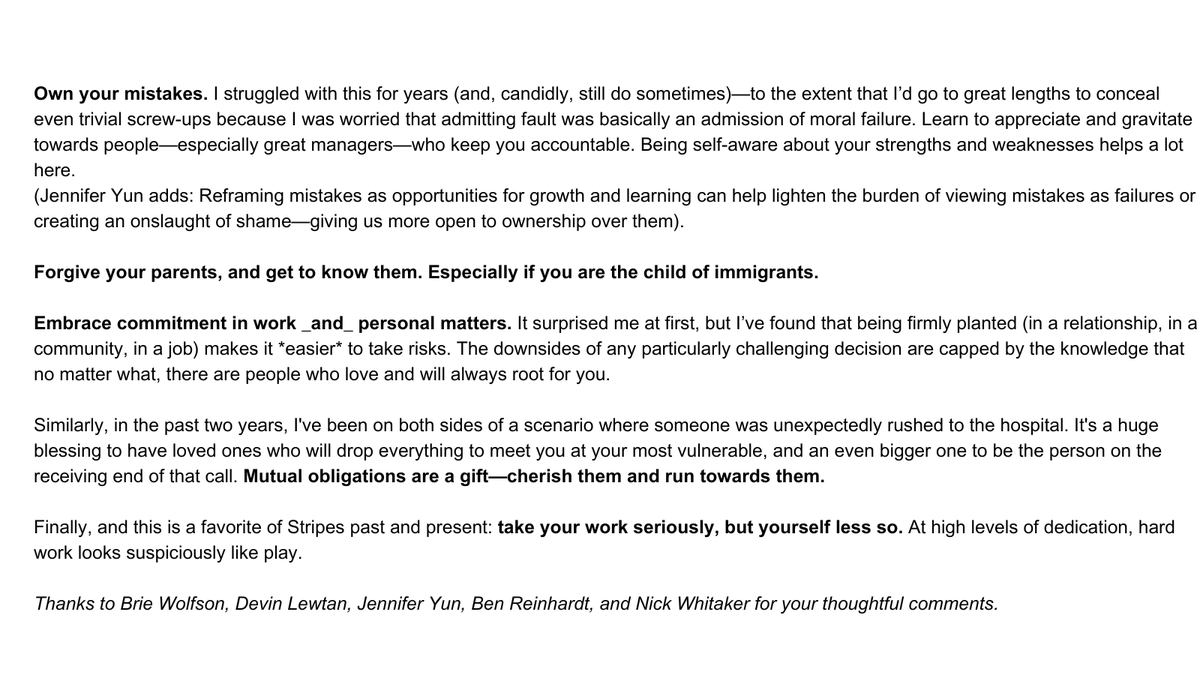
Featuring cameos from some people whom I love, look up to, and who successfully graduated from precociousness: @zebriez, @DevinLewtan, @Jennifer_Yun, @Ben_Reinhardt, and @ns_whit. ❣️
• • •
Missing some Tweet in this thread? You can try to
force a refresh

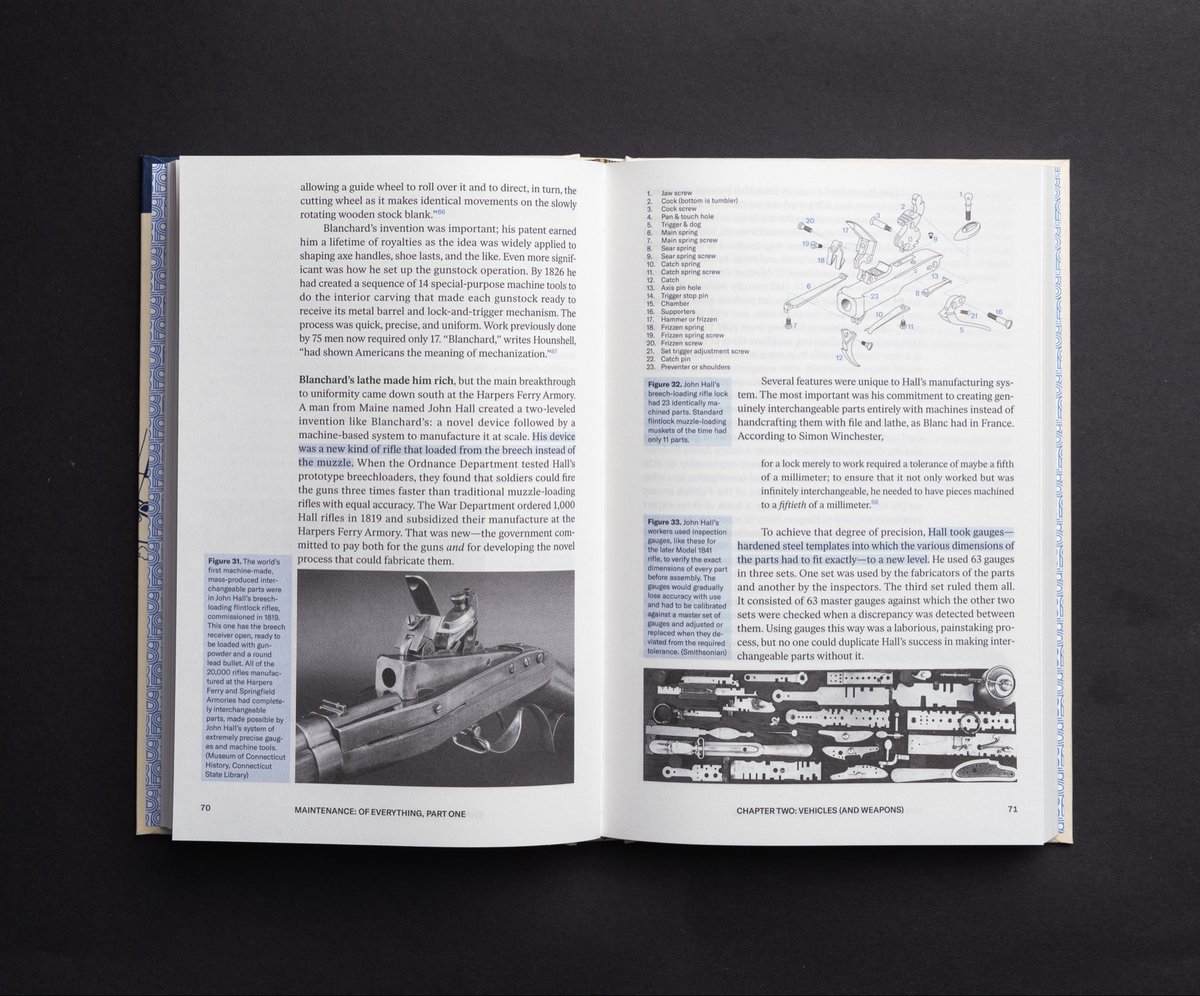
1/ Today @stripepress publishes one of my favorite books to date: Maintenance: Of Everything, Part One by @stewartbrand, about the unglamorous yet civilizationally important work of maintenance and repair.
2/ Sometimes the proximate cause of a civilization’s collapse is rapid and obvious. But sometimes civilizations unravel slowly because they fail to maintain themselves. Infrastructure decay, increasingly sclerotic institutions, technical debt, and, yes, declining birth rates, are all examples of this phenomenon.
3/ I see Maintenance as a natural progression from two other beloved Stewart projects: the Whole Earth Catalog and How Buildings Learn. In this book too, we get to come along as Stewart follows his curiosity to sometimes surprising (and strange) places.
It starts with the 1968 around-the-world Golden Globe race, then moves on to motorcycles, cars, weapons, and more, with long digressions about subjects like rust and repair manuals. The book is laid out accordingly, and reads, as @leahlibresco said in her delightful review, like a late-night conversation with an obsessive friend.
TADSE goes viral on here every few months, but people sometimes struggle with it once they start.
They expect a linear book, but it's actually a set of lectures: part memoir, part philosophy, part technical aside. That unevenness is part of the charm, but can make it hard to approach.
Here’s how I recommend reading it:
I often tell people not to read it straight through, but instead to start with the last 5 chapters, in which the book really pays off.
In these Hamming writes about vision, style, and judgment. Specifically, why some scientists and engineers go further than others, and how to cultivate the habits that make a career matter.
This is also where Hamming revisits the famous drunken sailor story, which inspired the cover:
“It is well known the drunken sailor who staggers to the left or right with n independent random steps will, on the average, end up about √n steps from the origin. But if there is a pretty girl in one direction, then his steps will tend to go in that direction and he will go a distance proportional to n.”
“In a lifetime of many, many independent choices, small and large, a career with a vision will get you a distance proportional to n, while no vision will get you only the distance √n… the main difference between those who go far and those who do not is: some people have a vision and the others do not.”
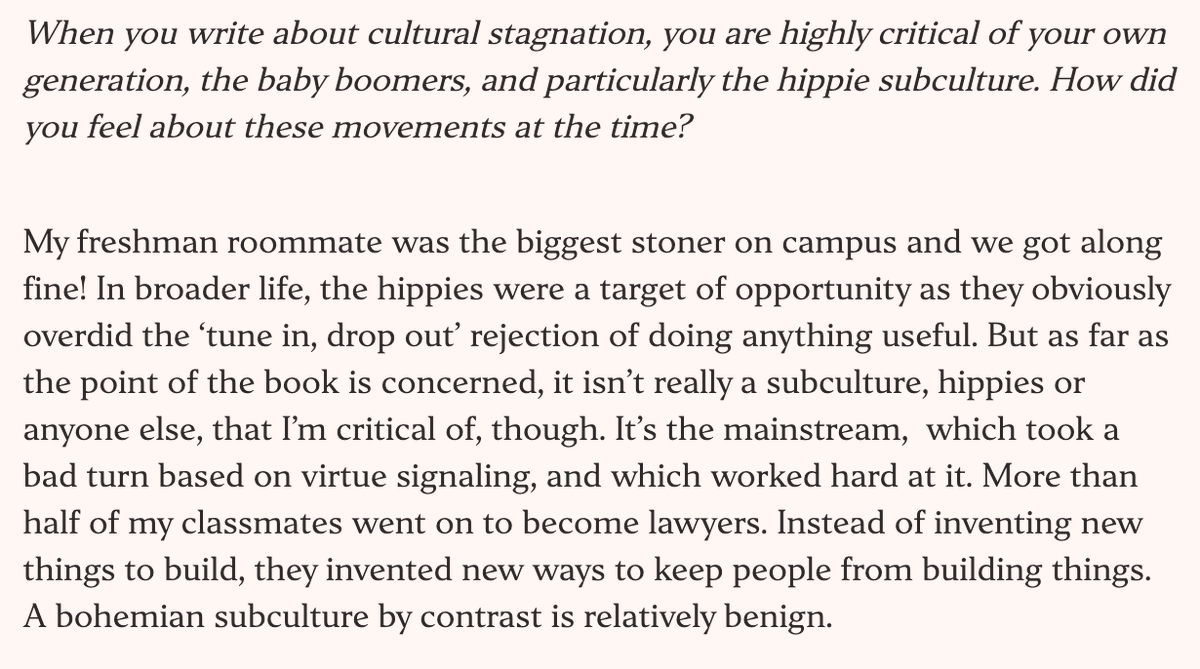
For LOST IN STAGNATION, the first of many @WorksInProgMag / @stripepress collaborations, I interviewed J. Storrs Hall, author of ‘Where is My Flying Car’ to talk about stagnation and the possibility of progress: worksinprogress.co/issue/intervie…
The proximate cause of stagnation (or, put a different way, of wtf happened in 1971)? In a word, energy.
Also appreciated this point from Josh: it's easy to blame hippies, baby boomers, blah blah blah, for our anti-growth turn. Josh isn't convinced (and neither am I).
I walked away with more books than I could carry (TY, @sashadem!) and an instant love for @stripepress—so it’s a bit surreal to announce today that I’m switching gears @stripe to become its commissioning editor.
2/ Stripe Press’s mission was a core reason why I joined Stripe. *Ideas* are the seeds of great companies and great institutions, and excellent ones should be widely available—particularly to high-agency, fiercely curious individuals around the world.