Mr Dutton has chosen Callide in Central Queensland as one of his putative 'locations' to build Federal Government nuclear power stations. Since I personally designed a number of the surface facilities on this site, thought you might be interested in a run-through. 

It's a congested, hilltop site. There are three power stations, two of which still operate, sometimes -- Callide B and Callide C. Despite being separately owned, the generators for those two are actually co-located in the same extended shed.
Here: google.com.au/maps/@-24.3407…
Here: google.com.au/maps/@-24.3407…

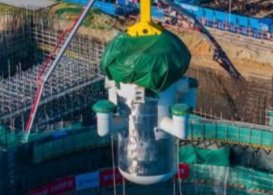
Image from this report: on the Callide C turbine explosion, mark-up mine. solarquotes.com.au/blog/callide-p…

I suppose you could find a place there somewhere to put a 500-1000 MW nuclear unit -- perhaps up near the old Callide A site, which plant has still not been demolished and rehabilitated, many years after it closed. (It was for a time used for abortive carbon capture experiments.)
This power station cluster is located where it is because it's beside the Callide coal mine, now run by a little private operator called Batchfire Resources. The site has no other major advantages.
google.com.au/maps/@-24.3212…
google.com.au/maps/@-24.3212…
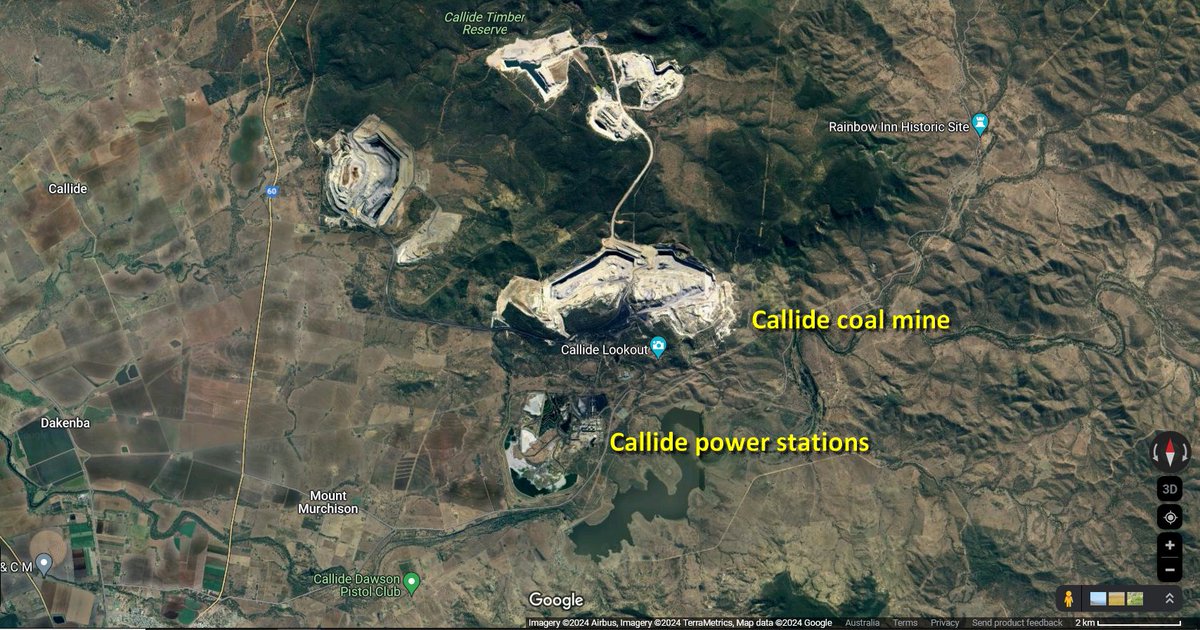
Actually it had significant disadvantages that needed to be overcome in the original design:
1. It's a long way from the load centre in South East Queensland. Solved with strong grid connections -- to Gladstone PS (then existing), Boyne Smelter, later Stanwell PS (Rockhampton).
1. It's a long way from the load centre in South East Queensland. Solved with strong grid connections -- to Gladstone PS (then existing), Boyne Smelter, later Stanwell PS (Rockhampton).
Dutton is correct to view those as a current *advantage* of the site.
2. It's in an important agricultural area, Callide Valley, with the available irrigation water supply (from two existing dams, Callide and Kroombit, and from groundwater) heavily overcommitted.
2. It's in an important agricultural area, Callide Valley, with the available irrigation water supply (from two existing dams, Callide and Kroombit, and from groundwater) heavily overcommitted.
These are thirsty evaporatively cooled power stations (note the cooling towers above). They need lots of fresh water. That was solved, for Callide B and C at least, by a part-distance pipeline over the Great Dividing Range from Awoonga Dam near Gladstone:
https://x.com/Gergyl/status/1790156036500050381
A nuclear power station on this site would also be evaporatively cooled, and at least as thirsty.
3. The site is hard-adjacent to the upstream edge of the agriculturally important Callide Aquifer. Protecting it was a significant concern, and would also be for any nuclear unit.
3. The site is hard-adjacent to the upstream edge of the agriculturally important Callide Aquifer. Protecting it was a significant concern, and would also be for any nuclear unit.
It's not widely appreciated that evaporatively cooled thermal power stations, coal-fired or nuclear, are significant generators of wastewater -- not especially toxic wastewater, but *salty* (technically, 'cooling tower blowdown'). That is generally just discharged, under licence.
At Callide that was not acceptable, because the downstream aquifer is already salty -- too salty to irrigate some crops. So, unlike (then) every other power station in Australia, Callide was design for on-site salty wastewater disposal, via extensive hillside evaporation ponds.
There are now other ways to do that (reverse osmosis with brine crystallisation), which might be used for an evaporatively-cooled nuclear unit here.
Is this a good site for a nuclear power station (leaving aside that other question)? Not imo. This is the driest lived-on continent on Earth. Inland evaporatively-cooled thermal power stations (nuclear!) are immensely thirsty machines. That's not a wise use of scarce fresh water.
(Correction: That's not actually the Great Dividing Range mentioned above; it's much further west. But it is a helluva big hill.)
• • •
Missing some Tweet in this thread? You can try to
force a refresh