Ok, I've been sorting through Mass. law to get a sense of what happened this morning and this thread will address what I've found. Bottom line: So far, it's unlikely that there has been any appealable error.
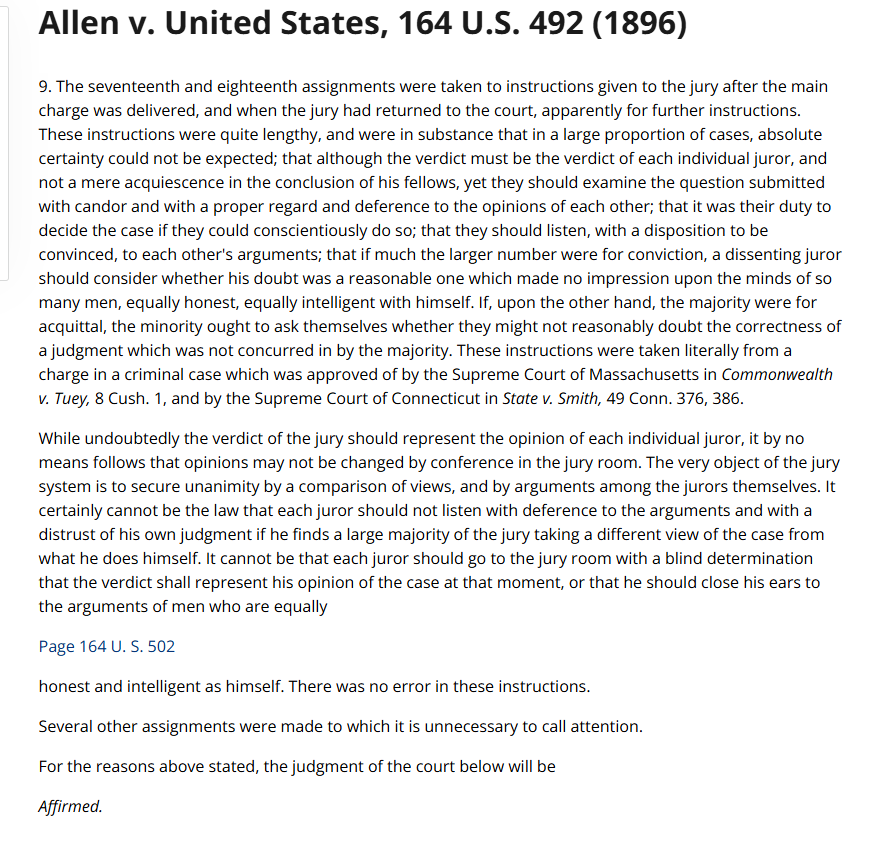
When a jury can't reach a unanimous verdict, courts can instruct them to continue their deliberations so long as the instruction to do so does not coerce a verdict. This rule derives from US Supreme Court precedent in Allen v. U.S.
Under MA law, there is a form instruction called a "Tuey-Rodriguez" instruction (named after 2 cases that generated it) to be given if, after due and thorough deliberation, the jury is deadlocked. You can read that instruction here: mass.gov/files/document…
MA law also has an interesting quirk that the jury cannot be sent back a second time to deliberate after they have deadlocked following due and thorough deliberation. This rule is statutory, from G.L. c. 234 § 34:
Note, however, that these rules only apply if there has been "due and thorough deliberation." This is why Judge Bev specifically found that there has *not* been due and thorough deliberation at this point.
Under MA law, the determination of whether deliberations have been "due and thorough" is discretionary with the court, meaning it's only overturned if it is patently unreasonable. The bar there is very high.
So, this means that Judge Bev has not yet initiated the "last chance" sequence that requires the Tuey-Rodriguez instruction or limits her ability to send the jury back again to continue deliberations if they repeat that they are deadlocked.
Notably, however, the judge can still run afoul of the restriction against coercing a jury verdict by refusing to release them in a reasonable time or by placing pressure on the minority to abandon their convictions. Coerciveness is a "totality of the circumstances" test.
At this point in time, there does not seem to be a viable appeal argument that what has been done is error. However, the longer the jury is out without making progress, the less likely it is that the judge could order them to continue without creating a coercive environment.
• • •
Missing some Tweet in this thread? You can try to
force a refresh

I missed all the fun everyone was having watching the Fani Willis hearing, but I did read the ruling. Overall, it seems within the judge's discretion and the law and will not be easily challenged by either side on aooeal. But a couple things did stand out to me.
The finding of no actual conflict of interest concluded that Ms. Willis's testimony about cash reimbursements wasn't entirely incredible. But the judge also seemd to go out of his way not to make specific findings about her credibility, and how it could affect the conflict issue.
The judge is right that he isn't required to make findings on every issue before him. But, this is an officer of the court who regularly apoears before him. Personally, I think he should take a deeper interest in the integrity of what's sworn in his courtroom.
Like most people, I'm predicting we'll see a not guilty plea from Bryan Kohberger at this stage. But I don't think an early guilty plea is off the table. Let's look at why.
The decision of plea is his, not his attorney's. It's his attorney's job to counsel him about the potential consequences of the plea to help him make his decision, and then advocate for his decided objective. He bears the risk, so he decides.
Currently, he is charged with 4 counts of murder without aggravating circumstances alleged. Aggravating circumstances are necessary for ID to seek the death penalty or a LWOP sentence.
Lots of action in the Marilyn Manson case recently! The case has been on simmer since the complaint was filed in March, but now lots of new information is emerging. This is a short thread on where the case is at and the significance of the new filings.
Evan and Illma filed anti-SLAPP motions in April and May. The motions only challenge the defamation claim and 3 of 5 causes of action for intentional infliction of emotional distress. The swatting and hacking allegations are unchallenged.
It’s been a while since I did a full legal review of one of Elaine’s briefs. She’s still up to the same old tired tricks! This will be a long thread; if you'd rather wait for the video version, it's in the editing bay and should be ready tomorrow morning.
🧵
As you’ve probably heard, Amber Heard has filed a post-trial motion asking Judge Azcarate to reduce the verdict, and/or set aside the verdict, and/or dismiss Johnny’s complaint. She also asks the court to investigate potentially improper juror service by Juror no. 15.
For those of you who don’t want to read the whole thread and just want the bottom line: Judge Azcarate will not grant any of these requests. I also think there is a non-zero chance she could find the argument about Juror no. 15 to be made in bad faith and sanctionable.
Because lots of people are asking what happens when Amber Heard runs out the clock on her allocated time, I'm going to take this opportunity to introduce folks to the jurisprudential theory of legal realism. This theory holds simply: The law is what the judge says the law is.
VA clearly recognizes that cross-examination on material issues is a basic right in a trial that cannot be denied simply due to time limits imposed, according to this published precedent.
Getting lots of questions about Rottenborn's question to Johnny on Thursday to the effect of, "Don't you know you're only suing Amber for 2018 statements?" Some have seized on this to claim everything before then is irrelevant. That's not correct, and I'm going to explain why.
In this thread, I will be screenshotting portions of Judge White's letter ruling on Amber's second motion to dismiss, filed March 27, 2020, which you can download from the Fairfax County Circuit Court website here:
Virginia allows defamation to be established by implication or innuendo. Because the defamatory meaning isn't overt, it requires the surrounding circumstances to be considered in order to evaluate what meaning the statement would have had in context.