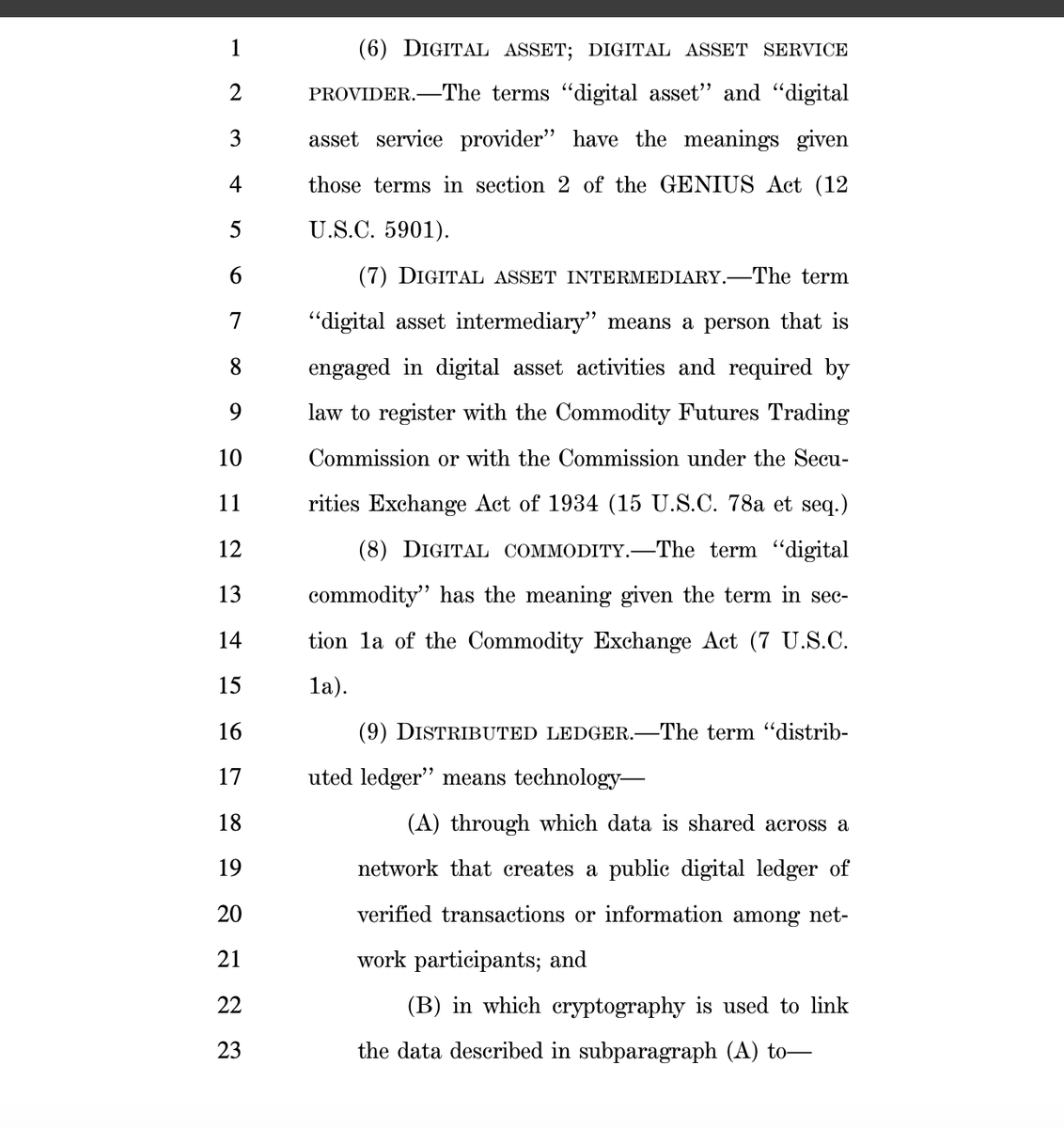
There’s been lots of news in the last 24 hours, but it’s possible that the most consequential event amidst all this will be the Supreme Court’s decision in a case known as Loper Bright.
Basically, it will trigger a sea change in all regulations.
Thread.
Basically, it will trigger a sea change in all regulations.
Thread.

So, the modern administrative state (which exists in basically every major economy) is built on a pretty basic system: the legislature passes laws and then agencies issue regulations to implement those laws.
Why does every country do this? Well, the short answer is that modern life is very complicated. No legislature has the time to deal with every granular part of policymaking, and technical expertise is often important.
Congress doesn’t want to dictate jet engine specs.
Congress doesn’t want to dictate jet engine specs.
In the U.S., we were slow to build a modern administrative state, but it really got underway with the New Deal.
Congress was making many new programs (social security) and regulatory regimes (securities laws, telecommunications laws, etc.), & you need agencies to run them.
Congress was making many new programs (social security) and regulatory regimes (securities laws, telecommunications laws, etc.), & you need agencies to run them.
But a pretty clear problem emerged almost immediately: how do you keep the new regulatory agencies within their ambit? Who regulates the regulators? .advocacy.sba.gov/2018/08/10/the…
For the first few years during the 1930s and 1940s, the answer wasn’t really clear, and executive branch agencies had tremendous authority to basically do whatever they wanted. This really angered a decent number of people (especially those against the New Deal).
But even FDR, far-sighted and heterodox as he actually was, saw that an unaccountable administrative state could be misused by future men. He tasked his Attorney General (and future Justice) Robert Jackson with analyzing how to improve administrative law.
regulationwriters.com/downloads/apa1…
regulationwriters.com/downloads/apa1…
The result was ultimately the Administrative Procedure Act, which set the guidelines and guardrails for agency’s to use their congressionally granted administrative powers and issue regulations. epa.gov/laws-regulatio…
Most things you hear about if you ever deal with an agency rulemaking - the comment period, recordkeeping, and the idea that rules cannot be “arbitrary or capricious” comes from this law.
It’s a super statute that is critical to how the government works. law.cornell.edu/uscode/text/5/…
It’s a super statute that is critical to how the government works. law.cornell.edu/uscode/text/5/…
Of course, as with any major law, answers often new, more granular questions.
One of the big ones revolved around how much deference should courts give to agency decisions?
One of the big ones revolved around how much deference should courts give to agency decisions?
In the 1960s, 1970s, and early 1980s, there were basically two views.
On the left, focusing on the importance of courts, the view was that courts should not defer to agency decisions that much.
On the right, which dominated presidential elections, the view was the opposite.
On the left, focusing on the importance of courts, the view was that courts should not defer to agency decisions that much.
On the right, which dominated presidential elections, the view was the opposite.
Some might say these views differed because progressives dominated the courts (including the Supreme Court) at the time and conservatives controlled the regulatory agencies (bc the GOP generally won the WH). But those were the views.
Eventually, this debate came to a head with a Supreme Court case in 1984 called Chevron v. NRDC. The case revolved around an environmental group’s challenge to how the Reagan EPA defined the word “source” in a rule under the Clean Air Act.
.en.m.wikipedia.org/wiki/Chevron_U…
.en.m.wikipedia.org/wiki/Chevron_U…
In a 6-0 decision (with several justices across the ideological spectrum not participating), Ford appointee and future liberal lion John Paul Stevens held in favor of the Reagan EPA.
He also provided a new standard for how courts should defer to agency actions.
He also provided a new standard for how courts should defer to agency actions.
Basically (I’m simplifying greatly), when courts are analyzing a challenge to how an agency interprets a law it is implementing, judges ask a two part question:
First: is the law in question unambiguous on the topic?
Second: if it is ambiguous, is the agency’s view reasonable?
First: is the law in question unambiguous on the topic?
Second: if it is ambiguous, is the agency’s view reasonable?
This test probably seems pretty banal, but this case became a core pillar of all administrative regulations.
Agencies could have confidence that courts would defer to their analysis of a novel question if they showed their work. The idea was to encourage good government.
Agencies could have confidence that courts would defer to their analysis of a novel question if they showed their work. The idea was to encourage good government.
It also made it possible for agencies to use older, broad grants of statutory authority to respond to new issues that were considered (or even theoretical) when the a law was enacted. Basically, it helped make the administrative state operate even without new congressional laws.
But there was a flip side: some people, mainly now on the right, felt Chevron became an obstacle to Congress now enacting new laws.
If agencies don’t need new laws to take novel actions, went the argument, they won’t push for Congress to pass new laws.
If agencies don’t need new laws to take novel actions, went the argument, they won’t push for Congress to pass new laws.
Whether that critique is right or wrong (I tend to think it’s complicated) that critique gained purchase with the growing conservative majority on the Supreme Court over the last decade.
Today, they acted. In a 6-2 vote, the Court overruled Chevron. supremecourt.gov/opinions/23pdf…
Today, they acted. In a 6-2 vote, the Court overruled Chevron. supremecourt.gov/opinions/23pdf…
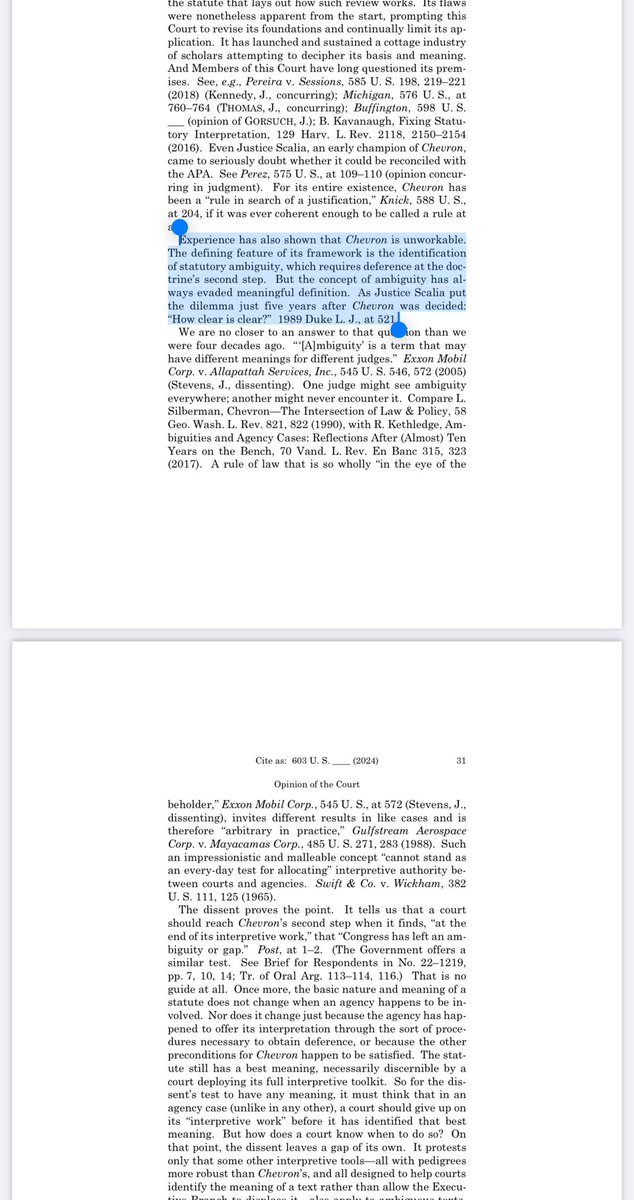
The basic argument of the Court is that agencies are not the proper analysts of how much power they have under a statute, because that’s the explicit power and duty of courts under the APA.
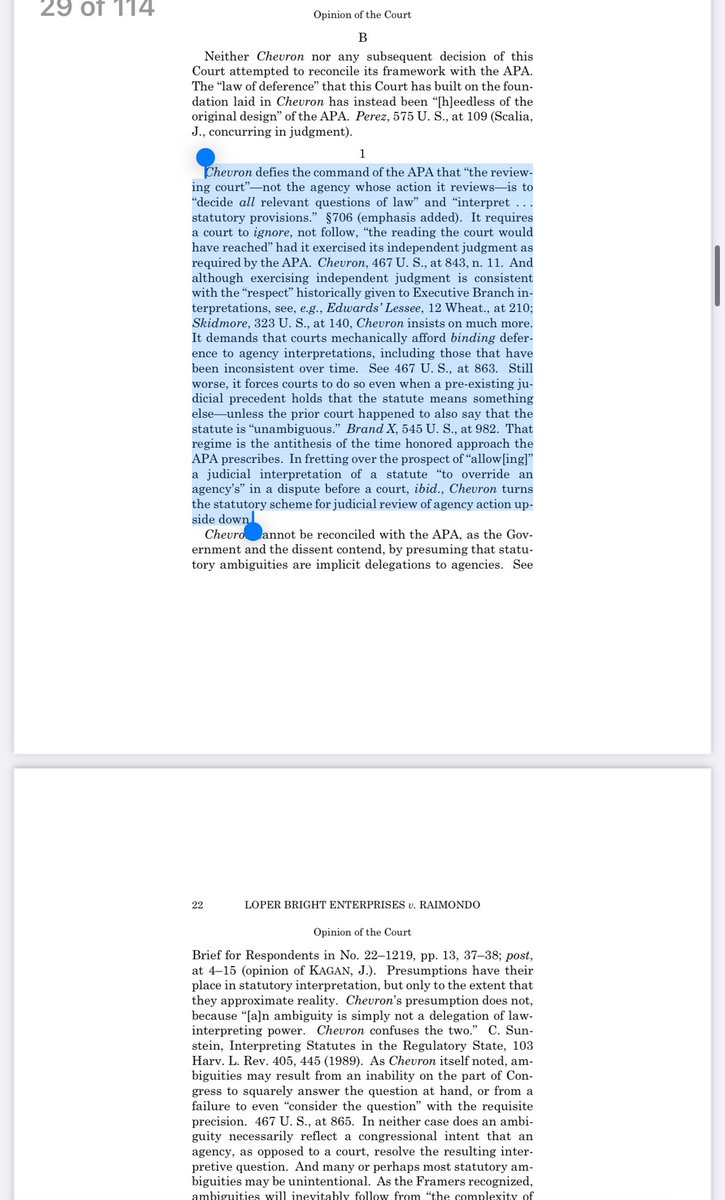
Also, the Court suggests that agencies are self-interested - what agency isn’t going to argue its authority is maximal? And that is a fair hit to some extent (though courts could deem such self-dealing not reasonable/not worthy of deference, hard for them to suss that out).
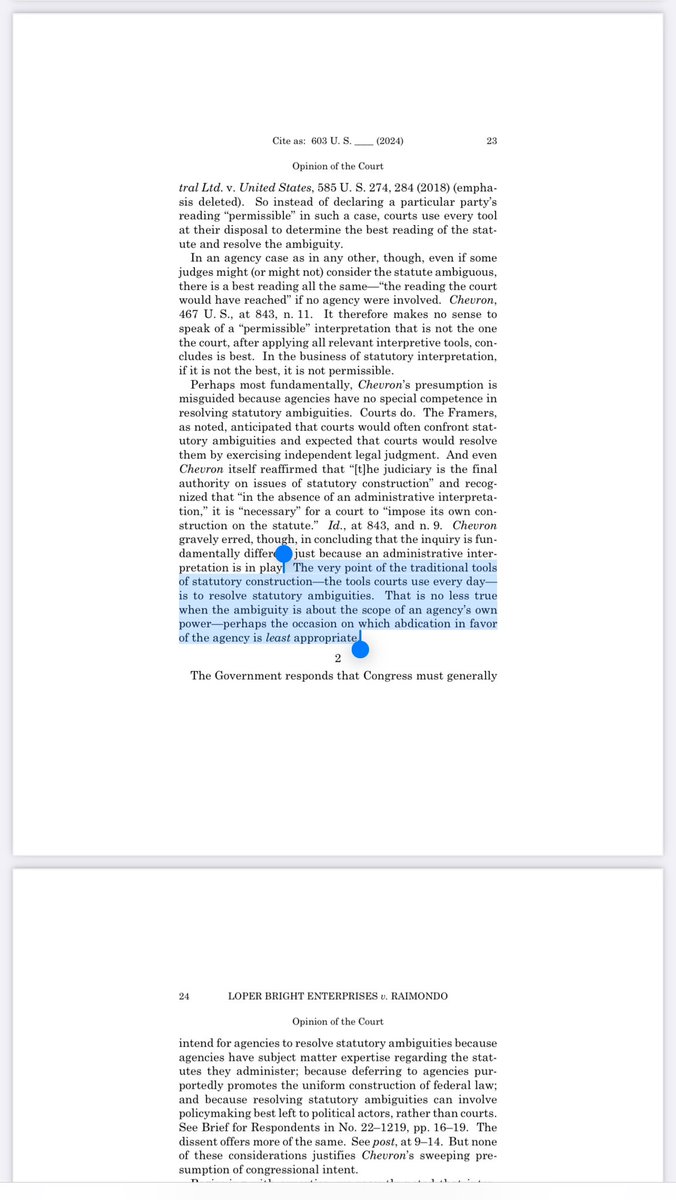
To be crystal clear, the Court is not saying that Congress cannot delegate agencies rulemaking powers (that would utterly annihilate the administrative state). But the Court hints that such delegations have to be “expressly delegated.” This will be the subject of future cases.
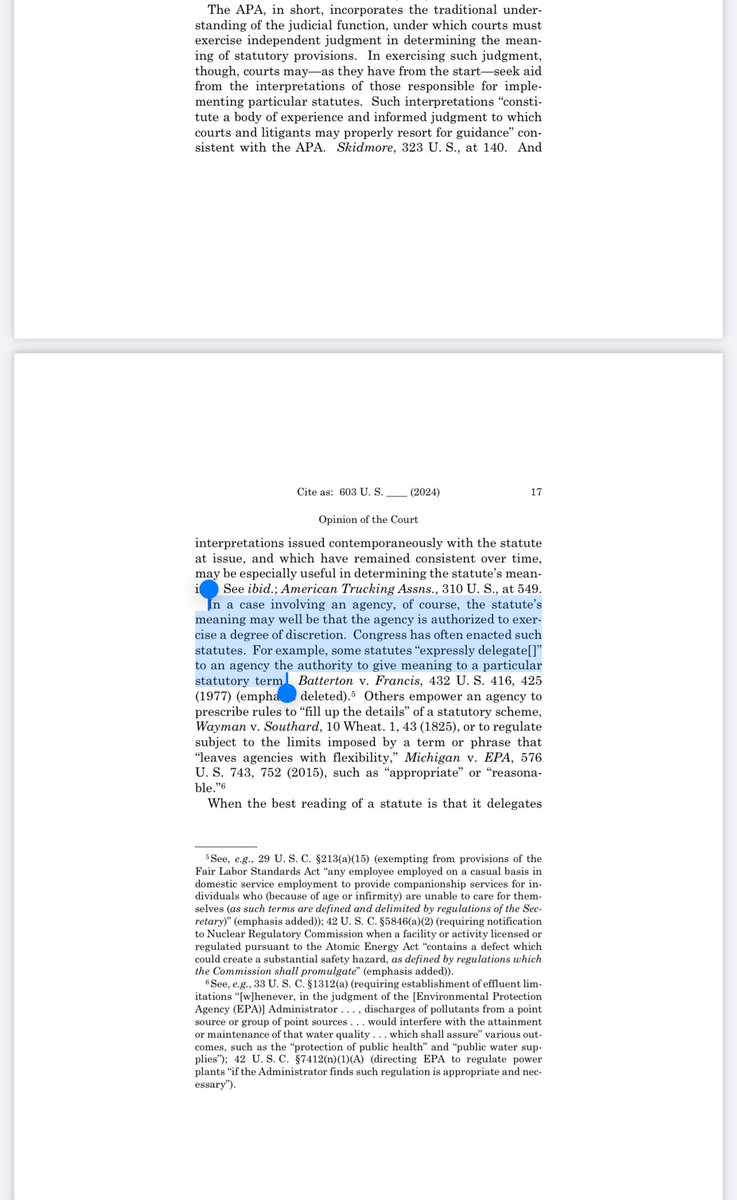
But this decision puts an end to what was a cornerstone of administrative law and regulation.
Where agencies before could be confident that they could try and apply an old law to a new subject and a court would allow any reasonable effort, now that path is less clear.
Where agencies before could be confident that they could try and apply an old law to a new subject and a court would allow any reasonable effort, now that path is less clear.
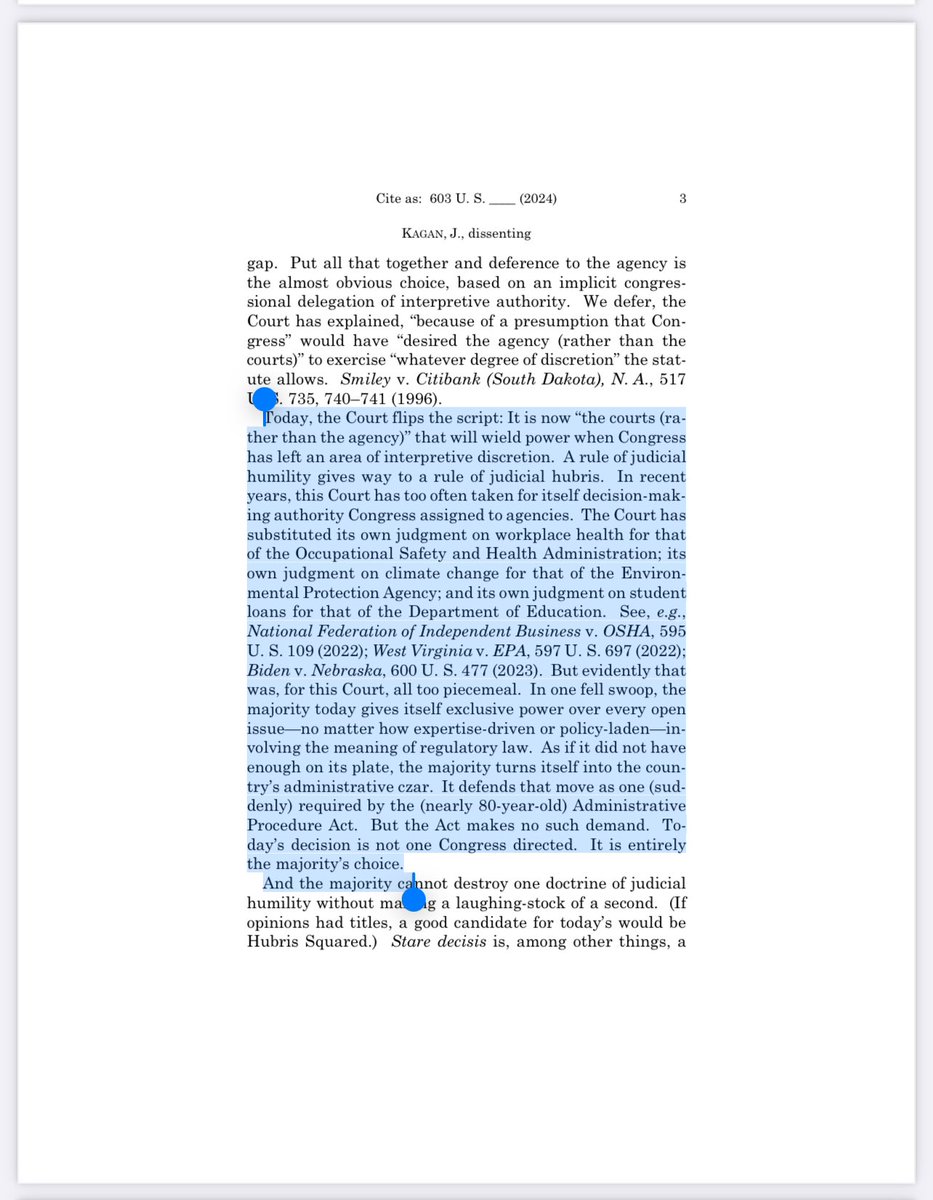
The ably written dissent by Justice Kagan ties to argue that this approach means chaos and courts dipping into the expertise of agencies. The Roberts opinion basically says it doesn’t care and the Chevron approach is itself unworkable and shambolic.
A lot is being made today of the idea that this case is a good thing for progressives, as it will allow courts to restrain a newly re-elected president Trump. But nobody really believes that this conservative court will equally apply this new doctrine to both Dem and GOP rules.
https://twitter.com/reubenr80027912/status/1806705511368171702
The more interesting point is that Chevron was originally a means to stop a liberal judiciary from messing with conservative rules, and now it’s being taken away so a conservative judiciary can stop liberal rules. The ongoing multi-round of politics will continue.
By the same token, the idea that this means the death of policymaking overwrought. Yes, it’s going to be harder to have agencies just act on novel problems without going to Congress first. That just means all roads lead back to Congress and winning elections.
There are no cheat codes in politics. And the last few years have seen Dems & GOPers try clever tricks when they can’t win a majority at the ballot box. The idea that you can dodge the need for a new law with clever legal analysis was one, and now this Court is closing that road.

Of course, some agencies have already seen this coming. You’ll notice Chevron is all about regulations not enforcement.
Some clever folks on the left have figured a way to dodge the Court cracking down on Chevron by focusing on enforcement actions.
Such as the SEC on crypto.
Some clever folks on the left have figured a way to dodge the Court cracking down on Chevron by focusing on enforcement actions.
Such as the SEC on crypto.
Last year, on vacation with a friend who is very against crypto & senior in government, I asked him why the SEC wouldn’t just do regulations on crypto instead of enforcement. He said “it’s much easier for this Supreme Court to strike down regulations than enforcement actions.”
In the short term, I suspect a lot of agencies will take the Court literally rather than seriously and try to shift quasi-regulatory efforts on novel topics like crypto and AI into enforcement actions. @tphillips has some very thoughtful ideas on this.
@tphillips I think it probably won’t work because this Supreme Court is very hostile to administrative powers that aren’t explicitly delegated. They’re trying to cabin all novel approaches.
https://twitter.com/jbsdc/status/1806332930681155945
@tphillips The right solution therefore is probably, in the spirit of Chevron, a two parter.
For the short term, Dems need to try and make regulations have GOP buy-in if possible. That may help reduce the odds that this SCOTUS strikes a rule down.
For the short term, Dems need to try and make regulations have GOP buy-in if possible. That may help reduce the odds that this SCOTUS strikes a rule down.
@tphillips This is especially true for rules that aren’t super politically salient (and therefore unlikely to trigger popular anger when Supreme Court strikes them down). Also, a greater focus on passing laws that explicitly empower agencies on novel issues.
@tphillips For the long term, the goal should be to try ever harder to win majorities in Congress to update the APA and ideally cabin the Supreme Court’s own ability to be a super legislature, bc it’s unlikely we win back the Court soon.
@tphillips In the end, the goal is policy change that works not the power to do regulations. Close this route and change will find new ones. But the state of federal rulemaking will change now, and Congress will become more key.
• • •
Missing some Tweet in this thread? You can try to
force a refresh