1/7. Contrary to Prof. Christopher Taylor's claim, global greening is not "maxed out." That outlier Baozhang Chen study he cited is even contradicted by the IPCC:
(Note: accelerated terrestrial carbon uptake = greening.)
(Note: accelerated terrestrial carbon uptake = greening.)
https://twitter.com/ncdave4life/status/1719382451095535760
2/7. Here's a compilation of that thread (because Twitter/𝕏 keeps shadowbanning my tweetstorms):
@elonmusk, @lindayaX, @support, @premium PLEASE end 𝕏's SHADOWBANNING of replies — even replies to one's own tweets (tweetstorms). What good is a tweetstorm if you can't find the 2nd tweet while viewing the 1st?threadreaderapp.com/thread/1719382…
@elonmusk, @lindayaX, @support, @premium PLEASE end 𝕏's SHADOWBANNING of replies — even replies to one's own tweets (tweetstorms). What good is a tweetstorm if you can't find the 2nd tweet while viewing the 1st?threadreaderapp.com/thread/1719382…
3/7. Xin Chen et al (2024) refutes that outlier Baozhang Chen et al (2022) study:
Chen, Xin et al (2024). The global greening continues despite increased drought stress since 2000. Global Ecology and Conservation, Volume 49, 2024, e02791, doi:10.1016/j.gecco.2023.e02791.sciencedirect.com/science/articl…
Chen, Xin et al (2024). The global greening continues despite increased drought stress since 2000. Global Ecology and Conservation, Volume 49, 2024, e02791, doi:10.1016/j.gecco.2023.e02791.sciencedirect.com/science/articl…

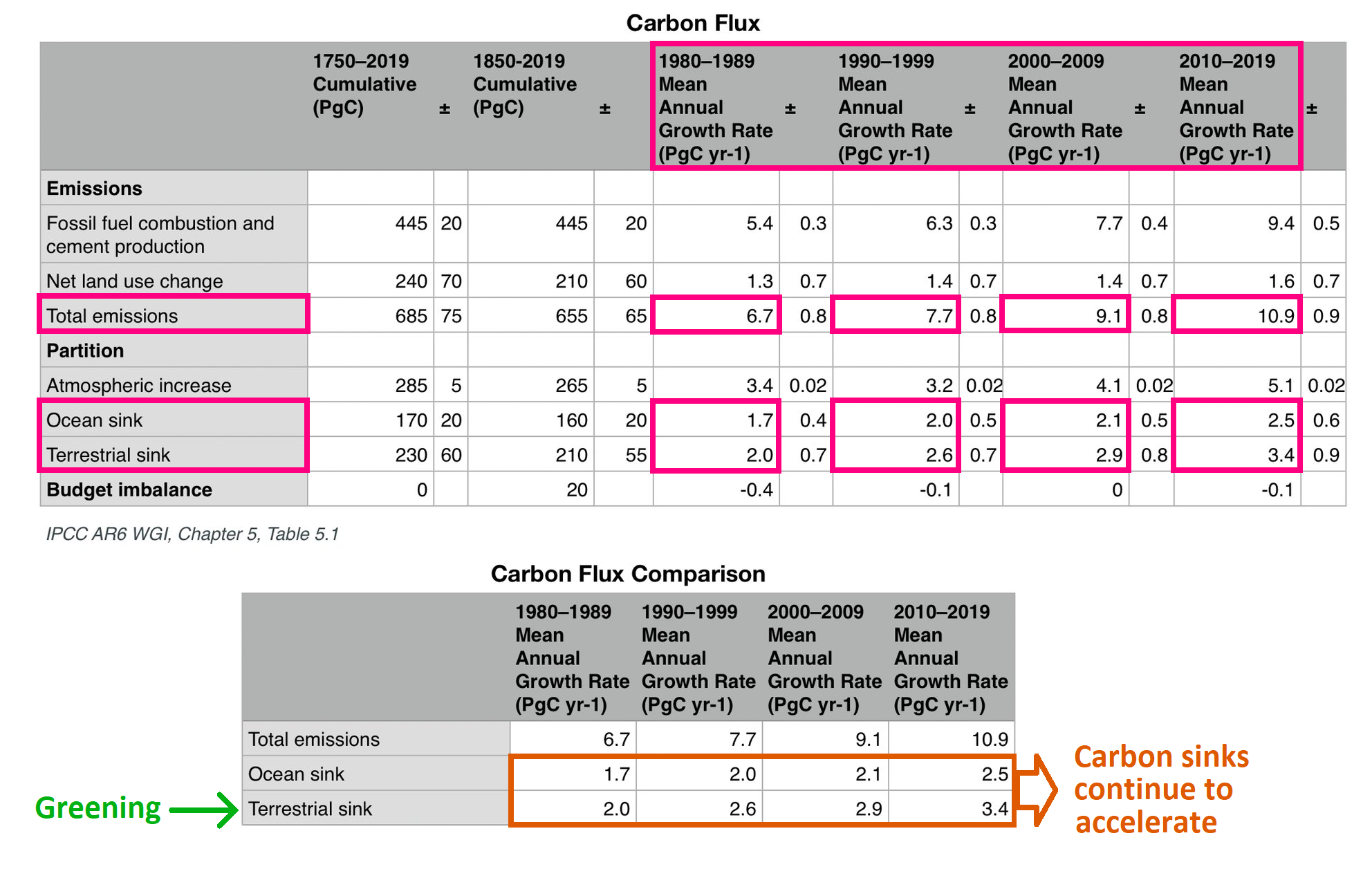
4/7. Here's AR6 WG1 Table 5.1, which shows how natural CO2 removals are accelerating:
I annotated it here:
ipcc.ch/report/ar6/wg1…
sealevel.info/AR6_WG1_Table_…
I annotated it here:
ipcc.ch/report/ar6/wg1…
sealevel.info/AR6_WG1_Table_…

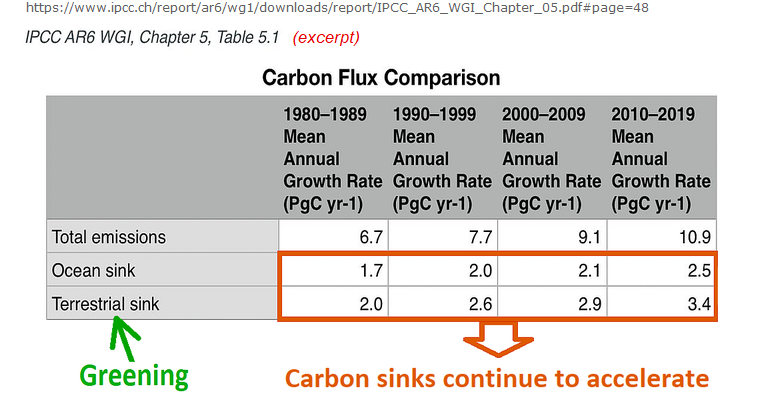
@deltablues11 @ammocrypta @Willard1951 @SpudNielsen @AristotleMrs @tonyjsargeant @3GHtweets @Anymous84861064 @BenKoby1911 @MartinDn1001 @Mark_A_Lunn @CDCollins5269 @HalBeowa @TheDisproof @rln_nelson @joe51du @Veritatem2021 @GillesnFio @Anvndarnamn5 @MarcEHJones @Rabs1958 @JohnWil12363553 @DenisDaly @S_D_Mannix @ozzorro1 @bomac_macbo @Devonian1342 @GAJAJW @Jaisans @bulkbiker @Climatehope2 @Data79504085 @Michael_D_Crow @Hji45519156 @waxliberty @priscian @SuperFoxyLoxy @ChrisBBacon3 @JaapTitulaer @wjack76995 @Rocky35418823 @NobaconEgbert @balls95652097 @BointonGiles @SeekerTheGreat1 @ubique60 @elonmusk @lindayaX @Support @premium 5/7. Here are the relevant parts:
As you can see, as atmospheric CO2 levels have risen, the natural CO2 removal rate has sharply accelerated. (That's a strong negative/stabilizing climate feedback.) sealevel.info/AR6_WG1_Table_…
As you can see, as atmospheric CO2 levels have risen, the natural CO2 removal rate has sharply accelerated. (That's a strong negative/stabilizing climate feedback.) sealevel.info/AR6_WG1_Table_…

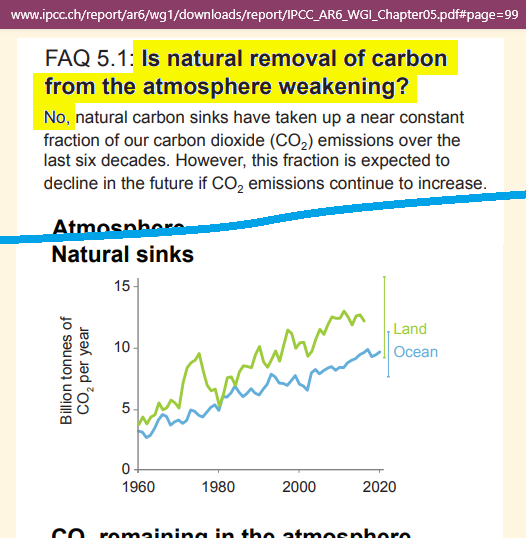
6/7. Here's the caption, saying that natural removal of carbon from the atmosphere is NOT weakening.
(They should've stopped with the word "No." The rest is a muddled attempt at "spin.")
The AR6 authors did PREDICT a "decline" in the FUTURE, "if" emissions "continue to increase." But it hasn't happened yet.
What's more, the "decline" which they predicted was NOT for the rate of natural CO2 removals by greening and marine sinks, anyhow. Rather, if you read it carefully, you'll see that that hypothetical "decline" was predicted just for the ratio of natural removals to emissions.
What's more, their prediction was conditional, depending on what happens with future emissions ("if CO2 emissions continue to increase").
Predictions are cheap. MY prediction is that natural removals of CO2 will continue to accelerate, for as long as CO2 levels rise. (MY prediction is based on scientific evidence, not political spin.)
The "fraction" which AR6 predicts might decline, someday, does NOT represent anything physical, anyhow. It is one minus the equally unphysical "airborne fraction."
Our emission rate is currently about twice the natural removal rate, so if emissions were halved, the removal "fraction" would be 100%, and the atmospheric CO2 level would plateau. If emissions were cut by more than half then the removal "fraction" would be more than 100%, and the CO2 level would be falling.sealevel.info/AR6_FAQ_5.1_NO…
(They should've stopped with the word "No." The rest is a muddled attempt at "spin.")
The AR6 authors did PREDICT a "decline" in the FUTURE, "if" emissions "continue to increase." But it hasn't happened yet.
What's more, the "decline" which they predicted was NOT for the rate of natural CO2 removals by greening and marine sinks, anyhow. Rather, if you read it carefully, you'll see that that hypothetical "decline" was predicted just for the ratio of natural removals to emissions.
What's more, their prediction was conditional, depending on what happens with future emissions ("if CO2 emissions continue to increase").
Predictions are cheap. MY prediction is that natural removals of CO2 will continue to accelerate, for as long as CO2 levels rise. (MY prediction is based on scientific evidence, not political spin.)
The "fraction" which AR6 predicts might decline, someday, does NOT represent anything physical, anyhow. It is one minus the equally unphysical "airborne fraction."
Our emission rate is currently about twice the natural removal rate, so if emissions were halved, the removal "fraction" would be 100%, and the atmospheric CO2 level would plateau. If emissions were cut by more than half then the removal "fraction" would be more than 100%, and the CO2 level would be falling.sealevel.info/AR6_FAQ_5.1_NO…

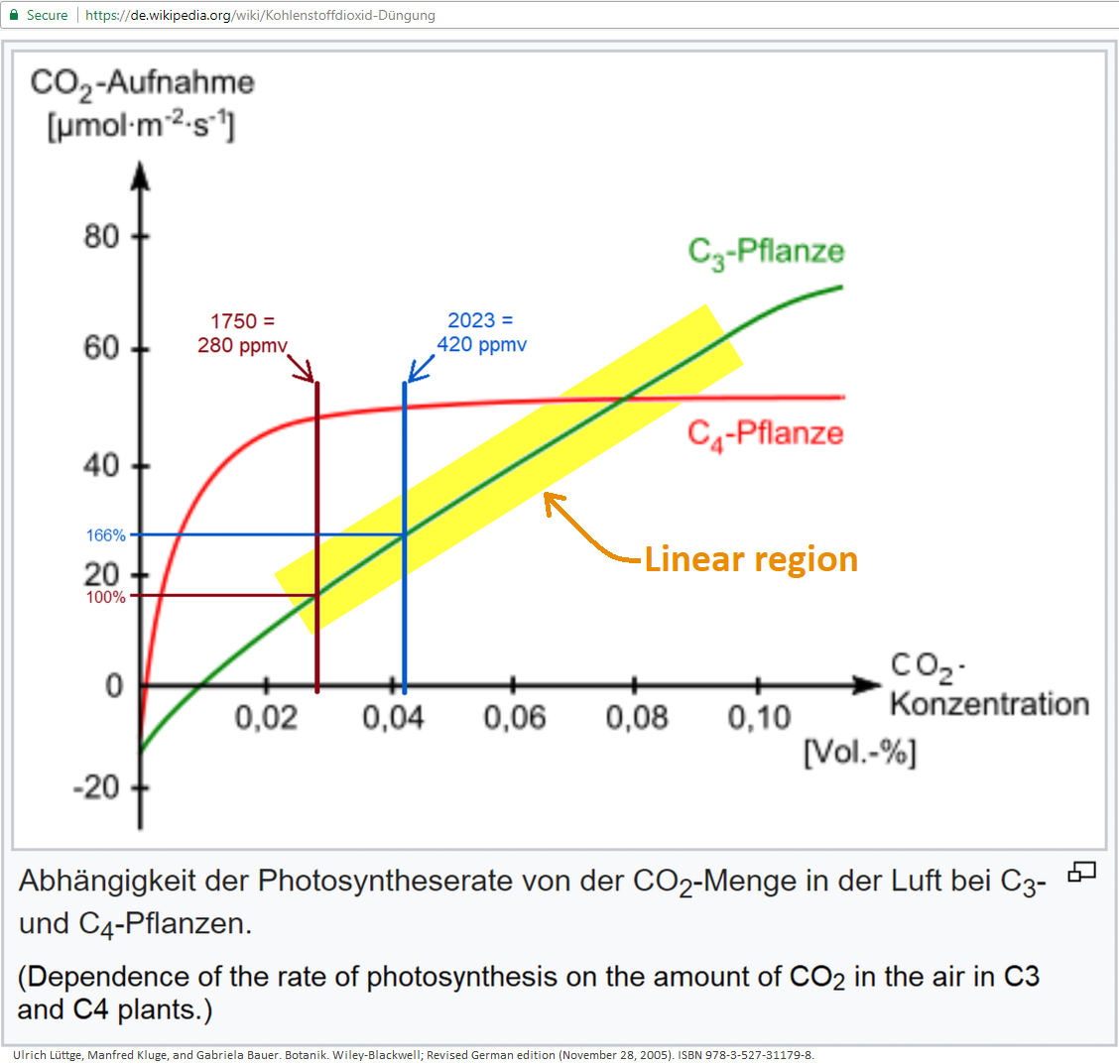
7/7. The greening trend is driven largely by the response of C3 plants (especially trees), to rising CO2 levels. That's the green curve:
As you can see, the CO2 level would have to rise above 1000 ppmv (“0,10”) before the benefits of additional CO2 would significantly diminish.sealevel.info/C3_and_C4_Pfla…
As you can see, the CO2 level would have to rise above 1000 ppmv (“0,10”) before the benefits of additional CO2 would significantly diminish.sealevel.info/C3_and_C4_Pfla…

@deltablues11 @ammocrypta @Willard1951 @SpudNielsen @AristotleMrs @tonyjsargeant @3GHtweets @Anymous84861064 @BenKoby1911 @MartinDn1001 @Mark_A_Lunn @CDCollins5269 @HalBeowa @TheDisproof @rln_nelson @joe51du @Veritatem2021 @GillesnFio @Anvndarnamn5 @MarcEHJones @Rabs1958 @JohnWil12363553 @DenisDaly @S_D_Mannix @ozzorro1 @bomac_macbo @Devonian1342 @GAJAJW @Jaisans @bulkbiker @Climatehope2 @Data79504085 @Michael_D_Crow @Hji45519156 @waxliberty @priscian @SuperFoxyLoxy @ChrisBBacon3 @JaapTitulaer @wjack76995 @Rocky35418823 @NobaconEgbert @balls95652097 @BointonGiles @SeekerTheGreat1 @ubique60 And, in case Twitter/𝕏 shadowbans this tweetstorms, too…
Compilation:
@ThreadReaderApp @Rattibha @threaddotblue unroll
@reSeeIt save threadtwitter-thread.com/t/180901292151…
Compilation:
@ThreadReaderApp @Rattibha @threaddotblue unroll
@reSeeIt save threadtwitter-thread.com/t/180901292151…
• • •
Missing some Tweet in this thread? You can try to
force a refresh