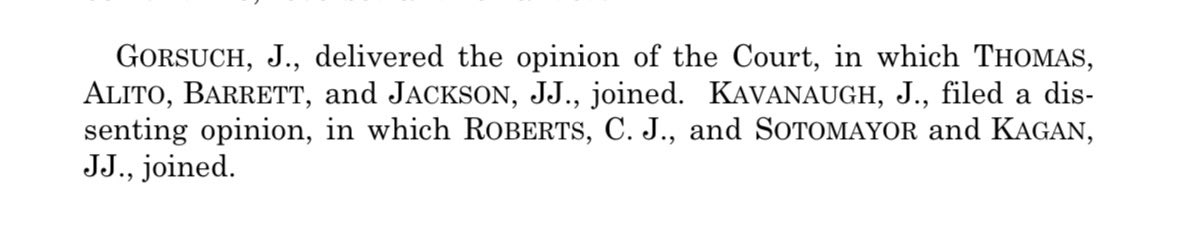
1/ The Special Counsel has conceded (as he should) that the parties should brief the impact of SCOTUS' immunity decision in Trump v. US on the classified documents prosecution. Trump hopes Judge Cannon will apply it to his post-presidency conduct—that may be a bridge too far even for her. We'll see. documentcloud.org/documents/2480…
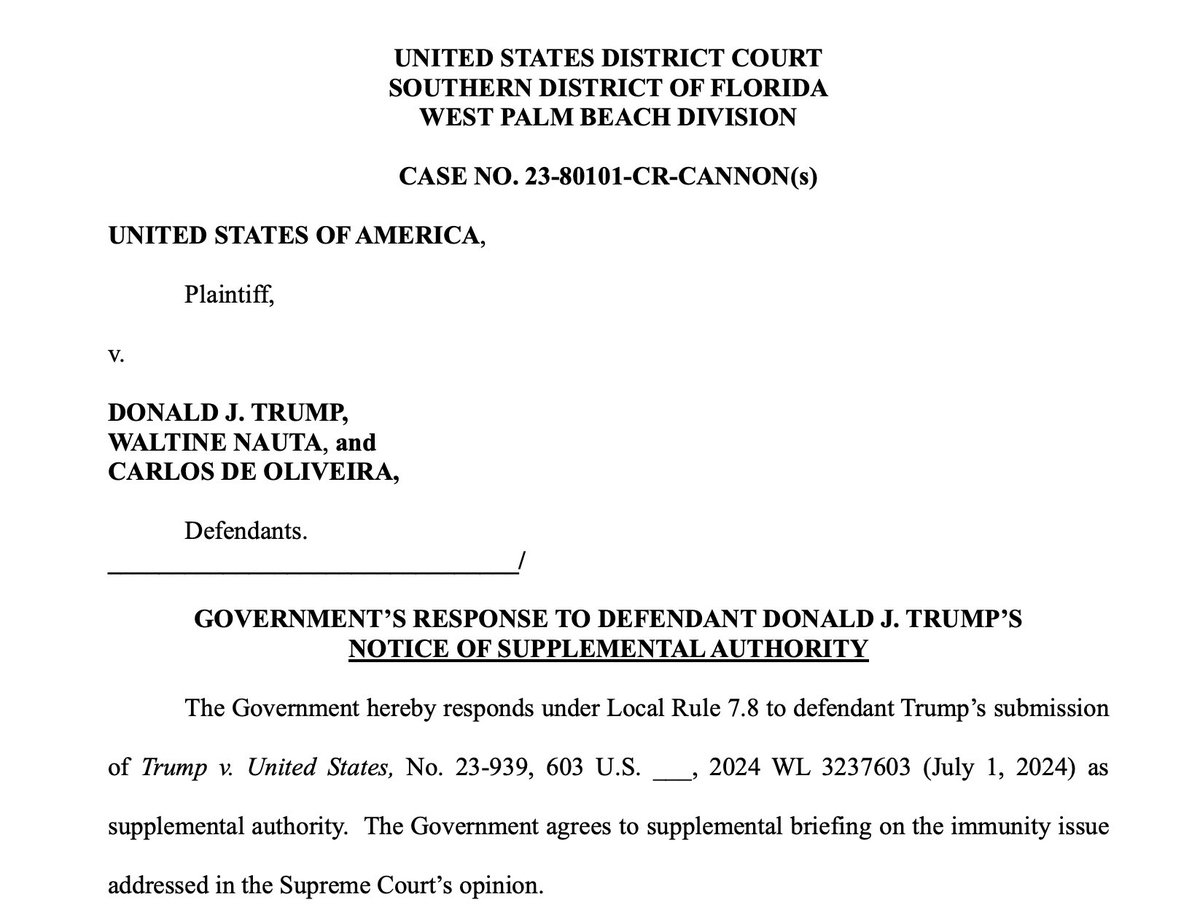
2/ The Special Counsel argues up front that Justice Thomas' throw-away concurrence, signed by no other justice & contrary to well-established law & practice, that supports Trump's contention the SC's appointment was unconstitutional should have no impact on this case.
3/ Cannon has been no friend to the gov't but Trump is charged with retaining documents after he left office. Only a convoluted theory would permit her to strike charges or evidence in this case. That, of course, is not off the table with her, but it would be quite a stretch. This will be the first real test of how far courts will stretch SCOTUS' decision, especially the provision to keep evidence of official acts off the table, to protect Trump.
• • •
Missing some Tweet in this thread? You can try to
force a refresh

1/A week ago, Kevin Roberts, the head of the Heritage Foundation & architect of Project 2025, responded to Democrats plans to take on Project 2025. Roberts said, “Project 2025 will not be stopped,” & that Democrats are “more than welcome to try” to stop it.
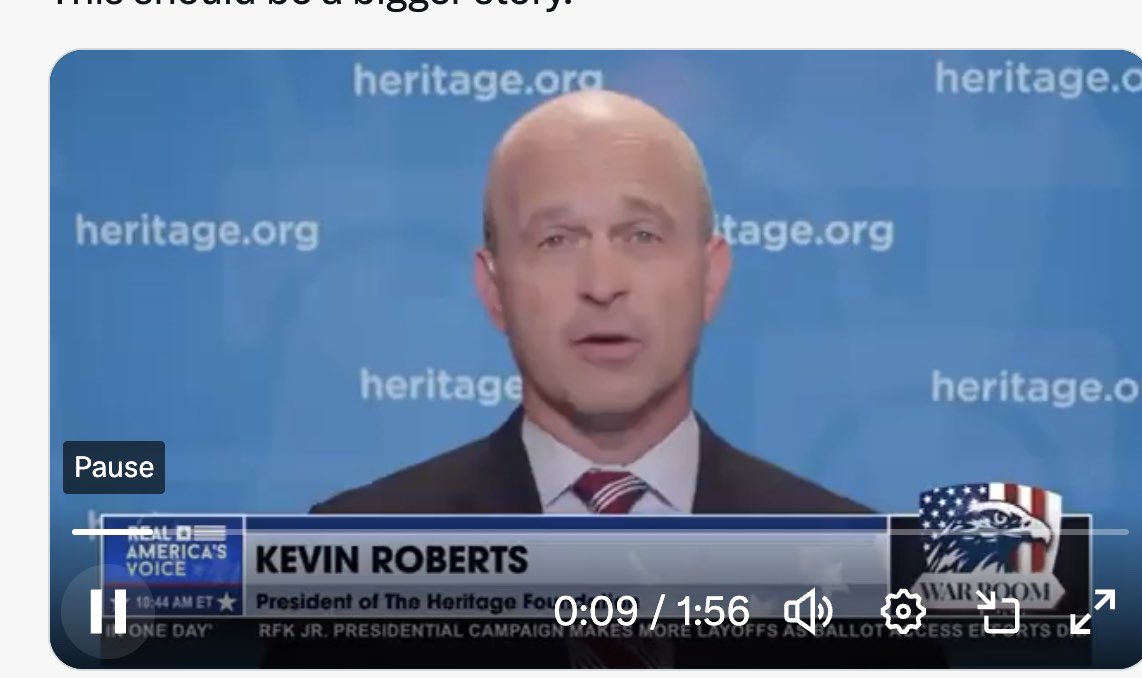
2/On Tuesday, Roberts was on Steve Bannon’s War room. It was minus Bannon, of course, because he’s in federal prison. Roberts told a guest host: "We are in the process of the second American Revolution, which will remain bloodless if the left allows it to be"
3/Is Roberts threatening people who speak out with violence? What if they protest? What if they vote? He’s saying it will get bloody. The more we learn about Project 2025 and the people behind it, the worse it gets. substack.com/redirect/f5e68…
1/ The more I read the immunity opinion, the clearer it becomes that the conservative majority is more concerned with concentrating power in the hands of the president than in how a president might abuse that power. Presidents as kings.
2/There is absolute immunity for a president acting within his constitutional authority and up to the full extent of the outer perimeter of whatever the Court says that authority is. Then, it gets even more troubling.
3/Presidents get “presumptive immunity" for their implied authority, what the Court characterizes as the "Twilight Zone" of presidential authority. They don't have to decide if it applies "at this stage" which suggests they expect further appeals once the district court does, but
1/There are a few bright lines for today's immunity decision. Trump's lawyer conceded at oral argument that they were only asking for immunity for *official acts* not private ones, what I've often viewed as President Trump vs. Candidate Trump. Assuming the Court agrees, they may
2/provide a test for lower courts to use in distinguishing between official and private acts. That's likely a fact-based test, which will require judges to let parties argue the evidence, hold an evidentiary hearing, or both. It's also possible that the Court will decide that...
3/some official conduct merits immunity-a president who orders a strike on foreign enemies based on the best advice of advisors in a time-constrained situation & one result is killing an American citizen, which is a fed'l crime. The Court might decide there is a narrow band of...
1/Loper Bright v. Raimondo, handed down on Friday by SCOTUS, will have a direct impact on all of our lives. It will upend agency regulations that are used to implement federal law. That sounds dry and far away from our daily lives. But it’s not.
2/The "administrative state" has operated since the Chevron decision in 1984 on the basic premise that Congress passes laws and agencies issue regulations that implement them. What happened when a regulated entity didn’t like an agency’s decision? They could sue.
3/The longstanding Chevron deference doctrine required courts to defer to agency action when the law was ambiguous and the agency’s view was reasonable. That came to an end on Friday, when Chief Justice Roberts wrote for the majority in no uncertain terms, “Chevron is overruled.”
2/My personal view is that this is a terrible decision that makes homelessness a crime. But it seemed clear during oral argument that this was where the majority was headed & today's decision unfortunately confirms that.
3/SCOTUS' reverses the longstanding Chevron deference doctrine, which requires courts to defer to decisions made using the expertise of federal agencies. supremecourt.gov/opinions/23pdf…
1/ 1st case: Ohio v. EPA. States opposed an EPA Good Neighbor provisions that restricted air pollution. For a case that came to the Court as a request for a quick ruling on a stay, it took a long time for them to rule (in favor of polluters, saying they're likely to prevail).
2/ Second case is Purdue Pharma, a legacy of the country's struggle with opioid addiction. SCOTUS says the Sackler family can't use a bankruptcy settlement to protect billions of dollars meant for victims. Interesting split here.
3/ Jarkesy. The technical holding is that a defendant in a civil SEC proceeding seeking penalties for fraud is entitled to a jury trial. Interesting background on the case here: politico.com/news/2024/05/2…