Izabella Kaminska Profile picture
Aug 1, 2024 10 tweets 4 min read Read on X
🧵Aside from the headline news, today’s Russian prisoner swap seems to me to include a potentially involuntary limited hangout by the US. It pertains to the release of Vladislav Klyushin and what that suggests about how spies and spy agencies really fund themselves.

The official line is that Klyushin was involved in “hack-to-trade” insider schemes. But why would that be of interest to the Kremlin?

To understand, first watch this suspiciously well produced (given the turnaround time) CNBC mini doc about “Putin’s trader.”

youtu.be/J4kWugbH4qo?si…
Not only is the doc extremely well produced for something that in theory only became public knowledge today - hinting of tactical embargo terms or pre-positioning of information by the Feds themselves - the access they were given to prosecutors suggests it serves a broader agenda.
There are other tactical if you know you know leaks throughout. For example, the last minute tip off from an anonymous source linking the reporter to a former Russian spy living under an assumed identity after defecting from Russia with US help. That isn’t the sort of source that you just uncover via investigative work.
So we have a former Russian spy telling us very clearly that Russia uses its spying power (both human and cyber) to gain access to insider information to make shed loads of money for spies. Why would Putin allow these individuals to get super rich? Likely because it’s the perfect off the books funding source which allows spies to self finance their work without the annoyance of sanctions.
But it’s not just about sanctions.

If information means power in markets, then it stands to reason that spy agencies - with all their backdoor access points, hacking specialists and general accumulation of privileged info - have possibly one of the biggest advantages in markets of all.

Would they use that privileged information tactically to front run markets to raise money for all sorts of black ops? If they’re already operating illegally in jurisdictions - it would be foolish to think they weren’t.
So the next question you have to consider is: when is an outsized hedge fund return really a genuine outsized return, and when is it the product of traders being fed privileged information from spy agencies - in a sort of hedge fund front collaboration deal - where proceeds are split between the spies and the front companies? Or even where the managers are the spies?
Note also the quip about how Klyushin is supposedly only the tip of the iceberg. There are (according to the former Russian spy) allegedly many more like him embedded across the US financial system. And unlike Klyushin these guys are pros and this discreet. They don’t raise suspicions by buying Lamborghinis or fur coats for their wives. They keep a low profile. [Perhaps even give some of their fortunes away anonymously to civil society organisations?]
What else do we learn from the doc? Well there’s also the fact that the Feds managed to get access to all their encrypted comms. Including on apps previously thought to be unhackable like Threema. Is this a boast by the US or a warning?
If you consider Klyushin’s little op generated about $90m - imagine how much more is being extracted from the financial system as a whole by all the hostile sovereign states that use similar tactics?

Now consider that it’s not just hostile states that stand to benefit from deploying privileged info garnered from spy/surveillance to generate off the books funds for all sorts of black ops.
The point being: the playbook is not unique to Russia.

The formula is simple and highly replicable.

1) Locate and recruit a good front man/mule - who you promise to make very rich. Ideally have it be someone you can trust or who you know you can control.

2) provide him and his team with insider info that lets him outperform the market.

3) Agree that he gets to keep a share of the wealth as long as he forwards the rest to wherever it may be needed. Maybe encourage him to be a vocal effective altruist from the very beginning. For maximum influence and disruption have him “donate” to all sorts of civil society orgs or political causes you want to influence.

4) if he gets sloppy and is found out throw him under the bus. If he refuses to comply (and you realise you’ve accidentally created an uncontrollable monster) panic slowly. If one of his team threatens to walk and spill the beans on all, pay them off until they go away.

5) keep your operations as low key and secretive as possible.

Makes you wonder just how many of the billionaires in this space might not be what they seem, eh?

👉🏅?

• • •

Missing some Tweet in this thread? You can try to force a refresh

 

Keep Current with Izabella Kaminska

Izabella Kaminska Profile picture

Stay in touch and get notified when new unrolls are available from this author!

Read all threads

This Thread may be Removed Anytime!

PDF

Twitter may remove this content at anytime! Save it as PDF for later use!

Try unrolling a thread yourself!

how to unroll video
  1. Follow @ThreadReaderApp to mention us!

  2. From a Twitter thread mention us with a keyword "unroll"
@threadreaderapp unroll

Practice here first or read more on our help page!

More from @izakaminska

Apr 7
There are so many layers to the dollar story that transcend conventional market economic dynamics. Until investors realise this I do believe they will be caught out by narratives that serve political agendas not reality.

Crucially, most “end of the dollar” takes completely miss the point and purpose of why the system came to be in first place. This had much less to do with Americans living beyond their means and much more to do with protecting capitalism and its open, property-rights-based economic order from rival systems that did not have to be accountable to such free market forces.

The central challenge emanating from the Cold War was not simply ideological or military — it was structural.

Command economies could direct resources at scale into strategic and military priorities without regard for market signals, profitability, or consumer welfare. Market democracies, by contrast, were constrained by inflation, capital costs, voter expectations, and financial discipline. Left on their own, market economies risked being outcompeted over time by rivals that could forcibly allocate capital into dual-use industrial capacity and military buildup without internal resistance.

The American “statecraft” solution was not to abandon markets, but to reorganize how they operated at the system level thanks to the cunning use of allies with guilty consciences due to historic war debts. And later petro states. The dollar-based order, and the alliance structure built around it, was designed to distribute economic roles in a way that neutralized those constraints.
Industrial allies such as Japan were encouraged — implicitly and explicitly — to pursue state-guided, export-led growth, building high-quality manufacturing capacity and running persistent surpluses.

Those surpluses were then recycled (on a gentleman’s agreement basis) back into dollar denominated private sector assets but also, crucially, into US government issued debt in a way that suppressed funding costs enough to ensure the U.S. could maintain its very substantial military industrial complex advantage.

That in turn allowed the United States to maintain an edge - even in a capitalist free market system - in defense, advanced research, and system integration, without having to bear the full economic burden domestically.

By externalizing parts of the industrial base and anchoring global finance in dollar demand, the system allowed market-based democracies to sustain a level of military competition that would otherwise have triggered destabilizing inflation, rising interest rates, and political backlash.

The dollar’s role was therefore not simply a privilege, but a mechanism: a way of converting allied industrial output and savings into strategic capacity.

From the allies’ perspective, the bargain was equally clear — access to U.S. markets, security guarantees, and the protection of property rights within a stable global framework. This was something they would not get from the other super power in the mix: the USSR.

Seen this way, the system was never about excess consumption or imbalances for their own sake. It was a deliberately constructed architecture to ensure that an open, capitalist order could compete with — and ultimately outlast — closed systems capable of mobilizing resources without constraint. The durability of the dollar is therefore not an accident of history, but a reflection of the enduring logic of that arrangement.
Also, via my framing, the petrodollar was a natural extension of that same logic.

The arrangement on offer was not subservience, but a precise alignment of incentives: price and settle oil in dollars, but recycle a defined share of the proceeds specifically into U.S. Treasuries — not merely into U.S. assets more broadly.

Remember recycling into private assets would have occurred regardless. The strategic objective was to direct a good chunk of those flows back to the state so that the core guarantor of the system — the U.S. military and security apparatus — remained fully funded.

From the producers’ perspective, this was a rational exchange. Wealth held in private assets ultimately depended on a security architecture they could not independently guarantee. By allocating a portion of their surpluses to U.S. government debt, they were sustaining the very system that protected their accumulated wealth and property rights, especially in the context of a Cold War that threatened appropriation.

Crucially, this architecture achieved something unusual: it coordinated economic roles across countries without requiring formal political control or the suppression of domestic autonomy. In contrast to the Council for Mutual Economic Assistance (COMECON) — which imposed centralized coordination within a closed, command-economy bloc — the Western system operated through incentives rather than directives.

Members retained sovereignty and market-based governance while participating in a structure that distributed industrial production, resource flows, and financial recycling in a mutually reinforcing way. In that sense, it functioned as a kind of market-based counterpart to Comecon — achieving strategic coordination without abandoning capitalism or political independence.

The durability of the system was connected to the fact that the arrangement allowed open, capitalist societies to sustain strategic competition while preserving both economic dynamism and political freedom.
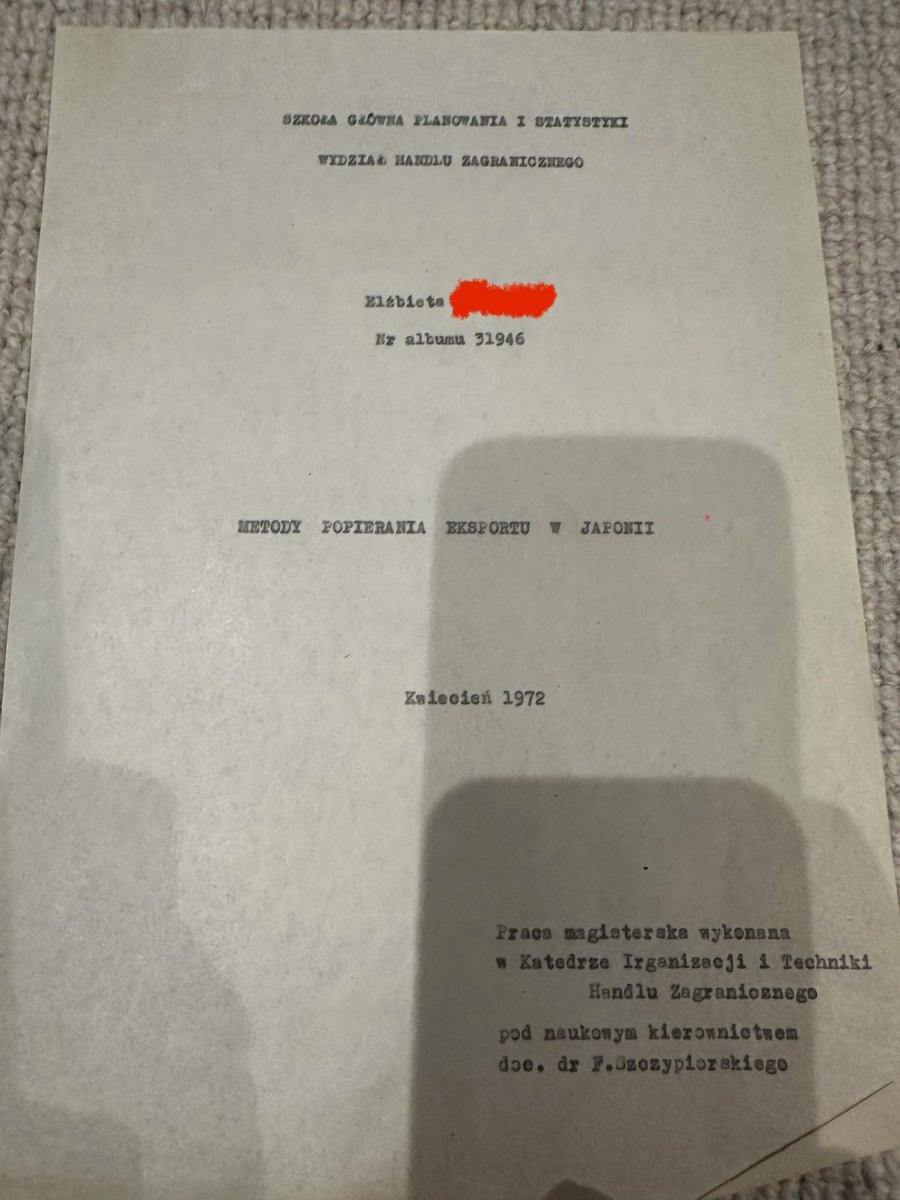
I do have historic proofs to support the thesis. A key influence is the work of my mum, who was an economic graduate of SGH (Poland’s top economic planning university) in 1972.

I recently found her thesis and it was entirely focused on these statecrafty arrangements, specifically the logic behind Japan’s export-oriented economic model and its close relationship with the US. A good chunk of it is focused on intellectual property licenses and transfers between the two states.Image
Image
Read 4 tweets
Mar 13
THREAD: Why the private credit crisis is just the West’s version of “involution”

1/ In my latest piece for TBS I argue that the West's growing private credit crisis represents its own version of China's economic "involution" — a liquidity-driven form of economic growth that produces enormous activity and capital deployment but progressively weaker underlying returns.
2/ In China the mechanism was domestic financial repression. Cheap household savings were channeled into low-return industrial investment, producing massive overcapacity and exports sold abroad at razor-thin or even negative margins.
3/ In the West the mechanism looked different but produced a similar outcome. Extremely cheap capital and abundant liquidity fueled a private-equity, venture, and later private-credit ecosystem that allowed large numbers of structurally unprofitable firms to keep expanding.
Read 23 tweets
Mar 11
Nice to see that @HyunSongShin has officially recognized that stablecoins open the door to an "Uber Surge Pricing" type liquidity market. [Actual gas markets also clear in a similar way, notably the NBP balancing point system.]

The below screenshot is from his latest BIS paper "Tokenomics and blockchain fragmentation".

This is something I've been pointing to for years, though I've seen it as eventually leading to dynamic pricing and markets for intraday funds in general.

The paper is more concerned about the fragility and fragmentation risk introduced in systems that rely on many different networks using surge pricing mechanisms to ration entry and exit across systems.

And of course turkeys don't vote for xmas, so the central bank perspective is that all this "congestion" and cost uncertainty can be avoided if programmable money just shifts to cbank ledgers where the cbank balance sheet can absorb congestion shocks in a way that can regulate transaction costs.

The BIS concludes: "These [programmable money] innovations do not require decentralised consensus among anonymous validators. They can be implemented on unified ledgers anchored by central banks, which benefit from the institutional trust of the
traditional monetary system."

bis.org/publ/work1335.…Image
Here's some historic context from :

the-blindspot.com/important-the-…
Also relevant, my long read regarding how perpetuals came to be:

thepeg.co/p/long-read-th…
Read 4 tweets
Feb 20
THREAD 🧵I know everyone is very excited about aliens this morning, but I ask you, is it really as exciting as super wonky insights on dollar liquidity plumbing, Federal Reserve balance sheet policy, and stablecoin statecraft?

I think not. I interviewed Fed governor Stephen Miran this week and those were just some of the topics we discussed. For those who can't be bothered to wade through the transcript, I thought it might be useful to highlight the wonkiest bits.

thepeg.co/p/transcript-f…
1) Top wonky insight for me is that Miran is as perplexed as me about the ongoing role of the Fed Funds Market. "I’m not quite sure why we hold on to the Fed funds rate, but we do. Maybe someday someone will explain it to me," he said.
2) I asked him if the current environment calls for greater awareness of how debt management policy is interacting with monetary policy.

He said that while the two don’t require explicit coordination, because the Fed should be pursuing monetary policy for monetary purposes, and Treasury should be pursuing fiscal policy for fiscal policy purposes, they do require awareness, because what "the one does can depend on what the other does, because the choices from the one can affect conditions that matter for the choices of the other."

And "In theory, you could run up against a time in which there are constraints."
Read 8 tweets
Jun 30, 2025
🧵1/ I wonder how many people realise that what's really going on with stablecoins is a massive US statecraft play to re-dollarize the world on its own terms. You could even call it a "re-stablization op" (yep - there's a gag in there).
2/ My analysis is that the reason why many countries are panicking about the upcoming dollar onslaught is because it's a backchannel way to rebase the system, and force 2008-era capital holes to be finally written down.
3/The intent is also to re-establish the supremacy of the dollar in markets where people can't trust their own governments, via a freely floated currency that can actually offer proper price discovery against domestic currencies.
Read 21 tweets
Apr 10, 2025
1/ Just a short recap of why it pays to watch your blind spots.

On Feb 23 we argued that the Mar-a-Lago Accord was gearing up to be more of a Bretton Woods 2.0 affair than a Plaza Accord. But also that the real challenge was how to get everyone to the table.

the-blindspot.com/in-the-blind-s…
2/ March 1 we explained the real struggle was between two systems, both of which independently believe are liberating the other from oppression. We called it mutual liberation syndrome.

the-blindspot.com/in-the-blind-s…
3/ On March 8, we explained that to get everyone to the table a controlled demolition of the stock market was necessary using Xi’s own strategy of shaking down the system to highlight its vulnerabilities and keep wealth imbalances in check.

the-blindspot.com/in-the-blind-s…
Read 4 tweets

Did Thread Reader help you today?

Support us! We are indie developers!


This site is made by just two indie developers on a laptop doing marketing, support and development! Read more about the story.

Become a Premium Member ($3/month or $30/year) and get exclusive features!

Become Premium

Don't want to be a Premium member but still want to support us?

Make a small donation by buying us coffee ($5) or help with server cost ($10)

Donate via Paypal

Or Donate anonymously using crypto!

Ethereum

0xfe58350B80634f60Fa6Dc149a72b4DFbc17D341E copy

Bitcoin

3ATGMxNzCUFzxpMCHL5sWSt4DVtS8UqXpi copy

Thank you for your support!

Follow Us!

:(