
Do teachers exhibit gender bias in grading?
It's well known that girls get better grades than boys on average. But the fact that boys and girls get different average grades is obviously not compelling evidence of bias.
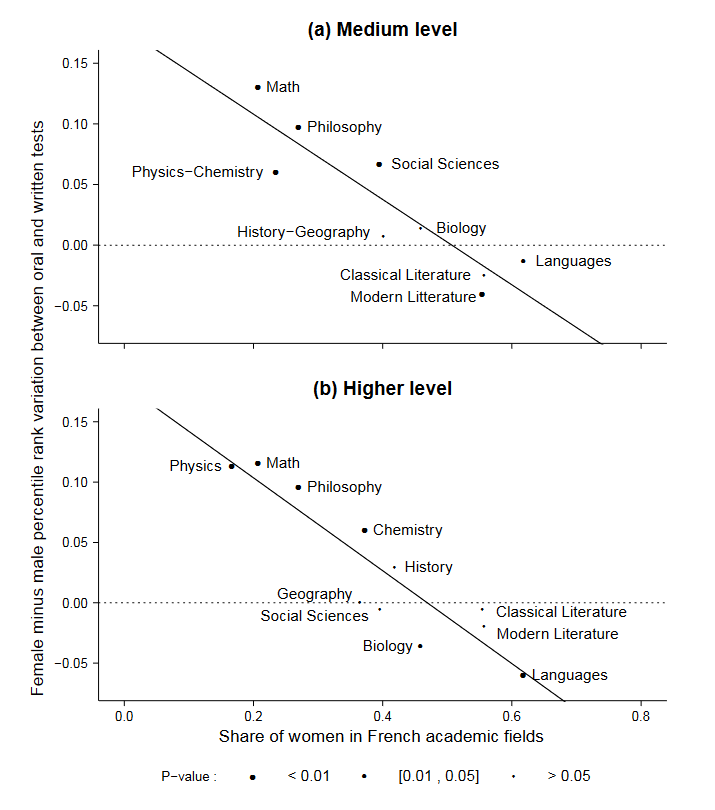
One attempt at quantifying bias has been to compare results from blind (anonymous) and non-blind tests. Using this approach on French data, Breda & Ly (2015) find that: “evaluation is biased in favor of females in more male-dominated subjects (e.g. math, philosophy) and in favor of males in more female-dominated subjects (e.g. literature, biology)”.
Breda & Hillion (2016) confirmed this finding with more data. Female students got a substantial boost in the most male-typical domains.
Terrier (2020) found similar results, and concludes that this impacts schooling trajectories: “Without teachers’ bias in favor of girls, the gender gap in choosing a science track would be 12.5% larger in favor of boys.”
One potential issue, however, is that the blind and non-blind tests aren't identical in content. It is therefore possible that these studies aren't simply capturing bias.
Using Greek data, Lavy & Megalokonomou (2019) explored this issue more carefully. They found, among other things, that teachers' estimated biases were persistent between classrooms. This gives us greater confidence that the bias estimator isn't just picking up various unobserved classroom and/or student characteristics. It seems like it really is related to teacher behavior.
In Lavy & Megalokonomou's study they found a mix of pro-male and pro-female teachers, but, on average, teachers were biased in favor of girls.
In summary, while grade disparities shouldn't be interpreted simply as a manifestation of bias, a net pro-female grading bias probably does contribute, at least in these countries.
It's well known that girls get better grades than boys on average. But the fact that boys and girls get different average grades is obviously not compelling evidence of bias.
One attempt at quantifying bias has been to compare results from blind (anonymous) and non-blind tests. Using this approach on French data, Breda & Ly (2015) find that: “evaluation is biased in favor of females in more male-dominated subjects (e.g. math, philosophy) and in favor of males in more female-dominated subjects (e.g. literature, biology)”.
Breda & Hillion (2016) confirmed this finding with more data. Female students got a substantial boost in the most male-typical domains.
Terrier (2020) found similar results, and concludes that this impacts schooling trajectories: “Without teachers’ bias in favor of girls, the gender gap in choosing a science track would be 12.5% larger in favor of boys.”
One potential issue, however, is that the blind and non-blind tests aren't identical in content. It is therefore possible that these studies aren't simply capturing bias.
Using Greek data, Lavy & Megalokonomou (2019) explored this issue more carefully. They found, among other things, that teachers' estimated biases were persistent between classrooms. This gives us greater confidence that the bias estimator isn't just picking up various unobserved classroom and/or student characteristics. It seems like it really is related to teacher behavior.
In Lavy & Megalokonomou's study they found a mix of pro-male and pro-female teachers, but, on average, teachers were biased in favor of girls.
In summary, while grade disparities shouldn't be interpreted simply as a manifestation of bias, a net pro-female grading bias probably does contribute, at least in these countries.
Studies:
aeaweb.org/articles?id=10…
pubmed.ncbi.nlm.nih.gov/27471301/
sciencedirect.com/science/articl…
nber.org/papers/w26021
aeaweb.org/articles?id=10…
pubmed.ncbi.nlm.nih.gov/27471301/
sciencedirect.com/science/articl…
nber.org/papers/w26021
• • •
Missing some Tweet in this thread? You can try to
force a refresh






