
Very excited by the FDU poll results out today. First, let's look at the gender gap.
The difference is NOT between men and women: it's between the 60% of men who are tied to traditionally masculinity, and literally everyone else, men and women alike.
The difference is NOT between men and women: it's between the 60% of men who are tied to traditionally masculinity, and literally everyone else, men and women alike.

Among men who claim to be "completely masculine" on a masculinity/femininity scale (as masculine as the scale goes), Trump leads 64/35. Among other men, Harris leads 55/35. That number is no different than the vote choice of women, regardless of their self-assessed femininity.
Next, let's look at the priming experiment we embedded in the survey. The topline results show Harris up by 7, but before being asked who they were going to vote for, respondents were assigned to one of three conditions.
All respondents were asked which of five issues were important to them, presented in random order. But 2/3rds of the respondents didn't see the fifth issue, and were instead asked about "the race of the candidates" or "whether the candidate is a man or a woman."
These randomly assigned primes had an enormous effect on the stated candidate preference.
In the issue prime condition (no race/sex prime), the race is tied. In the sex prime, Harris is up by 10. In the race prime, she's up by 14.
In the issue prime condition (no race/sex prime), the race is tied. In the sex prime, Harris is up by 10. In the race prime, she's up by 14.
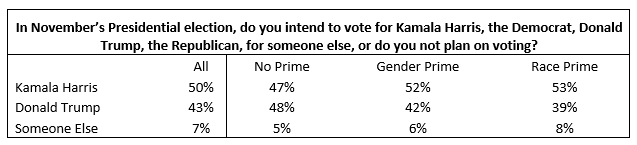

You might say to yourself, "Self, doesn't that mean that the REAL result is a tied race, with Trump up by one?"
I'd argue no: remember, everyone is being primed. There's no "no prime" control condition. If we're making people think about certain issues that seems to help Trump.
I'd argue no: remember, everyone is being primed. There's no "no prime" control condition. If we're making people think about certain issues that seems to help Trump.
Also, I've been running survey experiments like this since 2008, and I've sometimes fallen into the trap of saying, "let's report the more neutral prime condition as the main number." Every time I have, the overall number has been closer to the true result.
It's likely that the issue prime is cutting Harris's support among respondents who would otherwise be thinking about race and/or sex: they are common considerations! If we were priming issues no one was thinking about, maybe the more realistic condition would be the baseline.
Who gets moved by these primes? For the sex prime, it's men: thinking about the sex of the candidates moves them away from Trump, and into the "don't know" category. Is that real movement, or them getting shy? I don't know.
For the race prime, it's non-white voters. The n is too small to show in the release, but the race prime reduces Trump support among Blacks from low 20s to zero. Not "less than 0.5." Literally zero.
The race prime drops Hispanic support for Trump by about 20 points as well.
The race prime drops Hispanic support for Trump by about 20 points as well.
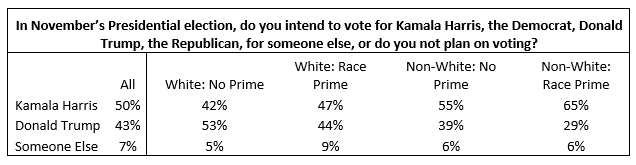
What's the takeaway? You have pundits and strategists all over the place saying "Don't talk about identity," but our results show that including identity as part of the basket of issues HELPS Harris, especially because it pulls non-white voters away from Trump.
The results on masculinity show the importance of masculinity appeals in this race. Literally the only reason this race is close is that Trump is holding the support of men who embrace traditional ideas of masculinity.
The problem Trump faces is somehow maintaining that masculinity appeal without alienating women and other men, and I don't know how he can do that.
Full release here: fdu.edu/news/fdu-poll-…
• • •
Missing some Tweet in this thread? You can try to
force a refresh






