Musa al-Gharbi Profile picture
Aug 25 7 tweets 4 min read Read on X
Critically, the cause of the gap depicted here is 100% shifts in *women.* Men 18-29 are no more rightwing than any other cohort of men. For men, it's basically a straight line going all the way down the generational ladder (with the exception of 45-64 year olds).

All the action is with *women.* But this is, unfortunately, unlikely to be how the trend is analyzed. We'll likely hear a lot about "right wing young men" after the election, even though they're no more conservative than any other dudes (and are markedly less conservative than 45-64 year olds).

Another example of ironically ignoring female agency in ostensibly "feminist" work. In truth, if we want to understand growing gender polarization in politics, all the "action" is on the female side of the equation.

But because polarization is widely perceived as "bad" and women are "good" scholars tend to ignore the female line, and try to explain "bad" things in terms of men, even if their own data clearly suggest that women are driving the trends.
We see the same type of tendency in analyzing "red" and "blue" lines of political trends, as I detail here:

Anything that is "bad" (e.g. polarization around science, identity, etc.) is explained in terms of the red line, even in cases where all of the "action" is clearly on the blue line.
More on the ironic tendency of scholars/ pundits to ignore female agency in the name of feminism here:
Note, was fast typing on phone, but the above should have said that young men are no more likely to *vote GOP* than older voters. The chart is not about liberal/ conservative, but voting prefs!
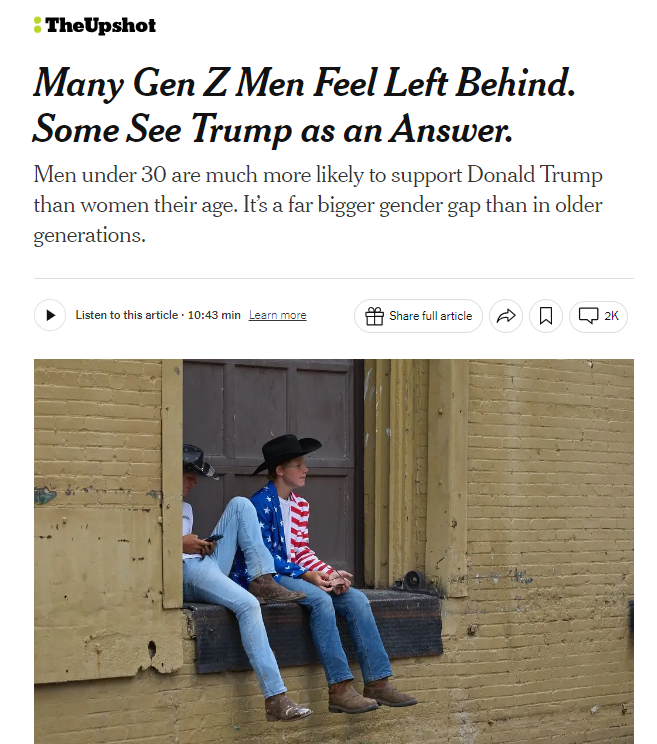
I didn't notice this, but the story that the initial chart is from is totally focused on *men.* Profoundly illustrating my point! The @nytimes own chart clearly shows basically a straight line among men across generations, and a huge shift among young women, but the story is "why are young men so right-wing" (they're not!) rather than "why are young women so Democrat." 😅Image
Image
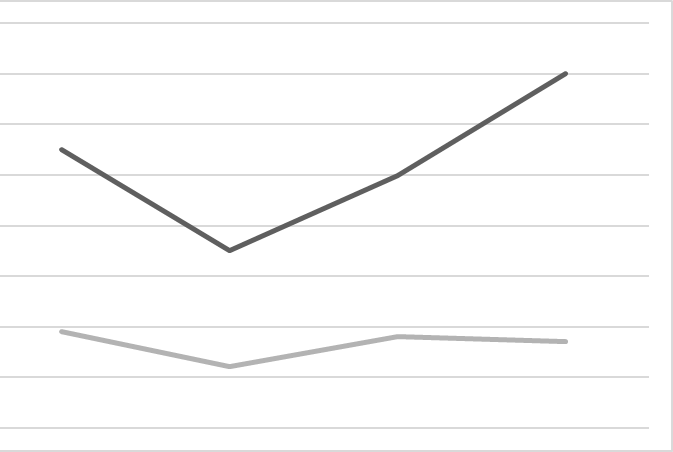
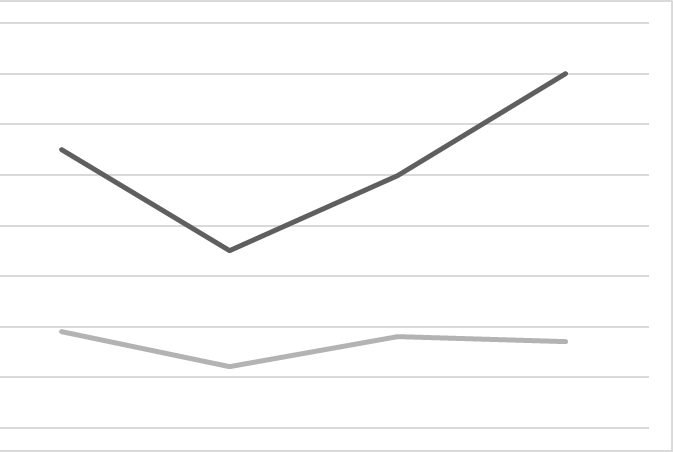
Which of these two lines is driving polarization? Which shifted more? Which is more responsible for the fact that the two lines are growing further apart?

When you graph it like this, anyone can see what's going on. But once you label the top line "women" and the bottom line "men" folks somehow lose their minds and can't see the obvious pattern.

(for the reference, this chart is, literally, just taking the data from the NY Times piece and graphing it as two lines from oldest voters to youngest, with the top line women, the bottom line men, indexed to propensity towards one party or the other)Image
Put another way, it's just the @nytimes own graph, turned sideways, with labels removed.
Image
Image

• • •

Missing some Tweet in this thread? You can try to force a refresh

 

Keep Current with Musa al-Gharbi

Musa al-Gharbi Profile picture

Stay in touch and get notified when new unrolls are available from this author!

Read all threads

This Thread may be Removed Anytime!

PDF

Twitter may remove this content at anytime! Save it as PDF for later use!

Try unrolling a thread yourself!

how to unroll video
  1. Follow @ThreadReaderApp to mention us!

  2. From a Twitter thread mention us with a keyword "unroll"
@threadreaderapp unroll

Practice here first or read more on our help page!

More from @Musa_alGharbi

Aug 8
Back in @GuardianUS for a piece looking at the racial dynamics of #Election2024.

tldr: polls show Trump poised to take home roughly 20 percent of the black vote. That probably won't happen.

But @TheDemocrats *will* likely see continued losses with black voters. Which may be offset with gains among whites. 🧵Image
Let's start by disabusing readers of one storyline about why the @GOP is unlikely to receive the black vote share that current polling suggests: Kamala's race.

In truth, black voters have been really tepid on Harris. This was clear in the 2020 primaries, in the 2020 general election, and in contemporary polling. Black voters have not shifted towards Democrats any more than any other block has since Biden dropped out. They might've shifted a bit *less.*

theguardian.com/commentisfree/…Image
Image
Image
This is a bit of a tangent (not covered in the article), but here, I think people learned the wrong lessons from the election of @BarackObama.

Yes, he won a higher share of the black vote than typical (), but not because AAs were going to vote based on race. It was because his campaign inspired lots of irregular voters to the polls. And at the time, irregular voters favored Democrats, and irregular voters have always been disproportionately black, so mobilizing irregular voters led to a higher black vote share.

Black voters turned out, not because of Obama's race, but because his "hope and change" policies on economic fairness, turning the page on Bush's foreign policy misadventures, etc.

Compared to other sectors of the Democratic base, black voters, and irregular voters, are especially *unlikely* to be motivated by identitarian appeals. It tends to turn them off.musaalgharbi.com/2020/11/23/oba…
Read 10 tweets
Jul 22
In recent years, I've dedicated a lot of effort to chronicling and analyzing the rapid shifts among knowledge economy professionals that seems to have kicked off after 2011.

Alongside colleagues like @DavidRozado, @epkaufm and @ZachG932, research has documented major shifts in journalistic outputs, books, academic articles, political attitudes and behaviors and more.

In my forthcoming book, I expand this work to document shifts in television, movies, music and other entertainment industries.

But to my knowledge, no one has done #videogames yet. I don't even do it in my book! To rectify this oversight, my latest for Symbolic Capital(ism) tries to map out whether the shifts observed in other cultural spheres extend into the gaming world.

Boy, do they ever. 🧵Image
Let's start with #gender: Prior to the Great Awokening, only about 4 percent of title had exclusively female characters. By 2015, that number had doubled. By 2020, *that* number had doubled:

Today, a plurality of games include protagonists of both sexes (and a growing number include non-binary options too). And for titles that include protagonists of only one gender, nearly half now feature exclusively women.

Female characters have also become far less sexualized, and have much more agency, with marked shifts occurring after 2012.musaalgharbi.substack.com/p/video-games-…Image
Image
Image
There have been major shifts with respect to sexuality as well. #LGBTQ representation in games grew exponentially over the period in question -- with a growing share of LGBTQ characters featured as protagonists (instead of NPCs):

Note: I did not produce this chart!musaalgharbi.substack.com/p/video-games-…Image
Read 8 tweets
Jun 20
Why are there so few conservative or religious scholars in academia? Two popular theories:

1. They face discrimination on the job market, and a hostile work climate if they are employed
2. They would rather do other things with their lives.

There is some evidence in both directions, but also deep problems with both of these narratives as sufficient explanations.

A new piece in @NationalAffairs provides a more unified and compelling account of what's going on here, and possible responses.Image
Some baseline facts: as my own work for @HdxAcademy shows, the professoriate is highly unrepresentative of U.S. society overall along many dimensions, including and especially along ideological lines:

This is a problem for knowledge production (as I illustrate here: )

It is also a problem for public trust in our institutions, undermines the impact of our work, and threatens the long-term independence and financial viability of our work.

When people feel like they don't have a voice or a stake in institutions, and especially when they view them as hostile to folks like themselves, their natural and rational response is to delegitimize, marginalize, defund or dismantle those institutions (and it works the other way too, when people do feel like their will and interests are represented, as detailed here: ).musaalgharbi.substack.com/p/professors-a…

foreignaffairs.com/articles/world…Image
As far as explanations for why higher ed institutions are so ideologically parochial, political scientist Steve Teles compellingly argues that the "self-selection" hypothesis and the "discrimination" hypothesis are not contradictory. They're complementary: nationalaffairs.com/publications/d…
Read 11 tweets
Jan 4
Lots of places talk about viewpoint diversity, but @compactmag_ walks the walk.

Earlier today, they published an article by Alan Dershowitz arguing that Israel has committed no war crimes. My own article, just published, is a direct refutation of that position. Image
IDF representatives have repeatedly boasted about Israel's precise targeting capabilities. This raises troubling questions about the extraordinary level of killing of people who should be protected under international law: compactmag.com/article/israel…
Image
Comparing the civilian-to-combatant casualty ratios between Hamas' October 7 rampage and Israel in its aftermath leads to unflattering symmetries: compactmag.com/article/israel…
Image
Read 10 tweets
Oct 16, 2023
My latest explores the information warfare underway with respect to war crimes committed by #Hamas and #Israel, the failure of journalists to exercise due diligence before amplifying many of these claims, and the importance of acknowledging inconvenient facts. @thenation Image
In the immediate aftermath of the #HamasMassacre, many circulated false, unsubstantiated or misleading claims w/ a clear intent of driving support for rapid and aggressive violence against #Gaza, #Iran, #Hezbollah + others: thenation.com/article/world/…


Image
Image
Image
Image
However, beyond merely resisting false narratives about the #October7Massacre many concerned about #Israel's likely response refused to acknowledge basic moral and empirical facts. Some went so far as to justify or celebrate #Hamas' atrocities: thenation.com/article/world/…
Image
Read 5 tweets
Sep 26, 2023
My first essay for @CNN explores tensions within the GOP over "populism."


@Mike_Pence described populism as a "road to ruin" for the @GOP, joining a chorus of establishment figures in both parties across time. Yet economic populism is quite... popular! cnn.com/2023/09/26/opi…
Image
As @leedrutman illustrated, we can divide the American electorate into four quadrants based on their cultural and economic leanings. The quadrant he labels as "populist" (economically left, culturally right) is not well represented by either party: cnn.com/2023/09/26/opi…
Image
According to studies by Christopher Ellis, James Stimson and others, a plurality of Americans seem to occupy this general ideological space: symbolically conservative, operationally progressive. cnn.com/2023/09/26/opi…
Image
Read 11 tweets

Did Thread Reader help you today?

Support us! We are indie developers!


This site is made by just two indie developers on a laptop doing marketing, support and development! Read more about the story.

Become a Premium Member ($3/month or $30/year) and get exclusive features!

Become Premium

Don't want to be a Premium member but still want to support us?

Make a small donation by buying us coffee ($5) or help with server cost ($10)

Donate via Paypal

Or Donate anonymously using crypto!

Ethereum

0xfe58350B80634f60Fa6Dc149a72b4DFbc17D341E copy

Bitcoin

3ATGMxNzCUFzxpMCHL5sWSt4DVtS8UqXpi copy

Thank you for your support!

Follow Us!

:(