Recently, some folks have asked me where donations would best help Dems flip the House. IMO, there exist clear answers: four Dem challengers in Tossup races with MUCH less $$$ than their GOP opponents:
It makes a MUCH bigger diff to go from being outspent 2-1 to parity, than to go from parity to 1.1-1 (the case in well-funded races). And the more $$$ spent, the less each $ matters.
Rs won 3/4 of these in 2022, due in part to lack of Dem $$$. Dems can't let that happen again.
To be frank, if you're a small-dollar donor who wants your $$$ to REALLY matter, I'd advise donating to a local/state leg race for similar reasons.
But if you want to help decide control of Congress, the four races listed above are far and away where $$$ would do the most good.
Obligatory ActBlue links. Not really my thing, but it'd be wrong to answer "where should Dems donate?", and NOT provide links to do exactly that.
For reference, here's Sherrill's TV ad, which she's putting millions behind. Where her big selling point is declaring a State of Emergency to freeze power costs.
PRESIDENT - LEAN HARRIS (308-230)
HOUSE - LEAN D (225-210)
SENATE: LEAN R (51-49)
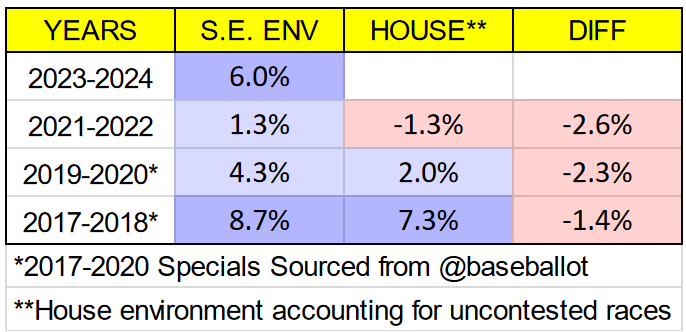
Based on a D+3 Environment, as implied by an aggregate of polls, special elections, Washington primary, Selzer, etc.
Thread on the 2024 election below 🧵
If one only looked at polls, with every swing state tied, one would easily conclude the election's a tossup.
However, actual voting behavior has consistently suggested something bluer. And the NYT's explanation - very red nonvoters - has just been mostly recanted in their polls.
Both special elections & the WA primary imply a D+3/4 year. And while they should never be used alone, an aggregate of polling & non-polling indicators has historically been the best way to forecast the national mood.
However, Harris does not even NEED a bluer env to win atm.
The idea of Jan 6 being a third-rail for GOP voters is possibly the greatest info op Trump has pulled off.
It’s his biggest vulnerability imo, and despite nominal party backing, a majority of the GOP don’t really believe it. Yet he’s convinced the GOP that they can’t attack it.
It’s the classic self-fulfilling prophecy of pols influencing public opinion influencing pols, except the “prophecy” isn’t even fulfilled - the pols are just gaslit into thinking it is.
RDS & establishment too cowardly and think too low of their voters to try turn against Trump.
Look, if RDS was only, say, ten points down to Trump, a cautious approach would make sense - don’t want to rock your base too much, and only need to flip a few more.
However, the man’s 30% down and counting! He needs to radically shift GOP opinions - caution just won’t suffice.
Looking back over the 2020 Senate elections atm, and I have to say, I don't think incumbency has ever been as lousy an indicator of strength as in these elections.
Dem incumbents went 7/11 for outperforming Biden.
GOP incumbents went 10/17 for outperforming Trump.
Even open & appointed incumbent seats split 2-4 between outperforming Biden and outperforming Trump.
Might need to rethink the prior that Senate incumbents outperform the top of the ticket by default.
For comparison, in 2016, every Dem senator, and 19/22 GOP senators, outperformed the top of the ticket. And this was more or less the norm for like decades before this.
Remains to be seen if 2020 was an outlier or a paradigm shift, but my gut currently leans toward the latter.
Catalist has released their new analysis on the 2022 electorate (HIGHLY recommend reading), and one of the most interesting findings: Dems actually did BETTER w/ Latinos in 2022 than w/ 2020 Prez, but did WAY WORSE with Asians.
Equally as interesting - for white voters, Dems actually held steady w/ non-college whites, and mostly suffered w/ COLLEGE-ED whites (downballot lag?).
M.w. for black voters, we have the opposite.
The Dem gain w/ Latinos & loss w/ Asians were roughly equal, college-ed or not.
Catalist tries to frame the youth vote as having “exceptional turnout” - however, it’s clear this is simply a function of Gen Z/Millenials aging into a bigger slice of the electorate.
In a general sense, both Walker and Dr. Oz were bad candidates. However, the swing maps in GA and PA look very different - Walker was garbage in the burbs, but held up in the rurals, while the opposite was true for Dr. Oz.
Feels like diff ways of being bad has diff effects.
I know that it's kinda an obvious statement - of course different ways of being bad will have different effects! - but I wanna drill into that.
What kinds of being "bad" disproportionately turns off rurals? What kinds of being "bad" disproportionately turns of suburbs?
Like, there's the narrative that suburban voters didn't like Walker cuz he was unqualified and not a great guy personally. But why wouldnt that turn off rurals?
It might be a bit obfuscated by turnout and demographic shifts, but it seems clear GA rurals didn't mind as much. Why?