1/N:
This thread explores how ancient Indians (Hindus) were trailblazers in discovering the sine function, crafting sophisticated numerical methods to compute its values with remarkable precision.
This thread explores how ancient Indians (Hindus) were trailblazers in discovering the sine function, crafting sophisticated numerical methods to compute its values with remarkable precision.

74/N
The Āryabhaṭīyaṃ was crafted in the rhythmic Arya meter (छन्द), where the first, second, third, and fourth pādas contain 12, 18, 12, and 15 mātrās respectively.
The Āryabhaṭīyaṃ was crafted in the rhythmic Arya meter (छन्द), where the first, second, third, and fourth pādas contain 12, 18, 12, and 15 mātrās respectively.
75/N
This precise structure can be seen in the following example from Kālidāsa's renowned play, Abhijñānaśākuntalam (c. 400 CE):
आ परितोषाद्विदुषां न साधु मन्ये प्रयोगविज्ञानम्
बलवदपि शिक्षितानामात्मन्यप्रत्ययं चेतः
This precise structure can be seen in the following example from Kālidāsa's renowned play, Abhijñānaśākuntalam (c. 400 CE):
आ परितोषाद्विदुषां न साधु मन्ये प्रयोगविज्ञानम्
बलवदपि शिक्षितानामात्मन्यप्रत्ययं चेतः
76/N
Nearly every prominent Indian mathematician has engaged with the Āryabhaṭīyaṃ, frequently through formal commentaries known as Bhashyas.
Nearly every prominent Indian mathematician has engaged with the Āryabhaṭīyaṃ, frequently through formal commentaries known as Bhashyas.
77/N
The list of ancient Indian mathematicians who composed commentaries on Āryabhaṭīyaṃ includes Bhaskara I (629 CE), Suryadeva (1191 CE), Parameshvara (1400 CE) & Nilakantha Somayaji (1500 CE)
The list of ancient Indian mathematicians who composed commentaries on Āryabhaṭīyaṃ includes Bhaskara I (629 CE), Suryadeva (1191 CE), Parameshvara (1400 CE) & Nilakantha Somayaji (1500 CE)
78/N
As a key figure in the Kerala school, Nilakantha continued the groundbreaking tradition initiated by Madhava (1350–1420 CE), who laid the foundations for the calculus of trigonometric functions.
As a key figure in the Kerala school, Nilakantha continued the groundbreaking tradition initiated by Madhava (1350–1420 CE), who laid the foundations for the calculus of trigonometric functions.
79/N
Let’s focus back on Āryabhaṭīyaṃ. Among Ganitapada's verses, two stand out for addressing the solution to the linear Diophantine equation, which has rightly been acknowledged.
Let’s focus back on Āryabhaṭīyaṃ. Among Ganitapada's verses, two stand out for addressing the solution to the linear Diophantine equation, which has rightly been acknowledged.
80/N
However, our emphasis will be on the trigonometry within the Ganitapada
However, our emphasis will be on the trigonometry within the Ganitapada
81/N
Āryabhaṭa provides two methods for computation of sine values. We are going to take a look at both of them
Āryabhaṭa provides two methods for computation of sine values. We are going to take a look at both of them
82/N
In Āryabhaṭīyaṃ, Ganitapada 11, Āryabhaṭa gives a geometrical method for constructing the table. The verse is given below
In Āryabhaṭīyaṃ, Ganitapada 11, Āryabhaṭa gives a geometrical method for constructing the table. The verse is given below

83/N
Translation of the above verse:
One must divide a quarter of the circumference of a circle into triangles and rectangles. Thus will be obtained the required Jyās of arcs of equal lengths, when the radius of the circle is given.
Translation of the above verse:
One must divide a quarter of the circumference of a circle into triangles and rectangles. Thus will be obtained the required Jyās of arcs of equal lengths, when the radius of the circle is given.
84/N
Brahmagupta in his Brahmasphuta Siddhanta has elaborated this method of Āryabhaṭa using a geometric recipe. It is found in Brahmasphuta Siddhanta, chapter 21, verses 18-22
Brahmagupta in his Brahmasphuta Siddhanta has elaborated this method of Āryabhaṭa using a geometric recipe. It is found in Brahmasphuta Siddhanta, chapter 21, verses 18-22

85/N
Let’s explore the problem of computing sine values as suggested by Arybhata’s first method
Let’s explore the problem of computing sine values as suggested by Arybhata’s first method

86/N
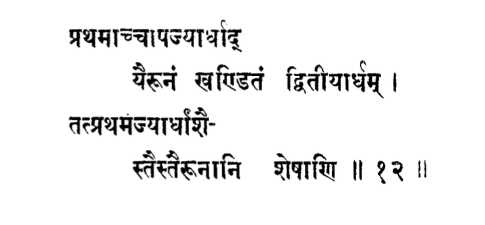
Aryabhata also provided another method, a recursive one to compute the values of sine. Verse #12 of his seminal work Āryabhaṭīyaṃ contains the recipe as provided below
Aryabhata also provided another method, a recursive one to compute the values of sine. Verse #12 of his seminal work Āryabhaṭīyaṃ contains the recipe as provided below
87/N
Āryabhaṭa used 3438 as the radius, which he derived by considering the circumference of the circle as 360 (degrees) x 60 (minutes) = 21600 (minutes)
Āryabhaṭa used 3438 as the radius, which he derived by considering the circumference of the circle as 360 (degrees) x 60 (minutes) = 21600 (minutes)
88/N
In the 10th verse of Ganitapada of Āryabhaṭīyaṃ, Āryabhaṭa employed the value of π as 62832/20000, which equates to 3.1416.
In the 10th verse of Ganitapada of Āryabhaṭīyaṃ, Āryabhaṭa employed the value of π as 62832/20000, which equates to 3.1416.
89/N
He deliberately described this value as ‘proximate’ (आसन्न), implying that with greater precision and effort, a more accurate value of π could be determined.
He deliberately described this value as ‘proximate’ (आसन्न), implying that with greater precision and effort, a more accurate value of π could be determined.

90/N
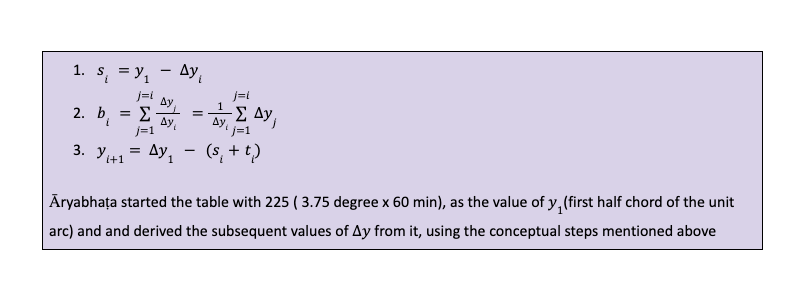
Instead of directly giving the values of half-chords, Āryabhaṭa gave the values of its segments: Δy₁, Δy₂, Δy₃,...Δyᵢ. In modern notations the relationship between y and the delta y’s are given below
Instead of directly giving the values of half-chords, Āryabhaṭa gave the values of its segments: Δy₁, Δy₂, Δy₃,...Δyᵢ. In modern notations the relationship between y and the delta y’s are given below

91/N
Given this formulation, let me provide a translation of the verse 12 of the Ganitapada chapter from Āryabhaṭīyaṃ
Given this formulation, let me provide a translation of the verse 12 of the Ganitapada chapter from Āryabhaṭīyaṃ

92/N
Using the above translation, we can know put together a recursive mathematical recipe for finding sine values as described by Āryabhaṭa
Using the above translation, we can know put together a recursive mathematical recipe for finding sine values as described by Āryabhaṭa
93/N
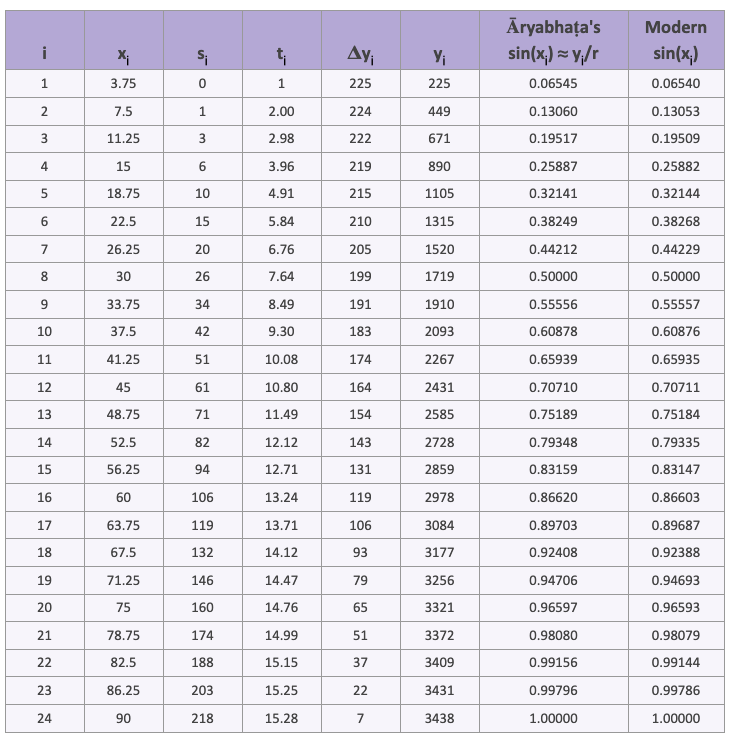
Below I am providing snapshot of a spreadsheet that I used to compute values of RSines and corresponding sine values following the recursive recipe provided by Āryabhaṭa
Below I am providing snapshot of a spreadsheet that I used to compute values of RSines and corresponding sine values following the recursive recipe provided by Āryabhaṭa
94/N
Renowned Indian astronomer Varāhamihira (no later than 505 CE) also provided a way to compute values of sign in his seminal work Pancha-siddhantika
Renowned Indian astronomer Varāhamihira (no later than 505 CE) also provided a way to compute values of sign in his seminal work Pancha-siddhantika

95/N
In the first chapter of this work, Vrahamihira gives summaries of five Siddhantas, namely Vasistha Siddhanta, Paitamaha Siddhanta, Paulisa Siddhanta, Rokama Siddhanta & Surya Siddhanta
In the first chapter of this work, Vrahamihira gives summaries of five Siddhantas, namely Vasistha Siddhanta, Paitamaha Siddhanta, Paulisa Siddhanta, Rokama Siddhanta & Surya Siddhanta
96/N
Varahamihira provided two rules for constructing a Table of Jyā, the first of which was already mentioned by Arayabhata earlier.
Varahamihira provided two rules for constructing a Table of Jyā, the first of which was already mentioned by Arayabhata earlier.
97/N
Varāhamihira used a method where he divided the quadrant of the circle into 24 arcs of 225′each, but the radius is 120 units. The methods to construct the sine table are given in verses 2-5 of chapter 4 in Pancha-siddhantika
Varāhamihira used a method where he divided the quadrant of the circle into 24 arcs of 225′each, but the radius is 120 units. The methods to construct the sine table are given in verses 2-5 of chapter 4 in Pancha-siddhantika

98/N
Below is a modern translation of verse 2 from chapter 4 of Pancha-siddhantika.
Below is a modern translation of verse 2 from chapter 4 of Pancha-siddhantika.

99/N
Varahamihira also gives you recipes for finding sine values for any arbitrary angle. Below are the relevant verses from Pancha-siddhantika. Below is a translation of verses 3 -5 from chapter 4 of Pancha-siddhantika.
Varahamihira also gives you recipes for finding sine values for any arbitrary angle. Below are the relevant verses from Pancha-siddhantika. Below is a translation of verses 3 -5 from chapter 4 of Pancha-siddhantika.

100/N
Notice how two famous trigonometric identities are mentioned in this recipe by Varahamihira.
Notice how two famous trigonometric identities are mentioned in this recipe by Varahamihira.
101/N
Brahmagupta is a genius scientist from ancient India who specialized in astronomy and mathematics Brahmagupta’s Khaṇḍakhādyaka provides a unique and simple method to compute key sine values (no later than 668 CE)
Brahmagupta is a genius scientist from ancient India who specialized in astronomy and mathematics Brahmagupta’s Khaṇḍakhādyaka provides a unique and simple method to compute key sine values (no later than 668 CE)

102/N
Brahmagupta’s Khaṇḍakhādyaka text provides a much shorter verse encoding only six numbers using the “object-numeral” system to present Sines
Brahmagupta’s Khaṇḍakhādyaka text provides a much shorter verse encoding only six numbers using the “object-numeral” system to present Sines

103/N
I am providing a translation of the verse 3.6 from Khaṇḍakhādyaka below.
I am providing a translation of the verse 3.6 from Khaṇḍakhādyaka below.

104/N
Another brilliant ancient Indian mathematician Bhāskara-I (no later than 600 CE) provided an entirely different method for computing sine of any arc.
Another brilliant ancient Indian mathematician Bhāskara-I (no later than 600 CE) provided an entirely different method for computing sine of any arc.
105/N
Bhāskara-I gave a simple but elegant algebraic formula with the help of which any sine can be calculated directly and with a great degree of accuracy.
Bhāskara-I gave a simple but elegant algebraic formula with the help of which any sine can be calculated directly and with a great degree of accuracy.

106/N
The rule stating the approximate expression for the trigonometric sine function is given by Bhāskara I in his seminal work called Mahābhāskarīya. The relevant Sanskrit text is given below
The rule stating the approximate expression for the trigonometric sine function is given by Bhāskara I in his seminal work called Mahābhāskarīya. The relevant Sanskrit text is given below

107/N
Below I am providing a translation of the verse 17–19 from Chapter 7 of Mahābhāskarīya as proposed by Bhaskara - I
Below I am providing a translation of the verse 17–19 from Chapter 7 of Mahābhāskarīya as proposed by Bhaskara - I

108/N
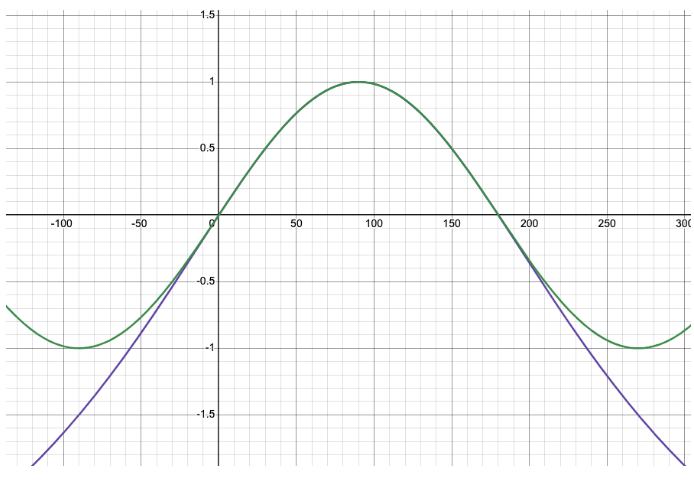
Below I have provided a rendering of Bhaskara’s approximation of sine in purple and the modern sine function in green. Notice in the segment 0 <= θ <= 180, how close Bhaskara’s approximation is. Rest of the sine function can be reconstructed from this segment.
Below I have provided a rendering of Bhaskara’s approximation of sine in purple and the modern sine function in green. Notice in the segment 0 <= θ <= 180, how close Bhaskara’s approximation is. Rest of the sine function can be reconstructed from this segment.
109/N
Also, notice how Bhaskara’s approximation satisfies two most important properties of the sine function
* Symmetric about θ= 90
* Concave over the range 0 <= θ <= 180
Also, notice how Bhaskara’s approximation satisfies two most important properties of the sine function
* Symmetric about θ= 90
* Concave over the range 0 <= θ <= 180
110/N
It is simply a stroke of genius that Bhaskara’s recipe provides more than 99% accuracy for the range of 0 <= θ <= 180
It is simply a stroke of genius that Bhaskara’s recipe provides more than 99% accuracy for the range of 0 <= θ <= 180
111/N
Many subsequent Indian mathematicians who dealt with the subject of finding sine without using tabular sines have given the rule more or less equivalent to that of Bhāskara I
Many subsequent Indian mathematicians who dealt with the subject of finding sine without using tabular sines have given the rule more or less equivalent to that of Bhāskara I
112/N
The famous ancient Indian mathematician Brahmagupta (no later than 628 CE) in his world famous work Brāhmasphuṭa Siddhānta.
The famous ancient Indian mathematician Brahmagupta (no later than 628 CE) in his world famous work Brāhmasphuṭa Siddhānta.
113/N
It provides a very similar method for directly computing approximate sine values. I am providing the relevant Sanskrit verses from Brahmagupta’s work
It provides a very similar method for directly computing approximate sine values. I am providing the relevant Sanskrit verses from Brahmagupta’s work

114/N
Below I am providing a translation of the verse 23–24 from Chapter 15 of Brāhmasphuṭa Siddhānta as proposed by Brahmagupta
Below I am providing a translation of the verse 23–24 from Chapter 15 of Brāhmasphuṭa Siddhānta as proposed by Brahmagupta

115/N
Another brilliant Indian mathematician Vaṭeśvara provides two different direct methods to approximate sine values in his work Vaṭeśvara Siddhānta (no later than 904 CE).
Another brilliant Indian mathematician Vaṭeśvara provides two different direct methods to approximate sine values in his work Vaṭeśvara Siddhānta (no later than 904 CE).

116/N
The relevant Sanskrit verses from Vaṭeśvara Siddhānta are below
The relevant Sanskrit verses from Vaṭeśvara Siddhānta are below

117/N
Below I am providing a translation of the verse 4 from Chapter 4 of Vaṭeśvara Siddhānta as proposed by Vaṭeśvara
Below I am providing a translation of the verse 4 from Chapter 4 of Vaṭeśvara Siddhānta as proposed by Vaṭeśvara

118/N
Śrīpati, in his seminal work Siddhānta-śekhara, (no later than 1039 CE) provides another direct rule for computing approximate values of sine.
Śrīpati, in his seminal work Siddhānta-śekhara, (no later than 1039 CE) provides another direct rule for computing approximate values of sine.
119/N
I am attaching the Sanskrit verses from Siddhānta-śekhara below
I am attaching the Sanskrit verses from Siddhānta-śekhara below

120/N
Below I am providing a translation of the verse 17 from Chapter 3 of Siddhānta Shekhara authored by Śrīpati
Below I am providing a translation of the verse 17 from Chapter 3 of Siddhānta Shekhara authored by Śrīpati

121/N
Madhava of Sangamagrama from Kerala, India, was a renowned 14th-century mathematician and astronomer from India.
Madhava of Sangamagrama from Kerala, India, was a renowned 14th-century mathematician and astronomer from India.
122/N
Madhava created a groundbreaking sine table that stands as a testament to his genius. This table meticulously lists the Jyās or Rsines for 24 angles, spanning from 3.75° to 90° in precise 3.75° increments.
Madhava created a groundbreaking sine table that stands as a testament to his genius. This table meticulously lists the Jyās or Rsines for 24 angles, spanning from 3.75° to 90° in precise 3.75° increments.
123/N
The Rsine values, calculated by multiplying the sine by a selected radius and expressed as integers, demonstrate a level of accuracy that echoes Aryabhata's earlier work, where R is defined as 21600 ÷ 2π ≈ 3438
The Rsine values, calculated by multiplying the sine by a selected radius and expressed as integers, demonstrate a level of accuracy that echoes Aryabhata's earlier work, where R is defined as 21600 ÷ 2π ≈ 3438
124/N
The table is artfully encoded in the Sanskrit alphabet by Madhava through the Katapayadi system, transforming its entries into the lyrical verses of a poem.
The table is artfully encoded in the Sanskrit alphabet by Madhava through the Katapayadi system, transforming its entries into the lyrical verses of a poem.
125/N
The Katapayadi system is an ancient Indian mnemonic technique used for encoding numbers into syllables or letters, primarily for remembering large numbers. It's a traditional method in Indian mathematics and can be found in ancient texts like the Kāśyapa's Tattvakaumudī.
The Katapayadi system is an ancient Indian mnemonic technique used for encoding numbers into syllables or letters, primarily for remembering large numbers. It's a traditional method in Indian mathematics and can be found in ancient texts like the Kāśyapa's Tattvakaumudī.
126/N
Vowels are often used as placeholders or to complete the words. For example, specific consonants correspond to digits from 0 to 9, and by combining these consonants, one can encode numbers into words or phrases.
Vowels are often used as placeholders or to complete the words. For example, specific consonants correspond to digits from 0 to 9, and by combining these consonants, one can encode numbers into words or phrases.
127/N
Though Madhava's original work containing this table remains lost to time, its legacy endures.
Though Madhava's original work containing this table remains lost to time, its legacy endures.
128/N
The table finds its echoes in the Aryabhatiyabhashya by Nilakantha Somayaji (1444–1544) and in the Yuktidipika/Laghuvivrti commentary on Tantrasamgraha by Sankara Variar (circa 1500–1560)
The table finds its echoes in the Aryabhatiyabhashya by Nilakantha Somayaji (1444–1544) and in the Yuktidipika/Laghuvivrti commentary on Tantrasamgraha by Sankara Variar (circa 1500–1560)
129/N
Madhava’s verses regarding sine values from Aryabhatiyabhashya are mentioned below
Madhava’s verses regarding sine values from Aryabhatiyabhashya are mentioned below

130/N
The last verse translates to “These are the great R-sines as said by Madhava, comprising arcminutes, seconds and thirds. Subtracting from each the previous will give the R-sine-differences.”
The last verse translates to “These are the great R-sines as said by Madhava, comprising arcminutes, seconds and thirds. Subtracting from each the previous will give the R-sine-differences.”
131/N
The last verse translates to “These are the great R-sines as said by Madhava, comprising arcminutes, seconds and thirds. Subtracting from each the previous will give the R-sine-differences.”
The last verse translates to “These are the great R-sines as said by Madhava, comprising arcminutes, seconds and thirds. Subtracting from each the previous will give the R-sine-differences.”

132/N
An example, let’s use Madhava’s method encoded in Katapayadi system to find the value of Sin (30o)
An example, let’s use Madhava’s method encoded in Katapayadi system to find the value of Sin (30o)

133/N
Below I am reproducing table as given by Madhava along with the modern Sine values for the sake of comparison
Below I am reproducing table as given by Madhava along with the modern Sine values for the sake of comparison

134/N
Madhava also gave us the brilliant Madhava sine series, one of the three infinite series expansions for the sine, cosine, and arctangent functions.
Madhava also gave us the brilliant Madhava sine series, one of the three infinite series expansions for the sine, cosine, and arctangent functions.
135/N
It took Europeans more than 250 years to independently rediscover these series.
It took Europeans more than 250 years to independently rediscover these series.
136/N
The series for sine and cosine were reintroduced by Isaac Newton in 1669, while the series for arctangent, known as Gregory's series, was rediscovered by James Gregory in 1671 and Gottfried Leibniz in 1673.
The series for sine and cosine were reintroduced by Isaac Newton in 1669, while the series for arctangent, known as Gregory's series, was rediscovered by James Gregory in 1671 and Gottfried Leibniz in 1673.
137/N
Madhava's sine series is prominently outlined in verses 2.440 and 2.441 of the Yukti-dipika commentary (Tantrasamgraha-vyakhya) by Sankara Variar.
Madhava's sine series is prominently outlined in verses 2.440 and 2.441 of the Yukti-dipika commentary (Tantrasamgraha-vyakhya) by Sankara Variar.

138/N
Below, I am providing the translation of the verses for the sine series by Madhava
Below, I am providing the translation of the verses for the sine series by Madhava

139/N
Madhava's series for the sine function can be effectively expressed using modern notation as follows: Let 𝑟 represent the radius of the circle and s denote the arc length.
Madhava's series for the sine function can be effectively expressed using modern notation as follows: Let 𝑟 represent the radius of the circle and s denote the arc length.

140/N
The earliest table of chords from the Greeks is available in the Mathematical Syntaxis of Ptolemy. The 10th chapter of the first book gives geometrical methods to construct the table and the table itself is given in the elevant chapter.
The earliest table of chords from the Greeks is available in the Mathematical Syntaxis of Ptolemy. The 10th chapter of the first book gives geometrical methods to construct the table and the table itself is given in the elevant chapter.

141/N
In the beginning of the 10th chapter, Ptolemy claims to arrive at the calculation by simple theorems, as few in number as possible.
In the beginning of the 10th chapter, Ptolemy claims to arrive at the calculation by simple theorems, as few in number as possible.
142/N
However it is important to point out that Ptolemy did not mention whether his method of calculation is his own or is borrowed from somewhere else.
However it is important to point out that Ptolemy did not mention whether his method of calculation is his own or is borrowed from somewhere else.
143/N
Describing Ptolemy’s method in detail is outside the scope of this thread, but let me provide a quick outline of his procedure
Describing Ptolemy’s method in detail is outside the scope of this thread, but let me provide a quick outline of his procedure

144/N
Here I would like to draw your attention to how biased some Western scholars have been in their approach to analyze brilliant and original works by Indian mathematicians and astronomers.
Here I would like to draw your attention to how biased some Western scholars have been in their approach to analyze brilliant and original works by Indian mathematicians and astronomers.
145/N
An example is Bernhard Friedrich Thibaut, a German mathematician who suggested that the Table of Jyā offered in Panchasiddhantika is derived from the Table of Chords given by Ptolemy - simply because the two tables look similar.
An example is Bernhard Friedrich Thibaut, a German mathematician who suggested that the Table of Jyā offered in Panchasiddhantika is derived from the Table of Chords given by Ptolemy - simply because the two tables look similar.
146/N
Thibaut argued that the Indian Table of Jyā was possibly derived from Ptolemy’s Table of Chords by dividing Ptolemy’s arcs by 2 and retaining his values for the chords.
Thibaut argued that the Indian Table of Jyā was possibly derived from Ptolemy’s Table of Chords by dividing Ptolemy’s arcs by 2 and retaining his values for the chords.
147/N
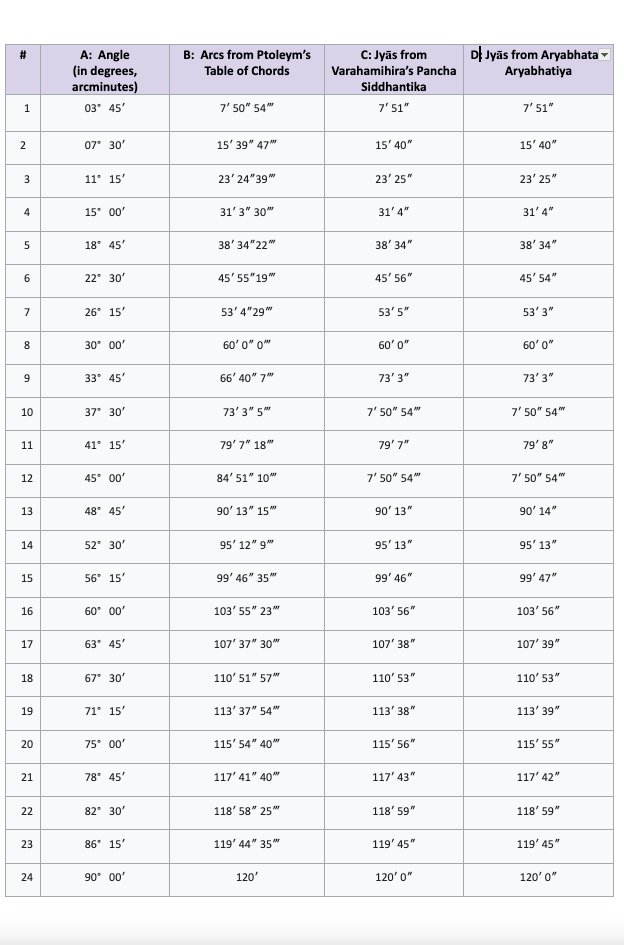
I have reproduced a comparative table for quick reference.
I have reproduced a comparative table for quick reference.
148/N
Column A gives the arcs; Column B provides the Jyās of these arcs as derived from Ptolemey’s table of chords.
Column A gives the arcs; Column B provides the Jyās of these arcs as derived from Ptolemey’s table of chords.
149/N
Column C provides the Jyās of these arcs as found in Pancha Siddhantika. Column D gives the Jyās derived from Aryabhata’s Table by substituting 120 for 3438
Column C provides the Jyās of these arcs as found in Pancha Siddhantika. Column D gives the Jyās derived from Aryabhata’s Table by substituting 120 for 3438
150/N
The basis of Thibaut’s argument is that because the values of the table of chords in Ptolemy’s works closely match with what has been provided in Panchasiddhantika, the ancient Indians must have borrowed this idea from Greek.
The basis of Thibaut’s argument is that because the values of the table of chords in Ptolemy’s works closely match with what has been provided in Panchasiddhantika, the ancient Indians must have borrowed this idea from Greek.
151/N
First, the very basis of the line of argument is simply ludicrous.
First, the very basis of the line of argument is simply ludicrous.
152/N
Imagine a person from India making a rice dish called “Chitrapaka” following a recipe which was already known for thousands of years. It consists of fragrant rice made out of onions, ginger, mushrooms, coriander, lemon, scented with saffron, musk etc.
Imagine a person from India making a rice dish called “Chitrapaka” following a recipe which was already known for thousands of years. It consists of fragrant rice made out of onions, ginger, mushrooms, coriander, lemon, scented with saffron, musk etc.
153/N
Also suppose a person from Greece makes another rice dish called “Spanakorizo” which is made with lemon, spinach and dill.
Also suppose a person from Greece makes another rice dish called “Spanakorizo” which is made with lemon, spinach and dill.
154/N
Now consider a third person who tastes both “Chitrapaka” & "Spanakorizo” and immediately claims that Indians must have learnt how to make rice dishes from Greeks because he could taste rice in both Chitrapaka & Spanakorizo.
Now consider a third person who tastes both “Chitrapaka” & "Spanakorizo” and immediately claims that Indians must have learnt how to make rice dishes from Greeks because he could taste rice in both Chitrapaka & Spanakorizo.
155/N
It would be harder to find a more idiotic argument. But some Western scholars have routinely employed such techniques to try to “prove” that ancient Indian contribution to the fields of math and science is not original
It would be harder to find a more idiotic argument. But some Western scholars have routinely employed such techniques to try to “prove” that ancient Indian contribution to the fields of math and science is not original
156/N
Secondly, Thibaut did not mention a single word about the fact that the methods used in Varahamihira’s Panchasiddhantika (Chapter 4, verses 2-5) to compute the sine values use a drastically different approach from the one used by Ptolemy.
Secondly, Thibaut did not mention a single word about the fact that the methods used in Varahamihira’s Panchasiddhantika (Chapter 4, verses 2-5) to compute the sine values use a drastically different approach from the one used by Ptolemy.
157/N
Thirdly, Thibaut conveniently ignores the value of PI used by Indian Mathematicians like Araybhata (3.1416) from which the radius in Aryabhatiyam derived and used in the Table of Jyā. Similar approach was taken by Varahamihira.
Thirdly, Thibaut conveniently ignores the value of PI used by Indian Mathematicians like Araybhata (3.1416) from which the radius in Aryabhatiyam derived and used in the Table of Jyā. Similar approach was taken by Varahamihira.
158/N
This level of accuracy in the value of PI does not occur in any of the Greek mathematical and astronomical works used for computation of table of chords
This level of accuracy in the value of PI does not occur in any of the Greek mathematical and astronomical works used for computation of table of chords
159/N
Finally, Thibaut disregarded important contexts when making comparisons between Indian & Greek approaches. An example is given below.
Finally, Thibaut disregarded important contexts when making comparisons between Indian & Greek approaches. An example is given below.
160/N
Varahamihira in Chapter 4 of Panchasiddhantika, in addition to giving values of sine, also provided methods to find latitude of a place, the ascensional differences for any given latitude-all of which are based on well-recognized ancient Indian methods
Varahamihira in Chapter 4 of Panchasiddhantika, in addition to giving values of sine, also provided methods to find latitude of a place, the ascensional differences for any given latitude-all of which are based on well-recognized ancient Indian methods
161/N
Nowhere in that chapter is there even an iota of sign of Greek influence. However Thibaut conveniently ignored all of that and proceeded to claim Greek origin of Indian sine values, simply because the final results look similar.
Nowhere in that chapter is there even an iota of sign of Greek influence. However Thibaut conveniently ignored all of that and proceeded to claim Greek origin of Indian sine values, simply because the final results look similar.
162/N
Conclusion
Conclusion

163/N
The pioneering work of ancient Indian mathematicians laid the foundation for trigonometry as we know it today. Their innovative methods for calculating the sine function reflect a deep understanding of mathematics, one that resonates through thousands of years.
The pioneering work of ancient Indian mathematicians laid the foundation for trigonometry as we know it today. Their innovative methods for calculating the sine function reflect a deep understanding of mathematics, one that resonates through thousands of years.
164/N
The Surya Siddhanta introduced the first known trigonometric functions, including the sine function, laying the groundwork for future developments in trigonometry.
The Surya Siddhanta introduced the first known trigonometric functions, including the sine function, laying the groundwork for future developments in trigonometry.
165/N
Aryabhata, in his Aryabhatiya, revolutionized mathematics with his highly precise sine table and recursive method for calculating sine values, marking a significant advancement in the field of trigonometry.
Aryabhata, in his Aryabhatiya, revolutionized mathematics with his highly precise sine table and recursive method for calculating sine values, marking a significant advancement in the field of trigonometry.
166/N
Varahamihira, in his Pancha-Siddhantika, refined trigonometric techniques and integrated them into his comprehensive astronomical treatises
Varahamihira, in his Pancha-Siddhantika, refined trigonometric techniques and integrated them into his comprehensive astronomical treatises
167/N
Bhaskara I, through his Mahabhaskariya, offered detailed explanations and approximations for sine computations, bridging the gap between theory and practical computation in trigonometry.
Bhaskara I, through his Mahabhaskariya, offered detailed explanations and approximations for sine computations, bridging the gap between theory and practical computation in trigonometry.
168/N
Brahmagupta's work in Brahmasphutasiddhanta included innovative methods for solving spherical trigonometry problems, which in turn introduced Arabs & Europeans to modern trigonometry
Brahmagupta's work in Brahmasphutasiddhanta included innovative methods for solving spherical trigonometry problems, which in turn introduced Arabs & Europeans to modern trigonometry
169/N
Madhava of Sangamagrama introduced infinite series for sine and cosine functions, paving the way for modern calculus and demonstrating remarkable mathematical foresight.
Madhava of Sangamagrama introduced infinite series for sine and cosine functions, paving the way for modern calculus and demonstrating remarkable mathematical foresight.
170/N
These contributions, marked by an unbroken chain of innovation and creativity, reflect an extraordinary continuity in the Indian mathematical tradition, where each scholar built upon the legacy of their predecessors, propelling the field of trigonometry to new heights.
These contributions, marked by an unbroken chain of innovation and creativity, reflect an extraordinary continuity in the Indian mathematical tradition, where each scholar built upon the legacy of their predecessors, propelling the field of trigonometry to new heights.
171/N
The mathematical techniques developed in ancient India for computation of sine function continue to be relevant, forming the backbone of many modern applications in science, engineering, and technology. This enduring impact highlights the timelessness of their contributions
The mathematical techniques developed in ancient India for computation of sine function continue to be relevant, forming the backbone of many modern applications in science, engineering, and technology. This enduring impact highlights the timelessness of their contributions
172/N
References
References

• • •
Missing some Tweet in this thread? You can try to
force a refresh