I'm 19.
I’m obsessed with learning how to learn.
So, I spent 300+ hours studying how geniuses, prodigies, and high performers master their disciplines.
Here's what I found on how to master anything faster... 🧵(thread)
I’m obsessed with learning how to learn.
So, I spent 300+ hours studying how geniuses, prodigies, and high performers master their disciplines.
Here's what I found on how to master anything faster... 🧵(thread)

Steve Jobs dropped out
Nikola Tesla never graduated
Thomas Edison was self-taught
Abraham Lincoln was homeschooled
In the academic setting, NONE of them were nothing but average.
But what made them so special?
Nikola Tesla never graduated
Thomas Edison was self-taught
Abraham Lincoln was homeschooled
In the academic setting, NONE of them were nothing but average.
But what made them so special?
The obsession for mastery.
"Mastery — the feeling that we have a greater command of reality, other people, and ourselves." Robert Greene
Aristotle, Plato, Feynman, Edison... when analyzing generational talents, this is the one theme that keeps on appearing.
"Mastery — the feeling that we have a greater command of reality, other people, and ourselves." Robert Greene
Aristotle, Plato, Feynman, Edison... when analyzing generational talents, this is the one theme that keeps on appearing.
You see a master at work through their eyes, movement, fluidity, and elegance.
Masters make the impossible, ordinary.
These subtle patterns may help you, but I've found a better mental model to spot the genius:
Masters make the impossible, ordinary.
These subtle patterns may help you, but I've found a better mental model to spot the genius:
To gain mastery, let’s define mastery.
The 4 stages of mastery is a mental model will help us explain why some become experts, while others are forever novice.
Let’s jump in…
The 4 stages of mastery is a mental model will help us explain why some become experts, while others are forever novice.
Let’s jump in…
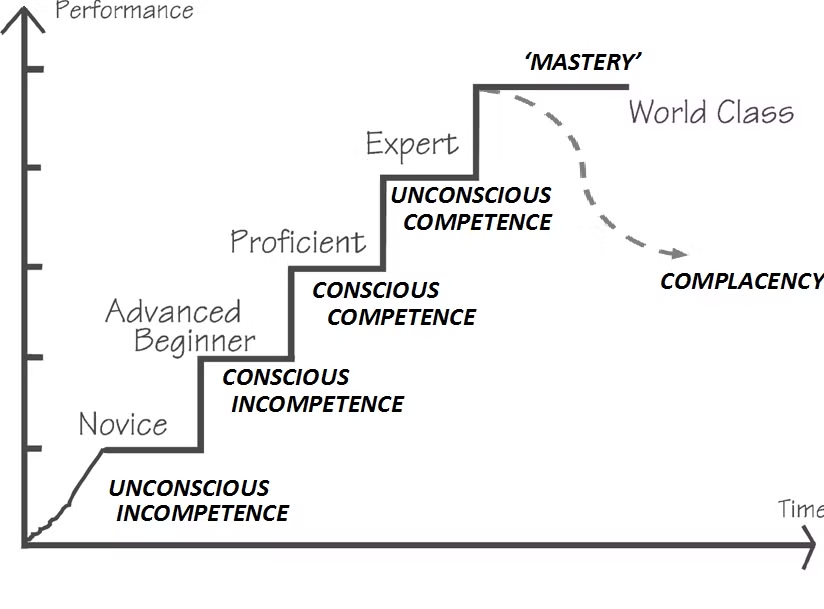
Unconscious Incompetence (Ignorance)
We all start here. The dangerous land of unknown.
You are unaware of problems and don't recognize the importance of improving.
Seek knowledge. Make mistakes.
We all start here. The dangerous land of unknown.
You are unaware of problems and don't recognize the importance of improving.
Seek knowledge. Make mistakes.

Conscious Incompetence (Awareness)
The first awakening call. Usually, the most frustrating stage is where 90% will quit.
You gain self-awareness of your limitations and start to understand the true difficulty.
Be open-minded.
Practice. Reflect. Iterate.
The first awakening call. Usually, the most frustrating stage is where 90% will quit.
You gain self-awareness of your limitations and start to understand the true difficulty.
Be open-minded.
Practice. Reflect. Iterate.

Conscious Competence (Learning)
The enlightenment phase.
If mastery was a journey up the mountain, this would be the last but steepest rise. One hiccup can undo miles of effort.
You perform tasks well but still require effort to execute.
The enlightenment phase.
If mastery was a journey up the mountain, this would be the last but steepest rise. One hiccup can undo miles of effort.
You perform tasks well but still require effort to execute.

Unconscious Competence (True Mastery)
• Mozart with piano
• Feynman with physics
• Stephen Curry with 3pts
Associated with the state of flow and peak performance.
The skill is wired into your subconscious. It now takes more effort to do it wrong.
• Mozart with piano
• Feynman with physics
• Stephen Curry with 3pts
Associated with the state of flow and peak performance.
The skill is wired into your subconscious. It now takes more effort to do it wrong.

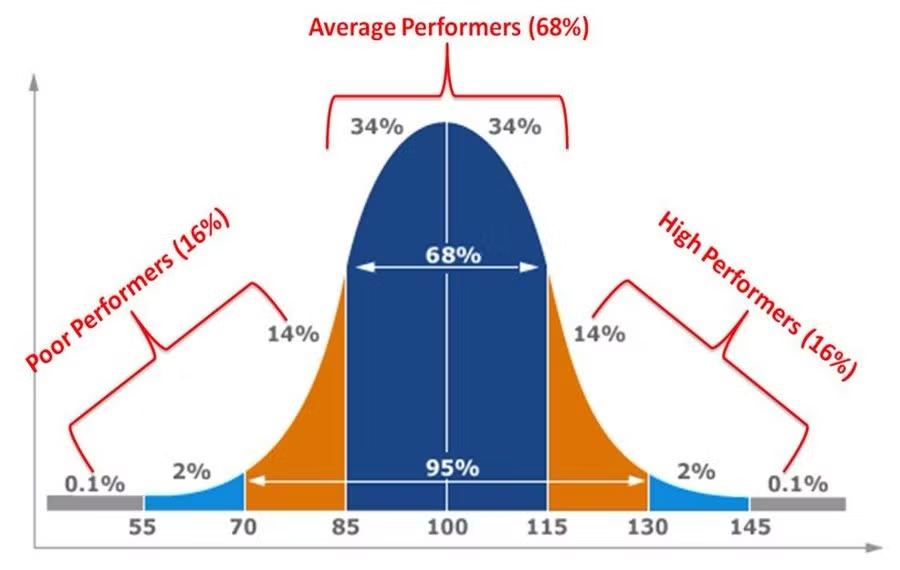
Remember… most people are average. It's hard to get past the first 2 stages of confusion and hopelessness.
But if you've read this far, I know this is not you.
Continue reading and I’ll show you how the best master their disciplines faster…
But if you've read this far, I know this is not you.
Continue reading and I’ll show you how the best master their disciplines faster…
Most creators will give you a checklist of ideas.
Not me.
The following tweets are divided into 3 sections:
1. Foundation: 6 everyday principles that, if applied, can get you instant improvement.
2. Intermediate: 4 optimizing practices to see gradual progression.
3. Advance: 1 tip that without it will make everything irrelevant.
Let’s dive in!
Not me.
The following tweets are divided into 3 sections:
1. Foundation: 6 everyday principles that, if applied, can get you instant improvement.
2. Intermediate: 4 optimizing practices to see gradual progression.
3. Advance: 1 tip that without it will make everything irrelevant.
Let’s dive in!
Traditional learning is built on debunked MYTHs
Old:
• Re-read notes
• Highlight and underline
• Flashcards for everything
New:
• Solve problems
• Find relationships
• Ask curious questions
(P.S. the most popular techniques are HARMING you)
Here's the solution:
Old:
• Re-read notes
• Highlight and underline
• Flashcards for everything
New:
• Solve problems
• Find relationships
• Ask curious questions
(P.S. the most popular techniques are HARMING you)
Here's the solution:
1. Understand how knowledge works.
Knowledge in isolation is knowledge forgotten. Think of your knowledge as a web of ideas.
The more integrated, and connected, the stronger it will be.
Always seeks and prioritize intuitive, logical, most "important" relationships, when learning anything.
Knowledge in isolation is knowledge forgotten. Think of your knowledge as a web of ideas.
The more integrated, and connected, the stronger it will be.
Always seeks and prioritize intuitive, logical, most "important" relationships, when learning anything.
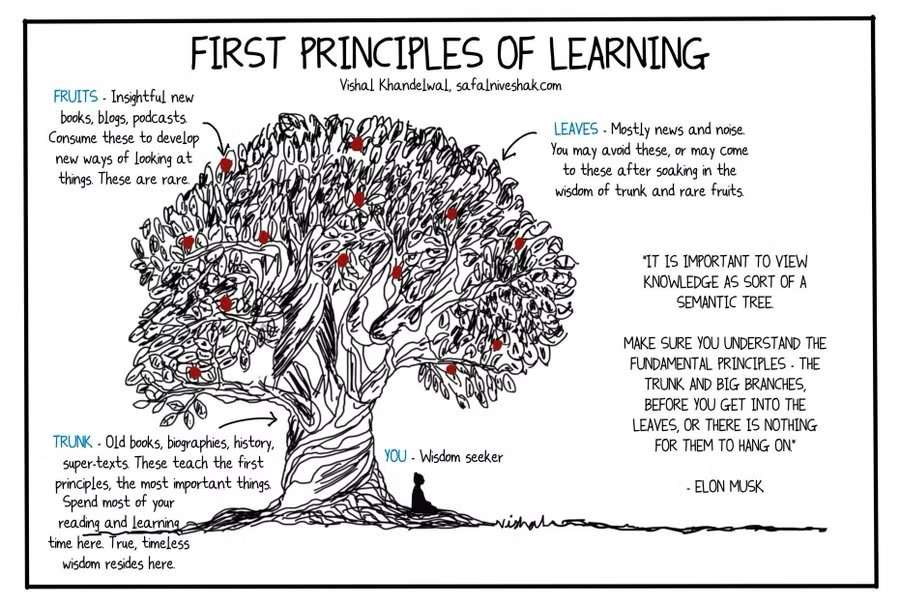
Plant your tree of knowledge
Think of knowledge as a tree. 80% of details are leaves attached to branches and multiple branches glued to the 20% trunk.
Most people pick up leaves, while experts strengthen the chunks.
A strong trunk can withstand any challenge.
Think of knowledge as a tree. 80% of details are leaves attached to branches and multiple branches glued to the 20% trunk.
Most people pick up leaves, while experts strengthen the chunks.
A strong trunk can withstand any challenge.
2. Higher order thinking
There are 2 types of thinking:
• Lower order: memorization, understanding, applying.
• Higher order: analyzing, evaluating, creating.
There are 2 types of thinking:
• Lower order: memorization, understanding, applying.
• Higher order: analyzing, evaluating, creating.
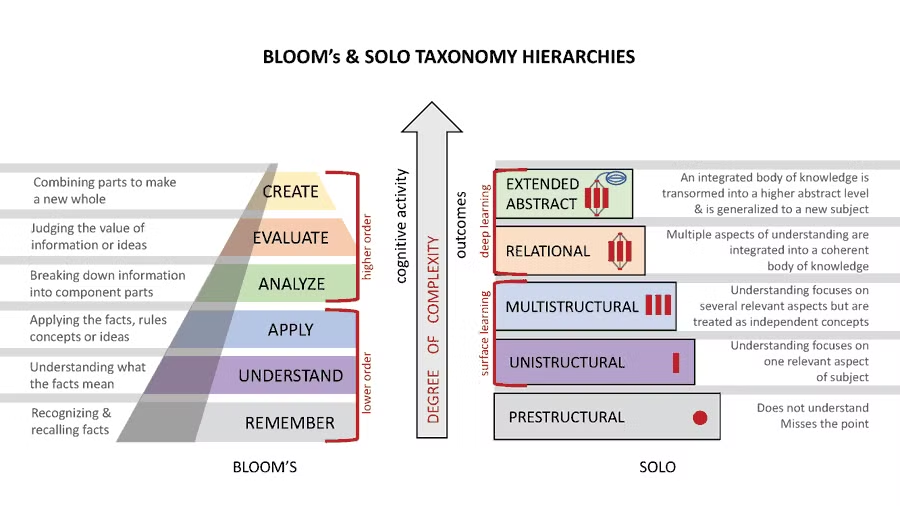
In simplest form, the more you connect and test relationships between ideas, the more you remember.
My aim when learning is to understand things deeply (HOTS), not memorization (LOTS).
Dr Justin Sung explains:
My aim when learning is to understand things deeply (HOTS), not memorization (LOTS).
Dr Justin Sung explains:
3. “Curiosity killed the cat... but satisfaction brought it back.”
Curiosity is the most powerful learning technique that we all have.
As adults we set boundaries on curiosity, but that's wrong.
Curiosity is the most powerful learning technique that we all have.
As adults we set boundaries on curiosity, but that's wrong.
4. Ask Questions - Inquiry-Based Learning
“The one who knows all the answers has not been asked all the questions.” – Confucius
Never fear looking dumb because of a question.
Sooner or later, it will happen, so why wait, what is the risk?
I love Tim Ferriss's top questions:
“The one who knows all the answers has not been asked all the questions.” – Confucius
Never fear looking dumb because of a question.
Sooner or later, it will happen, so why wait, what is the risk?
I love Tim Ferriss's top questions:
5. Interleaving
A 1986 badminton study tested blocked vs. interleaved practice.
Although the interleaving group felt challenged and slow, and more frustrated, they consistently outperformed because of their vast "experience".
A 1986 badminton study tested blocked vs. interleaved practice.
Although the interleaving group felt challenged and slow, and more frustrated, they consistently outperformed because of their vast "experience".
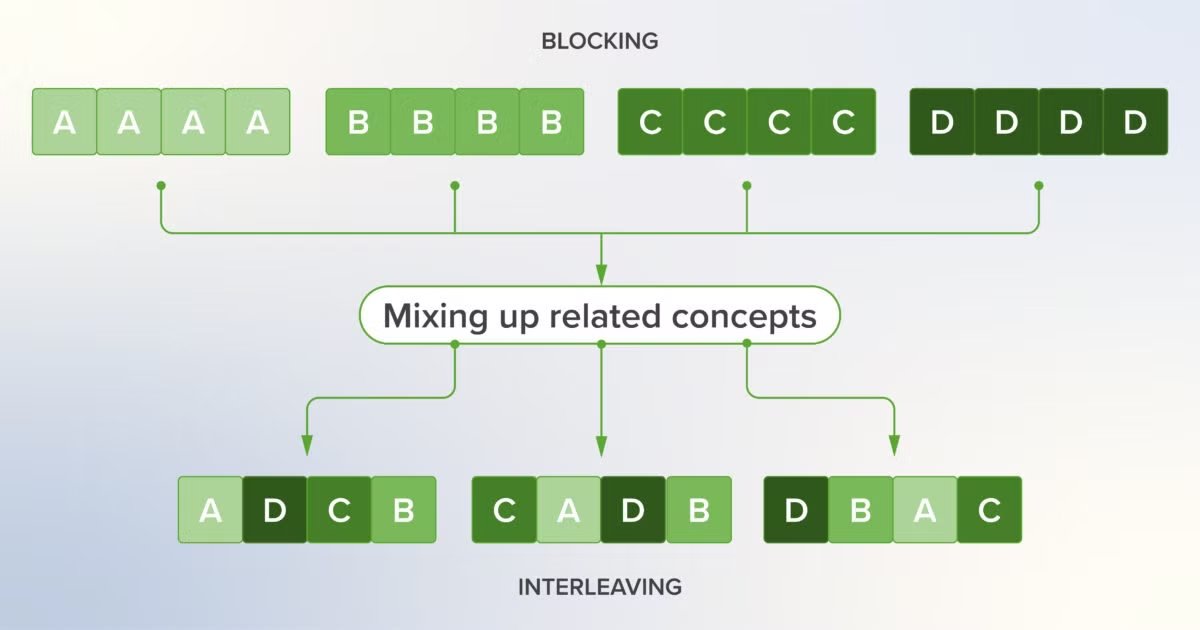
6. Have an eye for reflection:
"Insanity is doing the same thing over and over again and expecting different results" - Albert Einstein
When analyzing the process, find the hidden patterns, train of thoughts, and beliefs that control the outcome.
Mistakes are useless without reflection.
"Insanity is doing the same thing over and over again and expecting different results" - Albert Einstein
When analyzing the process, find the hidden patterns, train of thoughts, and beliefs that control the outcome.
Mistakes are useless without reflection.
Action Time!
1/ Daily learning time.
I LOVE this quote by Charlie Munger:
"I constantly see people rise in life who are not the smartest, sometimes not even the most diligent, but they are learning machines"
Regardless of your day, schedule time for YOUR growth.
Set clear outcomes you want to achieve and protect this time block.
1/ Daily learning time.
I LOVE this quote by Charlie Munger:
"I constantly see people rise in life who are not the smartest, sometimes not even the most diligent, but they are learning machines"
Regardless of your day, schedule time for YOUR growth.
Set clear outcomes you want to achieve and protect this time block.
In those sessions, remember to implement the principles we mentioned:
1. Higher order thinking - relating, connecting, analyzing ideas
2. Build your knowledge web - through HOT, you form a connection of well thought through ideas.
3. Always stay in tuned with your curiosity and keep asking (higher order) questions.
1. Higher order thinking - relating, connecting, analyzing ideas
2. Build your knowledge web - through HOT, you form a connection of well thought through ideas.
3. Always stay in tuned with your curiosity and keep asking (higher order) questions.
2. Start a project.
This is one of the best way to IMMERSE yourself into any subject.
It doesn't have to be complex.
• Record video
• Create a simulation
• Create a mini business
The key is to place this knowledge into a practical setting, where you will have numerous opportunities to INTERLEAVE organically.
This is one of the best way to IMMERSE yourself into any subject.
It doesn't have to be complex.
• Record video
• Create a simulation
• Create a mini business
The key is to place this knowledge into a practical setting, where you will have numerous opportunities to INTERLEAVE organically.
3. Find your mastermind group and mentor.
• Check your contact list
• Organize the meetup
• Shared learning
• Accountability
This provides accountability while you create a collective consciousness of shared ideas.
• Check your contact list
• Organize the meetup
• Shared learning
• Accountability
This provides accountability while you create a collective consciousness of shared ideas.
4. Last but not least, reflect, reflect, reflect.
Think as if you're the detective.
Observe obsessively, think deeply.
• What is my expectation?
• Why did I react this way?
• Do I react similarly in other areas of life?
Dr. Justin Sung explains:
Think as if you're the detective.
Observe obsessively, think deeply.
• What is my expectation?
• Why did I react this way?
• Do I react similarly in other areas of life?
Dr. Justin Sung explains:
That's it!
I know you were expecting crazy hacks, but it really reminds me of this quote:
"You don't need to have extraordinary effort to achieve extraordinary results. You just need to do the ordinary, everyday things exceptionally well." — Warren Buffett
Be extraordinary!
I know you were expecting crazy hacks, but it really reminds me of this quote:
"You don't need to have extraordinary effort to achieve extraordinary results. You just need to do the ordinary, everyday things exceptionally well." — Warren Buffett
Be extraordinary!
If you are a creator who wants to write threads like this.
Join my Skool community below...
I’ll show you the exact content system I’ve used to get over 193,000,000 views in the last 90 days on @GeniusGTX and for my clients.
skool.com/viral-xcelerat…
Join my Skool community below...
I’ll show you the exact content system I’ve used to get over 193,000,000 views in the last 90 days on @GeniusGTX and for my clients.
skool.com/viral-xcelerat…

That’s a wrap!
Thanks for reading. If you’re interested in learning how to learn, homeschooling, psychology or future of education, follow me at @learningtoan.
We are ONE genius away from saving the world.
Toan Truong.
Thanks for reading. If you’re interested in learning how to learn, homeschooling, psychology or future of education, follow me at @learningtoan.
We are ONE genius away from saving the world.
Toan Truong.
• • •
Missing some Tweet in this thread? You can try to
force a refresh