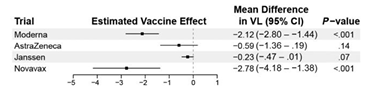
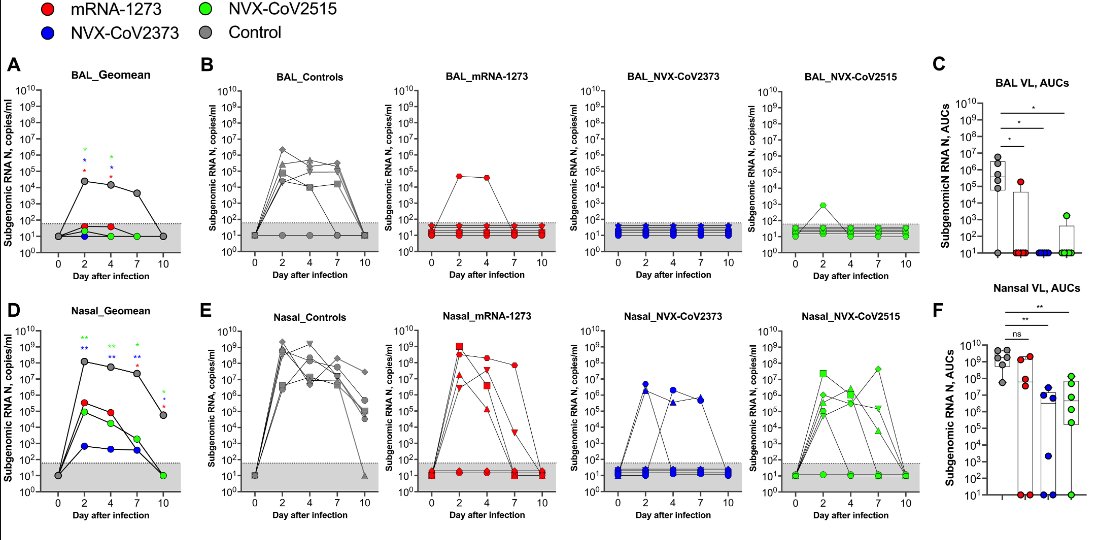
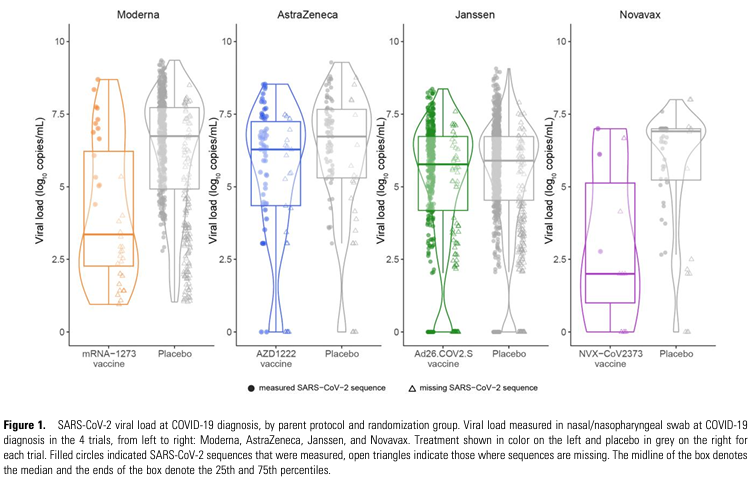
Vaccines likely lower transmission, in addition to reducing infection and severe illness. New study shows Novavax and Moderna significantly reduce viral load (amount of virus) in the upper respiratory tract.
Novavax reduces viral load by 2.78 log10, while the Moderna vaccine was 2.12. The log10 scale is 10x for each step, indicating Moderna reduces viral load by just over 100x, and Novavax reduces viral load by over 600x. No significant reductions seen for others.
These results are in line with earlier animal models where the Novavax platform was associated with the largest decrease in viral replication in the upper respiratory tract. science.org/doi/10.1126/sc…
Vaccines likely reduce chances of 1) being infected, 2) developing severe illness if infected, 3) transmitting the virus to others.
Increasing vaccine uptake reduces community circulation. Lower circulation overall helps everyone, from kids to the elderly. Fewer sick days. Improves economic activity. Reduces long COVID. Fewer empty seats at the family dining table.
I should note that Pfizer was not evaluated in the study being discussed, but it could have a similar reduction to moderna based on prior studies. nature.com/articles/s4159…
Clarification - *just over 100x" is used to indicate how close it is to 100, not a comparative indicator to novavax. The estimates are not statistically significantly different - both NVX and Moderna (& likely Pfizer as well) reduce viral load.
One more follow-up. Yes, this study is not with the current strains and w/o widespread preexisting immunity. However, many of the same immunologic principles should still be in effect today.
One potential avenue: the majority of the NVX response is not via IgG, but by mechanisms including FC effector functions. These are uniquely good at targeting viral particles for phagocytosis (clearing virus). nature.com/articles/s4146…
There's inadequate data to quantify exact reductions expected today (likely a moving number & different per person), but it would be hard to discount the human & animal (BA.5) data entirely. Certain COVID-19 vaccines have, and likely still reduce viral load and transmission
• • •
Missing some Tweet in this thread? You can try to
force a refresh

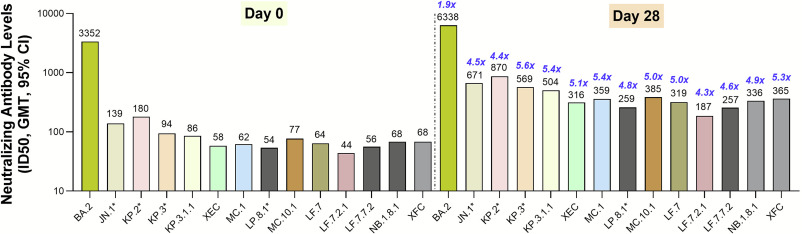
New paper showing Novavax JN.1 booster elicits broad cross neutralization across circulating omicron strains, including LP.8.1, XEC, LF.7, and NB.1.8.1.
Link to paper:
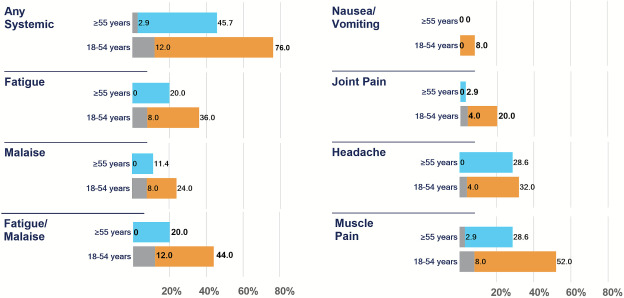
Reactogenicity remained similar to prior NVX boosters (e.g. similar to flu and many other conventional vaccines) sciencedirect.com/science/articl…
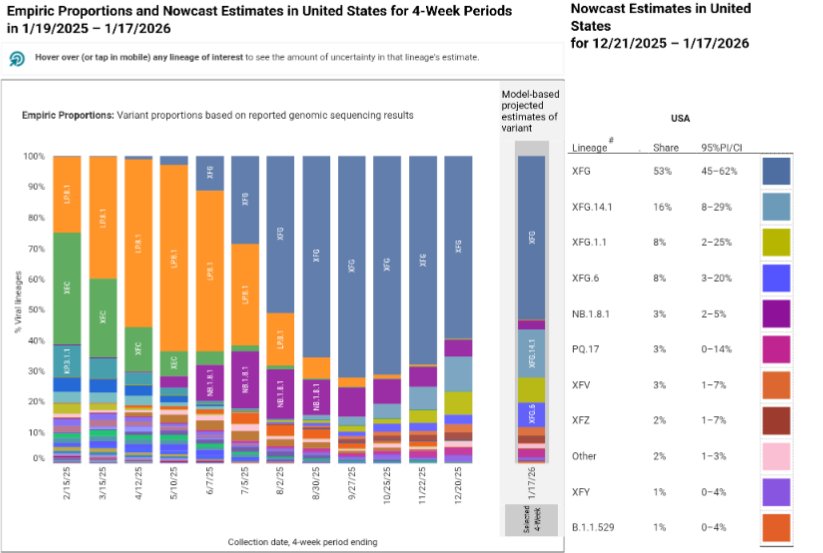
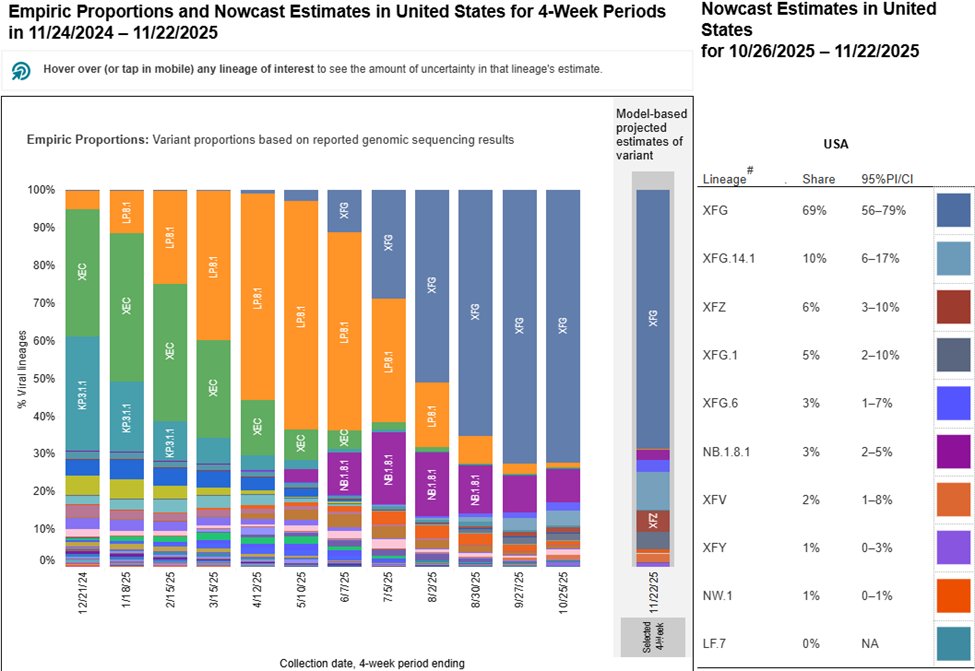
XFG, the currently dominant strain in the US, is a combination of LF.7 and LP.8.1. This was not included in the paper but both LF.7 and LP.8.1 showed a good response.
Quick personal note. A close friend recently died from a heart attack a week after COVID.
COVID increases risk of cardiac events.
It may have faded from the news cycle, but COVID continues to take people from their families. Please take it seriously.
I’ve gotten questions about whether JN.1- or LP.8.1-based COVID vaccines are better.
Short answer: both should be similarly effective against currently circulating strains. The important thing is to get vaccinated.
Longer answer: see thread
We are fortunate in that nearly all currently circulating strains stem from JN.1 (i.e. JN.1 lineage). JN.1 first emerged in late 2023 and became dominant during the winter 2023-2024 surge. Since then, we have gone through waves of KP.2, KP.3, XEC, and in spring 2025, LP.8.1.
Given the dominance of LP.8.1 during the spring, many suspected the WHO committee on COVID-19 vaccine composition (TAG-CO-VAC) and the US FDA Advisory Committee (VRBPAC) would select LP.8.1. However, selection of a dominant strain (assuming forward drift) is potentially flawed.
New study evaluating vascular and inflammatory diseases after COVID-19 infection and vaccination in nearly 14 million children.
Large persistent increase in major cardiovascular risks following infection. A small transient myocarditis risk following vaccination
Paper:
"COVID-19 infection in children & young people was associated w/ elevated risks... including venous thromboembolism, thrombocytopenia, myocarditis, & pericarditis particularly in the first month... w/ some risks remaining elevated up to 12 months"thelancet.com/journals/lanch…
"By contrast, COVID-19 vaccination was associated with a short-term increased risk of myocarditis or pericarditis, mainly within the first 4 weeks. However, no increased risk was observed beyond that period, and there was no evidence of long-term myocarditis signal"
Excellent study on correlates of protection for nuvaxovid / novavax. Higher IgG and nAb levels are excellent predictors for risk of any and severe infection. Helpful data on durability as well. 🧵
This study group received the original wuhan vaccine and assessed IgG and nAb levels vs Delta. This phase 2 follows the initial CoP analysis, which had no severe cases. That is great, but precluded analysis for severe COVID: nature.com/articles/s4146…
A key finding was that there were no severe cases above the 33rd percentile of IgG levels at day 35 - i.e. based on initial immune responses, no one with an average immune response had severe illness.
Excellent systematic review of COVID, flu, and RSV vaccines. Hundreds of studies, and millions of individuals represented, all demonstrating that these important vaccines help reduce the risk of severe illness and hospitalization.
Link to study:
Remember that the COVID vaccine effectiveness of ~50% is comparing up to date vaccination vs a background of infection acquired and prior vaccine immunity.nejm.org/doi/full/10.10…
Protection against long COVID in children and adults was also high (~60%) and lines up nicely with prior large studies thelancet.com/journals/lanre…