Google Search vs. User Intent 🔎
I'll explain one of THE most important concepts in SEO - Intent, for both the Search/Google/SERP level AND for user intent...
A 🧵
I'll explain one of THE most important concepts in SEO - Intent, for both the Search/Google/SERP level AND for user intent...
A 🧵
The majority of the SEO industry will say you need to optimize your pages for search / user intent, and describe them as the same thing... They are not.
Search intent is the SERP that Google has created based on what it thinks the users intent is - Not necessarily what it is...
Search intent is the SERP that Google has created based on what it thinks the users intent is - Not necessarily what it is...
User intent is indiviual and often nuanced.
You still want to serve the user intent to get results from your traffic, but your aim in SEO, should be building pages that match the search intent first - Or in a lot of cases, you won't be able to even make it to the top 10 anyway.
You still want to serve the user intent to get results from your traffic, but your aim in SEO, should be building pages that match the search intent first - Or in a lot of cases, you won't be able to even make it to the top 10 anyway.
The way you start matching your pages and building new pages based on search intent has the same beginnings as most things in our industry: SERP analysis.
- Search your keyword in Google or Ahrefs/SEMRush
- Analyze the top 10 for patterns
- See if you can build pages to match
- Search your keyword in Google or Ahrefs/SEMRush
- Analyze the top 10 for patterns
- See if you can build pages to match
For example, if I search for "best paintball guns 2024"
Then I can see the SERP is almost entirely dominated by YouTube videos, UGC threads and ECommerce sites... There are a handful of blog posts and pages ranking in the top 20, but none top 3 for any KW variation.
Then I can see the SERP is almost entirely dominated by YouTube videos, UGC threads and ECommerce sites... There are a handful of blog posts and pages ranking in the top 20, but none top 3 for any KW variation.
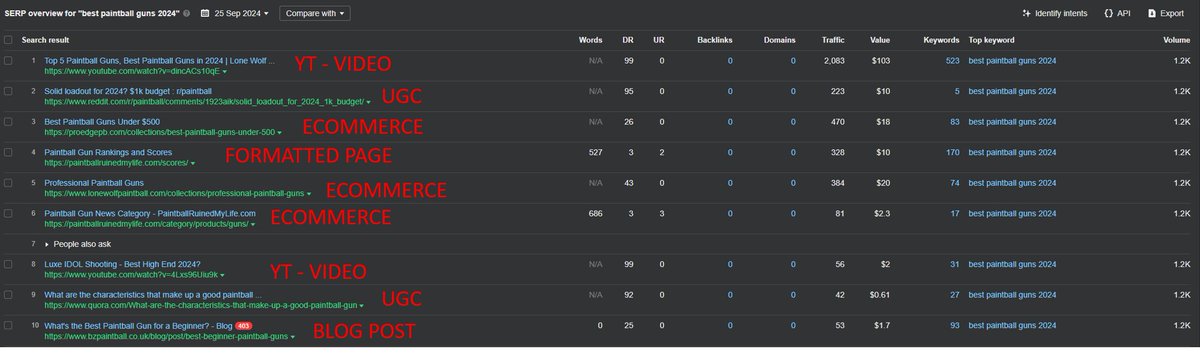
This means, if I wanted to rank for this keyword, I'd likely have to have an ECommerce site of my own + start pumping out optimized video content on a YouTube channel and regularly engaging in the subreddits that routinely rank for it too.
SEO isn't a one page game anymore!
SEO isn't a one page game anymore!
And even if your SERP doesn't necessarily need you to rank multiple pages to take over the first spot, it's a good tactic be implementing now ready for larger scale SGE and AI roll outs in search.
Unfortunately, you have to do this granular level analysis for every KW SERP...
Unfortunately, you have to do this granular level analysis for every KW SERP...
The idea is to combine this into your topical mapping (I've got a thread coming out on this, but check out my topical authority thread from yesterday in the meantime) and create the pages that support your topical authority AND you can actually rank for.
https://x.com/Charles_SEO/status/1840455264535019639
You also have different layers of intent:
- Informational Intent: e.g. "how to bake a cake"
- Navigational Intent: e.g. "Facebook login"
- Commercial Intent: e.g. "best smartphones 2024"
- Transactional Intent: e.g. "buy running shoes online"
- Informational Intent: e.g. "how to bake a cake"
- Navigational Intent: e.g. "Facebook login"
- Commercial Intent: e.g. "best smartphones 2024"
- Transactional Intent: e.g. "buy running shoes online"
Most SEOs tend to group SERPs by these linear intents, but Google often likes to rank multiple different types of pages in the same SERP - As I showed you above with our paintball example.
Of course grouping is good for your own sites, but not for larger search campaigns...
Of course grouping is good for your own sites, but not for larger search campaigns...
Bear in mind that Google routinely changes the intent of SERPs, especially in major or core updates - We've seen it happen in the latest August update, the March update and most of all in last years helpful content update, which in a lot of SERPs saw the entire top 10 change.
Making sure you are on top of where your industries search and user intents are shifting are the best ways to future proof your businesses.
If more people had watched where the updates were moving before HCU, they wouldn't have been as surprised when it clapped them.
If more people had watched where the updates were moving before HCU, they wouldn't have been as surprised when it clapped them.
And finally, the last part of the puzzle is SERP features.
Intent doesn't matter nearly as much as some of the major changes Google makes to the SERPs - If you are in flights, hotels, insurance, recruitment etc then you know that they can essentially monopolize them overnight.
Intent doesn't matter nearly as much as some of the major changes Google makes to the SERPs - If you are in flights, hotels, insurance, recruitment etc then you know that they can essentially monopolize them overnight.
And that's it for this thread! I hope you got a lot out of it, if you did learn anything it'd be much appreciated it you could drop a LIKE+RT on the original post 👇
https://x.com/Charles_SEO/status/1840775331894223088
• • •
Missing some Tweet in this thread? You can try to
force a refresh