🚨NEW DOCUMENTS in the Alabama lawsuit over sex "change" age restrictions.
Some very interesting facts now coming to light. 🧵
1/ @wpath sought but did not receive the American Academy of Pediatrics’ (@ameracadpeds) endorsement for its eighth “Standards of Care” (SOC8).
In private emails to WPATH a colleague, SOC-8 lead author Eli Coleman said that this was “highly confidential.”
2/ Coleman appears to admit that it is misleading to claim that medical groups writing amicus briefs against age restriction laws means these groups endorse SOC-8. WPATH tried but failed to get endorsements. (Exhibit #190)
3/ Coleman had “hope[d]” that the “Amer Plastic Surgery organization” (i.e., the American Society of Plastic Surgeons) would endorse SOC8 and said that efforts to that effect were “underway.”
4/ Disturbingly, Coleman complains about “a network of parents who have been concerned about the lack of careful evaluations, lack of involvement in decision making, and perceptions of rushed decisions which they feel account for the increased number of regret cases especially among youth.”
His solution? Not to address those concerns, but to “amplify the[] voices” of parents who transitioned their kids and are content with their decision.
5/ Despite gender clinicians like @YaleMedicine Meredithe McNamara and @jack_turban claiming that WPATH’s approach is aligned with the recommendations of the Cass Review (see, e.g., Yale Integrity Project white paper and related amicus brief in Skrmetti), Coleman admits that the U.K., Sweden, Finland, etc. are implementing policies that are “more and more out of step with WPATH SOC8.”
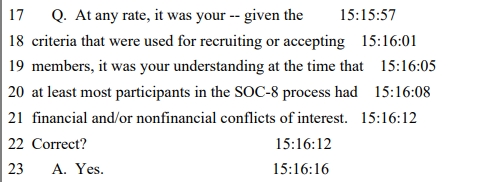
6/ On the critical question of conflicts of interest in SOC8's development, Coleman admits that he knew “at least most participants in the SOC-8 process had financial and/or nonfinancial conflicts of interest” when the guidelines were being developed. (Doc. 557-21, deposition of Coleman)
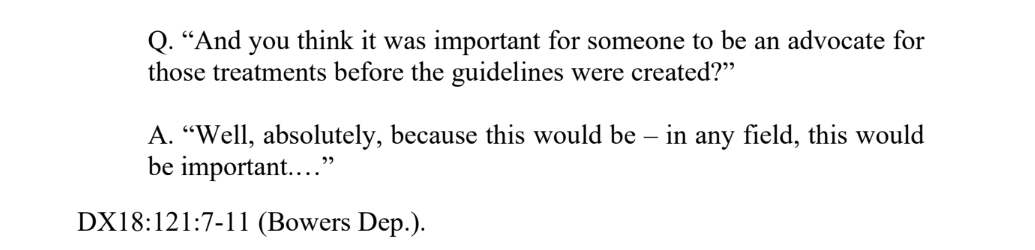
7/ WPATH president Marci Bowers (@Bowers_MD) said it was “absolutely” “important for someone to be an advocate for [gender transition] treatments” in order to be on the SOC8 development team.
A more smoking gun example of conflict of interest is hard to imagine.
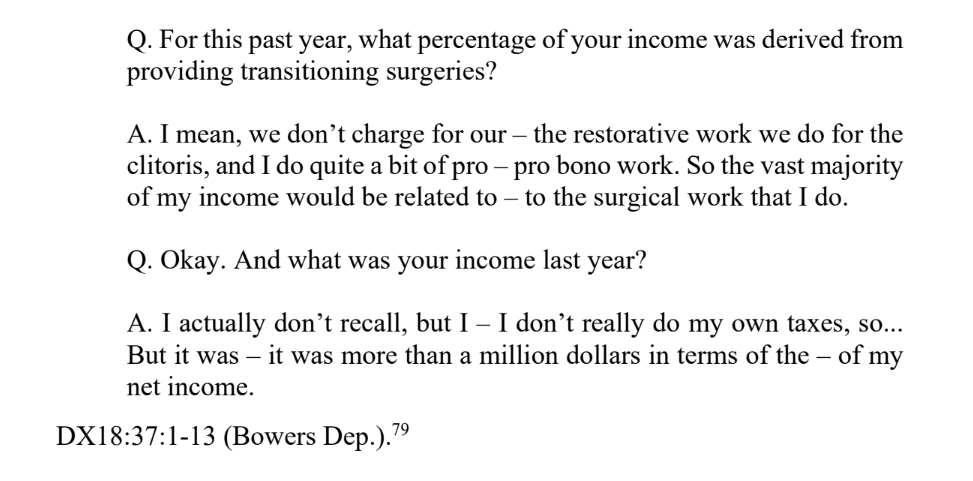
8/ Bowers, who famously performed Jazz Jennings' vaginoplasty, made over one million dollars in net income performing gender transition surgeries in the past year, according to Bowers' deposition.
There are other interesting findings, but that's it for now.
• • •
Missing some Tweet in this thread? You can try to
force a refresh

An ongoing @manhattaninst analysis of an all payer, all claims insurance database shows that the 7-year diagnostic persistence rate of adolescent gender dysphoria is between 40-50%.
I discuss this major finding in a new article for @CityJournal 🧵
A central belief justifying medical interventions for gender dysphoric (GD) adolescents is that, unlike childhood GD, GD that persists into (or even arises in) adolescence is almost always permanent. If the condition isn’t permanent, why offer Rx with permanent effects?
First, we analyzed the number of minors with GD in the U.S. between 2017 and 2023. We found 272,181 to 342,476 minors who had the diagnosis.
If we account for the 15% missing claims data in our data set, the range is roughly 320,000 to 400,000.
🚨NEW: I’ve received a FOIA’d file from the Washington State Department of Social and Health Services (@waDSHS) about a 17-year-old receiving puberty blockers.
I’ve seen some extreme cases of medicalization in the past, but this one stands out even for a deep blue state. 1/5
The kid is reported to have a “past [of] extensive abuse [including sexual] and neglect” and to have been through “93 different placements,” which include Qualified Residential Treatment Programs. 2/5
The kid has “borderline intellectual functioning,” with “adaptive scoring in the 2nd percentile.”
A recent study found “a possible detrimental impact [from GnRHa] on IQ. These findings accord with the wider literature on GnRH expression and brain structure and function.”
Unclear whether or how the kid’s use of GnRHa affected IQ in his case. 3/5
"McNamara et al. [the misleadingly titled 'Yale report' criticizing the @thecassreview @Hilary_Cass] is an exceptionally misleading, confused, and fundamentally unprofessional document."
A must-read by @jessesingal, but let me add a few additional details. 🧵
2/ The white paper is a good example of "eminence-based medicine." Its authors seemed to want to use the reputation of @Yale @YaleMed @YaleLawSch to bolster the credibility of the report. But they did so seemingly without first getting the approval of Yale.
3/ On July 1, the report was published and submitted by McNamara, the lead author, into evidence in Boe v. Marshall (Alabama). A little over a week later, the report was republished with a disclosure that the views it contains do not reflect those of the authors' institutions. It's not clear if the revised report, with the disclosure, is the one currently submitted into evidence in the lawsuit.
BREAKING: The American Society of Plastic Surgeons, an organization representing 92% of all board-certified plastic surgeons in the U.S., becomes the first major medical association to break from the consensus over “gender-affirming care” for minors.
This is big news. 🧵
2/ In the U.S., the use of puberty blockers, cross-sex hormones and surgeries to help kids who feel distressed about their developing bodies has depended on a perceived consensus of medical groups.
3/ Critics argue that the consensus is manufactured and enforced through suppression of alternative viewpoints and of evidence reviews. The @AmerAcadPeds, for instance, has suppressed member initiatives to get the group to conduct a systematic review of the evidence.
🚨 This is an extremely important new report by @writingblock for @TheFP about Planned Parenthood (@PPFA), a leading supplier of on-demand hormones to troubled teens and young adults.
3/ "Insurance claim information provided to @TheFP by @ManhattanInst shows that at least 40,000 patients went to Planned Parenthood for this purpose last year alone, a number that has risen tenfold since 2017. The largest proportion, about 40 percent, were 18- to 22-year-olds."
Arguably, Mays' most important empirical claim is that regret is very rare, and that “some studies” show a regret rate of “as little as 2%.”
The study she cites for this claim is Dhejne et al., “An analysis of all applications for sex reassignment surgery in Sweden, 1960-2010: prevalence, incidence, and regrets,” Arch Sex Behav (2014). This is a Swedish study based on data from a national database.
In the Dhejne study, a person is defined as transsexual (and thus part of the denominator) only if s/he had undergone “sex reassignment surgery” (SRS) and had obtained a new legal document reflecting the “new” sex. This required prior approval by Sweden’s National Board of Health and Welfare.