We were informed that we had to head to southern Gaza as it was declared a "safe humanitarian zone." On our way south, the road felt like hell itself. A bus carrying a family was bombed, and it was the first time I saw body parts flying through the air. Every kilometer or so, you would see a car, completely charred with the people inside, people who had lives and dreams. These cars were left as they were, and perhaps even run over by tanks.
We reached Khan Younis, where I stayed at the Red Crescent for 90 days. I lived through experiences you cannot even imagine. The Red Crescent was bombed more than 10 times. Death was closer to me than my jugular vein. I could almost taste it, yet it refused to take me, until Israeli tanks surrounded us.
The Israeli forces then stormed the Red Crescent. A soldier stood at the door, cursing and spewing vile, despicable words. He started yelling, "Come out, you animals!"
The path between their tanks was one of the hardest things I’ve ever faced in my life. They humiliated us, and they humiliated our women and elderly in the most brutal ways. They took one young man from among us and ordered him to take off his clothes and dance. When he refused, they put a bullet between his eyes.
The road was filled with corpses and tears.
We eventually reached Rafah, but after a short time, I had coordinated with a company, Ya Hala, to evacuate my deaf sisters, who were suffering greatly, to Egypt. Two days before their names were included in the evacuation list, the Israeli army entered Rafah and closed the crossing, forcing us to flee to Deir al-Balah.
I now live in a tent at a UNRWA school in Deir al-Balah. We are surrounded by the Zionists from all sides. They starve us, kill us, and bomb the schools every day. I’ve been displaced more than five times while in Deir al-Balah, from one tent to another, from one form of death to the next. Each time, I begged death to take me, but it refused, as if it found pleasure in my suffering.
This Zionist enemy has inflicted upon us every kind of torture imaginable, under the pretext of "self-defense" and "releasing their hostages."
If they truly wanted their hostages back, they could have ended this genocide in the first month. But instead, they enacted the "Hannibal Directive," which shows they don’t care about their hostages. All they care about is indulging in the killing and diverse methods of slaughtering innocent people.
• • •
Missing some Tweet in this thread? You can try to
force a refresh

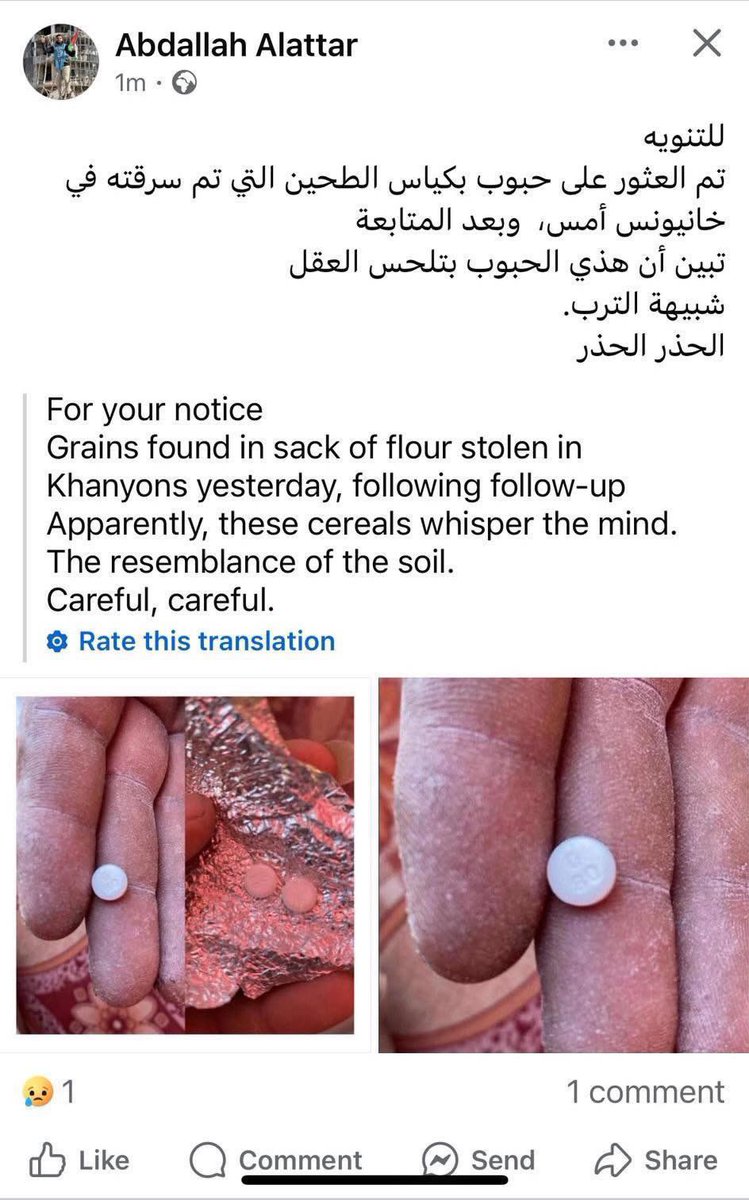
The most despicable form of genocide has recently come to light with the spread of a drug called Oxycodone among the population. Israel has reportedly been smuggling it in through bags of flour provided as aid.
As a pharmacist, let me explain what this drug is: it belongs to the opioid family and is used to relieve severe pain when regular painkillers fail—especially for cancer patients.
But the problem with this drug is that it acts on specific receptors in the nervous system, causing severe addiction, a decrease in heart rate, impaired awareness and consciousness, and dangerous respiratory depression.
Its side effects are numerous and can transform a person into something unrecognizable—a shell of who they were.
It has also been revealed that the drug is not only hidden inside flour bags, but the flour itself appears to be mixed with it.
Our battle with them is not only a battle of weapons, but also a battle of awareness and consciousness. They are masters at numbing our minds, distorting our perception, and using every means possible to erase our collective awareness and turn us against one another.
Abdullah says he found this drugs inside a sack of flour.
For those asking about the source, it is the Anti-Drug Committee in Gaza.
Many citizens have found these drugs, and I saw them with my own eyes in the flour sacks.
There is also a doctor named Khalil Abu Nada who wrote a full report on this issue.
My brother Abdullah called me and said: “There’s a library that was destroyed by the occupation, and there are many important books that can be saved — instead of being taken by the displaced to be used as firewood for cooking.”
I immediately went and managed to rescue many books — over 200 of them — some of which are more than 100 years old….+
1_ “A Tale of Two Cities” is one of the most famous works of the English writer Charles Dickens, first published in 1859. The novel takes place between London and Paris during the period leading up to and during the French Revolution.
The novel explores themes such as social injustice, sacrifice, and redemption. It begins with the famous line:
“It was the best of times, it was the worst of times…”
The story revolves around Charles Darnay, a French nobleman who abandons his aristocratic privileges to live a simple life in London, and Sydney Carton, an English lawyer who appears to be a lost, aimless man but possesses a noble heart. Both fall in love with Lucie Manette, the daughter of a doctor who was released after being imprisoned in the Bastille for a long time without just cause.
The novel delves into the class divide between the rich and the poor, highlighting how oppression and injustice led to the explosion of the revolution. One of the most powerful moments in the story is Sydney Carton’s ultimate sacrifice — giving his life for Lucie’s happiness, taking Charles Darnay’s place at the guillotine. The novel ends with his famous final words:
“It is a far, far better thing that I do, than I have ever done…”
The novel is filled with deep emotional scenes and provides a vivid portrayal of the brutality of the revolution, while also showcasing the humanity and compassion that can exist amidst the chaos..+
2_ “The Prince” by Niccolò Machiavelli is one of the most famous works in political philosophy. Machiavelli wrote it in 1513, but it was published posthumously in 1532. The book offers advice to rulers on how to gain and maintain power, focusing on political reality rather than morality.
Machiavelli argues that a ruler must be intelligent and pragmatic, and sometimes act immorally if necessary to preserve power and ensure the stability of the state. His phrase “the ends justify the means” — though not stated verbatim — reflects the core of his ideas.
Some of the book’s key ideas include:
•It is better for people to fear you than to love you if you cannot achieve both.
•A ruler must learn to be both a fox (cunning) and a lion (strong).
•Morality is important, but staying in power is more crucial when the fate of the state is at stake.
The book sparked significant controversy because it shattered the idealistic image of the just ruler, offering instead a realistic and provocative view of politics. Even today, the term “Machiavellian” is used to describe political strategies that prioritize pragmatism and cunning over morality…+
As my friends Ibrahim, Hossam, and I were walking among the rubble of the houses, we came across a library. We entered and found many books—it was like discovering a precious treasure.
In this thread, I’d like to write a brief paragraph about each book we found.
The first book is The World of Ornament:
The book covers a wide range of ornamental designs inspired by historical elements dating back to ancient times, including jewelry, tiles, stained glass, illuminated manuscripts, textiles, and ceramics. These designs encompass styles from various cultures and civilizations, such as: Egyptian, Greek, Roman, Etruscan, Asian, Middle Eastern and European (from the Middle Ages to the 19th century)...+
The Second book: “The Heart of Man” is a novel by the Icelandic author Jón Kalman Stefánsson, and it is the third part of the trilogy “Heaven and Hell.” This novel takes the young boy, the main character, by the hand and leads him toward the crucible he longed to merge into, after reaching the pinnacle of awareness, beyond which there is only silence. The boy survives the wrath of the sea and snow, and is drawn back to the coastal town, where he firmly plants his feet amidst its contradictions and all the virtues and vices it teems with. The town, battered by winds and scorched by frost, survives off the sea and perishes within it. Its people draw strength from the towering mountains, and tenderness seeps into their hearts from its green meadows that pierce the rock like dreams. This book is considered an essential exploration of life, love, desire, lust, and a challenge to death. It combines sublimity and simplicity, with words born from the heart of a poet and the insight of a philosopher. The Heart of Man is a musical piece from a distant island, played on the strings of life..+
@IamIbrahim21
The third book: “A Savage War of Peace: Algeria 1954–1962” is a comprehensive history of the Algerian War, authored by Alistair Horne and first published in 1977. The book delves into the complexities of the conflict, examining the political, social, and military aspects that led to Algeria’s independence from French colonial rule. Horne’s narrative is noted for its depth and balanced perspective, making it a seminal work on the subject…+
Horrific testimonies from the massacre of Mawasi Khan Younis committed by Israel on July 13th:
1_ "My son asked me to bring him his severed leg so he could say goodbye to it. Based on his request, I returned in the afternoon to check the place, but I couldn't find his leg." ..+
2_ "I was carrying an empty pot, heading to the nearby soup kitchen from my tent to get some food for my family. Suddenly, the color of the sky changed, and daylight was replaced by darkness and dust. I fainted briefly, and every time I tried to get up,..+
I saw feet running around me. It felt like I had forgotten how to walk."
3_ "I felt that life was suddenly filled with hungry ghosts, ready to bite into your body, your head, your hand, your foot. And if none of that happens, they might erase you forever." ..+
This story is different from all the other stories I've told. My cousin, the legend Hidaya Hamad. She was the volunteer manager at the Red Crescent in Khan Yunis, where the building was sheltering around 15,000 displaced people..+
Every night before bed, she would take a round among the displaced people and ask if they needed anything, fulfilling their needs. She was the first to go to the Rafah border crossing to secure humanitarian aid for the people of Gaza..+
where her mission would end at 2 AM amidst the terror of bombings and the dark, desolate night. Our hearts would reach our throats in fear that something might happen to her. She was like a mother to me when I was away from my family..+
When you see this word, you might find it difficult to grasp its full meaning or envision its true form. Perhaps you have seen on your phone a house collapsing on its residents, or a child whose entrails were left in the hallway between the kitchen and the bedroom..+
unreachable by rescuers, and fully decomposed over time. Perhaps you have seen fully decomposed bodies, with a mother holding her child's head and a wife lying on what remains of her husband's rib cage. Maybe you have finally seen a headless child..+
and spent the entire night wondering where the head is!
All these pains are nothing compared to witnessing them in reality, compared to living them. One day, I carried 27 dismembered bodies with my hands and lifted them onto a donkey cart. That day, my heart died..+