Yes, absolutely. Mainstream media is a (*checks notes*) poor helpless victim when it comes to (*double-checks*) influencing public perceptions about culture, world events, and the media itself.
Bezos is definitely *blaming the victim.* Poor widdle mainstream media. 😥
It's sad that they can't even be perceived neutral when journalists are rabidly clamoring for a political endorsement of the Democratic nominee, and the paper itself quite explicitly defined itself in opposition to Trump since 2016.
And the endorsements definitely don't reflect or enhance perceptions of political bias. The fact that the paper has literally never outright endorsed a Republican since 1976 when they started the practice -- this is just a pure coincidence: washingtonpost.com/opinions/patri…
The Democrats are just better, 100 percent of the time. That's not bias, that's fact. And the editorial bones should make no bones about it. And if the public thinks it might indicate bias that over nearly 50 years the paper endorses only one political party for the presidency (and overwhelmingly endorses Democrats for lower seats as well) -- that's just because *those people* have their brains cooked by the Koch Brothers and Trump.
And speaking of facts, the fact that Democrats outnumber Republicans 10:1 in the field likely does absolutely nothing to influence which topics they cover and how they cover them (as I highlight here, we're clearly unbiased: youtube.com/watch?v=o-uS14…).
It's silly that people would even think that. There's no evidence of bias whatsoever with how outlets cover (or ignore) contentious moral and political issues. How would anyone even get this idea, other than by through evil right-wing smear campaigns?
The fact that the Washington Post and most other mainstream media outlets abruptly grew intensely focused on prejudice and discrimination across all dimensions during the "Great Awokening" -- this likely has nothing whatsoever to do with the political, ideological, and demographic composition of the field: musaalgharbi.com/2023/02/08/gre…
It's dumb to even think that.
The fact that the @washingtonpost was absolutely obsessed with Trump, covered him more than any other candidate pre-election and post-election, covering him more than Joe Biden even after he was voted out of office -- with nearly unanimously negatively throughout irrespective of world events -- and the fact that similar patterns held for pretty much all other media outlets...
It's really unfair that anyone could possibly perceive bias in this in any way, shape, or form: musaalgharbi.com/2019/11/13/med…
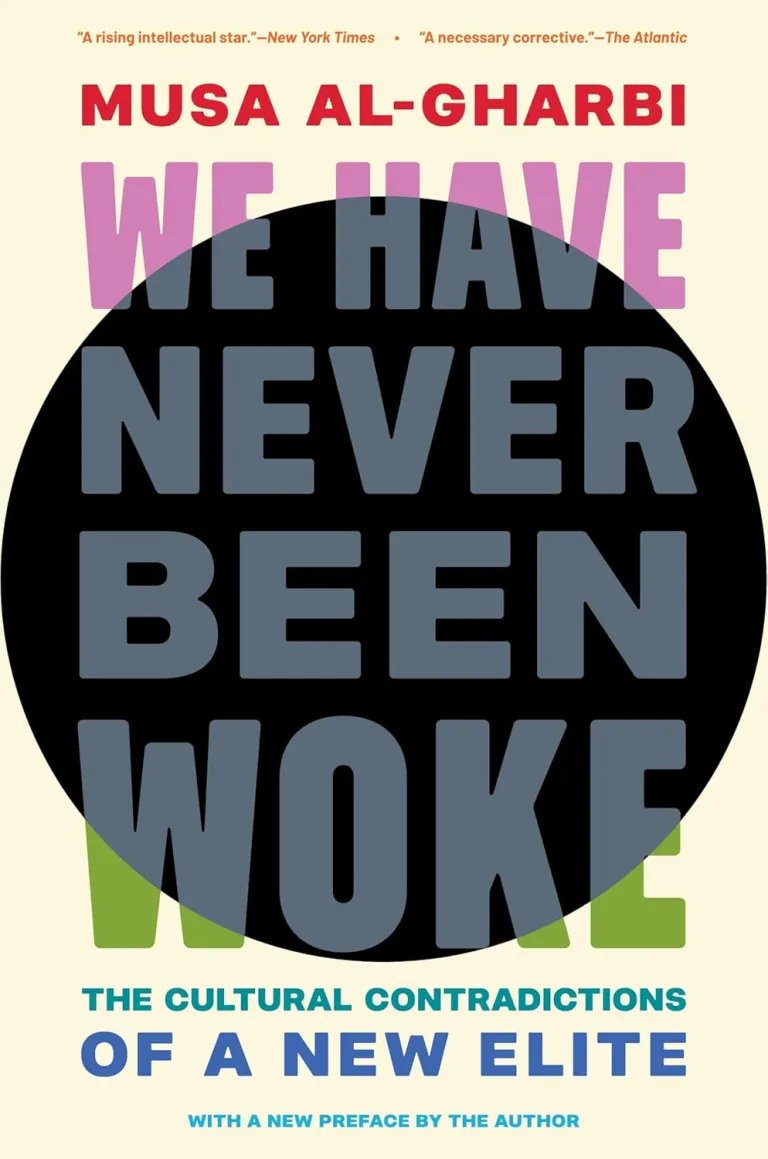
You definitely can't check out my book to find out a lot more about the composition and political economy of the journalism field, and how it relates to a lot of these tensions: musaalgharbi.com/we-have-never-…
After all, there's nothing to even possibly discuss here. Chuck Todd is right. Mainstream media organizations are just tiny helpless victims of an empty moral panic. Nothing they should, would, or even could change about what they do. And no need to change -- things are going swimmingly!
• • •
Missing some Tweet in this thread? You can try to
force a refresh

1. The outcome of the #NYC mayoral race was less extraordinary than most seem to think
2. Popular culture war talking points about the role of class, gender, sexuality, youth, race and residency length are total bunk
🧵
The fact that @TheDemocrats won the NYC municipal elections should surprise no one. Since 1932, for instance, there have been 26 mayoral elections. Republicans have won 7 of them. The last three consecutive contests went to Democrats by 2:1 margins: musaalgharbi.substack.com/p/a-graveyard-…
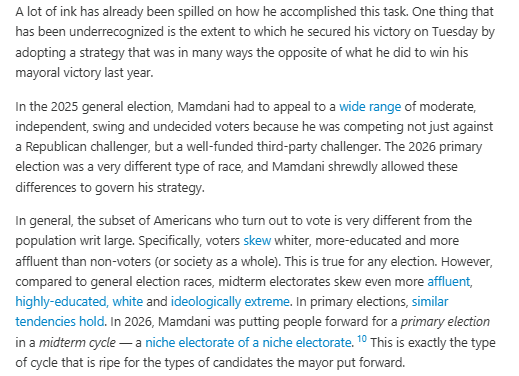
Mamdani’s performance in 2025 was far from extraordinary. In terms of vote share, he ranks 12 out of 19 elections since 1953. In terms of turnout, this race ranked 13 out of 19. The million votes Mamdani won? Largely a product of a larger NYC population: musaalgharbi.substack.com/i/178564807/hi…
My latest for Symbolic Capital(ism) explores the highly censorious culture that prevails in many symbolic industries.
It argues that universities play an important role in shaping institutional culture in all of these other fields --but not for the reasons most think. 🧵
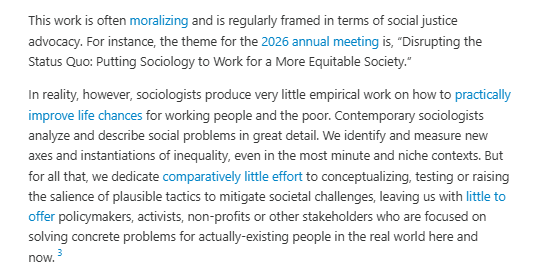
So, one thing that separates WHNBW from many other books charting the culture wars is that it spends precisely zero time trying to genealogize, taxonomize, or evaluate the correctness of "woke" theorists or ideas.
Antiwoke and right-aligned folks were SUPER annoyed with this, apparently having gone into the book hoping the book would be a definitive takedown or refutation of "wokeness" and discovering that, in fact, the book is not very interested theorists and their ideas.
One reason for this, as I've detailed previously, is because these sorts of considerations are orthogonal to the actual questions the book is trying to answer (see screenshots): musaalgharbi.substack.com/i/158204710/it…
BUT, it's also important to stress, that even if we want to answer some of the specific questions that the antiwoke crowd is interested in -- you simply can't get much mileage by studying widely-evoked thinkers and their work, for reasons I explain in my latest essay: musaalgharbi.substack.com/p/you-ask-i-an…
This is a place where my thinking was deeply informed by @JonHaidt and @glukianoff's Coddling of the American Mind.
When they began that project, they were working from an assumption that universities were taking normie kids and transforming them into censorious scolds. Through their research, however, they discovered that students were, in fact, arriving to campus already oriented towards safetyism and intolerance.
Universities might be doing a bad job of pushing back against these impulses (often reinforcing them instead), but they were not the *source* of the problem: musaalgharbi.substack.com/p/censorship-i…
We need to move away from classroom "indoctrination" stories and look at other mechanisms of enculturation if we want to understand unfortunate institutional dynamics.
My latest for Symbolic Capital(ism) explores why the symbolic professions tend to be highly unrepresentative of the societies they purport to serve, and are often dominated by bizarre beliefs and norms.
tldr: It's because they tend to be comprised of people who are cognitively sophisticated and highly educated. Quick 🧵
One thing that's critical for understanding how intelligence and education relate to political beliefs and behaviors is to recognize that our cognitive and perceptual systems are wired primarily to help us enhance our status and further our goals. We perceive and think about the world in fundamentally self-interested ways: musaalgharbi.substack.com/p/smart-people…
The tendencies to perceive and think about the world in ways that flatter our self interest, further our goals, and so on -- these are not necessarily "bad." In most circumstances, they are "life enhancing" in Nietzchean terms, but they do regularly cause problems in the context of knowledge and cultural production: musaalgharbi.substack.com/p/smart-people…
For Symbolic Capital(ism), I just published a piece pulling together lots of empirical data to answer questions like:
Did Trump win because of racism?
Did Trump win because of sexism?
Did Trump win because "elites" bought the election?
Did Trump win because of third-party "spoilers"?
Did Trump win because of weak turnout?
Did Trump win because Harris chose the wrong running mate?
As the essay details at length, the answer to all of these questions is "no." It's easy to see how people would be drawn to these questions, but none of these hypotheses do a good job of explaining what actually happened in 2024 (or the previous Trump cycles, for that matter). 🧵
Let's start with race: Democrats saw gains with white people this cycle. Harris did about as well with whites as Democrats typically do. She saw improvement with whites across gender lines relative to 2020: musaalgharbi.substack.com/p/a-graveyard-…
So why did she lose? Well, that would be because of shifts among non-whites. Non-whites across gender lines moved away from the Democratic Party. Harris put up weak numbers with Black women (relative to Hillary or Obama). Democrats' margins with Hispanic women shifted dramatically towards the Republicans. They saw losses with Asian women. And non-white men shifted even further (even as white men shifted heavily towards Democrats over Trump's tenure in office).
The preferred narrative on race is helpless to explain the trendlines among whites and the trendlines among non-whites. But put simply, Harris didn't lose because of the whites. She lost despite solid (and growing) support among the whites, because non-white voters had other ideas.
What about gender? This is two female nominees Trump has bested, but he lost to Joe Biden. A clear sexism story, open and shut case, right? Here, again, the voting data beg to differ: musaalgharbi.substack.com/p/a-graveyard-…
Gender polarization in the electorate was down since 2016. Harris' voteshare among men was consistent with typical Democrat performance (an outcome driven heavily by white men moving Democrat over the last decade, even non-white men across the board went the other direction). Trump's margins with men were not historic.
The reason Harris lost is because she performed abysmally with women. She got the lowest share of the female vote of any Democrat of the last 30 years other than John Kerry. And it wasn't white women: they actually shifted towards the Democrats this cycle. It was Hispanic and Asian women who shifted most towards the GOP -- although Harris also significantly underperformed Hillary Clinton and Barack Obama with black women too.
Since 2016, men shifted 2 percentage points towards the GOP. Meanwhile, women shifted five percentage points towards the GOP (i.e. more than twice as much!). But rather than analyzing this latter trend -- rather than exploring how women exercise their agency, the focus is intensely on men. Even though they are objectively less important: they are a smaller share of the overall adult population, they are registered to vote at lower levels, among registered voters they turn out at lower levels. Put simply, if we want to understand how any race went the way it did, we need to look at women and how they exercise their agency. But this isn't done. Not even by feminist scholars -- perhaps especially not by feminist scholars in this case -- because the actual data pattern is super inconvenient for the preferred narrative.
Today on Symbolic Capital(ism) I review George Orwell's "The Road to Wigan Pier" which had an immense influence on my thinking about Great Awokenings, but is also highly relevant to understanding many contemporary political dynamics. Quick 🧵
One of the first things that jumps out at you reading the book is how much the first Awokening has in common with the current one: musaalgharbi.substack.com/p/book-review-…
We have X. Kendi writing "Antiracist Baby." They had Comrade X writing "Marxism for Infants."
The Oppressor/ Oppressed framework? More than a century old.
Intersectional social justice struggles? Same, same.
I suspect the depictions in the screenshots below would seem immediately familiar to contemporary readers.
One of the most disturbing elements of reading a lot of historical texts is coming to see in stark terms the truth of Ecclesiastes, that there is nothing new under the sun.
A core objective of The Road to Wigan Pier is to understand and explain why the left was deeply unpopular with the working class -- the very people who stood to benefit the most from socialism, and the people who "the revolution" was supposed to be organized around. He came up with three answers: musaalgharbi.substack.com/p/book-review-…
Lots of folks on this site began by smearing McDonalds, showing revulsion for that kind of work, for the food, and disdain towards the kinds of people who would eat there. And then, when the poor class implications of these narratives became undeniable, they tried to retrofit their comments as being about something else... like the staged nature of the event, faux populism, etc.
It's fine to criticize those things! But that wasn't the initial tenor of the conversation at all. And the initial conversation is a good example of why this was a good political stunt for Trump -- provoking the Democrats' core constituency into mocking and deriding "those people" in elitist ways.
The same kind of thing happened when he served up McDonald's to college athletes: cnn.com/2019/01/15/pol…
For his part, Trump famously loves @McDonalds. He's eaten there his whole life, and has a really idiosyncratic go-to order, as highlighted during his initial run for office: businessinsider.com/trumps-mcdonal…
So it's theater. But it's also real passion for the product. And this latter fact is the kind of thing that a certain bloc of America really finds grating about the man. And another part of the population finds endearing.
For my part, I couldn't help but think of @Chris_arnade's book Dignity while watching many who self-identify with the left step onto a rake on this issue.
As Arnade highlights, for many less affluent folks, McDonalds is an important community gathering point.
It's bad politics to bash McDonalds, the people who work there, or the people who eat there. Don't recommend.