We’re going to hear lots of stories about which people, policies and rhetoric are to blame for the Democrats’ defeat.
Some of those stories may even be true!
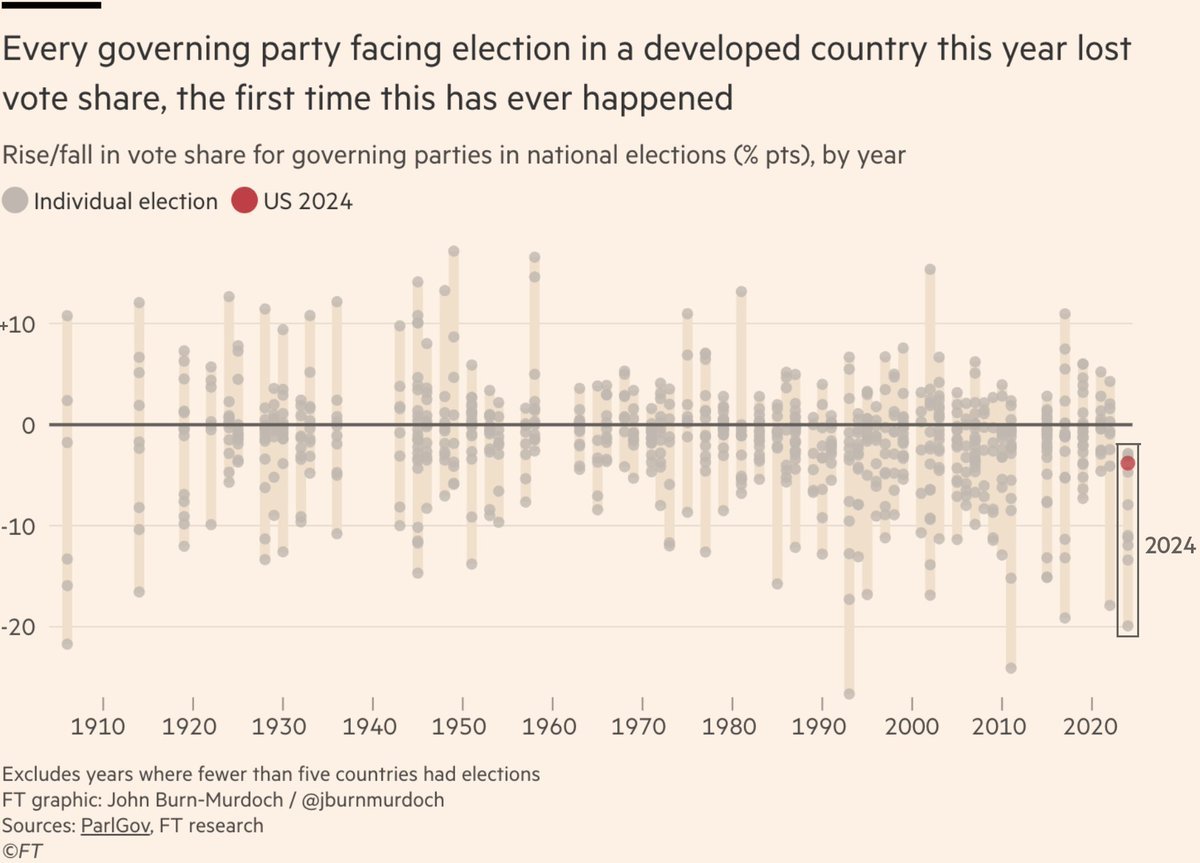
But an underrated factor is that 2024 was an absolutely horrendous year for incumbents around the world 👇
Some of those stories may even be true!
But an underrated factor is that 2024 was an absolutely horrendous year for incumbents around the world 👇

Harris lost votes, Sunak lost votes, Macron lost votes, Modi (!) lost votes, as did the Japanese, Belgian, Croatian, Bulgarian and Lithuanian governments in elections this year.
Any explanation that fails to take account for this is incomplete.
More here ft.com/content/e8ac09…
Any explanation that fails to take account for this is incomplete.
More here ft.com/content/e8ac09…
Did Biden hold on too long?
Has progressive politics alienated some Hispanic and Black men?
Yes and yes, but taking action to address those issues probably wouldn’t have produced a fundamentally different outcome.
Has progressive politics alienated some Hispanic and Black men?
Yes and yes, but taking action to address those issues probably wouldn’t have produced a fundamentally different outcome.
People *really* hate inflation!
Though it’s also notable that most countries seeing political reversals this year have also had record high immigration, and parties on the right have made big gains.
Economic upheaval + social upheaval = 2024 election results.
Though it’s also notable that most countries seeing political reversals this year have also had record high immigration, and parties on the right have made big gains.
Economic upheaval + social upheaval = 2024 election results.

And to clarify: this isn’t just the first time since WW2 that all incumbent parties in developed countries lost vote share.
It’s the first time since this data was first recorded in 1905. Essentially the first time in the history of democracy (universal suffrage began in 1894).
It’s the first time since this data was first recorded in 1905. Essentially the first time in the history of democracy (universal suffrage began in 1894).
@C1aranMurray Or do you mean one of the coalition parties (FG) is on course to gain vote share?
Apparently some Dems are concluding from this that they were powerless to avoid a heavy defeat, so I will take this opportunity to plug my column from last month warning that progressives’ leftward shift on social issues was alienating Hispanic voters ft.com/content/84b816…

• • •
Missing some Tweet in this thread? You can try to
force a refresh