First, the facts: it sounds like the feds will be able to recoup almost all of that $34 billion.
The PBO just put its value at between $29.6 and $33.4 billion.
pbo-dpb.ca/en/publication…
The PBO just put its value at between $29.6 and $33.4 billion.
pbo-dpb.ca/en/publication…
But that's its value to a private entity. Its value to Canada -- and mostly, Alberta -- is FAR higher.
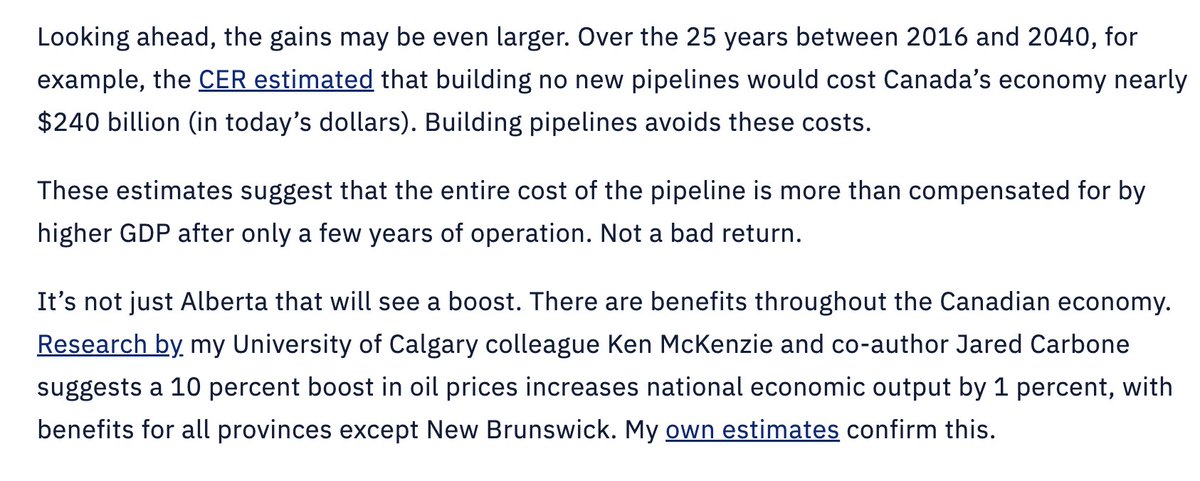
Here's Trevor Tombe:
Here's Trevor Tombe:
As to the idea that the feds should have just "cleared the way" for private industry?
It's like these guys don't learn. The Harper government tried that approach. It backfired massively -- and it built a grand total of zero pipelines to new tidewater.
It's like these guys don't learn. The Harper government tried that approach. It backfired massively -- and it built a grand total of zero pipelines to new tidewater.
And the comparison between the US and Canada?
It's *all* geography. If Alberta was located on the Pacific Ocean it would have built all sorts of LNG terminals and pipelines. And if America's oil and gas had to get through California or New York, it would have built NOTHING.
It's *all* geography. If Alberta was located on the Pacific Ocean it would have built all sorts of LNG terminals and pipelines. And if America's oil and gas had to get through California or New York, it would have built NOTHING.
And the stuff about billions being lost? Most of said projects that were scuttled had been planned or permitted *before* oil and global LNG prices crashed in 2014.
High-cost oil sands and greenfield LNG projects don't do well in low-price environments.
High-cost oil sands and greenfield LNG projects don't do well in low-price environments.
Now, I know folks like Jean won't actually engage with reality here. They need the boogeyman of Trudeau and the federal Liberals to distract Albertans from their own failures (hello, lost renewables investment!)
But the facts don't care about your feelings.
But the facts don't care about your feelings.
• • •
Missing some Tweet in this thread? You can try to
force a refresh