🧵Here's a special Black Friday FATF Thread to complement @pmarca 's explainer on the Joe Rogan show about how the USG's "control mechanism" was applied to Big Tech by emulating the way it already controlled the banking system.
2/ FATF stands for the Financial Action Task Force (FATF). It originated in 1989 as a one-year fact-finding mission, championed by the United States during the “war on drugs,” but has since evolved into one of the most influential, yet opaque, financial regulators in the world.
3/ Its power stems not from formal authority but from the coercive force of economic exclusion. Nations that ignore its mandates risk blacklisting that shuts them out of global markets.
4/ Yet the FATF’s origins and methods reveal a troubling inversion of legal norms, where financial institutions have arguably supplanted judicial processes and presumed guilt has become the default. So how did all this start?
5/ The FATF’s roots lie in the 1980s, a period when the United States began treating financial flows as tools of law enforcement. In 1986, the US passed the Money Laundering Control Act, the first law to formally criminalize money laundering.
6/ This domestic initiative soon spilled into international forums, with the Basel Committee issuing statements in 1988 and the UN defining money laundering that same year. Despite these efforts, global coordination faltered.
7/ To address this, the US proposed the Financial Action Task Force as a temporary intiative under the auspices of the G7. Its initial mission was modest: cataloging the state of anti-money laundering (AML) laws worldwide.
8/ But the FATF’s role soon expanded dramatically. In the 1990s, its mandate grew to encompass broad AML objectives. By 2001, the “war on terror” provided a new pretext for intervention, transforming the FATF into a counter-terrorism financing (CFT) body.
9/ This shift was no coincidence. Around the same time, the US was losing the so-called “crypto wars” — a battle over the control of encryption tech. American attempts to mandate backdoors in encryption software had largely failed, weakening its capacity to surveil digital chat.
10/ The FATF’s expanded focus on financial flows filled this gap, providing a new channel for economic data collection on a global scale.
11/ The FATF’s power is subtle but immense. It operates not as a formal institution, but as a project hosted by the OECD in Paris, staffed by a few dozen officials. Critics say the lack of a formal structure is deliberate, shielding it from accountability mechanisms.
12/ Its influence flows from a deceptively simple mechanism: the creation of black and grey lists. Countries that fail to meet FATF standards are effectively ostracized from the global financial system.
13/ Compliance, therefore, is non-negotiable, even when FATF standards conflict with national legal norms or civil liberties.
14/ Critics say at the heart of the FATF regime is a profound usurpation of judicial authority. This is because the task force’s AML and CFT frameworks rely on financial institutions, rather than courts, to enforce compliance.
15/ Banks are required to assess the risk profiles of their clients and report “suspicious” activity. But these determinations are often subjective, informed by opaque algorithms and vague guidelines.
16/ The result is a system where accounts can be frozen, assets seized, or services denied without due process. Innocent until proven guilty — a cornerstone of the judicial system — is often replaced by its inverse.
17/ 👉This shift has redefined banking. Historically, financial firms served as neutral intermediaries, providing credit & processing transactions without moral or political judgment. Under FATF, banks have become enforcement agents of the state, tasked with policing customers.
18/ Compliance costs have ballooned, with billions spent annually on AML measures that often fail to achieve their stated aims. Suspicious Activity Reports (SARs), for instance, are generated in vast quantities but largely ignored by underfunded law enforcement agencies.
19/ Meanwhile, the regime’s success at curbing actual crime — whether drug trafficking, terrorism, or fraud — remains dubious. There has been no notable suppression of criminal activity or sanctions abuse because of FATF.
20/ The costs, however, extend far beyond inefficiency. The FATF framework has politicized finance, undermining the principle of monetary neutrality. What qualifies as “terrorism” or “money laundering” often depends on geopolitical interests.
21/ Movements supported by NATO allies may escape scrutiny, while others face debanking and exclusion. This discretionary power has been wielded against figures as varied as crypto merchants and politicians like Nigel Farage, chilling dissent and innovation.
22/ Perhaps the most alarming aspect of the FATF’s evolution is its erosion of transparency and accountability. Banks are often forbidden from informing clients that they have been flagged as risks or Politically Exposed Persons (PEPs).
23/ This secrecy compounds the sense of arbitrariness, transforming financial institutions into covert surveillance arms. For individuals, the implications are stark: loss of access to financial services, reputational damage, and no clear recourse.
24/ Yet the FATF marches on. Its latest incarnation sees the EU establishing a centralized anti-money laundering authority in Frankfurt.
25/ FATF’s trajectory is a cautionary tale. What began as a tool for financial integrity has morphed into unchecked economic control, undermining civil liberties and the principle of monetary neutrality. All without meaningfully reducing any of the criminal activity it was tasked to reduce.
26/ The other perverse consequence is that the de-facto outsourcing of policing to banking staff, has left the actual law enforcement agencies underskilled, complacent and under-resourced to fight real crime.
• • •
Missing some Tweet in this thread? You can try to
force a refresh

🏴☠️1/ If what I think is happening is really happening, then I can make some predictions. Especially about incoming European problems.
But first an important side story, which also relates to the “special relationship”.
What a lot of people don’t know is that when Minos Zombanakis, the father of the Eurodollar market, started looking for a hub for his offshore dollar operation in Europe, he originally hoped Brussels not London would be its base.
That’s because Brussels was the home of NATO.
This was not to be.
As Andrew Hilton (city veteran) once told me, the Belgian central bank refused to give approval.
Zombanakis next turned to Paris, but the BdF also rejected him.
Finally, he turned to London.
As Hilton tells the story “they [aka the BoE] didn’t put any obstacles in his way.”
The rest, as they say, is history. London Eurodollar clearing became a trillion dollar business, over which Brexit fights would eventually be fought.
In no time at all Stanley Yassukovich (at the time representing investment bank White Weld), as well as a number of other American banks, got approvals to set up euromarket operations in the square mile.
Why did no other central banks want to say yes? Officially, they were concerned about financial stability. In reality, they knew what a dollar tap in their jurisdictions signified for their own monetary sovereignty. Their currencies would never be their own again, because European corps would always find it more cost effective to fund in dollars.
This was all the more the case in any economy operating a dirigiste policy. They feared price discovery through competition.
Eurodollars didn’t just bypass monetary control — they undermined the system of domestically captive finance that governments relied on, raising funding costs and exposing fiscal policy to external market discipline.
It also translated to pressure on the gold price in ways that increasingly drained reserves.
Which brings us back to the special relationship. Why did London say yes when nobody else would? Probably because it had no choice.
It was just after Suez, which made the nature of capital flows and dependencies abundantly clear.
2/ the fallout from London’s approval would be substantial.
In Europe it assured that the continent’s many dirigiste economies would be continuously pressured by London’s shadow dollar financing networks. Even in the UK the price discovery effect of Eurodollars would prove destabilising for the government.
By 1962 the wider Bretton Woods system began to crack, inviting the first significant intervention from the Fed.
The first line was with the Bank of France in 1962 (quickly tested by drawing on it). By the end of 1962, the Fed had lines with nine key countries, including several in Europe: Austria, Belgium, England, France, Germany, Italy, and the Netherlands (plus Canada and others). Lines were also set up with the Bank for International Settlements (BIS)
In hindsight it was probably the discrepancy between market rates and controlled rates in Europe, as reflected in Eurodollar markets, that drove the Bretton Woods system to its knees.
Even with Fed support, however, the dollar’s linkage to gold meant the system was becoming unstable. Dollar claims far exceeded the amount of gold available in the Bretton Woods system, and notably the Fed.
In 1971 the system broke explicitly in an incident that became known as the Nixon shock.
After that, European currencies moved fairly quickly to more flexible exchange rates, while capital and exchange controls were dismantled more gradually over the following two decades.
But here’s the thing. once everything floated, Eurodollar liquidity continued to pool in London.
Moreover, because of the diversity of currencies in Europe, demand for dollars in London remained very high. It was simply far more logical to use liquid dollars as a bridging currency than to exchange between two illiquid European currencies directly instead.
This naturally infuriated the Europeans. Every transaction, one way or another, was sending economic value back to London.
On top of that, dollar float remained bound in London. This was highly lucrative since it not only provided lovely rents (seigniorage) for Queen and country, it enabled the UK to globalise its financing operations with the cunning use of flags and offshore dependencies.
Furthermore, it guaranteed that Britain’s added value to the EU would forever be finance.
The euro project was in part concocted to help liberate Europe from this broadening dollar “tyranny”.
Except, of course, any hope of the UK joining forces with the continent to rid itself of the dollar yoke died in 1992. This was when the pound famously came under attack by George Soros, forcing the UK to crash out of the ERM. The trade was notably facilitated by current US Treasury Secretary Scott Bessent. The incident would become known as Black Wednesday, the day Soros broke the Bank of England.
All UK aspirations of joining the euro project after that were quashed. Britain would instead be allowed to retain the pound, and with that Eurodollar clearing.
3/ so what does this foretell about the here and now?
First, there’s the reality that the euro’s creation did little to curtail Europe’s dependency on dollar financing and dollar clearing out of London.
After Eurodollars nearly brought the system down in 2008 (forcing the Fed to rollout dollar swap lines) the Europeans would hunker down in an attempt to prevent such risks from resurfacing.
In the immediate aftermath they constrained the Eurodollar machine by making it harder for continental European banks to run large, short-funded, dollar balance sheets.
Banks had to hold enough high-quality liquid assets for stressed outflows and fund longer-term assets with more stable liabilities. That directly penalised the classic Eurodollar model: borrow short-term wholesale dollars, lend or invest longer.
It made the whole thing a much more narrow system.
The deleveraging however would have a huge bearing on demand for home country sovereign bonds. These we now know had been substantially used by banks in certain jurisdictions (among other assets) as collateral to obtain dollar funding. In some cases super leveraged to raise financing for hard up governments.
In particular, the Greek deals with Goldman Sachs were cross-currency swaps structured at off-market rates so that Greece received upfront cash in exchange for higher future payments. Economically it was borrowing, but because it was packaged as a derivative, the liability was deferred and less visible in headline debt figures.
Before 2008, banks could easily carry and fund these positions within the Eurodollar market: dollar liquidity was abundant, collateral could be reused, and cross-currency swaps were cheap to maintain. That meant the system could absorb these deferred liabilities without immediate stress.
After 2008, Basel III-style rules made this much harder. Higher capital charges, stricter liquidity requirements, and heavier collateral demands raised the cost of maintaining swap exposures and reduced banks’ ability to roll dollar funding. When stress hit, banks unwound positions instead of extending them.
That unwinding exposed the true cost of the deferred liabilities and simultaneously reduced demand for sovereign bonds, because the same balance sheets supporting the swaps were also supporting government debt. The result was higher yields and intensified sovereign stress.
The fallout nearly ended the euro project and led to Mario Draghi’s famous proclamation that he would do “whatever it takes” to save the system.
🧵Some other important swap line factoids: 1/ Robert McCauley has been warning about the potential weaponisation of dollar swap lines for quite a while. In this view, the US is likely to apply statecrafty terms and conditions on dollar liquidity access as and when tensions escalate.
2/ Dollar liquidity + conditionality => to allies only = New US sphere of influence. Over time, this new dollar swap line diplomacy club stands to displace the IMF-based system or bifurcate it in the old Cold War sense.
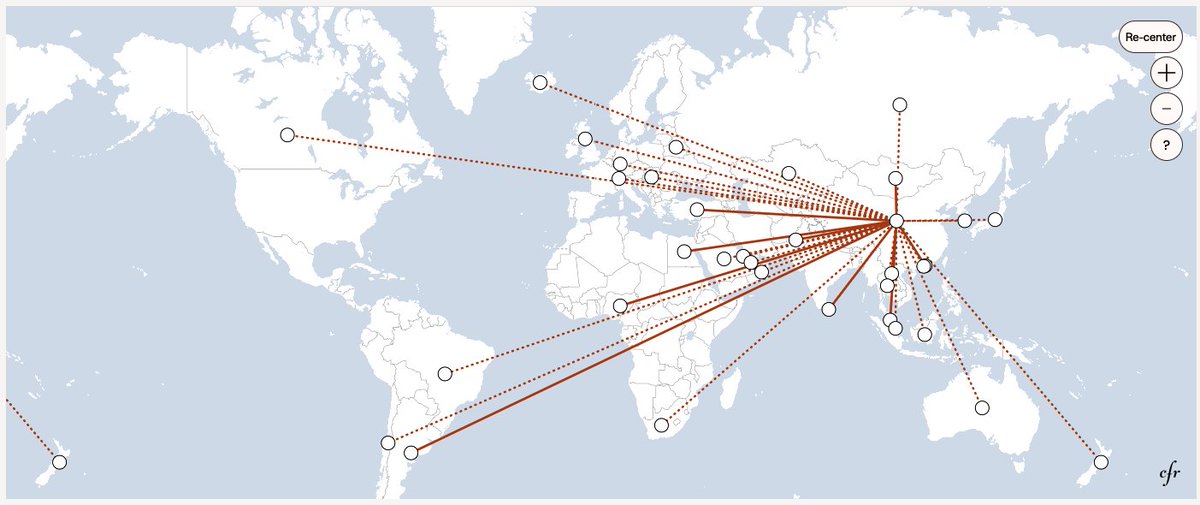
3/ American 'dollar swap line' diplomacy (or, if you prefer, weaponisation) is mostly a counter to Chinese 'yuan swap line' diplomacy. While the Fed has 5 lines in place, China has 31.. including with the ECB, BoE, BoC and the UAE.
A note on the increasingly frustrating dollar swap line confusion.
While the ESF definitely has a shady history in which it doubles up as black ops financing arm of the US Treasury, when it comes to the UAE situation, it's simple dollar liquidity mechanics that are the issue in this case.
To understand this you need to go back to your Zoltan Pozsar 101, about how shadow dollar liquidity actually flows through the system. This explains entirely what's going on at the moment.
Adam Tooze would have you think otherwise and brings up the ESF's shadowy history as a source of slush funds to add intrigue to the situation. (While it's not untrue, it's besides the point). And now Brad Setser is speculating there may be "something radically new about the US providing dollar credit to a country that itself has pledged to invest in the US" and that this "looks like the US government is financing a off balance investment fund outside Congressional scrutiny, with the Emirates getting the upside ..."
But I'm pretty sure that this is not the case. It's an entirely obvious and transparent situation.
First of all, the original WSJ story that flagged the UAE situation talked about swap lines not ESF-funded Argentina-style swaps. These are entirely different arrangements. For one, the ESF is a Treasury-powered vehicle and usually operates via finite credit facilities. It is also usually arranged between respective sovereign Treasuries.
A swap line, however, is Fed-initiated and potentially limitless. It is an arrangement between fellow central banks.
Now, if you speak to central bankers in the know, they will tell you that despite the central banking framing, it's not entirely the case that the Treasury has no influence on the initiation or not of a swap line. But this doesn't change the mechanical structure, which sits outside of the Treasury system — and imposes on it only in so much as central bank profits or losses ever do. The WSJ may have got the nomenclature wrong, but I doubt it.
As to why the UAE, despite having pledged to invest in the US, needs dollars? I'd argue it's because the original investment is mostly an expression of allegiance, and a signal that the UAE trusts the US to defend its property rights more so than any other superpower and is prepared to fund its military-industrial reconstitution... since the protection of its property rights also hangs in the balance.
If the UAE decides to fund these investments with USTs, this mostly constitutes a transfer of that economic value from the Treasury to the private sector. There needn't be a liquidity event associated with the transfer if it's mediated, as it has been, at the US Government level and extended via a co-investment with the US into newly forged equity investments.
The UAE leg, in that sense, becomes a promise to expire its outstanding claim over the US Treasury in exchange for x shareholding (49% one would presume) in the newly forged company. Think of it more like an asset swap, wherein its debt-based assets are swapped into equity assets underpinned by USG co-investments.
The actual liquidity to start the venture up would likely come exclusively from the US side, with the funding essentially already raised by way of the defense industrial allocations in the BBB. In that scenario, the investments act more like a quid pro quo with an ally, to ensure the US can raise the money it needs via formal channels, without fear that its bond markets do a Liz Truss.
But it's very unlikely that the UAE plans to fund these American investments entirely with UST reserve assets. Much more likely, it plans to deploy its trillion-dollar sovereign wealth fund chest, as well its future oil revenue, to meet most of the $1.4 trillion investment it has promised over 10 years.
In that case, what the UAE would really be doing is merely bouncing back dollar liquidity that's already coming its way from existing USD-denominated assets straight back into American investments. The only difference is that on this occasion, it has agreed to transfer some level of influence over how those investments will be steered. This makes sense if the true purpose of the arrangement is to help reindustrialise the US, as the USG sees fit, so that it can better provide regional security and defy industrial decoupling with China.
Why does it make sense for the UAE? Since some 50% of its SWF is already invested in the US, if America loses in a war with China or Iran, so does the UAE. It needs a strong and autonomous America with trusted supply chains to defend it.
In some respects, this is an echo of how China funded its own industrialization. In 1979 under Deng Xiaoping’s broader “Reform and Opening-Up,” China brought in its Equity Joint Venture Law, creating the main channel through which foreign capital first entered China’s industrial economy.
The main difference here is that in China's case, the co-investments were with Western private sector companies or multinationals. In America's case it is wooing capital from fellow sovereigns, with whom it can establish related defense agreements. Statecraft 101.
Why dollar swap lines then? Well, if a good chunk of UAE dollar liquidity is drawn from oil sales, this is self-evidently currently under pressure. And while the UAE probably has many other sources of dollar income, it's what happens at the margin that matters. Under a peg system even a small marginal fluctuation in flows can put pressure on the system. All the more so, if foreign residents are moving money out of the UAE because of regional volatility.
A country like the UAE, in such circumstances, faces the same problem as a distressed bank. It finds itself technically dollar-asset rich, but simultaneously dollar-liquidity poor.
The options it has on the table in that case are either to abandon its peg temporarilly, liquidate its assets at potentially firesale prices compounding the problem (definitely suboptimal), borrow from the market, or seek the one thing it doesn't have under a pegged system: Access to a dollar lender of last resort.
With the UAE likely to become a formal ally, extending lender of last resort facilities to help it manage local dollar liquidity issues, seems the obvious way to go for the US. In a sense it becomes the first official member of what Robert McCauley sees as the emergence of a new dollar swap-line diplomacy club. [Which could, in my mind, be the makings of a new type of IMF system.]
For a country that already operates under a soft form of dollarization, it's not too great a leap.
There are so many layers to the dollar story that transcend conventional market economic dynamics. Until investors realise this I do believe they will be caught out by narratives that serve political agendas not reality.
Crucially, most “end of the dollar” takes completely miss the point and purpose of why the system came to be in first place. This had much less to do with Americans living beyond their means and much more to do with protecting capitalism and its open, property-rights-based economic order from rival systems that did not have to be accountable to such free market forces.
The central challenge emanating from the Cold War was not simply ideological or military — it was structural.
Command economies could direct resources at scale into strategic and military priorities without regard for market signals, profitability, or consumer welfare. Market democracies, by contrast, were constrained by inflation, capital costs, voter expectations, and financial discipline. Left on their own, market economies risked being outcompeted over time by rivals that could forcibly allocate capital into dual-use industrial capacity and military buildup without internal resistance.
The American “statecraft” solution was not to abandon markets, but to reorganize how they operated at the system level thanks to the cunning use of allies with guilty consciences due to historic war debts. And later petro states. The dollar-based order, and the alliance structure built around it, was designed to distribute economic roles in a way that neutralized those constraints.
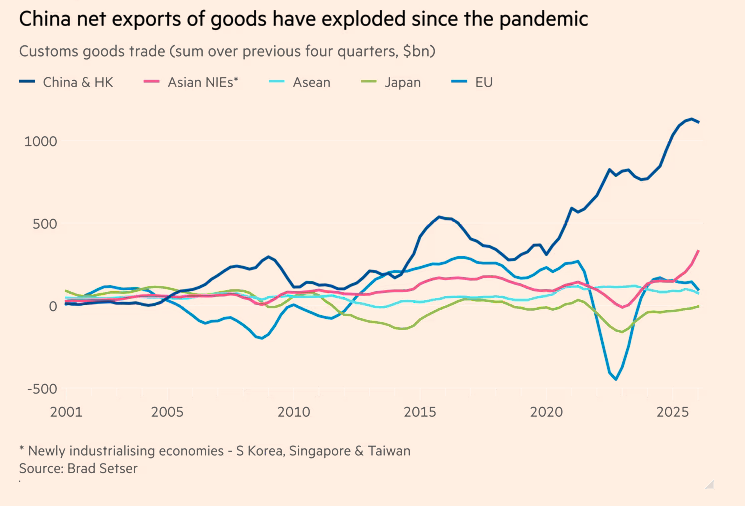
Industrial allies such as Japan were encouraged — implicitly and explicitly — to pursue state-guided, export-led growth, building high-quality manufacturing capacity and running persistent surpluses.
Those surpluses were then recycled (on a gentleman’s agreement basis) back into dollar denominated private sector assets but also, crucially, into US government issued debt in a way that suppressed funding costs enough to ensure the U.S. could maintain its very substantial military industrial complex advantage.
That in turn allowed the United States to maintain an edge - even in a capitalist free market system - in defense, advanced research, and system integration, without having to bear the full economic burden domestically.
By externalizing parts of the industrial base and anchoring global finance in dollar demand, the system allowed market-based democracies to sustain a level of military competition that would otherwise have triggered destabilizing inflation, rising interest rates, and political backlash.
The dollar’s role was therefore not simply a privilege, but a mechanism: a way of converting allied industrial output and savings into strategic capacity.
From the allies’ perspective, the bargain was equally clear — access to U.S. markets, security guarantees, and the protection of property rights within a stable global framework. This was something they would not get from the other super power in the mix: the USSR.
Seen this way, the system was never about excess consumption or imbalances for their own sake. It was a deliberately constructed architecture to ensure that an open, capitalist order could compete with — and ultimately outlast — closed systems capable of mobilizing resources without constraint. The durability of the dollar is therefore not an accident of history, but a reflection of the enduring logic of that arrangement.
Also, via my framing, the petrodollar was a natural extension of that same logic.
The arrangement on offer was not subservience, but a precise alignment of incentives: price and settle oil in dollars, but recycle a defined share of the proceeds specifically into U.S. Treasuries — not merely into U.S. assets more broadly.
Remember recycling into private assets would have occurred regardless. The strategic objective was to direct a good chunk of those flows back to the state so that the core guarantor of the system — the U.S. military and security apparatus — remained fully funded.
From the producers’ perspective, this was a rational exchange. Wealth held in private assets ultimately depended on a security architecture they could not independently guarantee. By allocating a portion of their surpluses to U.S. government debt, they were sustaining the very system that protected their accumulated wealth and property rights, especially in the context of a Cold War that threatened appropriation.
Crucially, this architecture achieved something unusual: it coordinated economic roles across countries without requiring formal political control or the suppression of domestic autonomy. In contrast to the Council for Mutual Economic Assistance (COMECON) — which imposed centralized coordination within a closed, command-economy bloc — the Western system operated through incentives rather than directives.
Members retained sovereignty and market-based governance while participating in a structure that distributed industrial production, resource flows, and financial recycling in a mutually reinforcing way. In that sense, it functioned as a kind of market-based counterpart to Comecon — achieving strategic coordination without abandoning capitalism or political independence.
The durability of the system was connected to the fact that the arrangement allowed open, capitalist societies to sustain strategic competition while preserving both economic dynamism and political freedom.
I do have historic proofs to support the thesis. A key influence is the work of my mum, who was an economic graduate of SGH (Poland’s top economic planning university) in 1972.
I recently found her thesis and it was entirely focused on these statecrafty arrangements, specifically the logic behind Japan’s export-oriented economic model and its close relationship with the US. A good chunk of it is focused on intellectual property licenses and transfers between the two states.
THREAD: Why the private credit crisis is just the West’s version of “involution”
1/ In my latest piece for TBS I argue that the West's growing private credit crisis represents its own version of China's economic "involution" — a liquidity-driven form of economic growth that produces enormous activity and capital deployment but progressively weaker underlying returns.
2/ In China the mechanism was domestic financial repression. Cheap household savings were channeled into low-return industrial investment, producing massive overcapacity and exports sold abroad at razor-thin or even negative margins.
3/ In the West the mechanism looked different but produced a similar outcome. Extremely cheap capital and abundant liquidity fueled a private-equity, venture, and later private-credit ecosystem that allowed large numbers of structurally unprofitable firms to keep expanding.
Nice to see that @HyunSongShin has officially recognized that stablecoins open the door to an "Uber Surge Pricing" type liquidity market. [Actual gas markets also clear in a similar way, notably the NBP balancing point system.]
The below screenshot is from his latest BIS paper "Tokenomics and blockchain fragmentation".
This is something I've been pointing to for years, though I've seen it as eventually leading to dynamic pricing and markets for intraday funds in general.
The paper is more concerned about the fragility and fragmentation risk introduced in systems that rely on many different networks using surge pricing mechanisms to ration entry and exit across systems.
And of course turkeys don't vote for xmas, so the central bank perspective is that all this "congestion" and cost uncertainty can be avoided if programmable money just shifts to cbank ledgers where the cbank balance sheet can absorb congestion shocks in a way that can regulate transaction costs.
The BIS concludes: "These [programmable money] innovations do not require decentralised consensus among anonymous validators. They can be implemented on unified ledgers anchored by central banks, which benefit from the institutional trust of the
traditional monetary system."