Gerd Gigerenzer's "ecological rationality" builds on Herbert Simon's "bounded rationality".
Both concepts describe human decision making in a way that challenges the traditional assumptions of "homo economicus".
🧵:
Both concepts describe human decision making in a way that challenges the traditional assumptions of "homo economicus".
🧵:
https://twitter.com/page_eco/status/1860470656372260891
Simon observed that real humans face limits on information, time and computational capacity. He called decision making under these constraints "bounded rationality". 

Given these constraints, humans make "good enough" decisions, trading off optimality for efficiency.
Why are good enough decisions more efficient? Because information and computation aren't free--they're costly.
Why are good enough decisions more efficient? Because information and computation aren't free--they're costly.
Simon called this approach to decision making "satisficing", a portmanteau of "satisfying" and "sufficing".
Using heuristics is a form of satisficing. Heuristics are general rules that help balance decision quality and efficiency.
Using heuristics is a form of satisficing. Heuristics are general rules that help balance decision quality and efficiency.
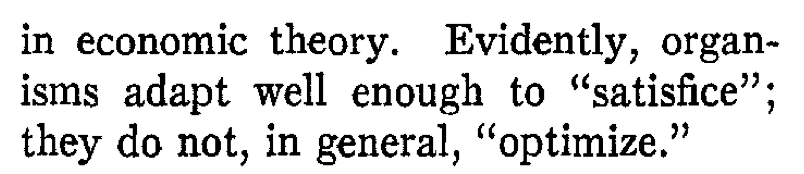
Gigerenzer extends Simon's ideas. He shows that heuristics aren’t just “good enough” compromises. When well-matched to their environment, heuristics can outperform more complex, computationally intensive methods.
To learn more:
Simon introduced satisficing in his 1947 book Administrative Behavior (amazon.com/Administrative…).
He refined the idea in his 1955 paper “A Behavioral Model of Rational Choice": iiif.library.cmu.edu/file/Simon_box…)
And in “Rational Choice and the Structure of the Environment” (1956): pages.ucsd.edu/~mckenzie/Simo…
(Also note the explicit connection between Simon's 1956 title referencing "the environment" and Gigerenzer's "ecological rationality".)
Simon introduced satisficing in his 1947 book Administrative Behavior (amazon.com/Administrative…).
He refined the idea in his 1955 paper “A Behavioral Model of Rational Choice": iiif.library.cmu.edu/file/Simon_box…)
And in “Rational Choice and the Structure of the Environment” (1956): pages.ucsd.edu/~mckenzie/Simo…
(Also note the explicit connection between Simon's 1956 title referencing "the environment" and Gigerenzer's "ecological rationality".)
• • •
Missing some Tweet in this thread? You can try to
force a refresh