In his “Clash of Civilizations” Samuel Huntington identified eight civilisations on this planet:
Confucian, Japanese, Hindu, Buddhist, Islamic, Western, Orthodox, Latin American, and, possibly, African
I have always found this list a bit dubious, not to say self-contradictory:
Confucian, Japanese, Hindu, Buddhist, Islamic, Western, Orthodox, Latin American, and, possibly, African
I have always found this list a bit dubious, not to say self-contradictory:

You know what does this Huntingtonian classification remind to me? A fictional “Chinese Encyclopaedia” by an Argentinian writer Jorge Luis Borges:

Classification above sounds comical. Now why would that be? That it because it lacks a consistent classification basis. The rules of formal logic prescribe us to choose a principle (e.g. size) and hold to it.
If Jorge Borges breaks this principle, so does Samuel P. Huntington.
If Jorge Borges breaks this principle, so does Samuel P. Huntington.
You cannot classify berries into the red, exotic, expensive, poisonous to dogs, growing only in Peru, and the ones you had absolutely loved in childhood.
But that is exactly what Huntington is doing here:
But that is exactly what Huntington is doing here:

So, is it a good classification? No. Its a bad system, torturing the principles of formal logic. But. That does not mean we cannot work anything out of it. Bad ideas may hold a grain of important truth in them. So, we should not dismiss an idea simply because it is wrong.
Does the (wrong) Huntingtonian classification contain a grain of important truth within it?
I think it does.
Let’s take a glance at the “Western” vs “Orthodox” border, for example. Doesn't make much sense logically, yet clearly represents some reality on the ground.
I think it does.
Let’s take a glance at the “Western” vs “Orthodox” border, for example. Doesn't make much sense logically, yet clearly represents some reality on the ground.
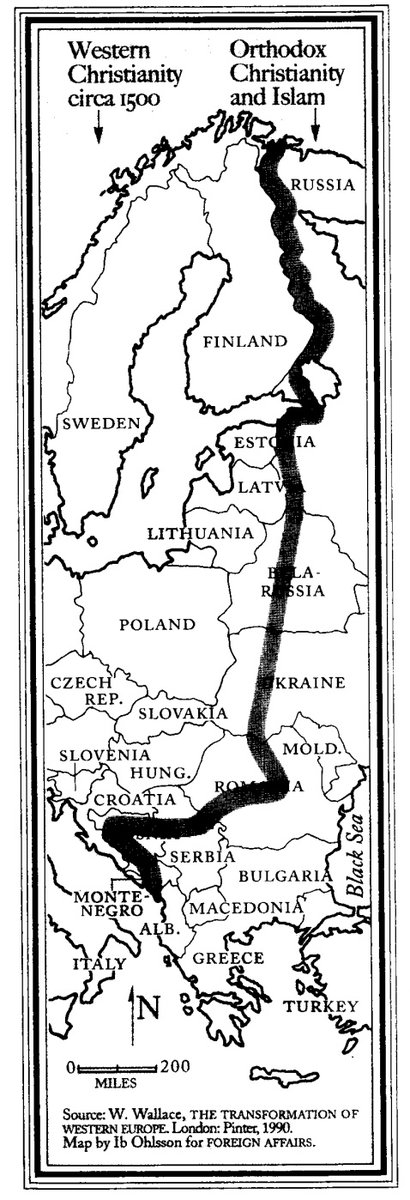
The line is real, as everyone who travelled from Helsinki to St Petersburg can testify. The framing is wrong. So how can we improve the framing? My answer: Change “Western” to “Latin” Then it all starts suddenly making sense. "West" is a poor way to say "Latin Civilisation".
Now the "Latin" does not refer to the languages spoken on the ground. It is irrelevant whether the people speak Czech, Estonian, Gaelic or Basque. What Latin vs non-Latin refers to is the sacred language, the emanation-of-reality language, defining this civilisation historically
Imagine Europe as of 1500. There are lots of polities, large and small. Each polity is populated by the human beings who communicate with each other with the help of sounds. Their means of verbal communication are called vernaculars.
Sound-based languages of the everyday life.
Sound-based languages of the everyday life.

How many vernaculars there were in Europe?
The answer is yes. There were many and many. There was no single standardised German, for example, but rather a continuum of West Germanic vernaculars, distinctive from each other, often to the point of mutual unintelligibility.
The answer is yes. There were many and many. There was no single standardised German, for example, but rather a continuum of West Germanic vernaculars, distinctive from each other, often to the point of mutual unintelligibility.

There was no single standardised French either, but rather lots of Romance (mostly) vernaculars, again, distinctive from each other, often to the point of mutual unintelligibility.

It is important to understand that the linguistic map did not really align with the political one. That people lived under the power of one king, duke or whatever, does not mean their languages were similar. Consider France. What is now Southern France used to speak vernaculars very different from those of the north, yet, similar to the Catalan vernaculars in the south.
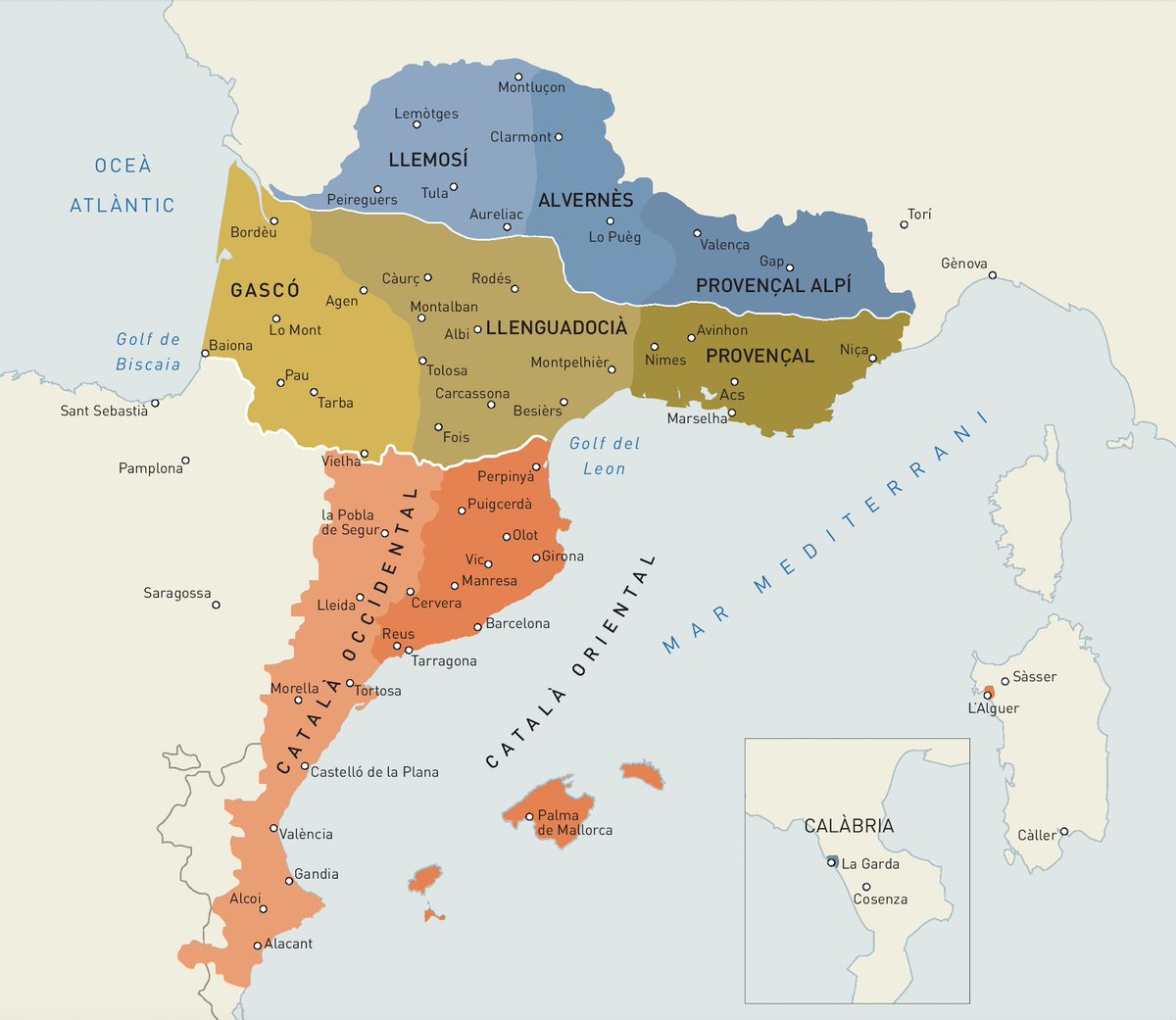
There were tons of vernaculars, everyone was speaking vernaculars, and these vernaculars were highly distinctive from each other. Their actual map would be more webbed, and complicated than what you see on these maps. Vernaculars, if anything, divided the premodern world.
Now what did unite it then?
The sacred language. The sacred dead language.
In case of Europe, that would be the sacred dead language of Latin. And that is why we call it the Latin civilisation, of all things.
The sacred language. The sacred dead language.
In case of Europe, that would be the sacred dead language of Latin. And that is why we call it the Latin civilisation, of all things.

You can read the full text here kamilkazani.substack.com/p/what-is-civi… or here patreon.com/posts/what-is-…
• • •
Missing some Tweet in this thread? You can try to
force a refresh