On the American Academy of Pediatrics' Faulty Brief to the Supreme Court About Gender-Care Bans
🧵⬇️⬇️My breakdown of the amicus brief that the AAP and a roster of other medical societies submitted to the high court, which is riddled with flaws and remarkable omissions.
🧵⬇️⬇️My breakdown of the amicus brief that the AAP and a roster of other medical societies submitted to the high court, which is riddled with flaws and remarkable omissions.
On the American Academy of Pediatrics' Faulty Brief to the Supreme Court About Gender-Care Bans
LINK: benryan.substack.com/p/on-the-ameri…
LINK: benryan.substack.com/p/on-the-ameri…
The American Academy of Pediatrics has sent an amicus ("friend-of-the-court") brief to the Supreme Court urging it to overturn Tennessee's ban on pediatric gender-transition treatment. Some 20 other medical organizations, including the activist-medical org @WPATH, also signed.
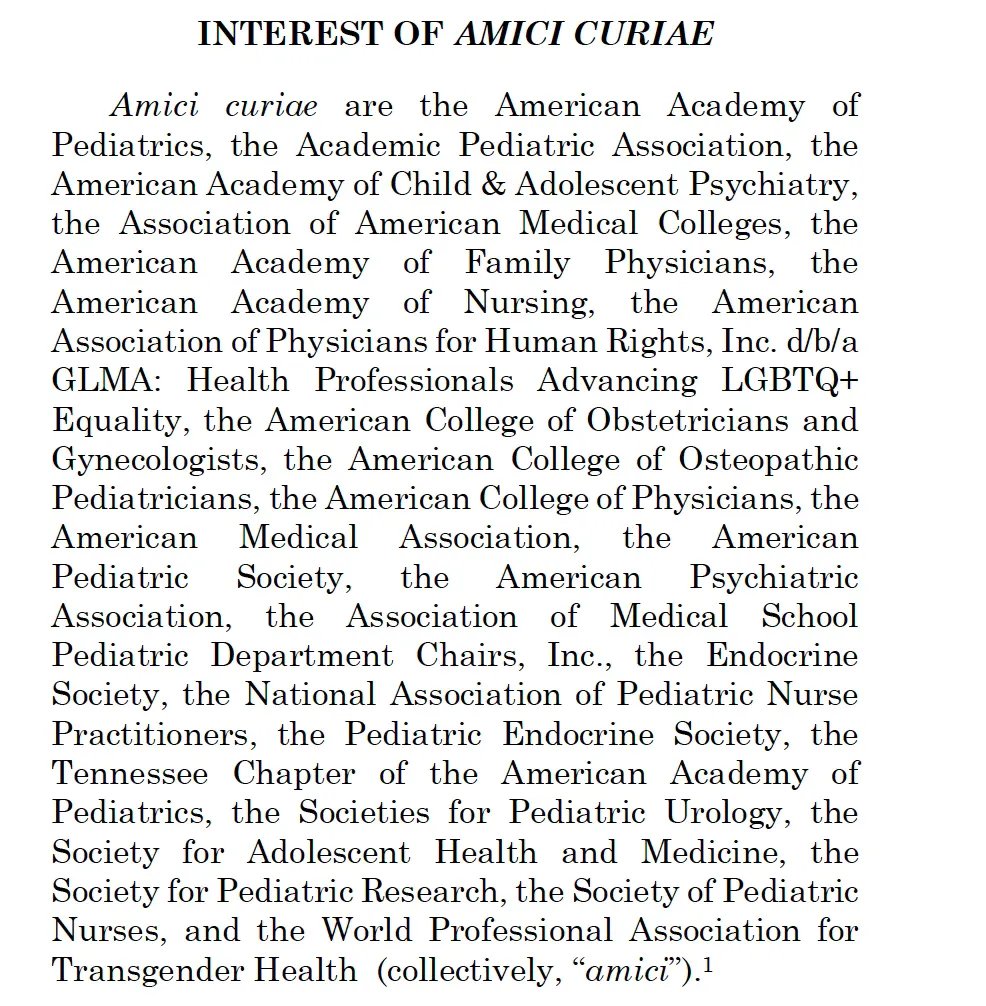
In the summary of its argument in its amicus brief to Supreme Court, the AAP asserts that the medical treatment that Tennessee has banned is “critical, medically necessary, evidence-based care for gender dysphoria.” The brief pledges to provide an “accurate description of the relevant treatment guidelines and summarize the scientific evidence” behind this treatment. The brief notes that the case against the Tennessee ban, called U.S. v. Skrimetti, only concerns medication-based gender transitions for minors and not surgeries. And in a footnote, the brief characterizes gender-transition surgeries as “typically available to adults”—an apparent suggestion that minors uncommonly receive such surgeries.

🚨Fact check🚨
1. Alabama's amicus brief to SCOTUS reveals that WPATH leadership, absent actual scientific justification, inserted the term “medically necessary” throughout the SoC 8 for the purpose of helping providers secure insurance coverage and to ward against lawsuits.
1. Alabama's amicus brief to SCOTUS reveals that WPATH leadership, absent actual scientific justification, inserted the term “medically necessary” throughout the SoC 8 for the purpose of helping providers secure insurance coverage and to ward against lawsuits.

2. As for whether pediatric gender medicine is “evidence-based,” journalist Jennifer Block @WritingBlock reported in the BMJ in 2023 that evidence-based medicine experts concluded that because the relevant evidence was, in fact, so weak, the field could not justify brandishing the title “evidence based.” bmj.com/content/380/bm…
benryan.substack.com/p/on-the-ameri…
benryan.substack.com/p/on-the-ameri…
And as I recently reported in The New York Sun: "Since 2020, a half-dozen systematic literature reviews—the gold standard of scientific evidence—have emerged that have found the research backing pediatric gender-transition treatment wanting and inconclusive."
benryan.substack.com/p/on-the-ameri…
benryan.substack.com/p/on-the-ameri…
In response to these review papers, and given the substantial risks of gender-transition treatment, including infertility, the heath authorities in five European nations, including the UK and much of Scandinavia, have recently reclassified pediatric gender-transition treatment as experimental and have sharply restricted access. benryan.substack.com/p/on-the-ameri…
But despite pledging to provide a comprehensive account of this research and clinical field, AAP makes no mention in its amicus brief of these review findings and the about-face in Europe. Instead, it portrays these medical interventions for children and widely accepted an uncontroversial among doctors. The brief does not clarify that it is referring narrowly to the U.S. medical field when claiming a lack of controversy or disagreement about pediatric gender medicine. Nor does it acknowledge that there is at least quiet pushback from American doctors. Plus, many other skeptical doctors, as I’ve reported, are too afraid to speak out about their concerns about this field of medicine for fear of career damage. benryan.substack.com/p/on-the-ameri…
Failing to acknowledge the flaws in the AAP’s own policy statement
benryan.substack.com/p/on-the-ameri…
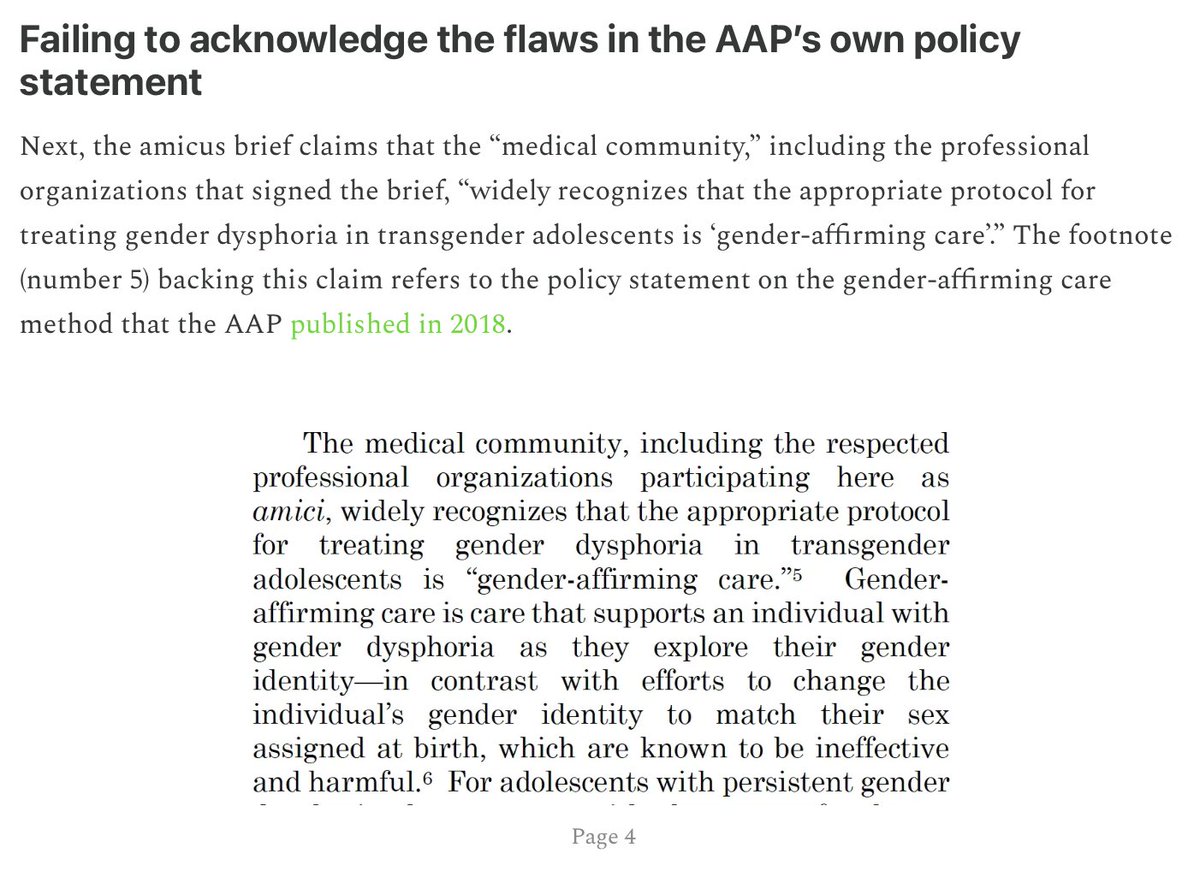
Next, the amicus brief claims that the “medical community,” including the professional organizations that signed the brief, “widely recognizes that the appropriate protocol for treating gender dysphoria in transgender adolescents is ‘gender-affirming care’.” The footnote (number 5) backing this claim refers to the policy statement on the gender-affirming care method that the AAP published in 2018.
benryan.substack.com/p/on-the-ameri…
Next, the amicus brief claims that the “medical community,” including the professional organizations that signed the brief, “widely recognizes that the appropriate protocol for treating gender dysphoria in transgender adolescents is ‘gender-affirming care’.” The footnote (number 5) backing this claim refers to the policy statement on the gender-affirming care method that the AAP published in 2018.
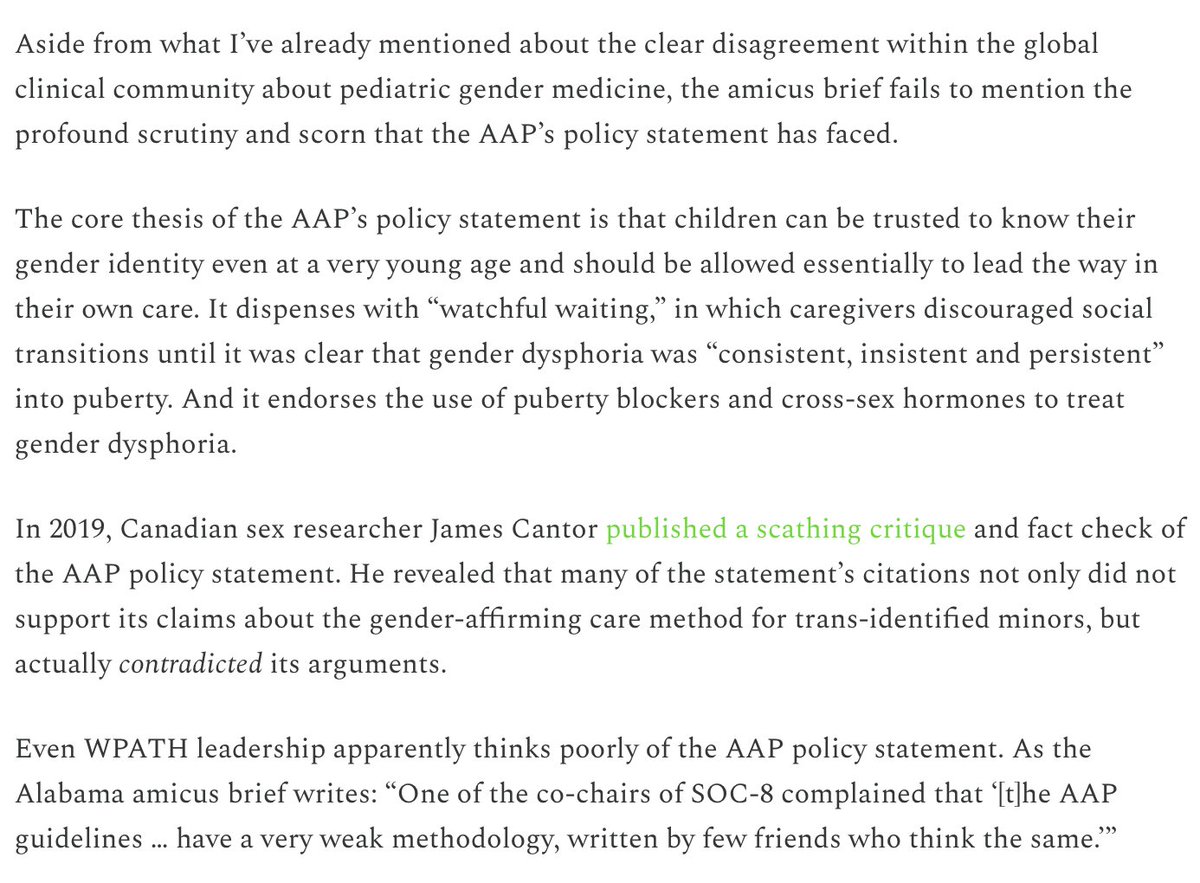
The AAP amicus brief to SCOTUS fails to mention the profound scrutiny and scorn that the AAP’s policy statement on the gender-affirming care method has faced.
benryan.substack.com/p/on-the-ameri…
This includes:
▶️A scathing fact check by @JamesCantorPhD: ohchr.org/sites/default/…
▶️A medical-malpractice lawsuit in which the statement is a linchpin: nysun.com/article/lawsui…
▶️A probing letter from 20 Republican state attorneys general that is probably the prelude to a lawsuit over the letter: scribd.com/document/77256…
▶️Even @WPATH leadership think little of the policy statement. The Alabama AG writes: “One of the co-chairs of SOC-8 complained that ‘[t]he AAP guidelines … have a very weak methodology, written by few friends who think the same.’”
benryan.substack.com/p/on-the-ameri…
This includes:
▶️A scathing fact check by @JamesCantorPhD: ohchr.org/sites/default/…
▶️A medical-malpractice lawsuit in which the statement is a linchpin: nysun.com/article/lawsui…
▶️A probing letter from 20 Republican state attorneys general that is probably the prelude to a lawsuit over the letter: scribd.com/document/77256…
▶️Even @WPATH leadership think little of the policy statement. The Alabama AG writes: “One of the co-chairs of SOC-8 complained that ‘[t]he AAP guidelines … have a very weak methodology, written by few friends who think the same.’”
Overstating the evidence backing gender-affirmative care
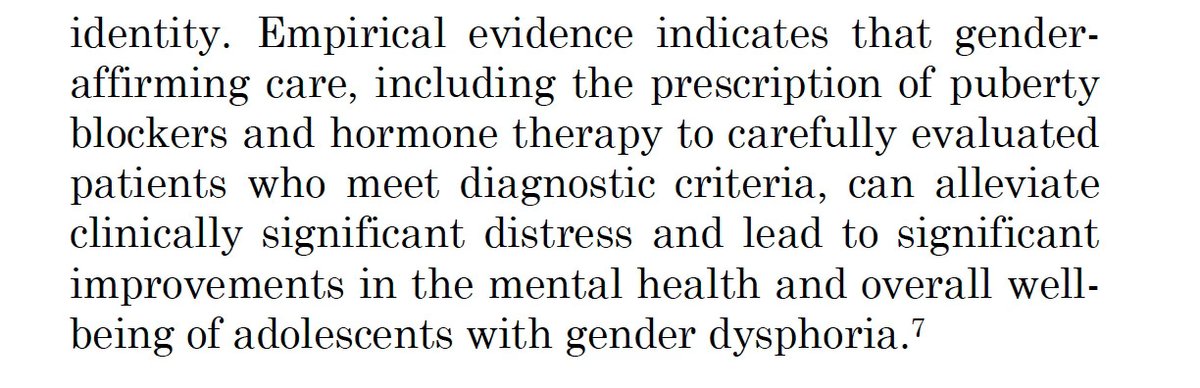
“Empirical evidence,” the AAP amicus brief states, “indicates that gender affirming care, including the prescription of puberty blockers and hormone therapy to carefully evaluated patients who meet diagnostic criteria, can alleviate clinically significant distress and lead to significant improvements in the mental health and overall wellbeing of adolescents with gender dysphoria.”
benryan.substack.com/p/the-global-p…
“Empirical evidence,” the AAP amicus brief states, “indicates that gender affirming care, including the prescription of puberty blockers and hormone therapy to carefully evaluated patients who meet diagnostic criteria, can alleviate clinically significant distress and lead to significant improvements in the mental health and overall wellbeing of adolescents with gender dysphoria.”
benryan.substack.com/p/the-global-p…
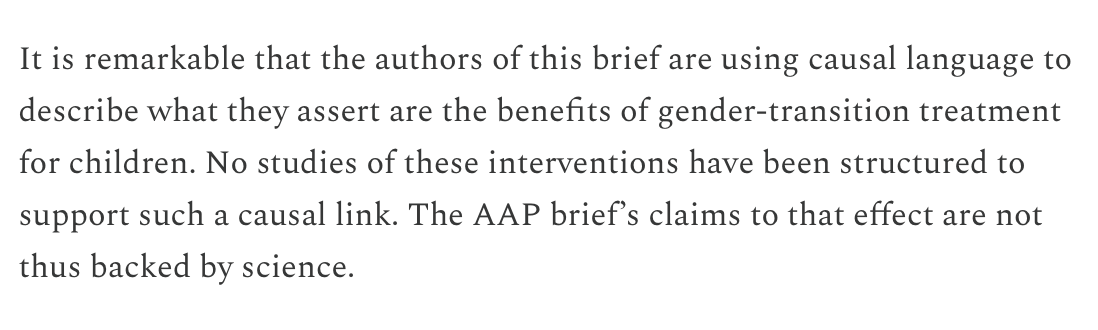
It is remarkable that the authors of this brief are using causal language to describe what they assert are the benefits of gender-transition treatment for children. No studies of these interventions have been structured to support such a causal link. The AAP brief’s claims to that effect are not thus backed by science. benryan.substack.com/p/on-the-ameri…
Zeroing in on puberty blockers’ supposed efficacy
benryan.substack.com/p/on-the-ameri…
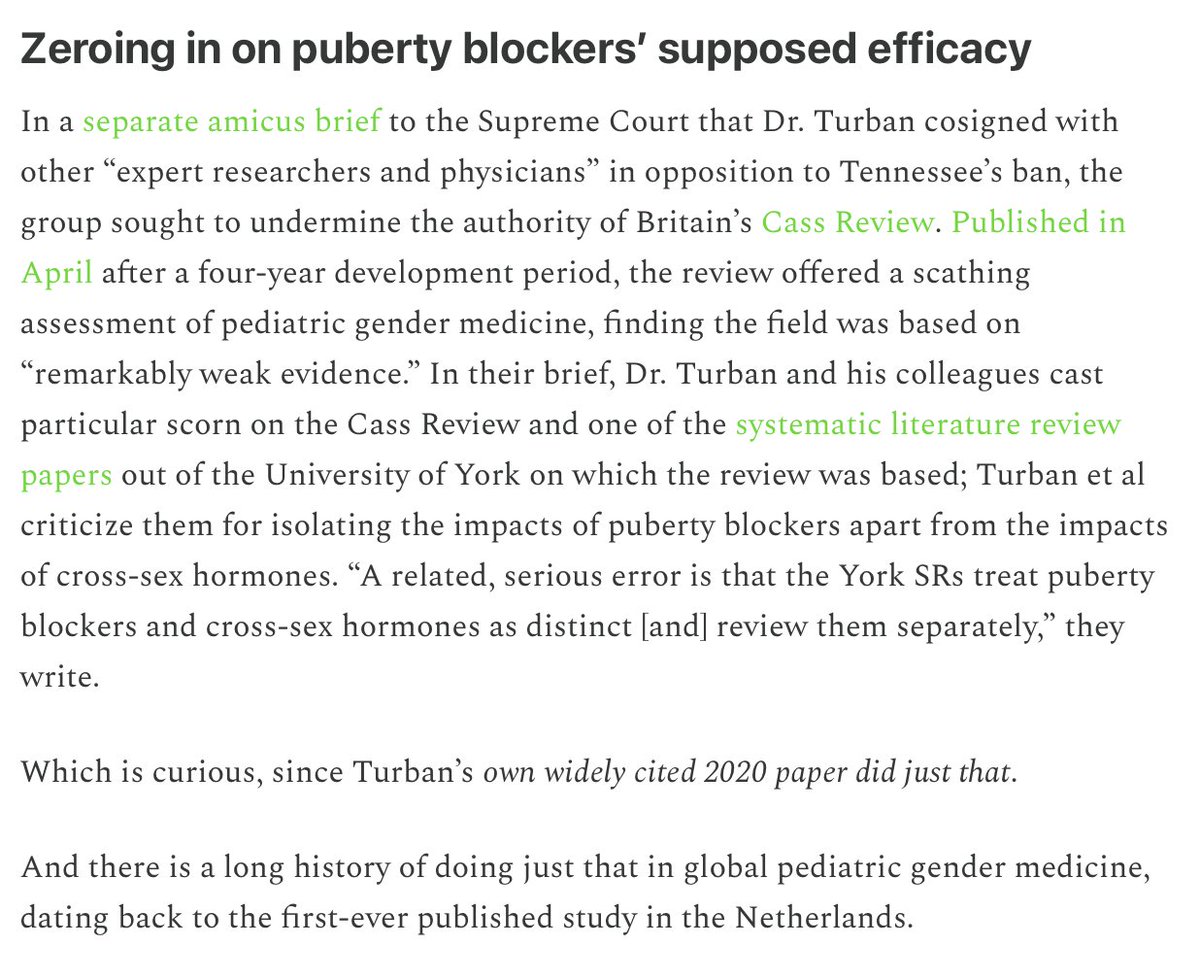
In a separate amicus brief to the Supreme Court that @UCSF's Dr. Jack Turban cosigned with other “expert researchers and physicians” in opposition to Tennessee’s ban, the group sought to undermine the authority of Britain’s Cass Review. Published in April after a four-year development period, the review offered a scathing assessment of pediatric gender medicine, finding the field was based on “remarkably weak evidence.” In their brief, Dr. Turban and his colleagues cast particular scorn on the Cass Review and one of the systematic literature review papers out of the University of York on which the review was based; Turban et al criticize them for isolating the impacts of puberty blockers apart from the impacts of cross-sex hormones. “A related, serious error is that the York SRs treat puberty blockers and cross-sex hormones as distinct [and] review them separately,” they write.
Which is curious, since Turban’s own widely cited 2020 paper did just that.
benryan.substack.com/p/on-the-ameri…
In a separate amicus brief to the Supreme Court that @UCSF's Dr. Jack Turban cosigned with other “expert researchers and physicians” in opposition to Tennessee’s ban, the group sought to undermine the authority of Britain’s Cass Review. Published in April after a four-year development period, the review offered a scathing assessment of pediatric gender medicine, finding the field was based on “remarkably weak evidence.” In their brief, Dr. Turban and his colleagues cast particular scorn on the Cass Review and one of the systematic literature review papers out of the University of York on which the review was based; Turban et al criticize them for isolating the impacts of puberty blockers apart from the impacts of cross-sex hormones. “A related, serious error is that the York SRs treat puberty blockers and cross-sex hormones as distinct [and] review them separately,” they write.
Which is curious, since Turban’s own widely cited 2020 paper did just that.
Researchers at National Health Service (NHS) pediatric gender clinic in London tried to replicate the Dutch researchers’ success with puberty blockers. They failed. The Dutch’s foundational 2011 paper had found: “Behavioral and emotional problems and depressive symptoms decreased, while general functioning improved significantly during puberty suppression.” But the British found a null result: “no changes in psychological function.” They nevertheless wrote this up as if it were a positive finding, but only after they had long sat on the disappointing results.

And Children’s Hospital of Los Angeles’ Dr. Johanna Olson-Kennedy recently told The New York Times that her long-unpublished study of puberty blockers similarly found no associated mental-health benefits. Dr. Olson-Kennedy has since denied under oath that she is withholding publication of these findings for political reasons.
benryan.substack.com/p/on-the-ameri…
benryan.substack.com/p/the-global-p…
benryan.substack.com/p/pediatric-ge…
benryan.substack.com/p/on-the-ameri…
benryan.substack.com/p/the-global-p…
benryan.substack.com/p/pediatric-ge…

Scientific rigor?
benryan.substack.com/p/on-the-ameri…
In their opening, authors of the AAP amicus brief assert that the contents of their filing will describe the “scientifically rigorous process by which” trans-care guidelines for minors were developed and will detail the related evidence that backs pediatric gender-transition treatment.
They go on to highlight the WPATH and Endocrine Society guidelines in particular.
benryan.substack.com/p/on-the-ameri…
In their opening, authors of the AAP amicus brief assert that the contents of their filing will describe the “scientifically rigorous process by which” trans-care guidelines for minors were developed and will detail the related evidence that backs pediatric gender-transition treatment.
They go on to highlight the WPATH and Endocrine Society guidelines in particular.

And yet, according to the Alabama amicus brief, the process by which @WPATH revised its Standards of Care was anything but rigorous. The Cass Review and the York systematic literature review on clinical guidelines were particularly scornful. Cass found what WPATH’s guidelines “lack developmental rigor.”
benryan.substack.com/p/on-the-ameri…
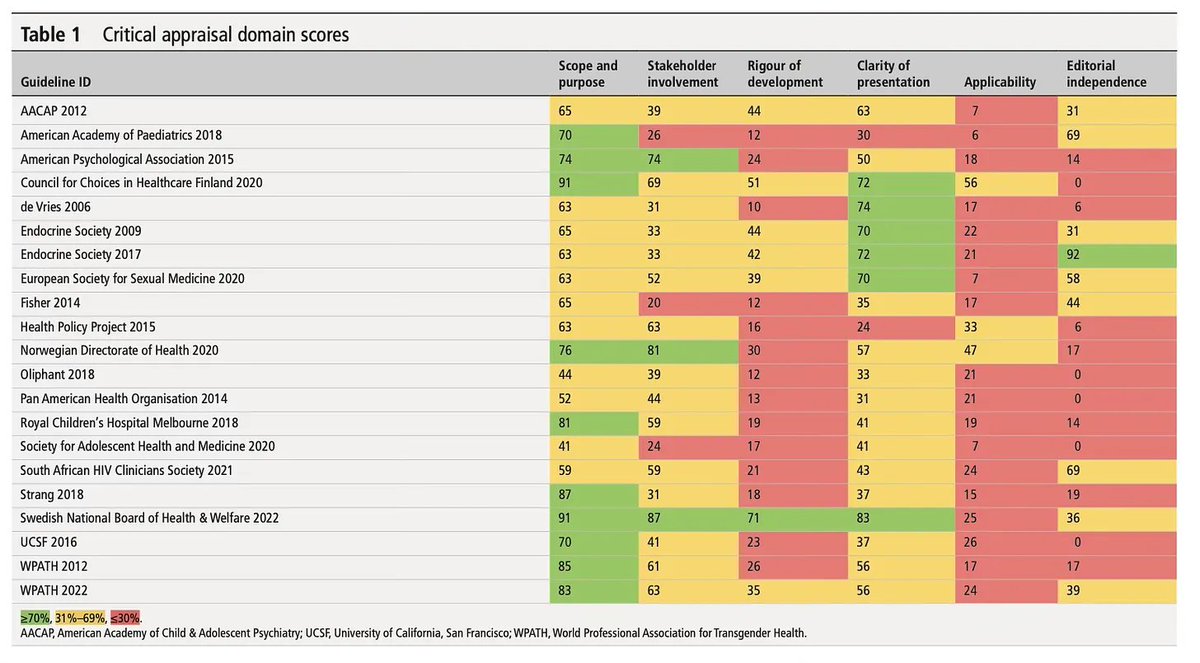
The York systematic literature review on clinical guidelines for pediatric gender-transition treatment found that the 2020 WPATH guidelines and the 2017 Endocrine Society guidelines, each of which the AAP amicus brief praises, scored quite poorly:
benryan.substack.com/p/on-the-ameri…
The York systematic literature review on clinical guidelines for pediatric gender-transition treatment found that the 2020 WPATH guidelines and the 2017 Endocrine Society guidelines, each of which the AAP amicus brief praises, scored quite poorly:
The chapter of the SoC 8 on caring for adolescents explicitly states that the research base on which the guidelines was based is patchy. And behind the scenes, WPATH leaders privately acknowledged how weak the evidence base was, according to the Alabama brief. They also, under pressure from the Biden administration and the AAP, removed the age limits on gender-transition treatment and surgeries without engaging in their scientific method, known as Delphi, for reaching consensus on making such changes. benryan.substack.com/p/on-the-ameri…

The AAP brief, for its part, seeks to degrade the Cass Review. It falsely claims that the review was a systematic review (not mentioning that the Cass Review was based in part on 7 systematic literature reviews from the University of York). It then mischaracterizes what a systematic review while dismissing such academic efforts: “However, the Cass Review, like other systematic reviews, is simply a summary of some of the existing research, as selected by the author.” The brief leaves out the part in which all the systematic reviews that have examined pediatric gender-transition treatment have assessed the quality of the research and the corresponding degree to which one can have confidence that its findings are valid. benryan.substack.com/p/on-the-ameri…

How many kids does this medical field impact?
benryan.substack.com/p/on-the-ameri…
The AAP amicus brief vastly under-reports the number of adolescents believed to identify as transgender in the United States. The authors cite the Williams Institute at UCLA Law School when stating that between 2017 and 2020 about 10% of the 1.6 million transgender people in the U.S., or 160,000, were 13 to 17 years old. This is incorrect. The report they cite estimates that there were, in fact, 300,000 trans Americans in this age range:
benryan.substack.com/p/on-the-ameri…
The AAP amicus brief vastly under-reports the number of adolescents believed to identify as transgender in the United States. The authors cite the Williams Institute at UCLA Law School when stating that between 2017 and 2020 about 10% of the 1.6 million transgender people in the U.S., or 160,000, were 13 to 17 years old. This is incorrect. The report they cite estimates that there were, in fact, 300,000 trans Americans in this age range:

Are the assessments of gender dysphoric kids actually thorough?
benryan.substack.com/p/on-the-ameri…
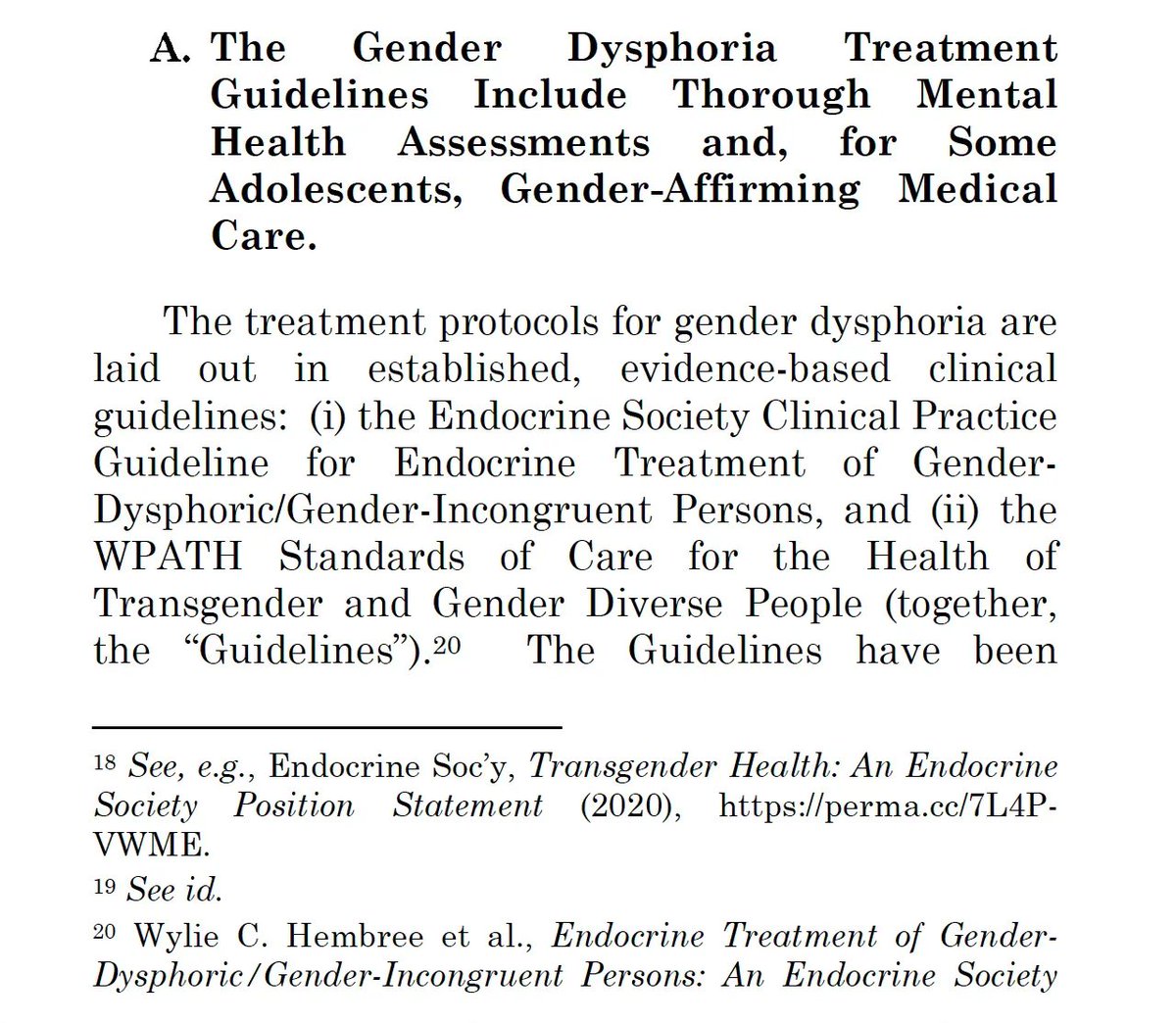
The question of whether the WPATH-recommended assessments that minors are at least meant to receive from mental health professionals before receiving approval to undergo a medicalized gender transition are, in fact, “thorough,” as the AAP amicus brief asserts, remains wildly controversial.
benryan.substack.com/p/on-the-ameri…
The question of whether the WPATH-recommended assessments that minors are at least meant to receive from mental health professionals before receiving approval to undergo a medicalized gender transition are, in fact, “thorough,” as the AAP amicus brief asserts, remains wildly controversial.
But we’re starting to get more clarity on the matter.
benryan.substack.com/p/on-the-ameri…
Last month, I reported for The New York Sun about the practices at Boston Children’s Hospital, which was the first hospital to establish a pediatric gender clinic in the U.S., importing the treatment model from the Dutch researchers in 2007. My reporting revealed that it has been the policy at Boston Children’s gender clinic since 2018 to provide gender-dysphoric kids and their parents only a single two-hour assessment appointment. It took a civil trial for this information to finally come to light.
Reuters conducted an investigation in 2022 that found that at 7 of the 18 pediatric gender clinics they surveyed, the staff would provide gender-transition drugs to minors after a single appointment if they “didn’t see any red flags.”
In his recent book on trans kids, Dr. Turban repeatedly strongly suggests that he thinks these assessments are worthless and should be done away with. benryan.substack.com/p/dr-jack-turb…
benryan.substack.com/p/on-the-ameri…
Last month, I reported for The New York Sun about the practices at Boston Children’s Hospital, which was the first hospital to establish a pediatric gender clinic in the U.S., importing the treatment model from the Dutch researchers in 2007. My reporting revealed that it has been the policy at Boston Children’s gender clinic since 2018 to provide gender-dysphoric kids and their parents only a single two-hour assessment appointment. It took a civil trial for this information to finally come to light.
Reuters conducted an investigation in 2022 that found that at 7 of the 18 pediatric gender clinics they surveyed, the staff would provide gender-transition drugs to minors after a single appointment if they “didn’t see any red flags.”
In his recent book on trans kids, Dr. Turban repeatedly strongly suggests that he thinks these assessments are worthless and should be done away with. benryan.substack.com/p/dr-jack-turb…

• • •
Missing some Tweet in this thread? You can try to
force a refresh