How should we help young children develop positive social skills? The typical answer:
>put children in groups
>enforce norms like sharing
>encourage collaborative play
But this approach *backfires*... often tragically. Montessori saw this, and developed a new approach:
>put children in groups
>enforce norms like sharing
>encourage collaborative play
But this approach *backfires*... often tragically. Montessori saw this, and developed a new approach:
Most people think the focus for ages 0-6 should be socializing.
Learning can wait, they say.
This is the time to meet other children and do things together: play outside, pretend, build things.
Learning can wait, they say.
This is the time to meet other children and do things together: play outside, pretend, build things.
There's just one problem with this strategy...
young children, by and large, aren't all that interested in one another.
They *prefer* to work and play alone.
young children, by and large, aren't all that interested in one another.
They *prefer* to work and play alone.
This is not a random assertion made by Montessori.
It is a developmental phenomenon, observed by child psychologists for nearly a century.
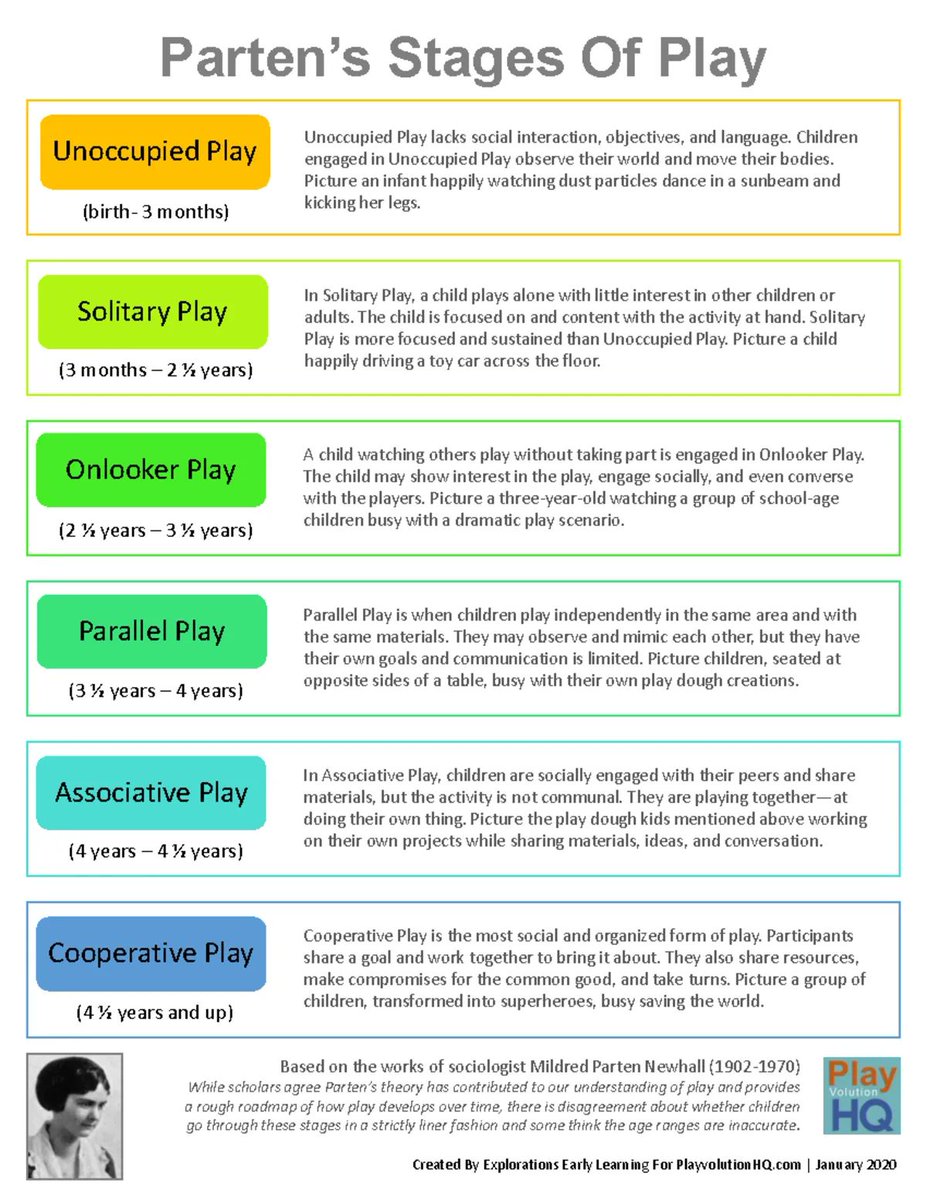
see e.g. Mildren Parten's oft-cited work on stages of play:
It is a developmental phenomenon, observed by child psychologists for nearly a century.
see e.g. Mildren Parten's oft-cited work on stages of play:
so, to achieve our socialization goals, we fight nature. We become hyper-involved, helicopter-parents.
We needle and pressure.
Often, we put them in daycare to "socialize"—i.e. to be forced to join circle time and do activities and games and crafts in big groups.
We needle and pressure.
Often, we put them in daycare to "socialize"—i.e. to be forced to join circle time and do activities and games and crafts in big groups.
All the alleged downsides of early academics and 'cognitive learning' are *actually* attributable to a too-early pressure to socialize.
>healthy development thwarted
>misery and frustration for the child
>coercion and conflict between the adult and child
>healthy development thwarted
>misery and frustration for the child
>coercion and conflict between the adult and child
and for all our efforts, the "beneficial" social experience we achieve:
>Ava is building blocks. She's following a sacred vision only she can see. Theo comes up and tries to grab one. Ava resists, and the adults rush in to tell her SHE is the problem. She must share.
>Ava is building blocks. She's following a sacred vision only she can see. Theo comes up and tries to grab one. Ava resists, and the adults rush in to tell her SHE is the problem. She must share.
>Henry is painting. He likes mixing the colors and experimenting with different brushes.
>"It's circle time. Let's put that away."
>When he resists, he's guilted and pressured. Does he really want to disappoint all his "friends" who are waiting for him?
>"It's circle time. Let's put that away."
>When he resists, he's guilted and pressured. Does he really want to disappoint all his "friends" who are waiting for him?
What is the likely result of thousands of such experiences, repeated over years and years of early childhood?
A child who *likes* and *trusts* other people?
A child positioned to be benevolent, generous, and kind?
A child who *likes* and *trusts* other people?
A child positioned to be benevolent, generous, and kind?
No, the end result is what we see all around us. People who:
>are anxious, afraid of others
>cynical and distrustful of humanity
>cope, curry favor, and follow the crowd
Or worse: those who seek to control the crowd through threats, manipulations, and violence.
>are anxious, afraid of others
>cynical and distrustful of humanity
>cope, curry favor, and follow the crowd
Or worse: those who seek to control the crowd through threats, manipulations, and violence.
On the whole, the children learn to see other people as *threats* or *resources* not potential sources of joy, kinship, or admiration.
The nightmare of the middle and high school years was set in motion years ago.
The nightmare of the middle and high school years was set in motion years ago.
But all of this is avoidable! A young child preferring to work alone is NOT a moral flaw.
It's not something we have to worry about or fix.
It's normal and *absolutely necessary* for healthy development.
It's not something we have to worry about or fix.
It's normal and *absolutely necessary* for healthy development.
The main reason why: children are BRAND NEW to the world.
Their focus is and *must be* on reality, on soaking up as much of it as they can, as fast as they can.
Their focus is on building their foundational abilities, the ones that make all others possible.
Their focus is and *must be* on reality, on soaking up as much of it as they can, as fast as they can.
Their focus is on building their foundational abilities, the ones that make all others possible.
Cooperation and collaboration are advanced skills, not starting points. They require preparation.
They require the child to observe and make logical connections, set goals, focus and follow a sequence of steps, inhibit and control their actions.
They require the child to observe and make logical connections, set goals, focus and follow a sequence of steps, inhibit and control their actions.
Think of it this way: to cooperate doesn't mean "is nice to others" it means to CO-operate.
It means individuals, all with the ability to operate independently, coming together to achieve a shared goal.
It means individuals, all with the ability to operate independently, coming together to achieve a shared goal.
Independence, self-mastery, the ability to navigate the world on one’s own two feet...
these must be built first if we hope to also nurture positive socialization.
these must be built first if we hope to also nurture positive socialization.
This doesn't mean the child should be isolated for the first 5 or so years of life.
But it does means she needs an intentionally designed social environment.
She needs a social culture prepared for her developmental needs.
But it does means she needs an intentionally designed social environment.
She needs a social culture prepared for her developmental needs.
Montessori designed such a social environment. Here are two key components:
1. Mixed-age groupings
2. Cultural norms based on respect
1. Mixed-age groupings
2. Cultural norms based on respect
1. Mixed-age groupings
Montessori environments are mixed-age by design. e.g. In preschool, children ages 3-6 are grouped together.
This means it is *normal* and *expected* for every child to be at a different spot in their development.
Montessori environments are mixed-age by design. e.g. In preschool, children ages 3-6 are grouped together.
This means it is *normal* and *expected* for every child to be at a different spot in their development.
It's far easier to view other children as sources of joy and kinship...
when you're not chained together, forced to march through a curriculum in lockstep,
where those who walk slow are dragging you down and those who walk fast are tugging and pulling you forward.
when you're not chained together, forced to march through a curriculum in lockstep,
where those who walk slow are dragging you down and those who walk fast are tugging and pulling you forward.
But mixed-age groupings are not just about eliminating a negative, they achieve a real positive.
In a mixed-age group, a child is ~guaranteed to find children who know more and can do more than him.
He's guaranteed to have someone to admire and to emulate.
In a mixed-age group, a child is ~guaranteed to find children who know more and can do more than him.
He's guaranteed to have someone to admire and to emulate.
By the same token, the child is ~guaranteed to *be* a source of admiration and emulation for other children who know less than him.
In a mixed-age environment, then, a child:
>experiences others as deeply valuable
>is deeply valued himself
In a mixed-age environment, then, a child:
>experiences others as deeply valuable
>is deeply valued himself
There is no better recipe for positive social skills, than for a child to *truly experience* what a positive social life has to offer him:
the richness of knowledge, the inspiration of achievement, the beauty of human ability...
both to enjoy and to create.
the richness of knowledge, the inspiration of achievement, the beauty of human ability...
both to enjoy and to create.
2. Cultural norms based on respect
In a Montessori early-childhood environment, children have the freedom to interact, work together, play together, collaborate or not.
If a child declines, she is not forced.
In a Montessori early-childhood environment, children have the freedom to interact, work together, play together, collaborate or not.
If a child declines, she is not forced.
A child who has the right to decline interaction if she's busy or focusing or just needs space, is a child who feels secure.
She feels respected and in-control.
She feels respected and in-control.
For the same reason, a Montessori environment has a policy of turn-taking, NOT sharing.
A child who is doing purposeful work, who is observing the world for the first time, like a scientist bent on new discoveries, *needs* and *deserves* the chance to focus.
A child who is doing purposeful work, who is observing the world for the first time, like a scientist bent on new discoveries, *needs* and *deserves* the chance to focus.
Focus is *sacred*
The opportunity to pursue a line of thought to completion, to make connections, to observe reality...
This is HOW a child learns. Focus is the single most important thing she needs for healthy development.
The opportunity to pursue a line of thought to completion, to make connections, to observe reality...
This is HOW a child learns. Focus is the single most important thing she needs for healthy development.
In Montessori, adults don't disturb a child while she focuses on purposeful work.
They also prevent other children from disturbing or distracting her.
It's about respect for the child's autonomy, yes. But even more, it's about respect for the needs of her *mind*
They also prevent other children from disturbing or distracting her.
It's about respect for the child's autonomy, yes. But even more, it's about respect for the needs of her *mind*
Instead of coerced sharing, Montessori teachers support a child in taking turns.
They help her find other engaging activities to do while she waits.
She watches others work with hands behind her back to avoid the temptation to touch their work.
They help her find other engaging activities to do while she waits.
She watches others work with hands behind her back to avoid the temptation to touch their work.
The alternative, telling a child to be kind and generous to others while she herself is constantly disrespected and her needs minimized (with the sanction of all the authorities!) is a recipe for self-hatred, people-pleasing, and misanthropy, NOT social harmony.
In a Montessori social environment, children *experience* and *practice* respect.
Moreover, they're given an abundance of hands-on and captivating work they enjoy.
Moreover, they're given an abundance of hands-on and captivating work they enjoy.
Often, this work is practical in nature. Sweeping floors, dusting, preparing a snack.
This work is real and rewarding to the child.
And serves a real need in her environment. She feels a sense of belonging to her community because she helps create and maintain it.
This work is real and rewarding to the child.
And serves a real need in her environment. She feels a sense of belonging to her community because she helps create and maintain it.
This work helps a child build many core skills necessary for life success.
Self-control, persistence, resilience, goal-setting.
And as a result, she becomes increasingly capable, knowledgeable, and self-disciplined.
Self-control, persistence, resilience, goal-setting.
And as a result, she becomes increasingly capable, knowledgeable, and self-disciplined.
And when the child looks up from her work, what does she see?
A whole class of peers who are busy, productive, and capable too.
She sees people who are achieving things and know things. She sees people to admire, to learn from, to respect.
A whole class of peers who are busy, productive, and capable too.
She sees people who are achieving things and know things. She sees people to admire, to learn from, to respect.
In such an environment, a child’s desire to be social grows organically and spontaneously.
It springs from a true and *validated* recognition that other people are sacred and afford tremendous value to her.
It's a natural response to a world designed to welcome her.
It springs from a true and *validated* recognition that other people are sacred and afford tremendous value to her.
It's a natural response to a world designed to welcome her.
• • •
Missing some Tweet in this thread? You can try to
force a refresh