Russia is facing a strategic calamity in Syria.
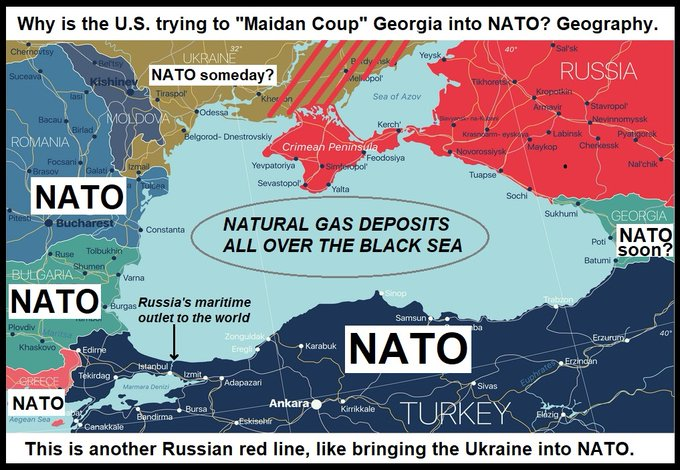
Russia has had naval forces in the port of Tartus since 1971. Tartus was Russia's external "warm water port" on the Mediterranean. The Black Sea fleet is under extreme pressure during the SMO, and in any event it can only enter and leave with the good graces of Turkey, which controls the Bosporus and Dardanelles Straits. (Maritime treaties notwithstanding.)
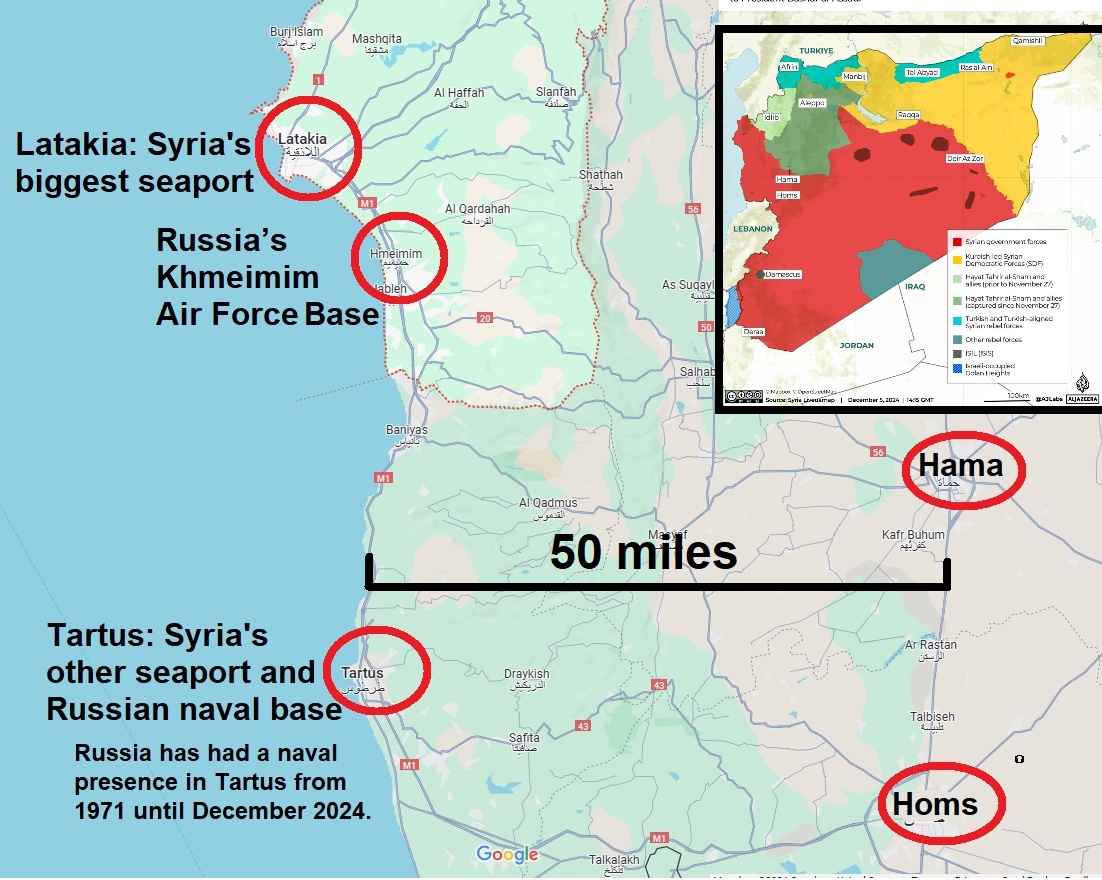
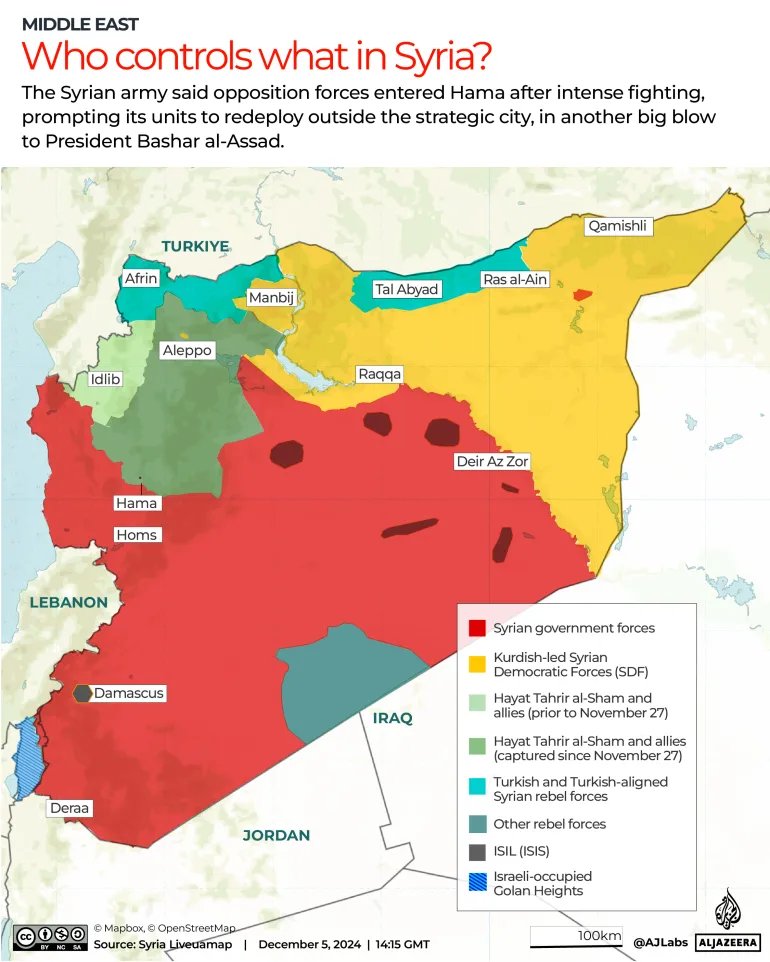
And now, after half a century, the Russian Navy has sortied from Tartus. From the Russian perspective, this is a strategic disaster. And in the era of drone warfare, the Russian Air Force will not risk leaving its planes undefended on the ground at its air base at Khmeimim southeast of Latakia. It's too close to the approaching HTS forces, which are now taking Hama and nearly taking Homs, cutting Syria in two, and leaving Damascus land-locked and isolated.
Turkey initiated the current HTS military offensive in Syria, so it also goes without saying that Turkey controls Russian naval movements in and out of the Black Sea (maritime treaties be damned) unless Russia wants to force the issue kinetically, and go to war with Turkey and NATO.
Where will the Russian naval forces departing Tartus go? They can't refuel indefinitely in the Med, a "NATO Lake." The Black Sea is very tricky during the SMO, and it's a long, long way to the Baltic and Kaliningrad (on another NATO Lake) and even further to Murmansk.
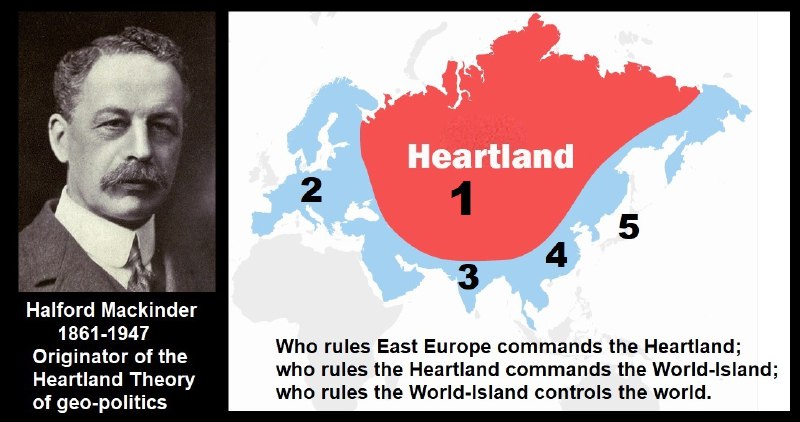
Once again, geography plays its tricks on Mother Russia. The Great Game goes on. Stay tuned.
Please see some maps and links in the replies.
Russia has had naval forces in the port of Tartus since 1971. Tartus was Russia's external "warm water port" on the Mediterranean. The Black Sea fleet is under extreme pressure during the SMO, and in any event it can only enter and leave with the good graces of Turkey, which controls the Bosporus and Dardanelles Straits. (Maritime treaties notwithstanding.)
And now, after half a century, the Russian Navy has sortied from Tartus. From the Russian perspective, this is a strategic disaster. And in the era of drone warfare, the Russian Air Force will not risk leaving its planes undefended on the ground at its air base at Khmeimim southeast of Latakia. It's too close to the approaching HTS forces, which are now taking Hama and nearly taking Homs, cutting Syria in two, and leaving Damascus land-locked and isolated.
Turkey initiated the current HTS military offensive in Syria, so it also goes without saying that Turkey controls Russian naval movements in and out of the Black Sea (maritime treaties be damned) unless Russia wants to force the issue kinetically, and go to war with Turkey and NATO.
Where will the Russian naval forces departing Tartus go? They can't refuel indefinitely in the Med, a "NATO Lake." The Black Sea is very tricky during the SMO, and it's a long, long way to the Baltic and Kaliningrad (on another NATO Lake) and even further to Murmansk.
Once again, geography plays its tricks on Mother Russia. The Great Game goes on. Stay tuned.
Please see some maps and links in the replies.
Syria live tracker: Maps and charts
Here’s what the situation on the ground looks like as of December 4, 2024.
aljazeera.com/news/2024/12/3…
Here’s what the situation on the ground looks like as of December 4, 2024.
aljazeera.com/news/2024/12/3…
Russia’s Khmeimim base just 20 miles from advancing Syrian rebels
Dec 3, 2024
bulgarianmilitary.com/2024/12/03/rus…
Dec 3, 2024
bulgarianmilitary.com/2024/12/03/rus…
en.wikipedia.org/wiki/Tartus_na…
[edit]1971 to 2012
The Soviet Union established a facility at Tartus during the Cold War in accordance with a Soviet–Syrian agreement concluded in 1971, with a view of supporting the Soviet Navy's 5th Operational Squadron in the Mediterranean, which the Soviets saw as a counterbalance to the U.S. Sixth Fleet headquartered in Italy (then in Gaeta).[4]
In the early 1970s, the Soviet Navy had similar support points located in Egypt, Ethiopia (Eritrea), Vietnam and elsewhere. In 1977, the Soviet Navy evacuated its Egyptian support bases at Alexandria and Mersa Matruh and transferred the ships and property to Tartus, where it transformed the naval support facility into the 229th Naval and Estuary Vessel Support Division.
In 1984, Moscow upgraded the Tartus support point to the 720th Material-Technical Support Point.[4]
In December 1991, the Soviet Union dissolved; the Soviet Mediterranean 5th Operational Squadron (composed of ships from the Northern Fleet, the Baltic Fleet, and the Black Sea Fleet) ceased to exist in December 1992. Since then, the Russian Navy has occasionally deployed ships and submarines to the Mediterranean Sea.
As Russia wrote off 73% of Syria's $13.4 billion Soviet-era debt in 2005[5] and became Syria's main arms supplier, Russia and Syria held talks about allowing Russia to develop and enlarge its naval facility, so that Russia could strengthen its naval presence in the Mediterranean.[6] Amid Russia's deteriorating relations with the West, because of the Russo-Georgian War and of plans to deploy a U.S. missile defense shield in Poland, an unsourced article said that President Assad reportedly agreed to the port's conversion into a permanent Middle East base for Russia's nuclear-armed warships.[7]
In September 2008, a second floating pier was built[by whom?] at the facility, following the discussion of the issue between presidents of Russia and Syria in August.[4] Meanwhile, mass media and officials of Russia, Israel, and Syria were making contradictory statements about Russian warships planning to call at Tartus as well as about the prospects of upgrading the facility to a naval base.[8]
In July 2009, the Russian military announced they would modernize the Tartus facility.[9]
[edit]During the Syrian Civil War prior to Russian intervention
See also: Russian military intervention in the Syrian civil war
Media reports in March 2012 suggested that Russian special forces had arrived at the Tartus port.[10] According to a TASS report published in December 2017, the Tartus facility has been used for supplies of Russian armaments and military cargo since June 2012.[4] Back in June 2012, Russian officials denied reports that they were reinforcing the garrison at Tartus with marines.[11] About 50 Russian sailors and specialist technicians were said[by whom?] to be stationed there then.[12]
On 3 August 2012, international media reported that three large Russian amphibious assault ships, carrying hundreds of marines would soon visit Tartus. Earlier reports, quoting a source at the Russian General Staff, said the ships would spend a few days in Tartus and would take on fresh supplies of food and water. British media added that the ships each had up to 120 marines on board. The Russian Defence Ministry left open the possibility that the ships might dock there at some point for logistical reasons, saying they had every right to do so. The unnamed General Staff source had said that after calling in at Tartus, they would head for the Bosphorus and the Russian Black Sea port of Novorossiysk.[13][14] The ships, part of Russia's Northern Fleet, were Aleksandr Otrakovskiy, Georgiy Pobedonosets and Kondopoga, all Ropucha-class landing ships. The source, quoted by Interfax news agency, said one would anchor off Tartus and the other two would use a floating pier, because the port facilities were limited. There was speculation that Russia may begin evacuating its nationals from Syria and deploy Marines to protect personnel and equipment, as the violence intensifies (about 30,000 Russian citizens were said to be living in Syria).[13][15]
In May 2013, a U.S. newspaper reported that Russia had sent a dozen or more warships to patrol waters near Tartus, a move that was seen as a warning to the U.S. and Israel not to intervene in the conflict in Syria.[16]
At the end of June 2013, Russian deputy foreign minister Mikhail Bogdanov said in an interview that the facility did not have any strategic or military importance and that Russia had evacuated all civilian and military personnel from Tartus and Syria ("Presently, the Russian Defense Ministry has not a single person stationed in Syria").[17] This information was then confirmed by the Russian Defense Ministry.[17]
After the permanent task force of the Russian Navy in the Mediterranean Sea was formed in September 2013, the facility at Tartus was charged with servicing and repairs of the ships of that formation.[4]
[edit]Withdrawal of Russian Navy
In November 2024, rebels including the Hayat Tahrir al-Sham (HTS) group launched a major offensive against the Russia-backed Syrian Arab Army and seized the city of Aleppo.[18]
On the morning of 3 December 2024, analysts such as Droxford Maritime[19] saw that a tanker and some warships were leaving Tartus. By the evening, image analysts such as M T Anderson[20] had confirmed the base was now empty. Two Admiral Gorshkov-class frigates, one Admiral Grigorovich-class frigate, one Improved Kilo-class submarine and two auxiliaries, one of which being the tanker Yelna, had all departed and sailed into the Mediterranean.[21][22][23][24]
On 5 December 2024, Syrian President Bashar al-Assad’s forces were reportedly engaged in battles with rebels advancing on the outskirts of the major city of Hama, which is just 52 miles from Tartus.[25][18]
[edit]1971 to 2012
The Soviet Union established a facility at Tartus during the Cold War in accordance with a Soviet–Syrian agreement concluded in 1971, with a view of supporting the Soviet Navy's 5th Operational Squadron in the Mediterranean, which the Soviets saw as a counterbalance to the U.S. Sixth Fleet headquartered in Italy (then in Gaeta).[4]
In the early 1970s, the Soviet Navy had similar support points located in Egypt, Ethiopia (Eritrea), Vietnam and elsewhere. In 1977, the Soviet Navy evacuated its Egyptian support bases at Alexandria and Mersa Matruh and transferred the ships and property to Tartus, where it transformed the naval support facility into the 229th Naval and Estuary Vessel Support Division.
In 1984, Moscow upgraded the Tartus support point to the 720th Material-Technical Support Point.[4]
In December 1991, the Soviet Union dissolved; the Soviet Mediterranean 5th Operational Squadron (composed of ships from the Northern Fleet, the Baltic Fleet, and the Black Sea Fleet) ceased to exist in December 1992. Since then, the Russian Navy has occasionally deployed ships and submarines to the Mediterranean Sea.
As Russia wrote off 73% of Syria's $13.4 billion Soviet-era debt in 2005[5] and became Syria's main arms supplier, Russia and Syria held talks about allowing Russia to develop and enlarge its naval facility, so that Russia could strengthen its naval presence in the Mediterranean.[6] Amid Russia's deteriorating relations with the West, because of the Russo-Georgian War and of plans to deploy a U.S. missile defense shield in Poland, an unsourced article said that President Assad reportedly agreed to the port's conversion into a permanent Middle East base for Russia's nuclear-armed warships.[7]
In September 2008, a second floating pier was built[by whom?] at the facility, following the discussion of the issue between presidents of Russia and Syria in August.[4] Meanwhile, mass media and officials of Russia, Israel, and Syria were making contradictory statements about Russian warships planning to call at Tartus as well as about the prospects of upgrading the facility to a naval base.[8]
In July 2009, the Russian military announced they would modernize the Tartus facility.[9]
[edit]During the Syrian Civil War prior to Russian intervention
See also: Russian military intervention in the Syrian civil war
Media reports in March 2012 suggested that Russian special forces had arrived at the Tartus port.[10] According to a TASS report published in December 2017, the Tartus facility has been used for supplies of Russian armaments and military cargo since June 2012.[4] Back in June 2012, Russian officials denied reports that they were reinforcing the garrison at Tartus with marines.[11] About 50 Russian sailors and specialist technicians were said[by whom?] to be stationed there then.[12]
On 3 August 2012, international media reported that three large Russian amphibious assault ships, carrying hundreds of marines would soon visit Tartus. Earlier reports, quoting a source at the Russian General Staff, said the ships would spend a few days in Tartus and would take on fresh supplies of food and water. British media added that the ships each had up to 120 marines on board. The Russian Defence Ministry left open the possibility that the ships might dock there at some point for logistical reasons, saying they had every right to do so. The unnamed General Staff source had said that after calling in at Tartus, they would head for the Bosphorus and the Russian Black Sea port of Novorossiysk.[13][14] The ships, part of Russia's Northern Fleet, were Aleksandr Otrakovskiy, Georgiy Pobedonosets and Kondopoga, all Ropucha-class landing ships. The source, quoted by Interfax news agency, said one would anchor off Tartus and the other two would use a floating pier, because the port facilities were limited. There was speculation that Russia may begin evacuating its nationals from Syria and deploy Marines to protect personnel and equipment, as the violence intensifies (about 30,000 Russian citizens were said to be living in Syria).[13][15]
In May 2013, a U.S. newspaper reported that Russia had sent a dozen or more warships to patrol waters near Tartus, a move that was seen as a warning to the U.S. and Israel not to intervene in the conflict in Syria.[16]
At the end of June 2013, Russian deputy foreign minister Mikhail Bogdanov said in an interview that the facility did not have any strategic or military importance and that Russia had evacuated all civilian and military personnel from Tartus and Syria ("Presently, the Russian Defense Ministry has not a single person stationed in Syria").[17] This information was then confirmed by the Russian Defense Ministry.[17]
After the permanent task force of the Russian Navy in the Mediterranean Sea was formed in September 2013, the facility at Tartus was charged with servicing and repairs of the ships of that formation.[4]
[edit]Withdrawal of Russian Navy
In November 2024, rebels including the Hayat Tahrir al-Sham (HTS) group launched a major offensive against the Russia-backed Syrian Arab Army and seized the city of Aleppo.[18]
On the morning of 3 December 2024, analysts such as Droxford Maritime[19] saw that a tanker and some warships were leaving Tartus. By the evening, image analysts such as M T Anderson[20] had confirmed the base was now empty. Two Admiral Gorshkov-class frigates, one Admiral Grigorovich-class frigate, one Improved Kilo-class submarine and two auxiliaries, one of which being the tanker Yelna, had all departed and sailed into the Mediterranean.[21][22][23][24]
On 5 December 2024, Syrian President Bashar al-Assad’s forces were reportedly engaged in battles with rebels advancing on the outskirts of the major city of Hama, which is just 52 miles from Tartus.[25][18]
• • •
Missing some Tweet in this thread? You can try to
force a refresh