Dr. Satyan Sharma Profile picture
Dec 18, 2024 5 tweets 1 min read Read on X
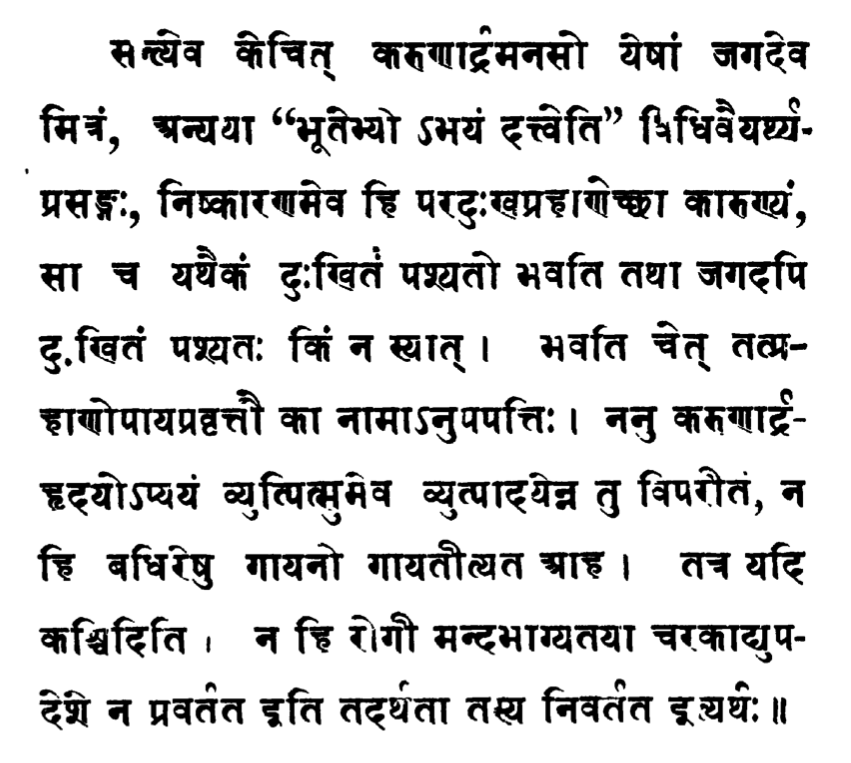
Yādavācārya (16th century), disciple of Rāmakṛṣṇa Cakravartī, refutes his opponent who says that teaching Nyāya philosophy to Śūdras would lead to sin. The issue is that sage Gautama is said to have created this for the benefit of 'all', which would include Śūdras also.

(1/5)
Yādavācārya specifies 'teaching' as an act directed to a specific person. If another person listens to it, it doesn't count as teaching. When the opponent points out that if 'all' includes Śūdras, it would be inevitably directed towards them also. Yādavācārya responds

(2/5)
Yādavācārya responds by that even in the thesis of the opponent, being directed toward Ātman of a Brāhmaṇa, it is directed towards the Ātman of a Śūdra also. So the same fault could be found with opponent too.

(3/5)
He then quotes a sarcastic statement of Raghunātha Śiromaṇi who says that such directed-ness happens even in the case of insects and so forth.

In conclusion, there's no sin on the teacher on account of teaching Nyāya philosophy to Śūdras.

(4/5)
It is rather interesting that such issues were being raised in the first place, although they were being responded to in one way or the other.

Reference: Yādavācārya's commentary on Jānakīnātha Bhaṭṭācārya's Nyāyasiddhāntamañjarī.

(5/5) Image

• • •

Missing some Tweet in this thread? You can try to force a refresh

 

Keep Current with Dr. Satyan Sharma

Dr. Satyan Sharma Profile picture

Stay in touch and get notified when new unrolls are available from this author!

Read all threads

This Thread may be Removed Anytime!

PDF

Twitter may remove this content at anytime! Save it as PDF for later use!

Try unrolling a thread yourself!

how to unroll video
  1. Follow @ThreadReaderApp to mention us!

  2. From a Twitter thread mention us with a keyword "unroll"
@threadreaderapp unroll

Practice here first or read more on our help page!

More from @sharmasatyan

Jul 30
Yudhiṣṭhira found it very difficult to ascertain a person's jāti because a lot of people were being born from parents of different varṇas/jātis.

He found such evidence in Veda itself; 'ye yajāmahe..'.

In the Maitrāyaṇī Saṃhitā of Yajurveda, we find something. [1/7] Image
"na vai tadvidma yadi brāhmaṇā vā smo'brāhmaṇā vā yadi tasya vā ṛṣeḥ 3smo'nyasya vā..."

"We don't know if we are Brāhmaṇas or non-Brāhmaṇas, we belong to that Ṛṣi, or another one?..."

Nāgeśa Bhaṭṭa takes an interesting stance regarding this. [2/7] Image
He says that such a statement shows humility or humbleness on the part of speakers, which proves that they are true Brāhmaṇas.

Yudhiṣṭhira's statement, that good behaviour is the deciding factor, is understood by NB in this manner.

[3/7] Image
Read 8 tweets
Jul 6
Have you seen these verses?

Some say that verse number 70 prohibits spoken Sanskrit for Śūdras (noccaret saṃskṛtāṃ giram).

Let me show you the context of these verses.

[1/8] Image
These verses appear in a chapter of Skanda Purāṇa, in which the procedure of tīrtha-yātrā to Somanātha has been mentioned.

Have a look at the beginning of the chapter, where Devī poses the question of tīrtha-yātrā to Somanātha.

[2/8] Image
Later, the context of upavāsa comes in.

How much of it could people of various varṇas and jātis perform?

Brāhmaṇa = complete upavāsa,
Śūdra = upto ṣaṣṭhakāla (evening of the 3rd day).
Saṅkaras = upto only one day.

[3/8] Image
Read 8 tweets
Apr 17
When imagination goes too far

Based on Vācaspati's argument, Udayana cites a belief that because the anumāna of Nyāyaśāstra has to be unopposed to Vedas, and the knowledge of such non-opposition requires knowledge of Vedas, Śūdras are not eligible for studying Nyāyaśāstra. + Image
Image
Image
Image
Although this is the pūrvapakṣa, but he accepts it at the end.

The flaw in this argument is twofold.

Firstly, to know that the some idea or behaviour is unopposed to Vedas can be known even through Itihāsas, Purāṇas, and verbal testimony of Śiṣṭas.
+
If not, Śūdras and others couldn't even practise their dharma, which should be unopposed to Vedas, because of the lack of direct access to Vedas. +
Read 8 tweets
Apr 15
Desire happiness? Stay disciplined

Manu says, “सन्तोषं परमास्थाय सुखार्थी संयतो भवेत्” (the one desirous of happiness should be disciplined while having contentment).

Why?

+
He says, “सन्तोषमूलं हि सुखं दुःखमूलं विपर्ययः” (contentment is the cause of happiness, non-contentment is the cause of suffering).

+
He briefly defines happiness and suffering as, “सर्वं परवशं दुःखं सर्वमात्मवशं सुखम्” (all that is in someone else’s control is the cause of suffering, all that which is in one’s own control is happiness).

+
Read 9 tweets
Dec 15, 2024
From the perspective of Dharmaśāstra, jāti is based on collective memory. Medhātithi notes this on Manusmṛti 10.5.

Generally the definitions of Brāhmaṇa etc. as presented in Dharmaśāstra-texts, assume the prior knowledge of who a Brāhmaṇa etc. is.

(1/5)
The definitions are like; 'A Brāhmaṇa is the one born of duly wedded Brāhmaṇa & Brāhmaṇī'. Now someone may ask; on what basis is his father a Brāhmaṇa (similar about his mother)?

Such questioning and lack of a definitive proof will lead to an infinite regress.

(2/5)
At this point Medhātithi brings in the idea that collective unbroken memory of a people as being of 'X-jāti' is the definitive proof of them being of 'X-jāti'.

That jāti cannot be identified by merely looking at someone, rules out the possibility of it being biological.

(3/5) From Medhātithi's commentary on Manusmṛti 10.5.
Read 5 tweets
Nov 7, 2024
Varṇa is a complex idea

A Pāraśava man (son of a Brāhmaṇa father & Śūdra mother) marries a Pāraśava woman, begets a Pāraśava son, who similarly marries a Pāraśava woman. If this process continues for 6 generations, the 7th generation will be born a Brāhmaṇa.

+ Manusmṛti 10.64 with Nandana's commentary.
Explanatory notes by Ganganatha Jha on the same verse, i.e., Manusmṛti 10.64.
Also, Ganganatha Jha's notes in the second screenshot show how the traditional commentators of this Manusmṛti-verse differ significantly in their interpretations.

My tweet contains Nandana's interpretation. He also cites Baudhāyanadharmasūtra which states something similar.

+
It says that if a Niṣāda (Pāraśava) man marries a Niṣāda woman, both beget a Niṣāda son who marries a Niṣāda woman, then if such tradition continues, the 5th generation wouldn't be a Śūdra and would get Upanayana, so on and so forth.

+ Baudhāyanadharmasūtra 1.8.13.
Baudhāyanadharmasūtra 1.8.14.
Read 4 tweets

Did Thread Reader help you today?

Support us! We are indie developers!


This site is made by just two indie developers on a laptop doing marketing, support and development! Read more about the story.

Become a Premium Member ($3/month or $30/year) and get exclusive features!

Become Premium

Don't want to be a Premium member but still want to support us?

Make a small donation by buying us coffee ($5) or help with server cost ($10)

Donate via Paypal

Or Donate anonymously using crypto!

Ethereum

0xfe58350B80634f60Fa6Dc149a72b4DFbc17D341E copy

Bitcoin

3ATGMxNzCUFzxpMCHL5sWSt4DVtS8UqXpi copy

Thank you for your support!

Follow Us!

:(