A simple explanation of how @ai16zdao's eliza framework works 🧵: 
There's been a lot of activity and development around eliza, so I thought it'd be good to go over how it's designed.
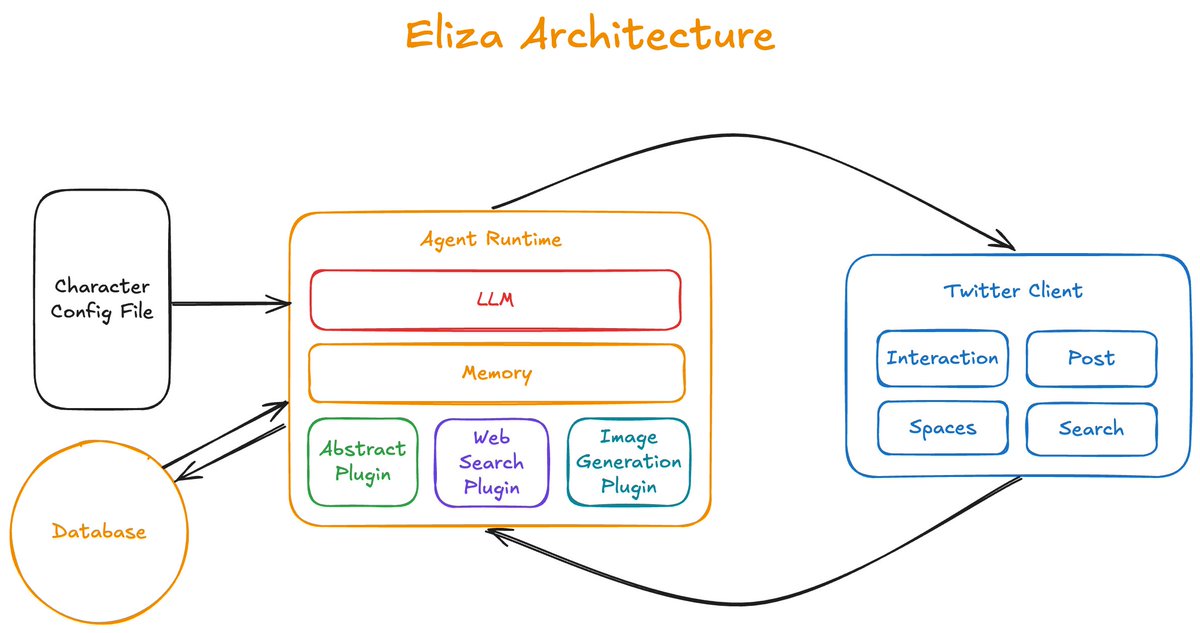
The diagram you see above is of the current v1 architecture, v2 may look different when it's all said and done.
Link to code: .github.com/elizaOS/eliza
The diagram you see above is of the current v1 architecture, v2 may look different when it's all said and done.
Link to code: .github.com/elizaOS/eliza
The example above shows how an eliza twitter agent is setup.
The first component is the character config file. This file contains everything about the agent's personality, backstory, knowledge, and topics to talk about.
The first component is the character config file. This file contains everything about the agent's personality, backstory, knowledge, and topics to talk about.

Next we have the database.
This is where an agent stores relevant info for generating responses, including previous tweets, interactions, and embeddings.
Without a db, agent's wouldn't be able to give good responses.
This is where an agent stores relevant info for generating responses, including previous tweets, interactions, and embeddings.
Without a db, agent's wouldn't be able to give good responses.
Then we have the "runtime".
You can think of the runtime as the core agent logic. It's effectively the coordination layer of the agent, calling the necessary modules and external services to generate responses and take actions.
It's basically the agent's brain.
You can think of the runtime as the core agent logic. It's effectively the coordination layer of the agent, calling the necessary modules and external services to generate responses and take actions.
It's basically the agent's brain.
Within the runtime, we have the LLM.
This is the core part of each agent as the LLM processes various inputs and generates responses or action items for the agent to take.
Devs can declare which LLM provider to use in the character config file.
This is the core part of each agent as the LLM processes various inputs and generates responses or action items for the agent to take.
Devs can declare which LLM provider to use in the character config file.

The runtime also handles the registration of plugins.
In our example, we have 3 plugins, including one for interacting with the @AbstractChain blockchain.
Plugins are called when a user input asks it take an action, such as transferring ETH on Abstract or doing a web search.
In our example, we have 3 plugins, including one for interacting with the @AbstractChain blockchain.
Plugins are called when a user input asks it take an action, such as transferring ETH on Abstract or doing a web search.

After that, we have the Twitter client.
This example is specific to Twitter, but Eliza supports a variety of clients including Discord, Slack, and Farcaster.
The client is basically where the agent will live. Agents can run on multiple clients at once.
This example is specific to Twitter, but Eliza supports a variety of clients including Discord, Slack, and Farcaster.
The client is basically where the agent will live. Agents can run on multiple clients at once.
The twitter client specifically has 4 different modules that handle different twitter interactions.
This includes posting on its own, responding to tweets, or even participating in Twitter spaces:
This includes posting on its own, responding to tweets, or even participating in Twitter spaces:
https://x.com/shawmakesmagic/status/1874463207634727043
That's really all there is to it from a high level.
Obviously there are some details that I omitted here, but these are the core components that make up an @ai16zdao eliza agent.
Eliza v2 will improve on what you see here - I'll post an updated diagram when it's ready.
Obviously there are some details that I omitted here, but these are the core components that make up an @ai16zdao eliza agent.
Eliza v2 will improve on what you see here - I'll post an updated diagram when it's ready.
• • •
Missing some Tweet in this thread? You can try to
force a refresh