Single most under-appreciated chart for understanding health insurance policy in the US.
Uninsured typically pay less than $5k out of pocket for care, regardless of their bill.
So, even without formal health insurance, ppl effectively have a $5000 deductible insurance policy.
The reason is
1/ the govt requires hospitals treat people before billing them (EMTALA)
2/ the threat of bankruptcy (incl exemptions) gives people bargaining power to negotiate down these bills (debts)
You don’t have to go into bankruptcy to do this. Most debts are marked down without bankruptcy. Fair debt collection laws help reduce the burden of this process.
All this means EMTALA + bankruptcy is a substitute for insurance. So demand for & enrollment in insurance is low.
Don’t feel to sorry for the hospitals. Hospitals exaggerate debt by inflating list prices. Plus the govt subsidizes hospitals likely to have a lot of bad debt via DSH payments.
Unsurprisingly, when the govt reduced uncompensated care by hospitals by expanding Medicaid in the ACA, they also cut back DSH payments. They weren’t necessary.
Once you understand this chart and its causes, you can see why the 2 largest health insurance experiments in the US found minimal health benefits from insurance. (RAND found only the very poor benefit, Oregon found only peace of mind effects.)
The chart also helps explain why the ACA had insurance mandates. It wasn’t adverse selection causing people to go without care. It was about financing. The govt wanted low risk (young people) to pay more, rather than existing (high income) tax payers to fund high risk patients.
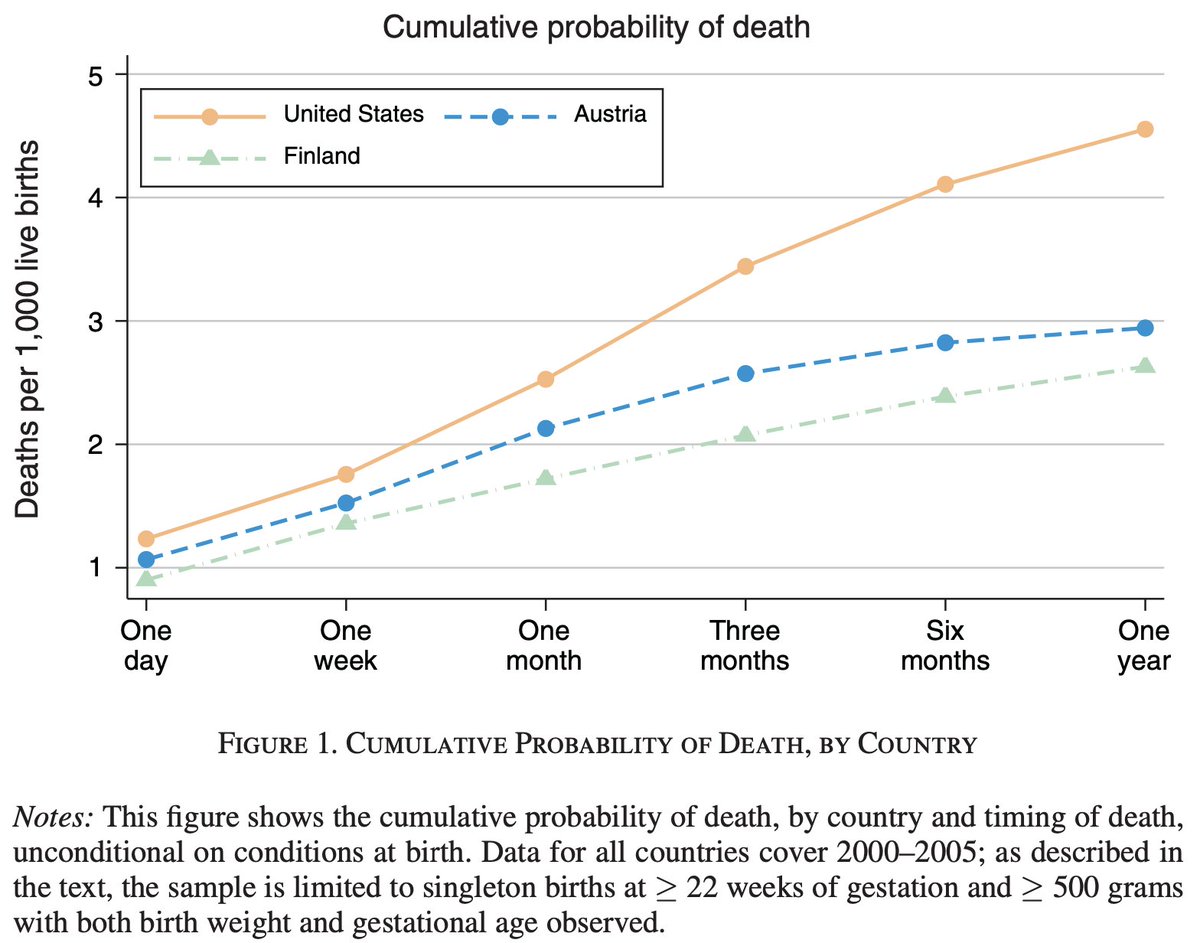
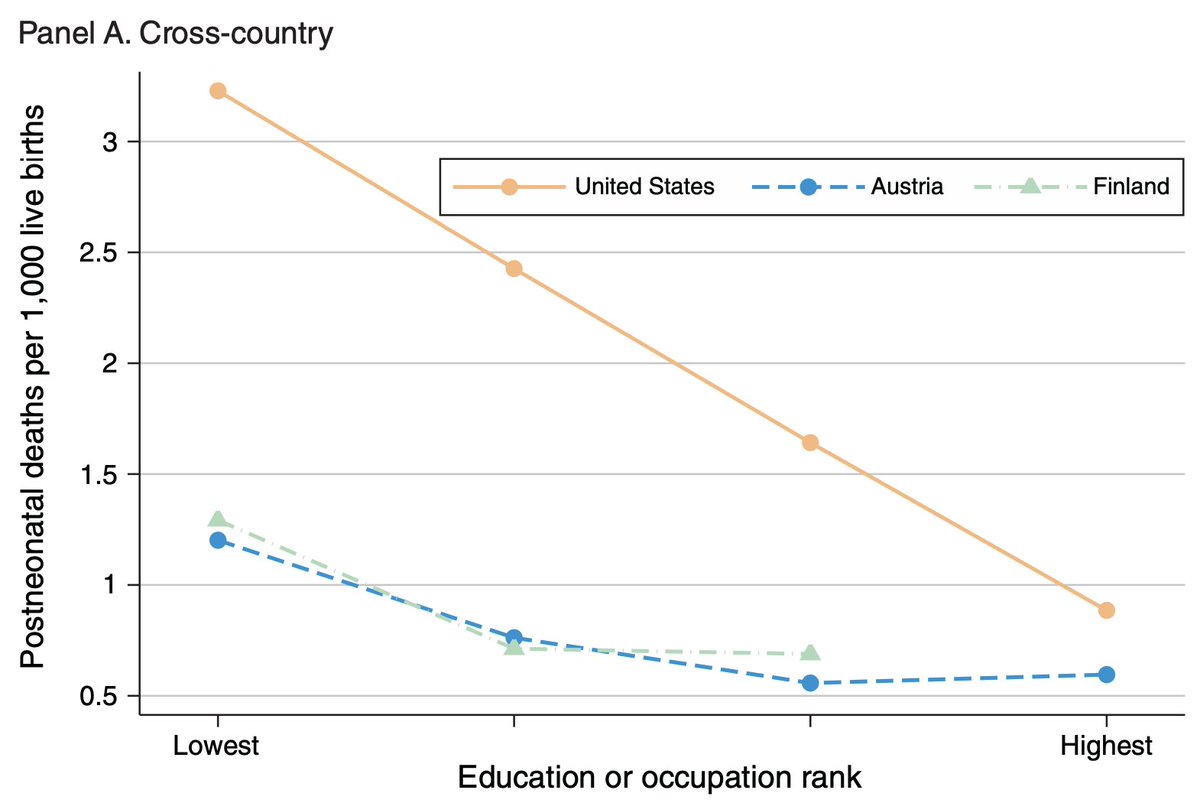
Two important charts for understanding why US lags Europe in longevity.
1/ It's behavior, not healthcare: US infant mortality is higher in the months after a baby goes home from the hospital. Suggesting it's at-home behavior, not bad healthcare that is responsible.
2/ The gap is driven by less-educated or lower economic status populations in the US. Being high status in the US is akin to being high status in Europe.
Source: Alice Chen, @ProfEmilyOster, @heidilwilliams_
More evidence that it's behavior and not health care is that the gap arises among those with normal birthweight.
Among those with low birthweight--the people who need healthcare--there is no US-Europe mortality gap.
I'm teaching microeconomics this quarter & frame the class as policy-relevant by discussing different methods of allocating scarce resources.
The purpose is to stop students from immediately going from mkt failure --> govt intervention. Instead...
I want them to compare mkt allocation to non-market methods, incl public ones by first specifying the alternative method & then discussing how it compares to mkts. Trashing mkts is easy, specifying better alternative is hard.
Obviously I start w/ (competitive) mkts. Instead of just saying the alternative is govt allocation, I give a bunch of different public & private mechanisms, using examples.
Teaching microeconomics today & explained Friedman point that econ, unlike eg biology, seeks a parsimonious predictive model rather than a descriptively accurate one.
But raises a q: as cost of info & processing power falls, should economics use a more complex base model?
The way I explain it is that predictive power (of a model for human behavior) is an increasing, concave function of complexity (eg number of variables k). Cost of complexity is increasing and complexly. Suggests an optimal complexity point where slope of power = slope of cost.
But as cost curve shifts down w technology, optimal model is more complex. Yet we kind of teach the same price theory model as Friedman in 1946.
One answer could be that Samuelson’s mathematical path is the optimal one.
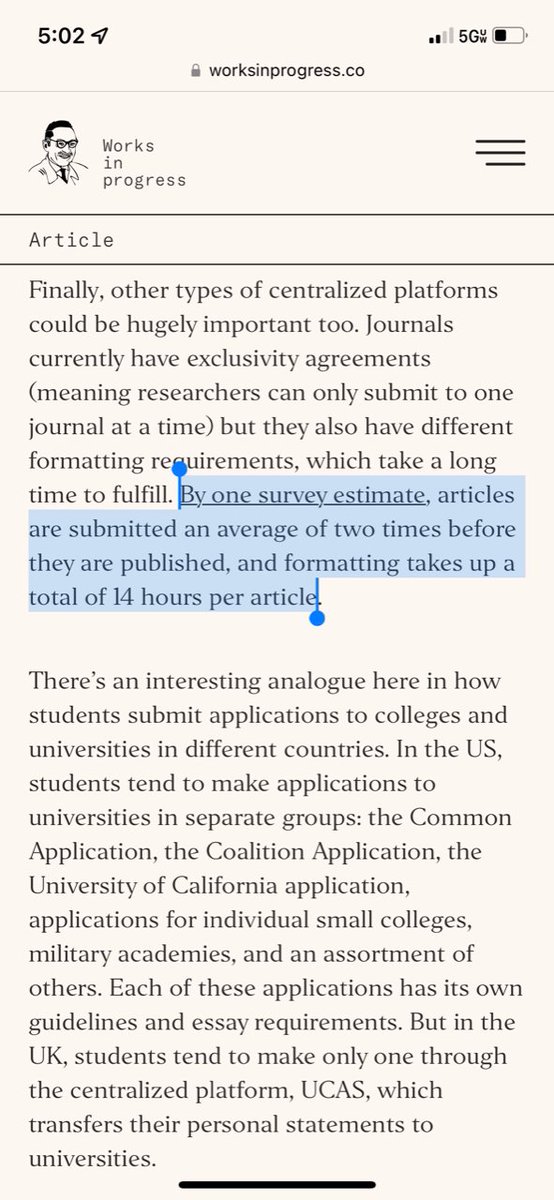
Research involves a *lot* of admin costs that reduce scientific productivity. Here are 8 ways to reduce this (especially in economics), with little cost to journals or grantors. We should pressure organization to make these changes....
1/ Journals should adopt a common manuscript format for submissions (borrowing from the common app for college applications). They should specialize formatting AFTER a paper is accepted. Researchers should spend more time researching, less time reformatting for submission.
What if you could bid to get quicker ref repts for your submission to the peer review journals? At least for econ journals.
Refs would be chosen by editor (not authors), remain anonymous. But payment for completed repts would increase acceptance of invitation & faster review...
Seems like the mechanism economists would like.
Benefits obvious: refs get $$ for time, encourages reviews at a time ppl are complaining abt how hard it is, etc.
Also research is public good w/ inadequate private supply. Why discourage supply w/ 0 or low-price caps on refs?
The cons are inequality and crowd-out.
1/ Inequality
Inequality boat has saled! Richer uni's could pay for higher rept fees. But even if we stop them, they already provide greater research budgets, facilities, networks. That swamps report fees!