This is actually an interesting debate in that it illustrates the immense gap - which is far from new - between Americans' supposed "traditional values" and their actions. That Vance feels compelled to redefine core Christian teachings to obscure this hypocrisy only sharpens the contradiction.
It also illustrates the perils of linking politics with religion, and particularly Christianity, whose universalist ethics—like the command to 'love thy enemy'—collide irreconcilably with statecraft’s inherent brutality (especially in America’s case). Attempting this fusion inevitably debases either the faith or the state.
The only way we know how to square this circle is to either run a theocracy that actually implements Christian principles (historically doomed to either collapse or compromise), or adopt a secular moral philosophy compatible with governance. Confucianism is a good example of the latter—a system prioritizing social harmony through reciprocal obligations, not divine edicts. Unlike religion, it rejects transcendent ideals for pragmatic role-based ethics: statecraft as collective choreography, not the application of dogma.
The Enlightenment attempted something similar with liberalism but 3 centuries later we're obviously reaching the end of that cycle: as should be obvious to anyone paying attention liberalism’s extreme individualism has eroded the social fabric and collective purpose that bind societies. Western societies are now largely adrift—atomized, purposeless, and increasingly nihilistic.
This is probably why we're witnessing this strange moment where folks like Vance perform theological contortions to grope their way towards a more communitarian framework. Vance knows that liberalism isn't working and that there's a thirst out there for more collective purpose and social cohesion. And he's trying to awkwardly retrofit Christianity to serve that role.
Today’s crisis interestingly mirrors the Enlightenment era, when the existing paradigm — Christian theology as a framework for governance — crumbled under the weight of its own contradictions. Just as the Wars of Religion exposed the dangers of dogmatic governance, today’s fractures—social isolation, inequality, America's endless wars—reveal liberalism’s limits.
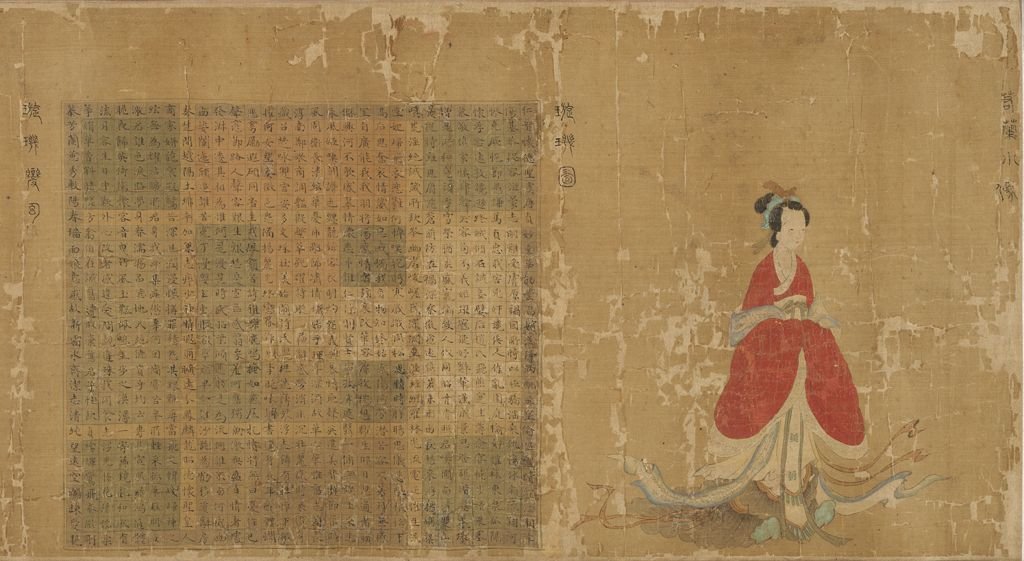
And fascinatingly, few know that at the time Enlightenment thinkers like Voltaire and Leibniz turned to Confucianism for inspiration. They saw in it a secular antidote to Europe’s theological bloodshed—morality rooted in social harmony, not scripture. Voltaire in particular was so in love with China that he had only one portrait in his study: that of Confucius, whom he described as “speaking only of the purest morality” and writing that, “since his time”, no “finer rule of conduct has ever been given throughout the earth”.
Yet the West chose liberalism—a system emphasizing individual rights over Confucian harmony. Three centuries later, we face the consequences: a society so obsessed with the individual it has forgotten how to sustain a common good. We've reached a wall just as our Enlightenment predecessors faced the limitations of Christian statecraft.
So in a funny way our 300-year experiment in prioritizing individual rights resembles a tragicomic attempt to outsmart Confucian wisdom. And we’re now rediscovering the value of his ‘differential order’ (差序格局)—not a rigid hierarchy, but a living network of mutual duties binding family, community, and nation.
The tragedy is that we’ll now likely repeat history’s mistakes: instead of embracing a Confucian-like pragmatism, we may distort Christianity into a state ideology — the very outcome the Enlightenment sought to escape. Vance’s rhetoric hints at this path: using faith not to unite, but to exclude.
All in all, three centuries later, the question endures: can we craft a moral framework that honors both individual dignity and the common good, free from dogma or nihilism? The answer, I think, lies not in hollowed-out liberalism or mangled theology, but rather in humility — recognizing that traditions once dismissed as ‘backward,’ like Confucianism’s reciprocity, Ubuntu’s ‘I am because we are,’ or even Hindu dharma’s contextual ethics, may hold keys to rebuilding societies that balance I and we.
• • •
Missing some Tweet in this thread? You can try to
force a refresh

This is big. The final U.S. National Security Strategy was just published and the refocus on the Western Hemisphere (i.e. the Americas) is confirmed.
The document clearly establishes this as the U.S.'s number 1 priority, saying that the U.S. will now "assert and enforce a 'Trump Corollary' to the Monroe Doctrine."
In terms of military presence, they write that this means "a readjustment of our global military presence to address urgent threats in our Hemisphere, and away from theaters whose relative import to American national security has declined in recent decades or years."
On China, a couple of points.
The most striking aspect to me is that China is NOT anymore defined as "the" primary threat, "most consequential challenge," "pacing threat," or similar formulations used in previous such documents.
It's clearly downgraded as a priority. Based on the document's structure and emphasis, the top U.S. priorities could be characterized as: 1) Homeland security and borders (migration, cartels, etc.) 2) Western Hemisphere (Monroe Doctrine restoration) 3) Economic security (reindustrialization, supply chains) 4) China and Indo-Pacific
To be clear they don't define China as an ally or a partner in any shape or form but primarily as 1) an economic competitor, 2) a source of supply chain vulnerabilities (but also a trading partner) and 3) a player who regional dominance should be "ideally" denied because it "has major implications for the U.S. economy."
Interestingly, I believe for the first time ever, they mention the possibility of being overmatched militarily by China:
- They write that "deterring a conflict over Taiwan, ideally by preserving military overmatch, is a priority": "ideally" clearly means that it's ideal, but not necessarily a given. The fact that they call deterring conflict over Taiwan merely "a priority" also suggests, by definition, that it's no more a top strategic priority, or a vital interest.
- On Taiwan they also clearly imply that if the U.S.'s "First Island Chain allies" don't "step up and spend - and more importantly do - much more for collective defense", then there might be "a balance of forces so unfavorable to us as to make defending that island impossible."
They still maintain that "the United States does not support any unilateral change to the status quo in the Taiwan Strait" but, clearly, there's a widening gap between what the US says it opposes and what it's actually willing to do about it.
Interestingly as well, contrary to previous such document, there is zero ideological dimension in the document when it comes to China. No "democracy vs. autocracy" framing, no "rules-based international order" to defend, no values-based crusade. China is treated as a practical issue to be managed, not an ideological adversary to be defeated.
In fact the document explicitly mentions, I think for the first time ever as well, that US policy is now:
- "not grounded in traditional, political ideology"
- that they "seek good relations and peaceful commercial relations with the nations of the world without imposing on them democratic or other social change that differs widely from their traditions and histories"
- and that they seek "good relations with nations whose governing systems differ from ours."
Which is quite a stunning departure from the rhetoric of the past few decades. We all knew this but it's now amply clear that the era of missionary liberal internationalism in US foreign policy is dead and buried.
The competition with China is primarily described in economic terms, explicitly so: they write the competition is about "winning the economic future" and that economics are "the ultimate stakes."
Notably, they admit that the tariffs approach "that began in 2017" when it comes to China essentially failed because "China adapted" and has "strengthened its hold on supply chains."
The new strategy, as described in the document, is to build an economic coalition against China that can exert more leverage than the US economy alone - a tacit admission that America just isn't powerful enough on its own anymore.
The contradiction is however obvious: unclear how you build an economic coalition against China while simultaneously waging trade wars against your coalition partners, demanding they shoulder more of their own defense, and treating every allied relationship as a deal to be renegotiated in America's favor.
At some point these "allies" will be asking a very obvious question: why sacrifice our economic interests to prop up an America that can no longer compete on its own - and that offers us less and less in return?
In a normal world, this should be an immense scandal in Europe.
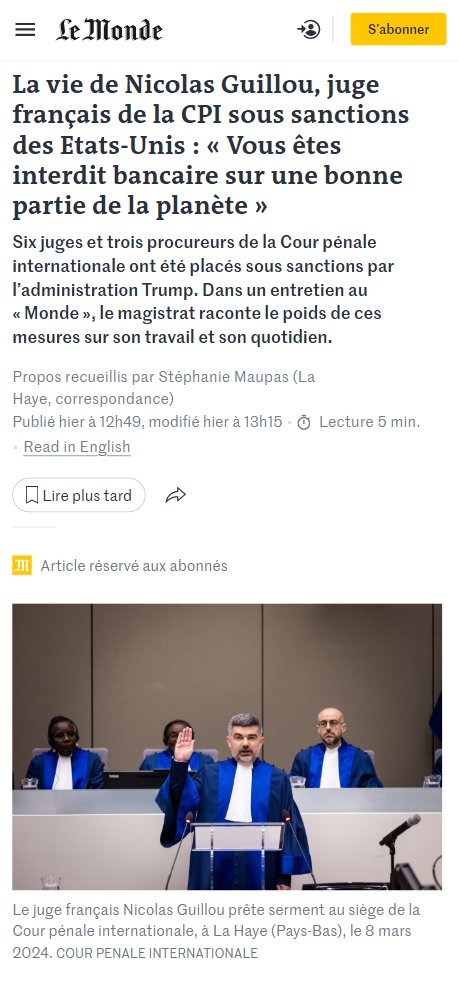
Le Monde has a long article (lemonde.fr/international/…) describing the hellish life of Nicolas Guillou, a French judge at the ICC in The Hague, due to U.S. sanctions punishing him for authorizing arrest warrants against Netanyahu and Gallant for war crimes in Gaza.
Guillou's daily existence has been transformed into a Kafkaesque nightmare. He cannot: open or maintain accounts with Google, Amazon, Apple, or any US company; make hotel reservations (Expedia canceled his booking in France hours after he made it); conduct online commerce, since he can't know if the packaging is American; use any major credit card (Visa, Mastercard, Amex are all American); access normal banking services, even with non-American banks, as banks worldwide close sanctioned accounts; conduct virtually any financial transaction.
He describes it as being "economically banned across most of the planet," including in his own country, France, and where he works, the Netherlands.
That's the real shocking aspect of this: the Americans are:
- punishing a European citizen
- for doing his job in Europe
- applying laws Europe officially supports
- at an institution based in Europe
- that Europe helped create and fund
and Europe is not only doing essentially nothing to protect him, they're actively enforcing America's sanctions against their own citizen - European banks closing his accounts, European companies refusing him service, European institutions standing by while Washington destroys a European judge's life on European soil.
Again, in a normal world, European leaders and citizens should be absolutely outraged about this. But we've so normalized the hollowing out of European sovereignty that the sight of a European citizen being economically executed on European soil for upholding European law is treated, at best, as an unfortunate technical complication in transatlantic relations.
I already wrote about this when I visited the ICC this summer 👇
We're on the edge of Europe's most humiliating moment in history.
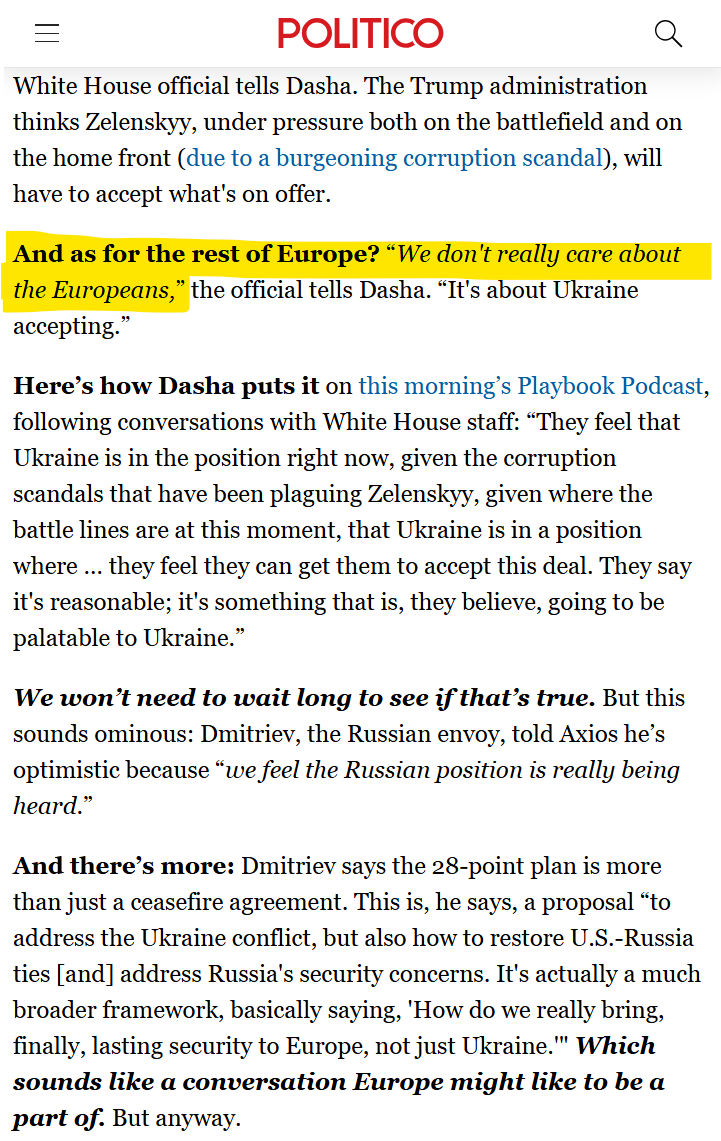
The White House is apparently about to achieve a comprehensive peace deal with Russia which Kirill Dmitriev, the Russian negotiator, say is "a much broader framework [than just a ceasefire agreement], basically saying, 'How do we really bring, finally, lasting security to Europe, not just Ukraine.'"
So in effect it looks like this is an agreement which redraws the entire European security architecture.
The thing, however, is that Europeans are NOT part of the discussions and, when asked about them, the White House replied: “We don't really care about the Europeans.”
This would make it probably the first time EVER in history that Europe's security is decided completely by outside forces, as a proxy with zero say in its own fate (indeed with explicit contempt for its input).
I actually looked into this for my August article "Not at the table: Europe's colonial moment" (arnaudbertrand.substack.com/p/not-at-the-t…). The only comparable parallel I could find is the fall of Constantinople in 1453. But even this was a somewhat “classic” military defeat where the victor simply dictated terms. At the time, there wasn't another external power negotiating with the Ottomans about how to carve up Byzantine territory - it was at least a straightforward conquest.
Don't misunderstand me. I'll be the first to applaud if the Ukraine war comes to an end. It was, as I have argued since day 1 (x.com/RnaudBertrand/…), one of the most predictable and therefore one of the most avoidable wars in history.
BUT, and this is a huge "but", having your continent's security architecture redesigned without you sets a catastrophic precedent: it defines Europe as nothing more than geography to be bargained over by others.
This is the natural consequence of decades of appalling strategic choices by Europeans, starting with the fundamental decision to outsource their security to NATO - effectively to Washington - rather than building genuine strategic autonomy. This shaped how Europe dealt with both Russia and Ukraine: following hawkish US policy, dictated by its own interests to keep Eurasia divided ("divide and conquer"), as opposed to Europe's own interests which clearly lay in continental integration and stability.
Now we see the wages of these choices: a continent whose opinion literally doesn't matter when its security is being negotiated.
Caveat: Tass (Russia's official news agency) says "Russia has no OFFICIAL information from US about some 'agreements'" 👇 x.com/imetatronink/s…
The emphasis on "official" is mine because this means there is *unofficial* information, which is indeed the case here given that the talks between Steve Witkoff (Trump envoy) and Kirill Dmitriev (who runs Russia's sovereign wealth fund) are backchannel negotiations.
My point still stands of course: the White House - backchannel or not - is negotiating with Russia without Europe at the table and they did say they "don't really care about the Europeans." Europe wasn't at the table either during Trump's *official* discussion with Putin in Alaska this summer.
Which means that even if this particular deal falls through or the timeline is premature, the pattern is clear: Europe's security is something the U.S. and Russia discuss between themselves and Europe isn't a participant in these conversations - it's the subject matter.
This is hilarious:
Witkoff posted as a public tweet which he undoubtedly meant as PM (and that he since deleted) that the story must have been leaked by "K", which could refer to the Russian negotiator Kirill Dmitriev or Keith Kellogg, Trump's special envoy for Ukraine.
This is a genuinely incredible story: China found in U.S. archives an energy source that could power its entire future for 20,000 years - and they just made it work.
I'm not exaggerating. In the 1960s the U.S. - specifically Oak Ridge National Laboratory in Tennessee - invented a revolutionary type of nuclear reactor that could run on thorium instead of uranium (much more abundant and cheaper), with no meltdown risk, generating 50x less waste, and requiring no water. Then, due to messy politics, they killed the program in 1969 and fired the visionary behind it.
Afterwards the declassified blueprints for the project sat forgotten in archives for decades. That is until Chinese scientists found them and decided in 2011 to run an experimental project in the Gansu desert to see if they could make it work.
A few days ago, after 14 years of work, they finally did.
I spent many days researching this and wrote the full story - how the technology works, the bureaucratic politics that killed it in America, and why this could genuinely be game-changing.
300 million tourists a year, free to roam everywhere unimpeded in Xinjiang, and still not a single photo evidence of this so-called "Uyghur genocide" 🤔
On the contrary you do get an overwhelming amount of photo evidence of Uyghurs just living normal lives.
Compare and contrast this with Gaza: zero tourist (or journalist, or anyone) allowed in and you still get overwhelming photo evidence.
Because, guess what, in the age of social when people are actually being mistreated and mass murdered, you can't hide it.
You can't hide it in a place that's completely blockaded, you can hide it even less in a place that's fully open to anyone (many foreigners, like almost all European countries, don't even need a visa nowadays to enter China and Xinjiang).
The BBC - which previously pushed the Xinjiang narrative hard - is trying hard to square this circle by claiming "there's a side of Xinjiang" that these 300 million tourists "don't see."
And what is that "side they don't see" according to the article? That even though the Uyghurs are there and Uyghur culture is everywhere, that's apparently not "the real Uyghur culture" because, as they claim, old towns were rebuilt for tourism and tourists see made-for-tourism ethnic performances.
Except this is literally how tourism development works everywhere in China (and pretty much everywhere in the world, frankly). Heck, this is how development - period - works: no-one wants to see the "real" old town from 1970s China because, guess what, it was completely run down and poor AF.
I partially grew up myself in a street of Paris called "rue Mouffetard" in the extremely touristic 5th arrondissement. The name of the street comes from the old French verb "mouffeter", which means to stink: this street used to be famous for smelling like shit because it was a very poor area of Paris back in the old days. Should it have been left as such so that people get to experience the "real" Paris instead of the heavily gentrified "Emily in Paris" version you get today? Anyone with a brain can see how idiotic that is.
Anyhow that's the new - utterly ridiculous - narrative: "the visible Uyghur culture doesn't count because things got redeveloped and updated."
Well, at least the Western media narrative seems to have been downgraded from crimes against humanity to "we don't like their tourism development model" - progress, I guess...
I suspect David is right here 👇 And if so it'd be the most ironic possible resolution for the Nexperia debacle.
What the White House factsheet (whitehouse.gov/fact-sheets/20…) says about Nexperia is: "China will take appropriate measures to ensure the resumption of trade from Nexperia’s facilities in China, allowing production of critical legacy chips to flow to the rest of the world."
Not a word about the Netherlands or Europe, it says trade will resume FROM CHINA.
So it's entirely possible, even likely, that the deal is that Nexperia China, which effectively split from Nexperia Netherlands after the Dutch seized the company, will become the main contracting party.
Meaning the deal would effectively hand China full operational control of Nexperia's operations while leaving Europe with a hollowed-out shell company.
The theory makes sense: Nexperia China already handled 70% of the actual production for Nexperia overall. The main thing they were getting from Europe were the silicon wafers, which Europe has now stopped sending (reuters.com/world/europe/n…). But those are legacy chips products that Chinese foundries like SMIC and Hua Hong can also produce at scale so the European fabs weren't providing anything irreplaceable.
If this all gets verified, there are so many layers of irony here.
This whole debacle occurred because of the new "BIS 50% rule" introduced by the U.S. in late September that expanded US sanctions to any company that was at least 50% owned by entities on Washington's trade blacklist. Wingtech Technology, the Chinese owner of Nexperia, was added on the blacklist since last December and so Nexperia was going to get sanctioned by the U.S. too. Unless, that is, as the U.S. told the Dutch (ft.com/content/db0198…), they were to seize the company away from its Chinese owners, which is what prompted the Dutch to do exactly that simultaneously to the U.S. introducing the new "BIS 50% rule."
Since then, as part of the deal between Xi and Trump, the U.S. has agreed to suspend this "BIS 50% rule," thereby removing the whole rational the Dutch had to seize the company.
However, probably out of misplaced pride, or rather shame of looking like complete U.S. vassals, the Dutch are ridiculously claiming their seizing the company was unrelated with the "BIS 50% rule" but rather had to do with "mismanagement" by the Chinese CEO of the business who, according to them, was seeking to move Nexperia's manufacturing operations to China and transfer technological knowledge to its Chinese parent company.
Which is laughable: since when does a government seize an entire company because it wants to produce in China, all the more a company that was already producing 70% of its output in China and had Chinese ownership for years? Apparently the Dutch suddenly discovered in September 2025 - coincidentally within 24 hours after the U.S. introduced its "BIS 50% rule" - that a manufacturing footprint established years earlier now posed an urgent national security threat.
If this resolution gets confirmed it's ironies upon ironies:
- Washington created the BIS 50% rule to decouple Chinese firms from Western supply chains. In practice, it may have just decoupled from the Dutch middleman while leaving China with more control
- The Dutch justified their action by claiming it was done to prevent Nexperia moving operations to China and the result of their action seems to have caused this exact outcome
- Trump suspended the BIS 50% rule after having pressured the Dutch to act on it, leaving them holding the bag for a decision made to satisfy American strategic interests that America itself has now walked back
- Europe positioned itself as defending its technological sovereignty and it looks like they'll end up losing both the company and its credibility as a sovereign actor, all the more since the resolution was negotiated between Trump and Xi in South Korea with Europe completely absent from the table
Boom: this just got essentially confirmed by Nexperia China in a statement
This is a fascinating technical analysis that I translate from Chinese, and I give my take at the end (source 👇 x.com/FrankyChen19/s…):
"Here's something that might surprise many: Wingtech's Shanghai fab (Dingtai Jiangxin), which can replace the production capacity of Nexperia's Hamburg facility, came online just before this crisis occurred!
One important clarification upfront: Dingtai Jiangxin isn't owned by Wingtech Technology itself, but by Wingtech's controlling shareholder (the "Wentianxia Group"). This makes it a related party under common control. The reality is that Chinese fabs including SMIC and Hua Hong were already capable of replacing a substantial portion of Hamburg's capacity.
For Wingtech's own facilities to fully replace Hamburg will require a "short-term partial transition + long-term complete substitution" process—relying primarily on domestic wafer manufacturing (especially the Shanghai Dingtai Jiangxin facility). This needs time to optimize technical compatibility, scale up production, and mature automotive certifications. However, the capability to fully replace Hamburg's capacity is already planned out.
Core Replacement Capability
China's domestic wafer manufacturing ecosystem is now in place. Through a combination of proprietary facilities and partnerships, Wingtech has built manufacturing capacity covering mature process nodes and automotive-grade applications that directly matches Hamburg's core products:
1. The Centerpiece: Dingtai Jiangxin Shanghai Fab
This is the key replacement for Hamburg. Built by Wingtech's controlling shareholder, it exclusively serves Wingtech/Nexperia's semiconductor business needs, with technology and capacity planning closely aligned with Hamburg's core products:
1.1 Technology match: Hamburg focuses on 8-inch/12-inch power devices (MOSFETs, IGBTs) using mature 130-180nm processes. Dingtai Jiangxin covers 110-180nm nodes, enabling direct migration of similar products. It produces key components including Trench MOSFETs, Super Junction devices, and IGBTs, with voltage coverage spanning 12V to 1700V across low, medium, and high voltage ranges. Product overlap with Hamburg exceeds 70%.
1.2 Rapid capacity ramp: Phase 1 capacity is planned at 45,000 wafers/month, with 30,000 wafers/month already achieved in H2 2025 and full capacity expected by year-end. After Phases 2 and 3, final capacity will reach 100,000 wafers/month. At full production, this can cover 45% of Hamburg's global capacity (Hamburg's annual capacity equals roughly 1.3 million 8-inch wafers; Dingtai Jiangxin's full capacity of 1.2 million 12-inch wafers per year offers superior equivalent capacity after conversion).
1.3 Automotive certification breakthrough: Dingtai Jiangxin is built to top international automotive standards. Its next-generation MOSFET products have already entered supply chains of leading Chinese EV manufacturers, and Wingtech's automotive-grade SiC MOSFETs and GaN FETs have passed certifications from Tesla, BYD, and other major customers—providing continuity with Hamburg's automotive qualifications.
2. Supply Chain Coordination: Domestic Fab Network
Beyond its own facilities, Wingtech has established long-term partnerships with Chinese foundries including SMIC and Hua Hong. By end of 2025, domestic wafer procurement can increase to 65%, absorbing orders for general-purpose power devices from Hamburg's mature 8-inch processes and alleviating short-term capacity gaps. Meanwhile, Nexperia's Dongguan facility has achieved 90% domestic production capacity, with core technologies transferred to China, providing the process integration foundation for "domestic wafer manufacturing + assembly/testing integration.
3. Technology Reserve: Next-Generation Semiconductors
While Hamburg focuses mainly on silicon-based power devices, Wingtech has proactively deployed GaN, SiC, and other third-generation semiconductor technologies, creating dual support of "mature process replacement + advanced technology upgrade": In 2024, Nexperia China commissioned production lines for high-voltage GaN transistors and SiC diodes. In 2025, the 8-inch SiC MOSFET production line began operations. The performance of its automotive-grade 1200V SiC MOSFETs exceeds comparable market products, enabling "generational replacement" of Hamburg's silicon-based products in high-end applications like EVs and industrial power supplies."
My take: this all goes to show the extent to which the Chinese were fully prepared for the Dutch's move. Wingtech had built a parallel supply chain ready to takeover: Dingtai Jiangxin (the Shanghai fab) came online just before the seizure with capacity to replace the European operations, automotive certifications were secured from major customers (like Tesla and BYD) and SMIC and Hua Hong partnerships positioned to absorb 65% of wafer procurement.
Meaning that when the Dutch seized Nexperia thinking they were protecting a critical European asset, they actually triggered the activation of a pre-positioned Chinese replacement system that makes the European operations obsolete.