Dr. Bendor Grosvenor 🇺🇦 Profile picture
Feb 2 13 tweets 3 min read Read on X
It took me a while, as a Brit, to see why Trump/Musk wanted to seize federal payment systems. But once you see the similarities between the Presidency Trump wants, and the kind of monarchy we used to have in England, do things become clearer? 🧵 Image
Image
Trump wants the powers of an ancient regime monarchy, and is being alarmingly clever at how to get them. Here’s a thesis >
It starts before the English Civil War. Then, the Crown was the executive branch of government. The legislature, Parliament, was at least partly independent. If the Crown wanted money, it had to ask parliament, and didn’t always get it.
>
Charles I, for reasons we don’t need to explore here, wanted to rule without parliament. But without being able to raise taxes, he used prerogative powers to raise money from things like Tonnage & Poundage (customs fees, or tariffs).
>
Charles I’s period of ‘Personal Rule’ lasted from 1629-1640. (It might have lasted longer, but he upset the Scots, who invaded.)
>
Then we had the Civil War, after which Parliament seized control of the executive from the Crown, and cut off Charles’ head. That’s why our Prime Minister sits in the Commons, and controls the legislature, and thus the raising and spending of revenue.
>
We call this model of government 'the Crown in Parliament'. The Prime Minister effectively wields the power of the Crown. (It's one reason why the political pendulum, and hence policy, swings so sharply in the UK).
>
But the US constitution was built with the pre-English Civil War model in mind; an executive presidency existing separate from a tax raising Congress. Congress could also say how it wanted taxes spent.
>
Hence the fabled US system of the separation of powers, and the checks and balances - a system designed to keep things broadly stable.
>
Now, by giving Musk/DOGE control of the government payment system, Trump effectively gives himself the ability to direct spending, ignoring Congress.
>
And tariffs give him the means to raise revenue, as Charles I did with Tonnage & Poundage. (Trump can only raise tariffs under the International Emergency Economic Powers Act, hence the claim Canada is flooding the US with fentanyl.)
>
Remember, Trump has explicitly said he wants to replace income taxes (raised by Congress) with tariffs (raised by him).
>
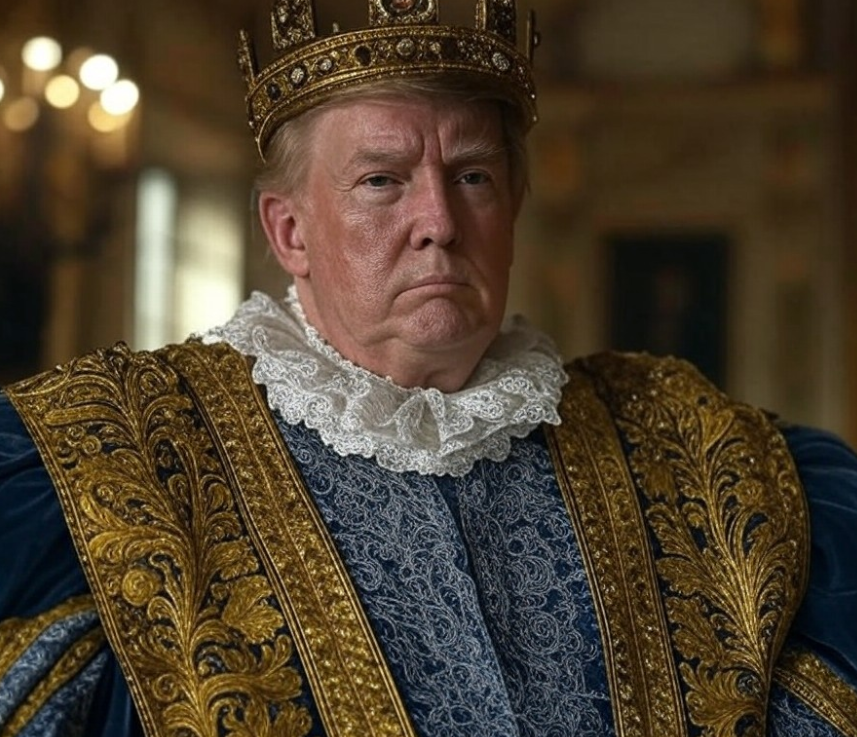
So is that the play – Trump wants a period of personal rule, like Charles I did. How does it end? Image
• • •

Missing some Tweet in this thread? You can try to force a refresh

 

Keep Current with Dr. Bendor Grosvenor 🇺🇦

Dr. Bendor Grosvenor 🇺🇦 Profile picture

Stay in touch and get notified when new unrolls are available from this author!

Read all threads

This Thread may be Removed Anytime!

PDF

Twitter may remove this content at anytime! Save it as PDF for later use!

Try unrolling a thread yourself!

how to unroll video
  1. Follow @ThreadReaderApp to mention us!

  2. From a Twitter thread mention us with a keyword "unroll"
@threadreaderapp unroll

Practice here first or read more on our help page!

More from @arthistorynews

Dec 17, 2024
Holbein’s epic The Ambassadors is seen as one of the most mysterious paintings in Western art. But understand the circumstances in which it was made, in 1533, and the meaning becomes clearer. Let me try a thesis on you. Long 🧵
1/ Image
First, some thread info - the painting is in the National Gallery in London, worth a visit! My research is taken from my new book (The Invention of British Art). And the pictures are mostly from Google’s excellent high-res image, zoom in here:
2/
artsandculture.google.com/asset/the-amba…
Let’s start with who we see in The Ambassadors. On the left is Jean de Dinteville, then the French ambassador to England. On the right is Georges de Selve, Bishop of Lavour, who visited de Dinteville twice in London in 1533.
3/ Image
Image
Read 33 tweets
Jul 23, 2024
In case you're wondering where all the arts TV has gone on the BBC, then today's Annual Report is both revealing and depressing. A short 🧵
1/
First, Arts and Music spend is down again, from £39m in 2022/3 to £34m in 2023/4. This is a 12% cut. It is true overall 'content spending' is down (due to Licence Fee freezes) but only by 3.5%.
2/
But more worryingly, Ofcom have changed the guidelines on what kind of original programming the BBC should produce. Under the previous Operating Licence, the arts target was high.
3/ Image
Read 5 tweets
May 24, 2024
Image fees - EXCELLENT news: the National Galleries of Scotland no longer claim copyright in digital images of historic artworks. These high-res images are therefore now in the public domain, and free to use. 🧵 Image
I asked the NGS, under the Freedom of Information Act:
"On what legal basis NGS claims copyright in digital images of out of copyright, two-dimensional artworks (e.g. paintings, drawings or prints) in its collection?"
>
And they replied:
"NGS does not claim copyright on digital images of artworks that are out of copyright."

This comes after the recent Appeal Court clarification (in THJ vs Sheridan) on what qualifies for copyright.
>
Read 7 tweets
May 4, 2024
Finally made it to the new Burrell Collection in Glasgow. Wow, what a triumph of museum renovation and curation. > Image
The lighting is superb, in all settings and for all types of objects. A rarity. Image
Colour matched ceramic displays. Yes!
> Image
Read 8 tweets
Dec 29, 2023
🚨 Image fees and UK museums - a breakthrough moment. The system is collapsing. There is now no reason to pay fees for historic artworks (2D) in most cases.

The UK's art history tax is over. Scholars, the public *and museums* will be better off. A 🧵 Image
The collapse is due to UK copyright law, and in particular a Court of Appeal ruling which clarifies - there is *no copyright*​ in museum photos of paintings/drawings which are themselves out of copyright. >
In the UK, copyright has been the glue which held the image fee system together. I set out some of the legal aspects of the new ruling in a thread recently, here:

>
Read 23 tweets
Dec 9, 2023
Image Fees - there's an important development after a recent Court of Appeal ruling. It's Good News for historians and art historians (and art lovers generally).
Long thread. >
Those of us who've had to pay image fees will know the system relies on museums claiming copyright in their photos - irrespective of whether the art they're photographing is itself in copyright.

(In the UK, copyright lasts for 70 years after the death of the artist). >
In other words, a painting by John Constable may be long out of copyright, but taking a photo of it creates a new copyright in that photo. By restricting the taking or sharing of other photos, museums force us to use their own photos for publication, and thus charge £££. >
Read 24 tweets

Did Thread Reader help you today?

Support us! We are indie developers!


This site is made by just two indie developers on a laptop doing marketing, support and development! Read more about the story.

Become a Premium Member ($3/month or $30/year) and get exclusive features!

Become Premium

Don't want to be a Premium member but still want to support us?

Make a small donation by buying us coffee ($5) or help with server cost ($10)

Donate via Paypal

Or Donate anonymously using crypto!

Ethereum

0xfe58350B80634f60Fa6Dc149a72b4DFbc17D341E copy

Bitcoin

3ATGMxNzCUFzxpMCHL5sWSt4DVtS8UqXpi copy

Thank you for your support!

Follow Us!

:(