🚨 🚨
The View of a Tech Insider
A 🧵 you’ll want to read
Amid all this talk of DOGE and tech and data and access, I thought I’d check in with another friend of mine who does this work for a living to hear his thoughts on it all. And share with us what we need to know.
1/
The View of a Tech Insider
A 🧵 you’ll want to read
Amid all this talk of DOGE and tech and data and access, I thought I’d check in with another friend of mine who does this work for a living to hear his thoughts on it all. And share with us what we need to know.
1/

Here’s what he told me before answering my questions:
“We're witnessing the first I.T.-driven restructuring of government in human history. While there's been some mockery of the young people Musk has employed…
2/
“We're witnessing the first I.T.-driven restructuring of government in human history. While there's been some mockery of the young people Musk has employed…
2/
they are extremely capable (albeit with little to no experience handling government systems).
Having spent decades working at the intersection of digital infrastructure, automation, and organizational strategy, I recognize the profound implications of such a shift.
3/
Having spent decades working at the intersection of digital infrastructure, automation, and organizational strategy, I recognize the profound implications of such a shift.
3/
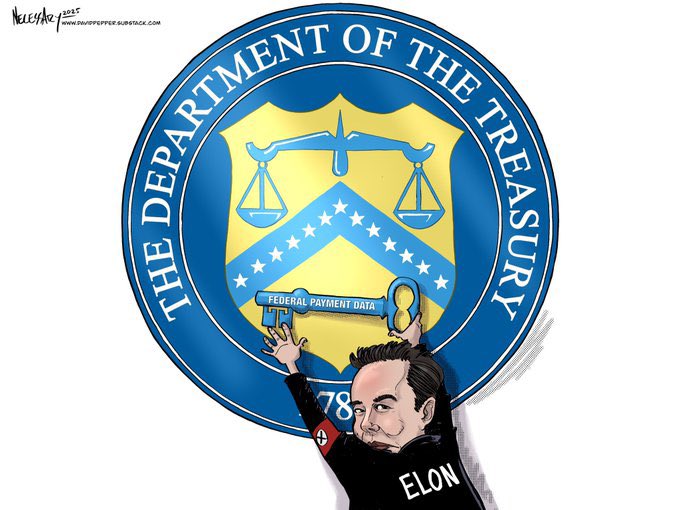
Musk has done two things -- he's grabbed the most influential digital megaphone in the world and plugged himself into the personal information of every American.
4/
4/
This is a digital coup, embedding itself into the core I.T. infrastructure of federal agencies with little oversight and only selective “transparency.” While they claim the access is "read only," they're locking out career civil servants
5/
5/
and scraping personal data from millions of federal employees; the "GSAi" initiative (Musk’s new AI-driven analysis tool for government contracts) is bypassing security vetting and granting Musk’s inner circle deep visibility into federal procurement.
6/
6/
This isn’t just unauthorized access -- it’s a full-scale redirection of the government’s digital nervous system into the hands of an unelected billionaire.
The existential risks here -- financial manipulation, mass data exploitation, and unchecked digital autocracy --
7/
The existential risks here -- financial manipulation, mass data exploitation, and unchecked digital autocracy --
7/
are no longer hypothetical. We're watching a truly unprecedented transfer of governmental power to a private entity in real time.”
Q: What are the risks of this for everyday Americans?
A: “Well, what’s to stop them from aggregating and analyzing personal data, expanding…
8/
Q: What are the risks of this for everyday Americans?
A: “Well, what’s to stop them from aggregating and analyzing personal data, expanding…
8/
to broader citizen records, tax data, social security information (which he’s made it clear he wants access to and may have already).
So far all of this is being under the guise of first principles
9/
So far all of this is being under the guise of first principles
9/
-- speech, assembly, religion -- but it grants one the power to engage in corporate exploitation or selective censorship on a whim. Disinformation campaigns could be hyper-targeted and used for commercial or political manipulation.”
10/
10/
Q: How does the existence of AI make what they’re doing worse?
A: “AI systems are a black box. Their decision-making processes are opaque even to their designers. If it’s being deployed across federal systems,
11/
A: “AI systems are a black box. Their decision-making processes are opaque even to their designers. If it’s being deployed across federal systems,
11/
one could start dictating key governmental functions without democratic checks with impunity — all in the name of “efficiency.” Even as I’m writing this it feels more like a Dan Brown novel than real life, but here we are.”
12/
12/
Q: What is the significance of “read only” access? Versus other access they might have?
A: “They’ve been using “read-only” access as a way to say, “Nothing to see here! It’s just read-only!” But even without direct manipulation,
13/
A: “They’ve been using “read-only” access as a way to say, “Nothing to see here! It’s just read-only!” But even without direct manipulation,
13/
they can still conduct large-scale data scraping, pattern recognition, and predictive modeling.
They’re analyzing and categorizing data at scale, which creates enormous leverage. Anyone in cyber security will tell you that “read only” doesn’t equate to “harmless.”
14/
They’re analyzing and categorizing data at scale, which creates enormous leverage. Anyone in cyber security will tell you that “read only” doesn’t equate to “harmless.”
14/
I’m also worried about backdoor escalation and API exploitation — they could leverage any number of technical loopholes to intercept or reroute government data flows.”
15/
15/
Q. There was a story yesterday that one agency (GSA) made a request for “read access” to data on 14,000 federal employees when they (GSA) already had “read/write access” to that data. That troubled you. Why?
16/
16/
A: “It suggests to me they’re trying to set up a new data pipeline for DOGE to control separately from GSA.”
Q: Why would they do that?
A: “For DOGE exclusive use? Perhaps for unmonitored access to the vast amount of federal data —
17/
Q: Why would they do that?
A: “For DOGE exclusive use? Perhaps for unmonitored access to the vast amount of federal data —
17/
but unmonitored — to analyze or centralize control of all government systems.”
Q: What are some of the worst case scenarios of what you’re seeing so far?
A: “It’s impossible to predict. I often tell people we’re living in a technological revolution
18/
Q: What are some of the worst case scenarios of what you’re seeing so far?
A: “It’s impossible to predict. I often tell people we’re living in a technological revolution
18/
on a scale larger than even the invention of the internet itself. The next 5 to 10 years are going to bring massive societal and technological change. I could see a government infrastructure irreversibly dependent on these privately-run/designed systems…
19/
19/
lack of public accountability… effectively a corporate-run shadow government. Wealth and power could become “locked in” to those engineering this new hierarchy.”
20/
20/
Q: Can people do anything right now to safeguard against the risks? What should be done going forward?
A: “The current “wait and see” approach is dangerous. We need Congress to demand full transparency and accountability/oversight —
21/
A: “The current “wait and see” approach is dangerous. We need Congress to demand full transparency and accountability/oversight —
21/
we need bipartisan opposition to this restructuring and for people to truly understand the risks.”
“The integration of modern technologies into government operations is inevitable, but how it’s done determines whether it will strengthen democracy or subvert it.
22/
“The integration of modern technologies into government operations is inevitable, but how it’s done determines whether it will strengthen democracy or subvert it.
22/
Any major technological shift in government (especially involving AI) needs to be debated/legislated, not decided by executive fiat.”
For the entire conversation, go here: open.substack.com/pub/davidpeppe…
For the entire conversation, go here: open.substack.com/pub/davidpeppe…
• • •
Missing some Tweet in this thread? You can try to
force a refresh