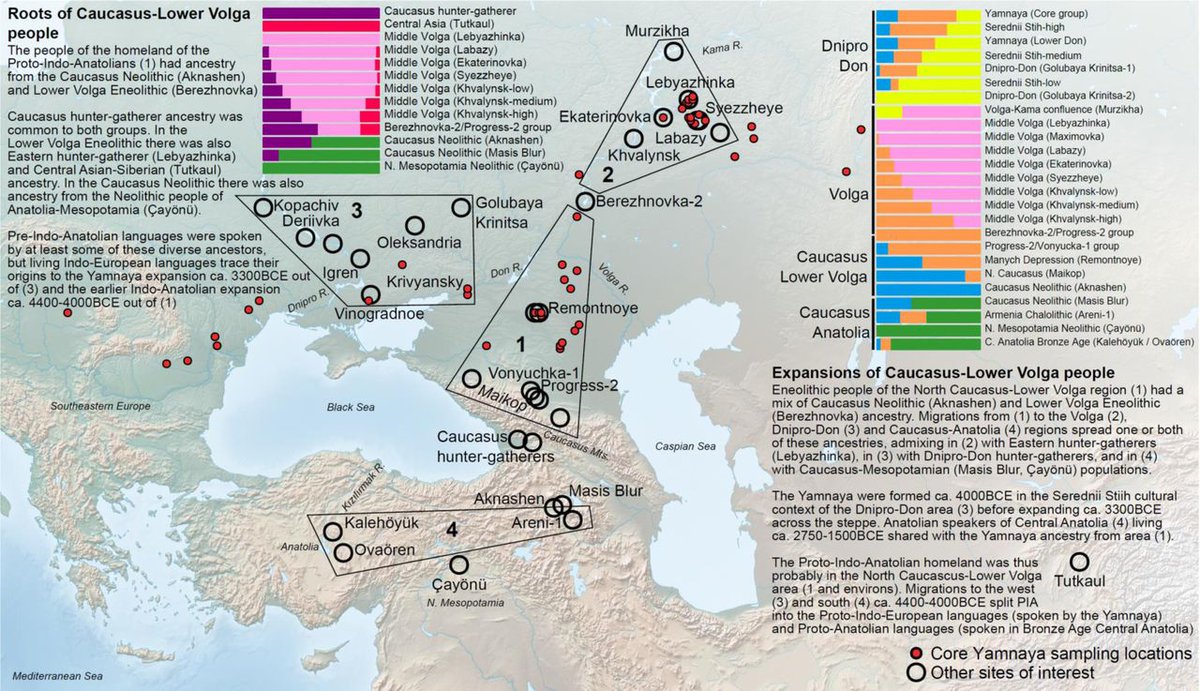
In the first screenshot see an attempt (by a commenter) to define "white" genetically. In the second (done by me), see how an ancient CLV population (BPgroup) has many of its closest PCA relatives (based on population Fst) outside the reader's "white" triangle. 1/
In two other screenshots (by X users), see the never-ending debate (in online platforms, at least) whether Jews are white or not. The same West Eurasian PCA, different arbitrary definitions of "white" or "non-white" 2/
If we look at genetically close populations to present-day Ashkenazi Jews (in terms of Fst), they parallel the West Eurasian PCA. The top-20 list includes Jews from Turkey, Greeks, S Italians/Sicilians (from Europe), as well as Turks, Lebanese, and Armenians (from West Asia) 3/
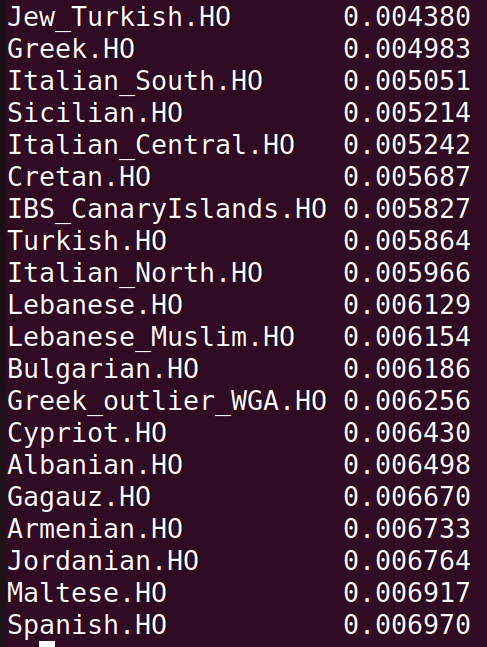
To many all of these would be considered "white". Others might draw triangles, circles, and ellipses to define an arbitrary and elaborate geometry of "whiteness" that has more to do with personal desires and tastes rather than any genetic reality in the data itself. 4/
People like the BPgroup of the first post in this thread belonged to the continuum of ancestry formed by admixture of diverse people who preceded them (hunter-gatherers of eastern Europe, the Caucasus, and Siberia/Central Asia). Their "whiteness" or not is beside the point 5/
And similarly about the Ashkenazi Jews of today, themselves part of a European-Near Eastern continuum of ancestry along the genetic bridge between Europe and West Asia, of mixed origins themselves, like pretty much everyone else on the planet at some time depth or another. 6/
Human history is much too interesting and varied to boil down to simplistic "white" or "not white" categories; these are perpetuated because of social inertia but do not carry any objective meaning and should not be misattributed to genetic variation /end
• • •
Missing some Tweet in this thread? You can try to
force a refresh

Our papers, out today in @nature, show how ancient DNA from the Eneolithic and Bronze Age steppe points to a North Pontic origin of the Indo-European language family and a Caucasus-Lower Volga (CLV) origin of Indo-Anatolian (inclusive of the now extinct Anatolian languages). 1/
"The genetic origin of the Indo-Europeans" describes our solution: a Caucasus-Lower Volga homeland of Proto-Indo-Anatolian speakers and a North Pontic (or Dnipro-Don) homeland of the Proto-Indo-Europeans which we identify as the Yamnaya. 2/
"A genomic history of the North Pontic Region from the Neolithic to the Bronze Age" focuses on how CLV migrants crossed or settled the steppes north of the Black Sea, and mixed in distinct waves with its local farmers and hunter-gatherers. 3/
In our new preprint we propose that the likely route connecting Anatolian speakers with the Yamnaya (and thus with the speakers of Indo-European languages) is from the east. This thread summarizes different arguments for this hypothesis, as well as the alternative (from the west)
This hypothesis agrees (partly) with both two hypotheses of the Southern Arc paper. Recall that Hypothesis A is a steppe origin with massive dilution and Hypothesis B is an eastern origin from the broad area denoted by the Proto-Indo-Anatolian circle of that paper.
Agreement with Hypothesis B pertains to the fact that the spread of Anatolian languages is linked to the major demographic transformations affecting Anatolia from the east (the replacement of the local Anatolians by people from the Caucasus-Mesopotamia).
The population of the Roman Republic was not simply "native Italians" but had already received migrants from the east -in accord with the writings of ancient Greek and Roman historians. This can be seen, e.g., in Fig. 3A,C below:
It can also be seen in Fig. 3B below. The excess of CHG ancestry -above and beyond what was included in steppe migrants- is a tell-tale sign of this eastern influence.
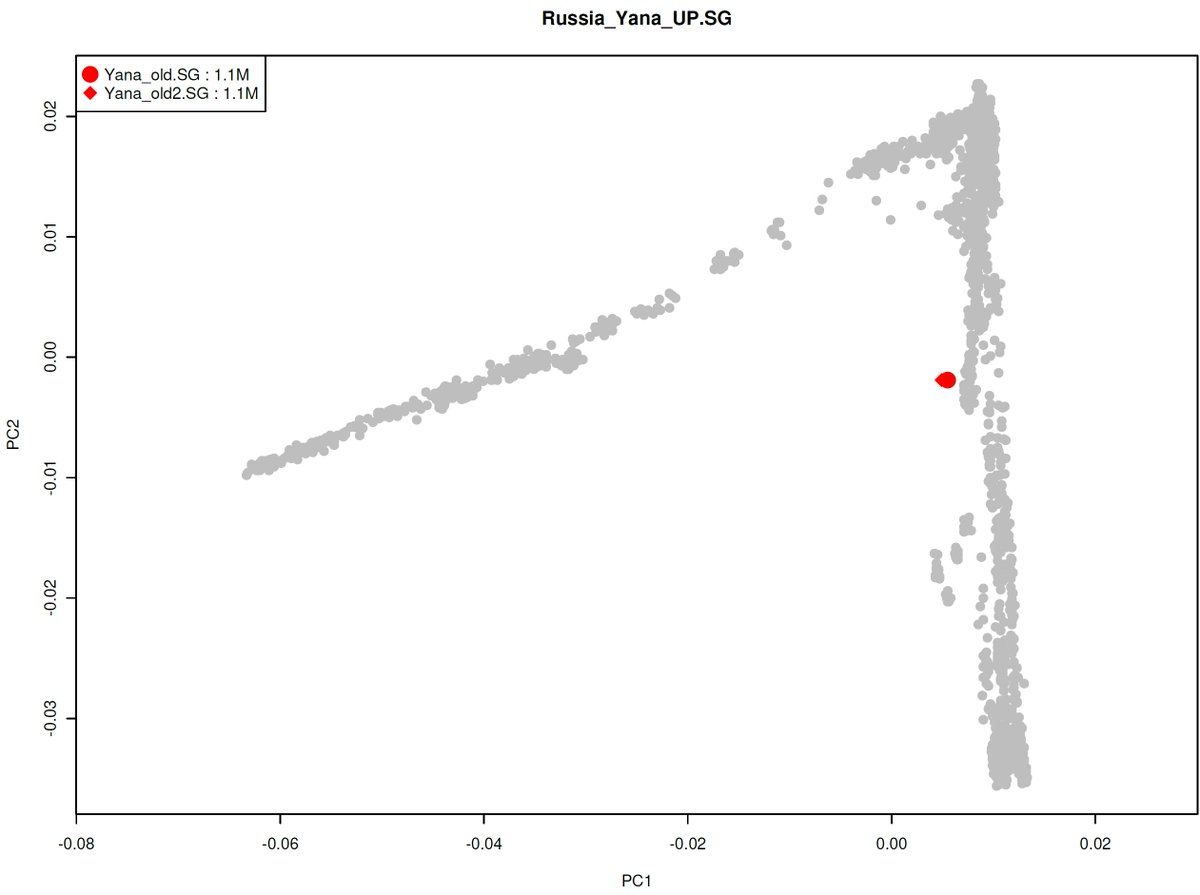
Any single figure visualization of global genetic diversity is likely to mislead. Below, I show a familiar V-shaped PCA I recently did, which shows a couple of ~31kya North Siberians (Sikora, Pitulko, et al. 2019) in the context of world genetic variation.
Someone could misinterpret this as evidence that Yana was intermediate between West Eurasians (around the point of the V) and East Eurasians (->bottom). In fact, this was an early population sharing deep ancestry with Europeans, quite unlike its recent PCA neighbors
Our paper on ancient DNA from likely combatants from both the 480BC and 409BC Battles of Himera (and other ancients from Sicily) is now out (led by @AlMittnik)
There are many interesting findings, but I will highlight a few:
First, many of the 5th c. BC Greek combatants were genetically very similar to Bronze Age Mycenaean Greeks (a thousand years earlier).
Thus, we may conclude that the Ionian and Dorian ethnē -from which the Sicilian Himerans were drawn, according to historical sources- did not represent the migration of a genetically dissimilar population into post-Mycenaean Greece.
It is a remarkable accident of history that Anatolian speakers lasted long enough to leave their writings in cuneiform and later alphabetic writing. If the Anatolian speakers had lived anywhere else we would have no clue they even existed as a sister group of IE
The same for Tocharian speakers: they presumably lasted for >3000 years, long enough to record their languages, even briefly, in medieval times, before their languages went extinct. It's an accident of history that we have evidence for them at all.
And 99% of Indo-European speakers stem from Corded Ware ancestors. It is only three small groups: Greeks, Armenians, Albanians who go up to the Yamnaya not via Corded Ware intermediaries. Many others were wiped out linguistically, e.g. Tocharians and most Paleo-Balkan speakers