🚨FCC WAIVER IMPLICATIONS🚨
📓DEEPDIVE DD EXPLAINED 👨🏼💻
Let’s start:
The way you can differentiate emmissions in space [where] and in time [when] and in strength [how much] you can also differentiate in the frequenzy domain [which channel].
That you transmit in.
🧶🐈⬛
1/n
📓DEEPDIVE DD EXPLAINED 👨🏼💻
Let’s start:
The way you can differentiate emmissions in space [where] and in time [when] and in strength [how much] you can also differentiate in the frequenzy domain [which channel].
That you transmit in.
🧶🐈⬛
1/n
https://twitter.com/catse___apex___/status/1876311548102418600
The transmissions are ”good signals” if they’re [when], [where], [as strong] and [which channel] combo that is needed to do the transmission that is sought for.
Another combo is ”a waste”.
But some other combos also do harm.
”Bad signal”
2/n
Another combo is ”a waste”.
But some other combos also do harm.
”Bad signal”
2/n
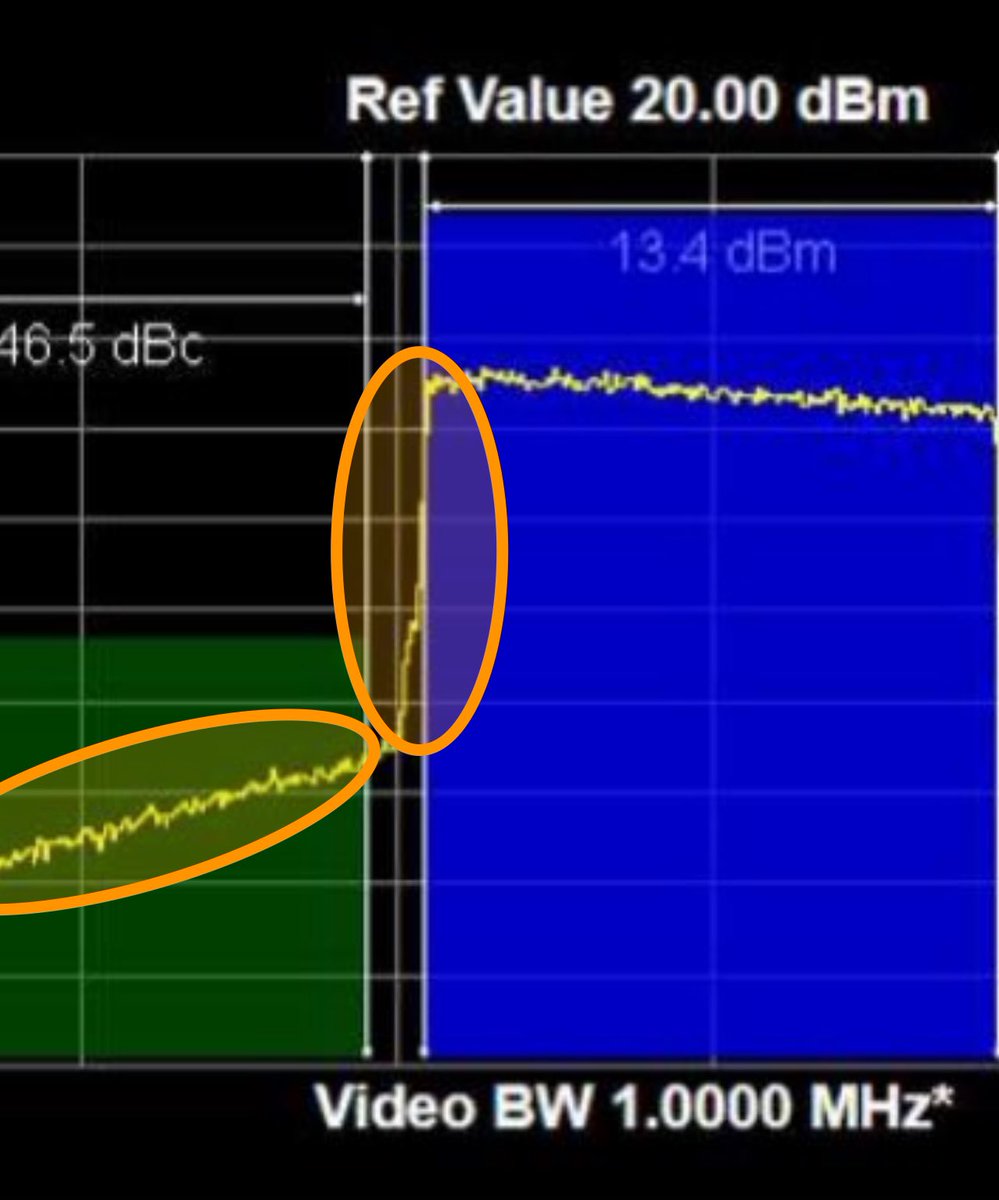
This is a result showing AST SpaceMobile technology to maximize the signal to which channel it is wanted in (blue) ”good signal” while minimizing it elsewhere, which is adjacent channels. (Green). ”Bad signal”
This is industry excellence.
3/n
This is industry excellence.
3/n

It’s the sharp drop-offs in signal strength highlighted here with orange ellipse that makes it very high tech.
Requires very good chips/ filters and amplifiers.
It is not easy stuff to do.
4/n
Requires very good chips/ filters and amplifiers.
It is not easy stuff to do.
4/n
Yesterday (see: )
Starlink received a waiver from FCC
It permits SpaceX to have higher aggregate out-of-band emissions (OOBE) power flux density (PFD) level in the USA, specifically up to -110.6 dBW/m2/MHz, instead of the standard -120 dBW/m2/MHz.
5/ docs.fcc.gov/public/attachm…
Starlink received a waiver from FCC
It permits SpaceX to have higher aggregate out-of-band emissions (OOBE) power flux density (PFD) level in the USA, specifically up to -110.6 dBW/m2/MHz, instead of the standard -120 dBW/m2/MHz.
5/ docs.fcc.gov/public/attachm…
Conditions:
1. SpaceX must address any harmful interference to authorized terrestrial licensees by its operations, or else cease operations.
2. The waiver applies 👉only to the 5 MHz band segments immediately adjacent 👈 to the downlinks for SpaceX's SCS service.
6/
1. SpaceX must address any harmful interference to authorized terrestrial licensees by its operations, or else cease operations.
2. The waiver applies 👉only to the 5 MHz band segments immediately adjacent 👈 to the downlinks for SpaceX's SCS service.
6/
And as Starlink d2c hardware isn’t as cutting edge as ASTs.
Because their differentiation in frequency domain doesn’t drop off as sharp.
(Starlink ACLR 20 dB AST 45 dB)
This has severe implications for Starlink.
6/
Because their differentiation in frequency domain doesn’t drop off as sharp.
(Starlink ACLR 20 dB AST 45 dB)
This has severe implications for Starlink.
6/

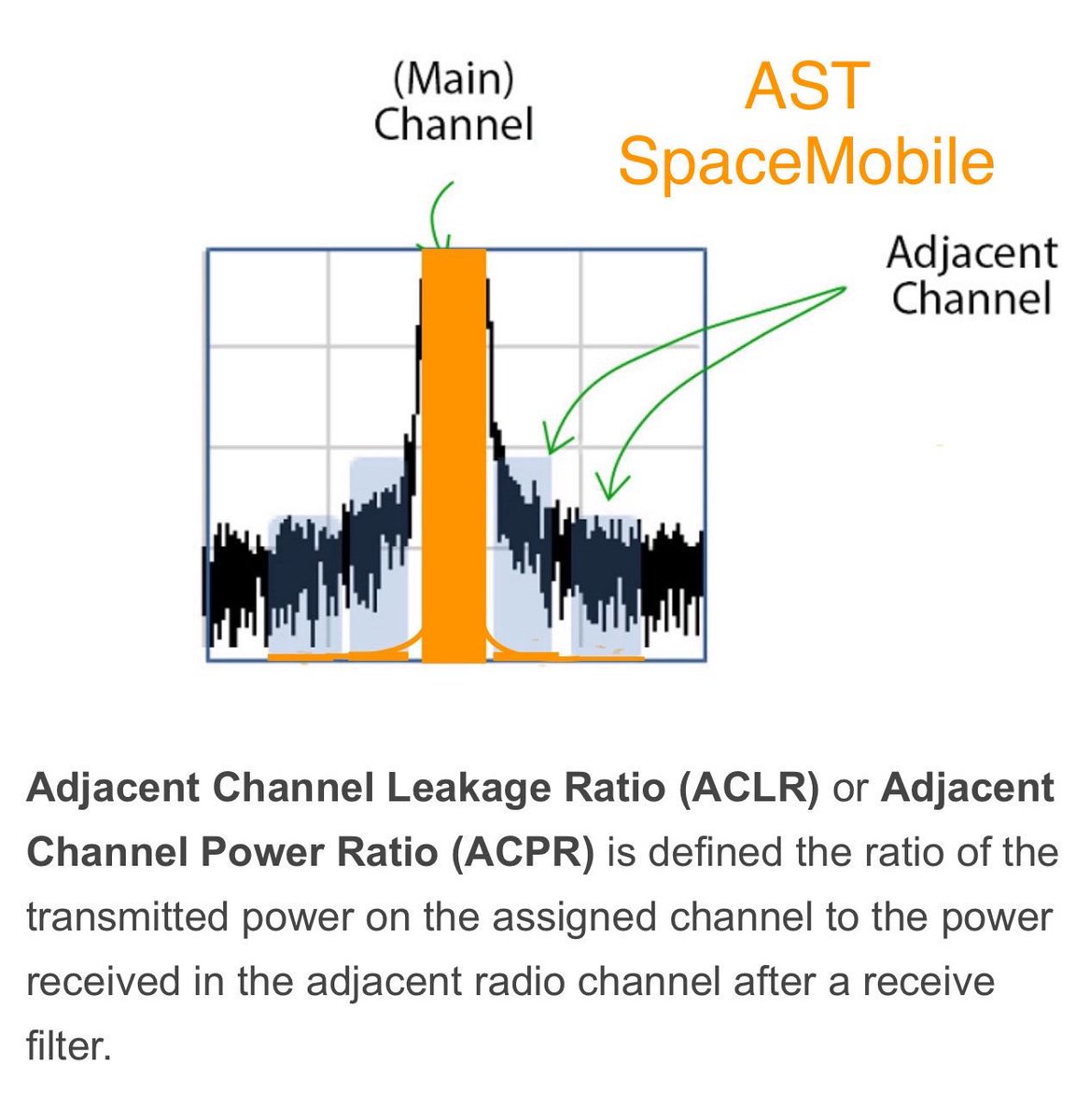
Basically FCC did this:
”Hi Starlink d2c feel free to spam the green box some more (adjacent 5MHz channels) but rule is still upheld in red box. (The channels beyond the most adjacent ones).”
7/
”Hi Starlink d2c feel free to spam the green box some more (adjacent 5MHz channels) but rule is still upheld in red box. (The channels beyond the most adjacent ones).”
7/

And so the waiver while it on paper might seem an appeasement to Elon is that mostly on paper only.
In reality Starlink d2c still need to upgrade their RF hardware a lot to be able to use this waiver for any significant increase in power and throughput.
8/
In reality Starlink d2c still need to upgrade their RF hardware a lot to be able to use this waiver for any significant increase in power and throughput.
8/
This becomes Starlinks problem under the new waiver.
If they raise power in the channel. Not only do they increase in adjacent channels where they are allowed some but also beyond that where they are not.
Not much of a gift from fcc given the width of that tent.
9/
If they raise power in the channel. Not only do they increase in adjacent channels where they are allowed some but also beyond that where they are not.
Not much of a gift from fcc given the width of that tent.
9/
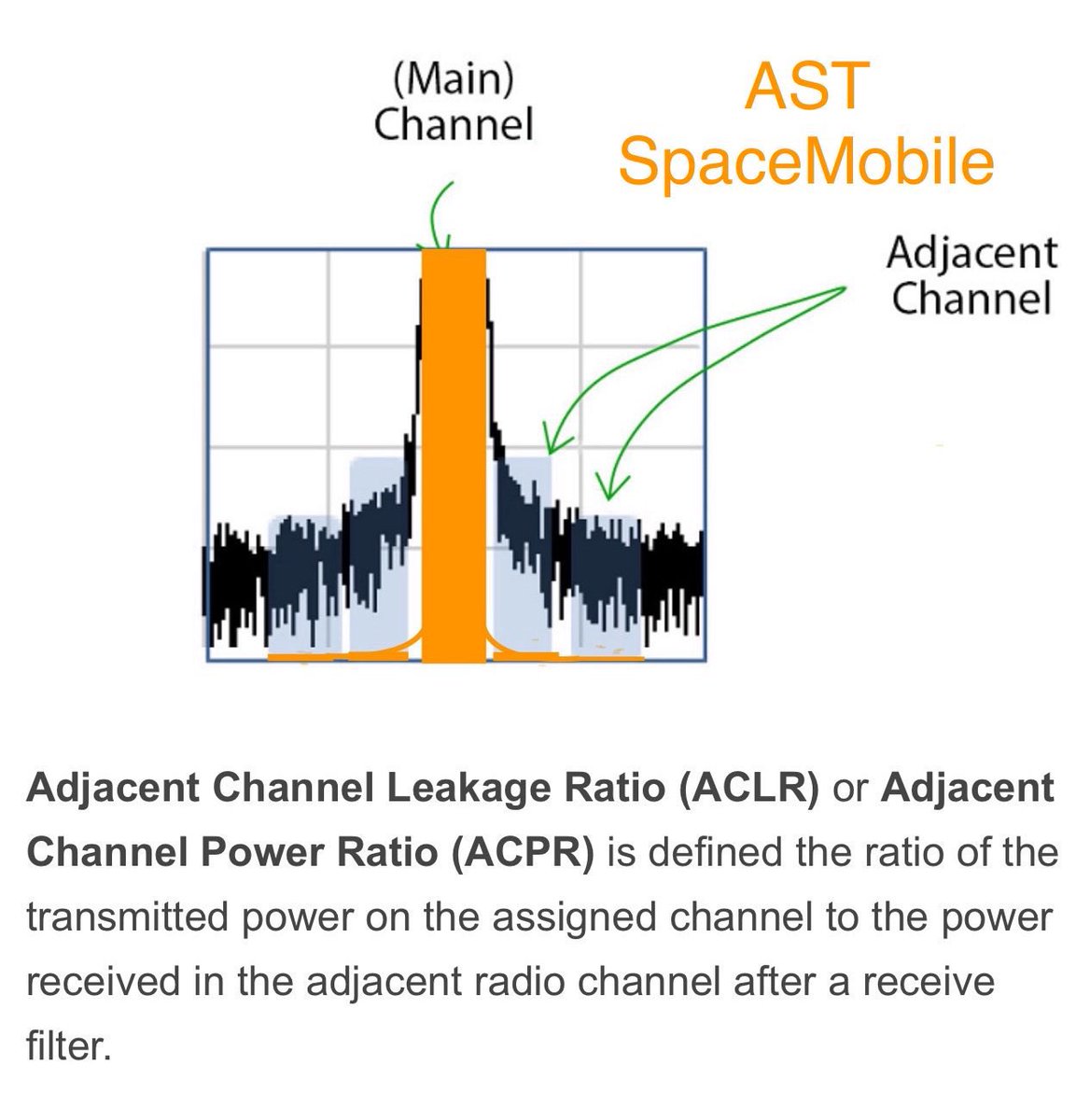
Here is AST type better RF technology on increasing power levels.
Note how the very sharp drop off means that spamming doesn’t propagate significantly beyond the main channel itself and certainly not beyond adjacent channels.
This feature also key to use Ligado spectrum.
10/
Note how the very sharp drop off means that spamming doesn’t propagate significantly beyond the main channel itself and certainly not beyond adjacent channels.
This feature also key to use Ligado spectrum.
10/
Now. Be adviced that Starlink fanbois posing as either journalists or consultants will not report on these key differentiators. Or even try to ridicule those who do.
Well. The joke is on them.
Because of the implication.
11/
Well. The joke is on them.
Because of the implication.
11/
When FCC establishes this type of precedent it is of some limited use to Starlink d2c.
But it will be of huge benefit to AST when launching the L-band and S-band compatible block 3 tier in ~2026-2026 for multi connectivity.
That will be full power on full spectrum width.
12🏁
But it will be of huge benefit to AST when launching the L-band and S-band compatible block 3 tier in ~2026-2026 for multi connectivity.
That will be full power on full spectrum width.
12🏁
Let’s acknowledge genious as they acquaint us.
HT: @defiantclient who had this gem identified 18h ago.
Love your DD, my friend.
🐾
HT: @defiantclient who had this gem identified 18h ago.
Love your DD, my friend.
🐾

@defiantclient *~2026-2027
• • •
Missing some Tweet in this thread? You can try to
force a refresh