Sam Knowlton Profile picture
Mar 12 7 tweets 2 min read Read on X
Microplastic pollution is disrupting photosynthesis across ecosystems and cropland, threatening our food security in ways we've drastically underestimated.

These invisible particles degrade our soils and undermine the biological foundation of our food system...🧵 Image
Microplastics physically block sunlight on leaf surfaces, disrupt internal nutrient transport pathways, release adsorbed toxins into plant tissues, and induce oxidative stress—collectively degrading photosynthetic efficiency at cellular levels. Image
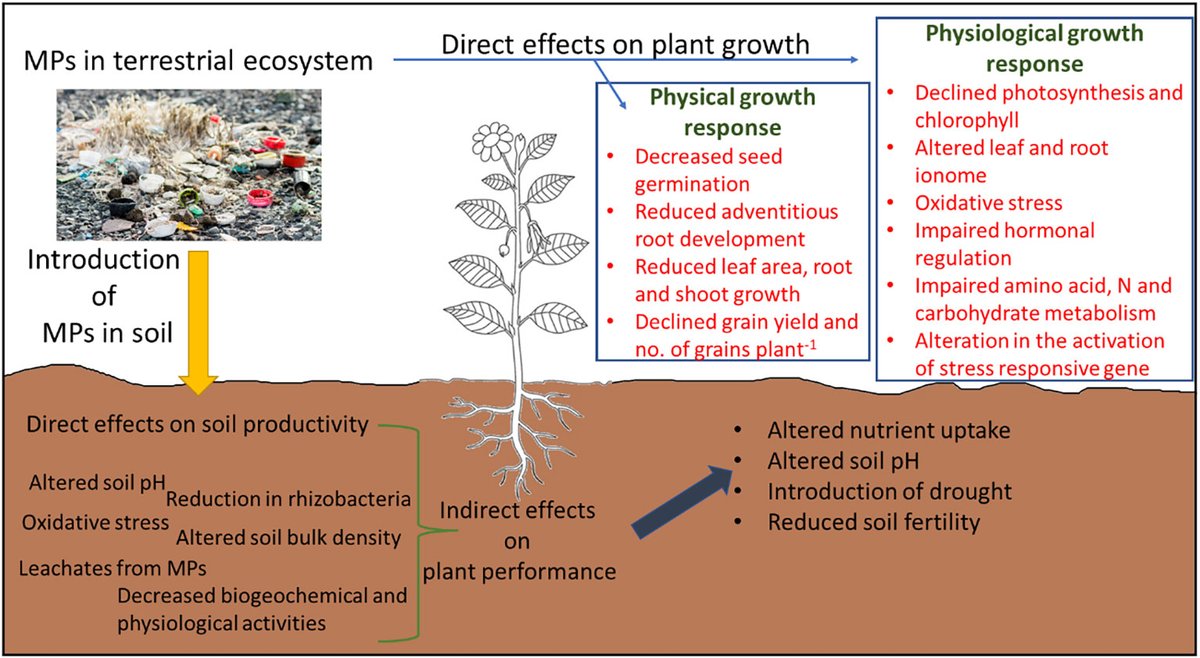
Microplastic particles in soil and water reduce plants' ability to convert sunlight to energy by 7-12% and decrease the green pigment plants need for this process by 11-13%.

This damage affects everything from crop fields to marine algae.
Food production data translates this into agricultural yields.

We're losing 109-360 MILLION metric tons of crops annually.

This massive reduction represents enough food to feed hundreds of millions of people and constitutes 4-14% of global staple crop production.
Agriculture exists in a paradoxical relationship with microplastics—both victim and vector.

Recent UK soil sampling found agricultural soils contain 1,320-8,190 microplastic particles per kg, with significantly higher concentrations where plastic crop covers were used. Image
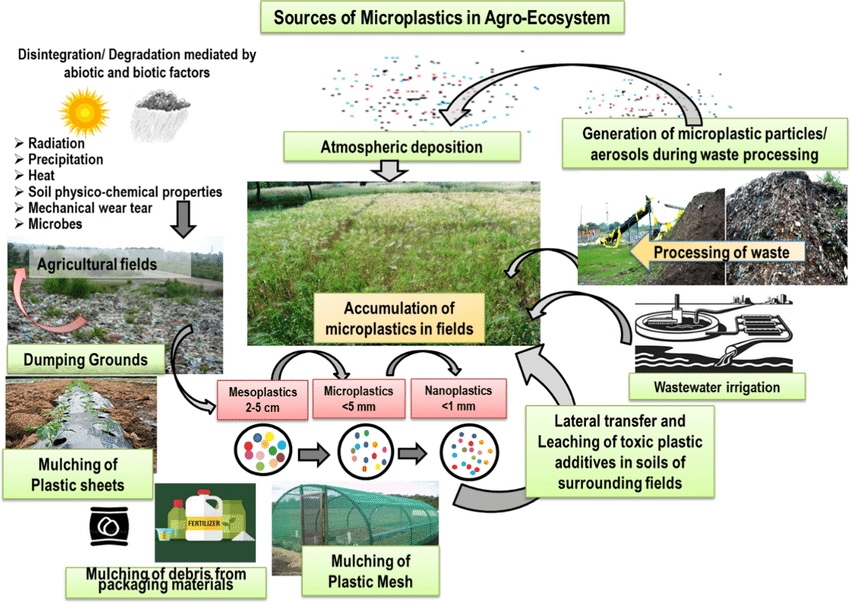
Plastics used to increase yields (mulches, covers, polytunnels) degrade into microplastics that subsequently reduce those same yields through photosynthetic interference—creating a classic ecological trap in agricultural systems.
To ensure an abundant and healthy food supply, reducing and remediating plastic pollution needs to become a priority in agricultural and environmental policies.

Until then, microplastics are undermining the most fundamental biological process that sustains crop productivity.

• • •

Missing some Tweet in this thread? You can try to force a refresh

 

Keep Current with Sam Knowlton

Sam Knowlton Profile picture

Stay in touch and get notified when new unrolls are available from this author!

Read all threads

This Thread may be Removed Anytime!

PDF

Twitter may remove this content at anytime! Save it as PDF for later use!

Try unrolling a thread yourself!

how to unroll video
  1. Follow @ThreadReaderApp to mention us!

  2. From a Twitter thread mention us with a keyword "unroll"
@threadreaderapp unroll

Practice here first or read more on our help page!

More from @samdknowlton

Mar 11
Pesticides persist in soils for decades, not months.

A study of 100 fields shows even after 20 years of organic management, soils contain up to 16 different pesticide compounds—disrupting microbial communities and undermining productivity long after application stops... 🧵 Image
Fields were analyzed across the agricultural spectrum—from conventional operations to established organic farms.

Certified organic soils contained significant levels of atrazine, chloridazon, and carbendazim (a compound linked to declining reproductive health). Image
The data contradicts what's on pesticide labels. Atrazine's official half-life (6-108 days) suggests quick breakdown, but field measurements show it persists for decades.

Our current models dramatically underestimate how long these compounds actually remain in soil systems.
Read 12 tweets
Mar 10
Biological Transmutation challenges a fundamental axiom of science: the immutability of elements.

Evidence suggests living systems can change one element to an entirely different one at ordinary temperatures—forcing us to reimagine the basic rules of matter itself... 🧵 Image
First documented systematically by Louis Kervran, biological transmutation suggests organisms possess biochemical pathways capable of rearranging nucleons at low energy thresholds, effectively converting one element to another through non-nuclear processes.
Studies reveal organisms generating elements absent from their environment.

Hens producing calcium-rich eggshells despite calcium-deficient diets, seeds in distilled water developing unexpected minerals.

This phenomenon spans plants, animals, and microbes alike.
Read 12 tweets
Mar 7
Farmers worldwide spend billions annually on potassium fertilizers that may actually REDUCE crop access to this essential nutrient.

This counterintuitive finding from University of Illinois research challenges decades of conventional agricultural practice.

A quick summary: Image
The "potassium paradox" occurs when potassium chloride (KCl) fertilizer triggers soil mechanisms that lock away rather than supply potassium

Meanwhile, unfertilized soils often show INCREASING potassium availability over time

Here's how it works:
Soils with 2:1 phyllosilicate clays have layered structures that trap K+ ions.

When KCl is applied, high K+ concentrations cause these clay minerals to collapse, sequestering potassium through "K fixation" — making it UNAVAILABLE to plants.
Read 14 tweets
Mar 5
The story that synthetic nitrogen represents a technological triumph that saved the world from hunger mischaracterizes its industrial origins.

These fertilizers weren't designed for optimal crop nutrition, they emerged from repurposed wartime chemical manufacturing...🧵 Image
Haber-Bosch wasn't developed to feed populations, it was engineered to manufacture explosives.

After WWII, the chemical industry faced massive production overcapacity and strategically pivoted toward agriculture, creating a new market for existing industrial infrastructure.
This transformation wasn't driven by agricultural necessity but industrial pragmatism.

Today, 85% of global ammonia production remains tied to fertilizer manufacturing, a direct legacy of post-war industrial strategy rather than a carefully optimized plant nutrition system.
Read 11 tweets
Mar 4
Soil functions as a complex electrochemical matrix where electron transfer processes govern nutrient availability, microbial activity, and plant physiological responses.

Understanding and managing this electrical dimension represents the frontier of agricultural science... 🧵 Image
Soil redox potential measures the availability of electrons—essentially quantifying your soil's "electrical charge"—and ranges from highly oxidized (+600 mV) to highly reduced (-300 mV).

This invisible electrical gradient determines which nutrients plants can access.
Think of soil redox like climate zones: different microbial communities thrive in specific electrical environments, just as distinct plant communities occupy tropical, temperate, or arctic regions.

Each zone supports specialized metabolic pathways.
Read 12 tweets
Feb 28
Since 1900, we've lost 75% of our global food crop varieties—the most rapid extinction of agricultural genetics in human history

Meanwhile, the US lost 93% of vegetable varieties between 1903-1983

This is one the greatest threats to agriculture and is rarely talked about 🧵 Image
The mechanisms of loss are clear.

High-yield varieties displaced 85% of traditional landraces post-1960.

Monocultures now dominate 80% of global cropland for just 12 plant species.

The 1980 Bayh-Dole Act enabled 4 firms to control 67% of commercial seeds today.
A public research vacuum accelerated this decline.

Breeding programs lost 37% of funding since 2002.

Only 5 public corn breeders remain in the U.S., down from 25 in 1960.

Private R&D focuses on 6 major crops, ignoring 7,000+ edible species used historically.
Read 9 tweets

Did Thread Reader help you today?

Support us! We are indie developers!


This site is made by just two indie developers on a laptop doing marketing, support and development! Read more about the story.

Become a Premium Member ($3/month or $30/year) and get exclusive features!

Become Premium

Don't want to be a Premium member but still want to support us?

Make a small donation by buying us coffee ($5) or help with server cost ($10)

Donate via Paypal

Or Donate anonymously using crypto!

Ethereum

0xfe58350B80634f60Fa6Dc149a72b4DFbc17D341E copy

Bitcoin

3ATGMxNzCUFzxpMCHL5sWSt4DVtS8UqXpi copy

Thank you for your support!

Follow Us!

:(



