DC Circuit denies the motion for an emergency stay in the Boasberg case 2-1, with a brief order and 92 pages of concurrences (one by Henderson, one by Millett) and a dissent (Walker).
I'm going to scan through the opinions and select out key parts. 🧵
1st up Henderson: The idea that the President's call is unreviewable is wrong.
"Questions of interpretation and constitutionality—the heartland of the judicial ken—are subject to judicial review."
Henerson: Under the statute, "invasion" is a limited concept.
Invasion means a military invasion.
Millett: The district court is handling this carefully, and there is no authority or reason to intervene at this early emergency stage.
Millett: "Judicial review has always been available to noncitizens detained or removed under the AEA."
Millett: The district court merely ordered the government to maintain custody; it wasn't telling them to turn a plane around.
Millett: "The judiciary, not the Executive, has the ultimate constitutional responsibility and capacity for saying what statutes and statutory terms mean." See Loper Bright.
Millett: "the government is mistaken about the extent of unilateral Executive authority under the Constitution."
Millett: "The government’s removal scheme denies Plaintiffs even a gossamer thread of due process."
Walker, dissenting: This case should have been filed in Texas, not DC.
Walker: There's a right to judicial review here, but the proper lawsuit is a habeas petition.
A habeas petition has to be filed in the district of confinement, which here is in Texas, not DC.
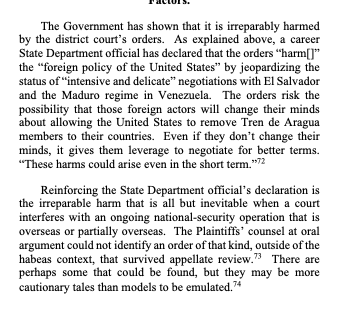
Walker, dissenting: The government has shown irreparable harm by the district court's order.
• • •
Missing some Tweet in this thread? You can try to
force a refresh

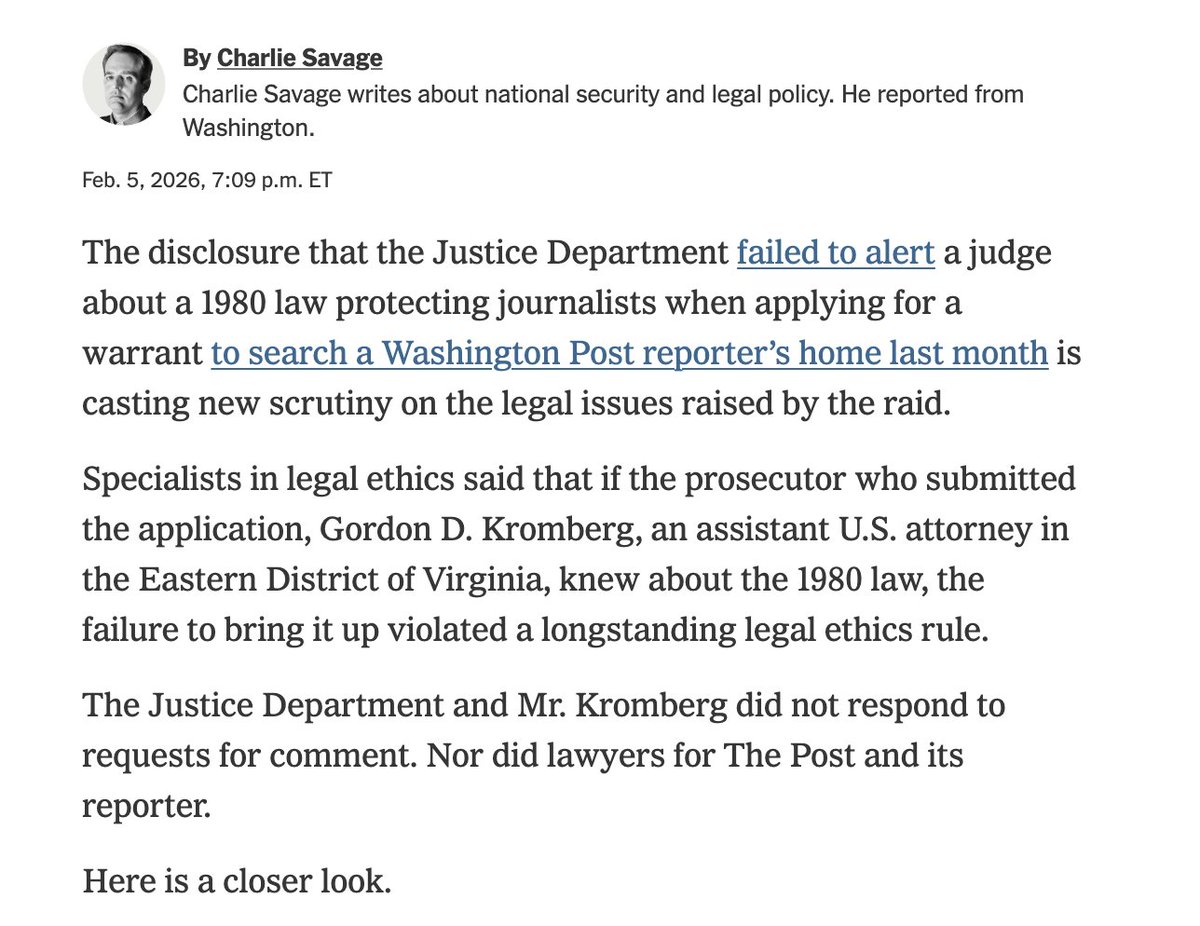
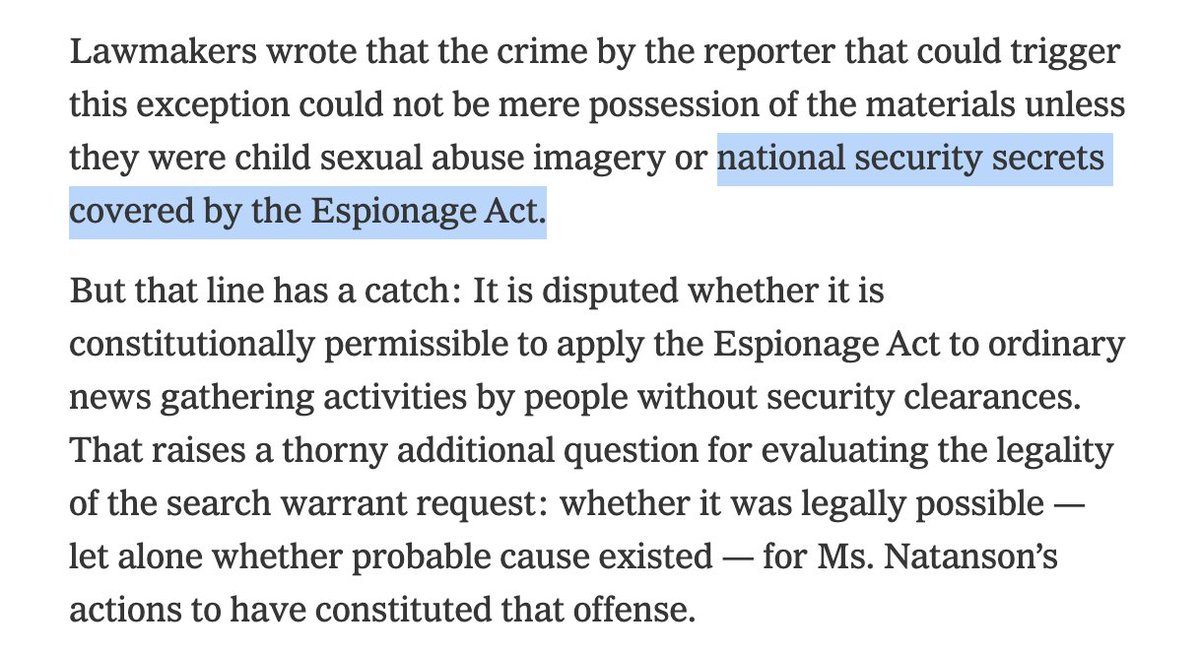
Unless I'm missing something, this is just absolute nonsense. The law has an explicit statutory exception that clearly applies in this case. And even if it didn't, the PPA is not an "adverse authority," as it's utterly irrelevant to probable cause. nytimes.com/2026/02/05/us/…
The article even briefly mentions the exception that obviously renders the statute completely irrelevant (see the highlighted text) but then adds that there is a "catch"-- that some think the 1st Amendment applies. But how is that relevant to the ethical duty to disclose?
There can't be a duty to disclose an obviously inapplicable statute just because some scholars have a theory that the First Amendment should apply instead. That doesn't expand the scope of the statute.
NOTEWORTHY: Pennsylvania Supreme Court rules that there are no 4th Amendment rights in your Google search terms. When you search on Google, you tell them your search terms; the government can get those queries without a warrant. The third-party doctrine applies.
You know that you're being tracked, the Court says, and your decision to use the Internet (or at least search engines) anyway makes your actions voluntary.
The Terms of Service at Google make this clear, according to the Court: Under Google's TOS, you're on notice that you don't have privacy. Under the TOS, you can't claim privacy. Carpenter doesn't apply.
This isn't my area, so maybe this is wrong, but it does seem to me that the unitary executive theory of control over prosecutions and the executive pardon power are something of an odd combination.
As I understand the history, at common law, prosecutions ordinarily were brought by private parties. A private victim would prosecute the criminal, sort of like a tort action except with the possibility of being hung if the defendant is convicted.
In that world, an executive pardon power made a lot of sense. Private parties would seek punishments when justice didn't require it, so someone was needed to be a check on the system of private prosecution.
Debates about when originalism first became a theory of constitutional interpretation are interesting to me in part because, in Fourth Amendment law, originalism has pretty much *always* been considered a critical method—if not the main method—of interpretation.
Take the first main Supreme Court case on Fourth Amendment law, Boyd v. United States (1886). It's all about how to apply the principles of the 18th century cases, like Entick v. Carrington (1765), that inspired the 4A's enactment. tile.loc.gov/storage-servic…
Or take Carroll v. United States (1925), introducing the automobile exception. It's all very explicitly originalist: "The Fourth Amendment is to be construed in the light of what was deemed an unreasonable search and seizure when it was adopted" tile.loc.gov/storage-servic…
Several notable 4th Amendment rulings in this 5th Circuit opinion today. Most importantly: People have a reasonable expectation of privacy in stored online contents—here, the contents of a Dropbox account. (Per Oldham, J., w/Richman & Ramirez)
Plaintiffs, Heidi Group, is a pro-life group that briefly had a contract with the Texas state government. A former employee named Morgan went to state investigators and said she had access to Heidi Group's documents b/c she was still given access to their Dropbox account.
A state investigator, Dacus, encourages Morgan to look through Heidi Group's files for evidence what Heidi Group did when it was a state contractor. Morgan does. Heidi Group realizes someone is accessing its files, eventually sues state officials for violating its 4A rights.
First off, the conservative/GOP bona fides of Bill Burck and Robert Hur have been covered elsewhere. telegraph.co.uk/us/news/2025/0…
But as @WilliamBaude notes, Lehotsky Keller Cohn is on the brief, with name partners Steve Lehotsky (Scalia clerk, former Bush-era OLC); Scott Keller (former Texas SG, Ted Cruz Chief of Staff, Kennedy clerk), and Jonathan Cohn (Thomas clerk).