The following is a list of U.S. universities where international students and faculty have faced visa revocations, detentions, or deportation orders under the Trump administration—many targeted for pro-Palestinian activism. In many cases, students have been accused, without evidence, of supporting terrorism or posing “foreign policy” risks. 🧵⬇️

2/ Arizona State University (ASU):
8 international students recently had their visas revoked, reportedly by U.S. consulates in their home countries. While ASU initially suggested the revocations were linked to “various legal infractions,” no specific charges or criminal records have been identified. Activism, including pro-Palestinian protests, has been cited as a factor in similar cases nationwide, though ASU denies this connection for its students.
8 international students recently had their visas revoked, reportedly by U.S. consulates in their home countries. While ASU initially suggested the revocations were linked to “various legal infractions,” no specific charges or criminal records have been identified. Activism, including pro-Palestinian protests, has been cited as a factor in similar cases nationwide, though ASU denies this connection for its students.

3/ Brown University (RI):
Dr. Rasha Alawieh, a 34-year-old assistant professor and kidney transplant specialist, was deported to Lebanon despite holding a valid H-1B visa and a federal judge’s order temporarily halting her removal. U.S. Customs and Border Protection agents reportedly found deleted photos and videos of Hezbollah leader Hassan Nasrallah’s funeral on her phone.
Dr. Rasha Alawieh, a 34-year-old assistant professor and kidney transplant specialist, was deported to Lebanon despite holding a valid H-1B visa and a federal judge’s order temporarily halting her removal. U.S. Customs and Border Protection agents reportedly found deleted photos and videos of Hezbollah leader Hassan Nasrallah’s funeral on her phone.
4/ Columbia University (NY):
Mahmoud Khalil, a former graduate student and pro-Palestinian activist, was detained and faces deportation proceedings. Ranjani Srinivasan, a 37-year-old doctoral student from India, fled to Canada after her F-1 visa was revoked, reportedly due to online advocacy for Palestine. Yunseo Chung, a legal permanent resident who has lived in the U.S. since age 7, is suing the Trump administration after ICE attempted to revoke her status following her participation in pro-Palestinian protests. All cases highlight the targeting of pro-Palestinian activism under immigration enforcement.
Mahmoud Khalil, a former graduate student and pro-Palestinian activist, was detained and faces deportation proceedings. Ranjani Srinivasan, a 37-year-old doctoral student from India, fled to Canada after her F-1 visa was revoked, reportedly due to online advocacy for Palestine. Yunseo Chung, a legal permanent resident who has lived in the U.S. since age 7, is suing the Trump administration after ICE attempted to revoke her status following her participation in pro-Palestinian protests. All cases highlight the targeting of pro-Palestinian activism under immigration enforcement.
5/ Colorado State University & University of Colorado:
A total of 10 international students had their F-1 visas revoked by the Department of Homeland Security. At CSU, six students were affected, including five Kuwaiti nationals and a Saudi graduate working on campus. CU reported four students impacted across its Boulder and Colorado Springs campuses but withheld further details.
A total of 10 international students had their F-1 visas revoked by the Department of Homeland Security. At CSU, six students were affected, including five Kuwaiti nationals and a Saudi graduate working on campus. CU reported four students impacted across its Boulder and Colorado Springs campuses but withheld further details.

6/ Cornell University (NY):
Momodou Taal, a British-Gambian Ph.D. student in Africana Studies, left the U.S. after his visa was revoked due to his involvement in pro-Palestinian protests. DHS agents reportedly visited his residence, prompting him to self-deport after a judge denied his motion to block deportation. Taal had faced suspension from Cornell for leading protests, including a disruption of a career fair featuring arms companies. He cited fears for his safety and the “lawlessness” of the Trump administration as reasons for his departure.
Momodou Taal, a British-Gambian Ph.D. student in Africana Studies, left the U.S. after his visa was revoked due to his involvement in pro-Palestinian protests. DHS agents reportedly visited his residence, prompting him to self-deport after a judge denied his motion to block deportation. Taal had faced suspension from Cornell for leading protests, including a disruption of a career fair featuring arms companies. He cited fears for his safety and the “lawlessness” of the Trump administration as reasons for his departure.

7/ Georgetown University (DC):
Badar Khan Suri, an Indian postdoctoral researcher and professor, was detained by ICE after his J-1 visa was revoked. DHS accused him of disseminating “Hamas propaganda” and fostering antisemitism on social media, though no evidence has been presented to substantiate these claims. Suri is currently held in a Texas detention center under overcrowded conditions, with his academic work indefinitely suspended. His detention highlights the Trump administration’s intensified scrutiny of international students’ social media activity, particularly targeting pro-Palestinian activism.
Read Drop Site’s report for more details on Badar Khan Suri.
Badar Khan Suri, an Indian postdoctoral researcher and professor, was detained by ICE after his J-1 visa was revoked. DHS accused him of disseminating “Hamas propaganda” and fostering antisemitism on social media, though no evidence has been presented to substantiate these claims. Suri is currently held in a Texas detention center under overcrowded conditions, with his academic work indefinitely suspended. His detention highlights the Trump administration’s intensified scrutiny of international students’ social media activity, particularly targeting pro-Palestinian activism.
Read Drop Site’s report for more details on Badar Khan Suri.

8/ North Carolina State University (NC):
Two Saudi graduate students, including Saleh Al Gurad, had their visas abruptly terminated by the U.S. government on March 25, without explanation or prior notice to the university. Al Gurad, studying engineering management and employed on campus, was apolitical and uninvolved in protests, according to his roommate. Both students self-deported to Saudi Arabia to avoid detainment, with NC State offering to help them complete their semester remotely.
Two Saudi graduate students, including Saleh Al Gurad, had their visas abruptly terminated by the U.S. government on March 25, without explanation or prior notice to the university. Al Gurad, studying engineering management and employed on campus, was apolitical and uninvolved in protests, according to his roommate. Both students self-deported to Saudi Arabia to avoid detainment, with NC State offering to help them complete their semester remotely.

9/ Southern Illinois University (IL):
An international student had their visa revoked last week, leaving them in immigration limbo. The university confirmed the revocation but has not disclosed the student’s name or country of origin. The federal government provided no explanation for the action, sparking anxiety among SIU’s international community. SIU issued guidance urging students to exercise caution on social media and at protests, emphasizing the risks such activities may pose to their immigration status.
An international student had their visa revoked last week, leaving them in immigration limbo. The university confirmed the revocation but has not disclosed the student’s name or country of origin. The federal government provided no explanation for the action, sparking anxiety among SIU’s international community. SIU issued guidance urging students to exercise caution on social media and at protests, emphasizing the risks such activities may pose to their immigration status.
10/ Temple University (PA):
An unnamed international student had their visa revoked by the U.S. Secretary of State for unspecified reasons, discovered during a routine review of visa records. The student, reportedly unaware of the revocation until informed by Temple’s Office of Global Engagement, chose to return to their home country voluntarily. While no evidence or allegations have been disclosed, advocacy groups like CAIR-Philadelphia have raised concerns that such actions may be linked to anti-genocide or pro-Palestinian activism, reflecting broader patterns of targeting student protestors nationwide.
An unnamed international student had their visa revoked by the U.S. Secretary of State for unspecified reasons, discovered during a routine review of visa records. The student, reportedly unaware of the revocation until informed by Temple’s Office of Global Engagement, chose to return to their home country voluntarily. While no evidence or allegations have been disclosed, advocacy groups like CAIR-Philadelphia have raised concerns that such actions may be linked to anti-genocide or pro-Palestinian activism, reflecting broader patterns of targeting student protestors nationwide.

11/ Tufts University (MA):
Rumeysa Ozturk, a Turkish Ph.D. student and Fulbright Scholar, was detained by ICE on March 25 while leaving her apartment for an Iftar dinner. Her visa was revoked shortly after, reportedly linked to an op-ed she co-authored in The Tufts Daily criticizing Israel and advocating for divestment from companies tied to its military actions in Gaza. Ozturk is currently held in a Louisiana detention center, with no formal charges filed. Tufts University has publicly condemned her detention, describing her as a valued community member in good immigration standing at the time of her arrest.
Rumeysa Ozturk, a Turkish Ph.D. student and Fulbright Scholar, was detained by ICE on March 25 while leaving her apartment for an Iftar dinner. Her visa was revoked shortly after, reportedly linked to an op-ed she co-authored in The Tufts Daily criticizing Israel and advocating for divestment from companies tied to its military actions in Gaza. Ozturk is currently held in a Louisiana detention center, with no formal charges filed. Tufts University has publicly condemned her detention, describing her as a valued community member in good immigration standing at the time of her arrest.

12/ UCLA (CA):
At least eight international students had their visas revoked under unclear circumstances, reportedly tied to arrests or misdemeanor convictions, according to campus sources. The Dashew Center for International Students and Scholars confirmed the terminations but could not provide further details on individual cases. Faculty groups have expressed concern over the lack of transparency and the potential targeting of students based on racial or political profiling, as similar cases nationwide have involved accusations of activism-related visa violations.
At least eight international students had their visas revoked under unclear circumstances, reportedly tied to arrests or misdemeanor convictions, according to campus sources. The Dashew Center for International Students and Scholars confirmed the terminations but could not provide further details on individual cases. Faculty groups have expressed concern over the lack of transparency and the potential targeting of students based on racial or political profiling, as similar cases nationwide have involved accusations of activism-related visa violations.

13/ University of Alabama (AL):
Alireza Doroudi, an Iranian doctoral student in mechanical engineering, was detained by ICE after his F-1 visa was revoked. DHS claims Doroudi poses “significant national security concerns,” though no evidence or charges have been presented. He was arrested at his home early in the morning and transferred to the Jena-LaSalle Detention Facility in Louisiana, a site criticized for human rights abuses. Doroudi’s attorney disputes the allegations, stating that he has no criminal record or involvement in protests, and was legally present in the U.S. pursuing his studies.
Alireza Doroudi, an Iranian doctoral student in mechanical engineering, was detained by ICE after his F-1 visa was revoked. DHS claims Doroudi poses “significant national security concerns,” though no evidence or charges have been presented. He was arrested at his home early in the morning and transferred to the Jena-LaSalle Detention Facility in Louisiana, a site criticized for human rights abuses. Doroudi’s attorney disputes the allegations, stating that he has no criminal record or involvement in protests, and was legally present in the U.S. pursuing his studies.
14/ University of Cincinnati (OH):
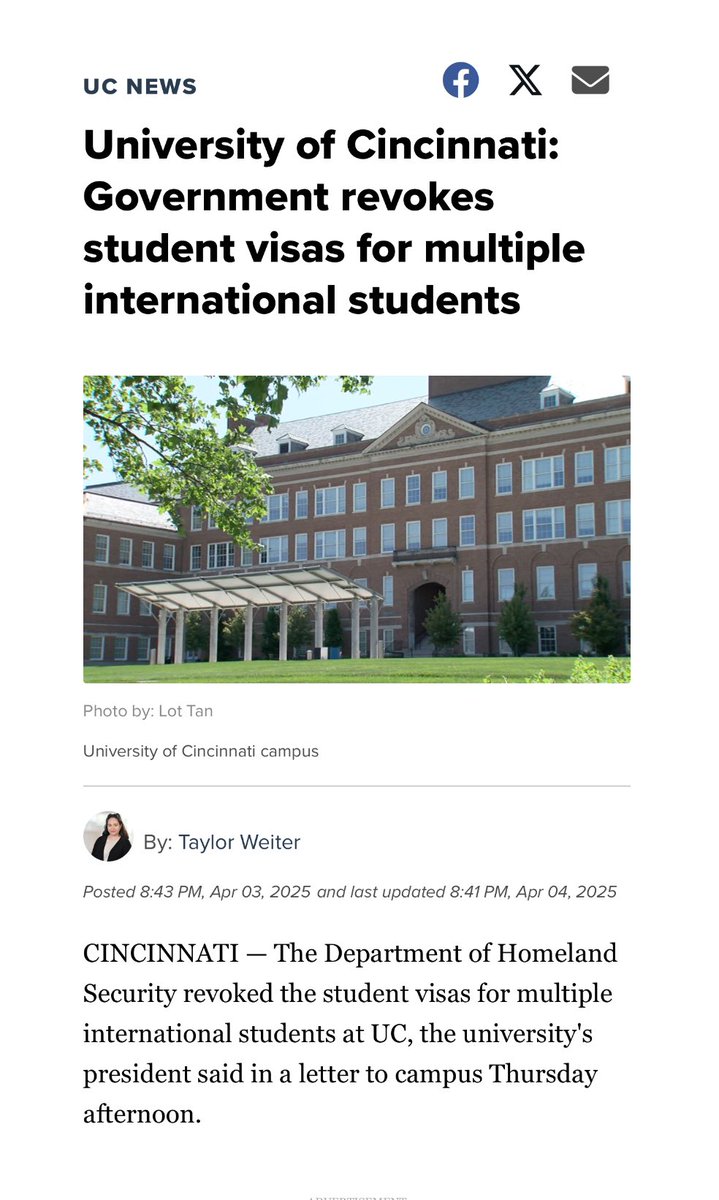
Multiple international students had their F-1 visas revoked by the Department of Homeland Security, with no specific reasons provided. UC President Neville Pinto confirmed the revocations in a campus-wide letter, describing the situation as deeply alarming and part of a broader trend affecting universities nationwide. The exact number of impacted students remains undisclosed
Multiple international students had their F-1 visas revoked by the Department of Homeland Security, with no specific reasons provided. UC President Neville Pinto confirmed the revocations in a campus-wide letter, describing the situation as deeply alarming and part of a broader trend affecting universities nationwide. The exact number of impacted students remains undisclosed
15/ University of Oregon (OR):
An unnamed international student had their F-1 visa revoked by the Department of Homeland Security on March 28 due to “unspecified criminal charges.” The university confirmed it was not notified in advance and has no details about the alleged charges. The student was given 15 days to leave the U.S. unless they could find a legal pathway to remain.
An unnamed international student had their F-1 visa revoked by the Department of Homeland Security on March 28 due to “unspecified criminal charges.” The university confirmed it was not notified in advance and has no details about the alleged charges. The student was given 15 days to leave the U.S. unless they could find a legal pathway to remain.
16/ University of Texas at Austin (TX):
Two international students, one Indian and one Lebanese, had their legal status terminated by DHS, reportedly tied to their participation in anti-Israel protests on campus. The revocations stem from the federal directive targeting activism deemed “counter to U.S. foreign policy interests.” Both students chose to leave the U.S. voluntarily rather than face detention.
Two international students, one Indian and one Lebanese, had their legal status terminated by DHS, reportedly tied to their participation in anti-Israel protests on campus. The revocations stem from the federal directive targeting activism deemed “counter to U.S. foreign policy interests.” Both students chose to leave the U.S. voluntarily rather than face detention.
17/ University of California Campuses:
▪️UCLA: At least nine students, faculty and student groups had their visas revoked. It's unclear whether any students were detained by immigration authorities or why the visas were canceled. The student government, which has been in touch with the UCLA administration confirmed the number.
▪️ At UC Davis, officials said visas for seven students and five recent graduates were terminated.
"This number may change. Federal agents have not entered our campus, and they have not placed any member of our community in custody," a university statement said on Saturday.
▪️UC San Diego: Five students lost their F-1 visas without prior notice, and a sixth student was detained at the border and deported to their home country. The federal government has provided no explanation for these actions.
▪️UC Irvine: Five international students were impacted by visa revocations; details remain undisclosed.
▪️UC Berkeley: Four students had their visas revoked, with no reasons specified. Advocacy groups suspect ties to activism.
▪️UC Santa Barbara: Three cases of visa revocations were reported, but no further details have been released.
▪️UCLA: At least nine students, faculty and student groups had their visas revoked. It's unclear whether any students were detained by immigration authorities or why the visas were canceled. The student government, which has been in touch with the UCLA administration confirmed the number.
▪️ At UC Davis, officials said visas for seven students and five recent graduates were terminated.
"This number may change. Federal agents have not entered our campus, and they have not placed any member of our community in custody," a university statement said on Saturday.
▪️UC San Diego: Five students lost their F-1 visas without prior notice, and a sixth student was detained at the border and deported to their home country. The federal government has provided no explanation for these actions.
▪️UC Irvine: Five international students were impacted by visa revocations; details remain undisclosed.
▪️UC Berkeley: Four students had their visas revoked, with no reasons specified. Advocacy groups suspect ties to activism.
▪️UC Santa Barbara: Three cases of visa revocations were reported, but no further details have been released.

18/ Stanford University (CA):
Four current students and two recent graduates had their visas revoked, according to a routine SEVIS database check. Stanford officials stated they were unaware of the reasons behind the revocations and confirmed no presence of immigration authorities on campus at the time. The affected individuals were notified, and the university is providing external legal assistance. No specific allegations have been disclosed.
Four current students and two recent graduates had their visas revoked, according to a routine SEVIS database check. Stanford officials stated they were unaware of the reasons behind the revocations and confirmed no presence of immigration authorities on campus at the time. The affected individuals were notified, and the university is providing external legal assistance. No specific allegations have been disclosed.
19/ Minnesota State University (MN):
Five international students had their visas revoked by DHS, with no prior notification to the students or the university. The revocations were discovered during a routine SEVIS database check by the school’s Global Education department. University President Edward Inch described the situation as unprecedented and troubling, urging sensitivity due to privacy laws.
Five international students had their visas revoked by DHS, with no prior notification to the students or the university. The revocations were discovered during a routine SEVIS database check by the school’s Global Education department. University President Edward Inch described the situation as unprecedented and troubling, urging sensitivity due to privacy laws.
20/ Texas A&M University (TX):
Three international students recently had their legal status terminated by DHS, with no specific reasons disclosed. University officials investigating the cases found that one of the students had a resolved speeding ticket, while the others had no apparent infractions or ties to activism.
Three international students recently had their legal status terminated by DHS, with no specific reasons disclosed. University officials investigating the cases found that one of the students had a resolved speeding ticket, while the others had no apparent infractions or ties to activism.
21/ Fordham University (NY): President Tania Tetlow confirmed in an April 4 email that an undergraduate student recently had their visa revoked, marking the first known case at the university amid a broader national trend. No details about the student’s identity or the reasons for the revocation were disclosed.


22/ University of Minnesota (MN):
Two international students recently faced visa revocations. One of the students, Dogukan Gunaydin, a Turkish graduate student, was detained by ICE due to a prior DUI conviction, not activism. He has filed a lawsuit challenging the legality of his arrest and visa termination.
Two international students recently faced visa revocations. One of the students, Dogukan Gunaydin, a Turkish graduate student, was detained by ICE due to a prior DUI conviction, not activism. He has filed a lawsuit challenging the legality of his arrest and visa termination.
23/ Kent State University (Ohio, USA):
Four international students—one current student and three recent graduates on Optional Practical Training—had their visas revoked by the U.S. government. The reasons for the revocations remain undisclosed, and the university has expressed concern over the lack of transparency and prior notice.
Four international students—one current student and three recent graduates on Optional Practical Training—had their visas revoked by the U.S. government. The reasons for the revocations remain undisclosed, and the university has expressed concern over the lack of transparency and prior notice.

24/ University of Akron (OH)
Two international students recently had their visas revoked, and their SEVIS records were deleted by the Department of Homeland Security. The university confirmed the cases on April 4 but provided no further details about the reasons behind the revocations. Both students are now working with immigration attorneys to address their status.
Two international students recently had their visas revoked, and their SEVIS records were deleted by the Department of Homeland Security. The university confirmed the cases on April 4 but provided no further details about the reasons behind the revocations. Both students are now working with immigration attorneys to address their status.

25/ Ohio State University (OH)
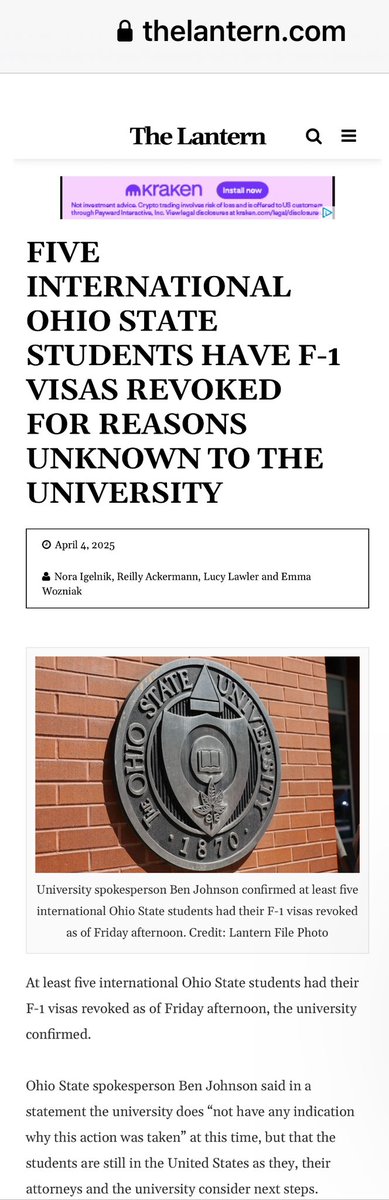
At least five international students had their F-1 visas revoked, as confirmed by university spokesperson Ben Johnson. The reasons for the revocations remain unclear, and the students are still in the U.S., working with attorneys and university officials to determine next steps.
At least five international students had their F-1 visas revoked, as confirmed by university spokesperson Ben Johnson. The reasons for the revocations remain unclear, and the students are still in the U.S., working with attorneys and university officials to determine next steps.
26/ University of Massachusetts Amherst (MA)
Five international students had their visas revoked and student statuses terminated by the federal government this past week. UMass Chancellor Javier Reyes announced the news on April 4, stating that the university was not notified in advance and discovered the revocations through proactive checks in the SEVIS database. The reasons for these actions remain unclear, though similar cases nationwide have been linked to minor infractions or activism.
Five international students had their visas revoked and student statuses terminated by the federal government this past week. UMass Chancellor Javier Reyes announced the news on April 4, stating that the university was not notified in advance and discovered the revocations through proactive checks in the SEVIS database. The reasons for these actions remain unclear, though similar cases nationwide have been linked to minor infractions or activism.

27/ Central Michigan University (CMU)
The U.S. Department of Homeland Security abruptly terminated the visa records of several current and former international students at CMU without prior notice. The university discovered the terminations during routine checks of the Student and Exchange Visitor Information System (SEVIS). Neither CMU nor the affected students were informed beforehand, and no reasons for the revocations have been disclosed.
CMU President Neil MacKinnon called the situation “alarming” and confirmed that the university cannot reverse these decisions or provide legal counsel. Affected students have been advised to seek immigration attorneys for assistance. The university has also designated spaces on campus where ICE agents require judicial warrants to enter.
The U.S. Department of Homeland Security abruptly terminated the visa records of several current and former international students at CMU without prior notice. The university discovered the terminations during routine checks of the Student and Exchange Visitor Information System (SEVIS). Neither CMU nor the affected students were informed beforehand, and no reasons for the revocations have been disclosed.
CMU President Neil MacKinnon called the situation “alarming” and confirmed that the university cannot reverse these decisions or provide legal counsel. Affected students have been advised to seek immigration attorneys for assistance. The university has also designated spaces on campus where ICE agents require judicial warrants to enter.

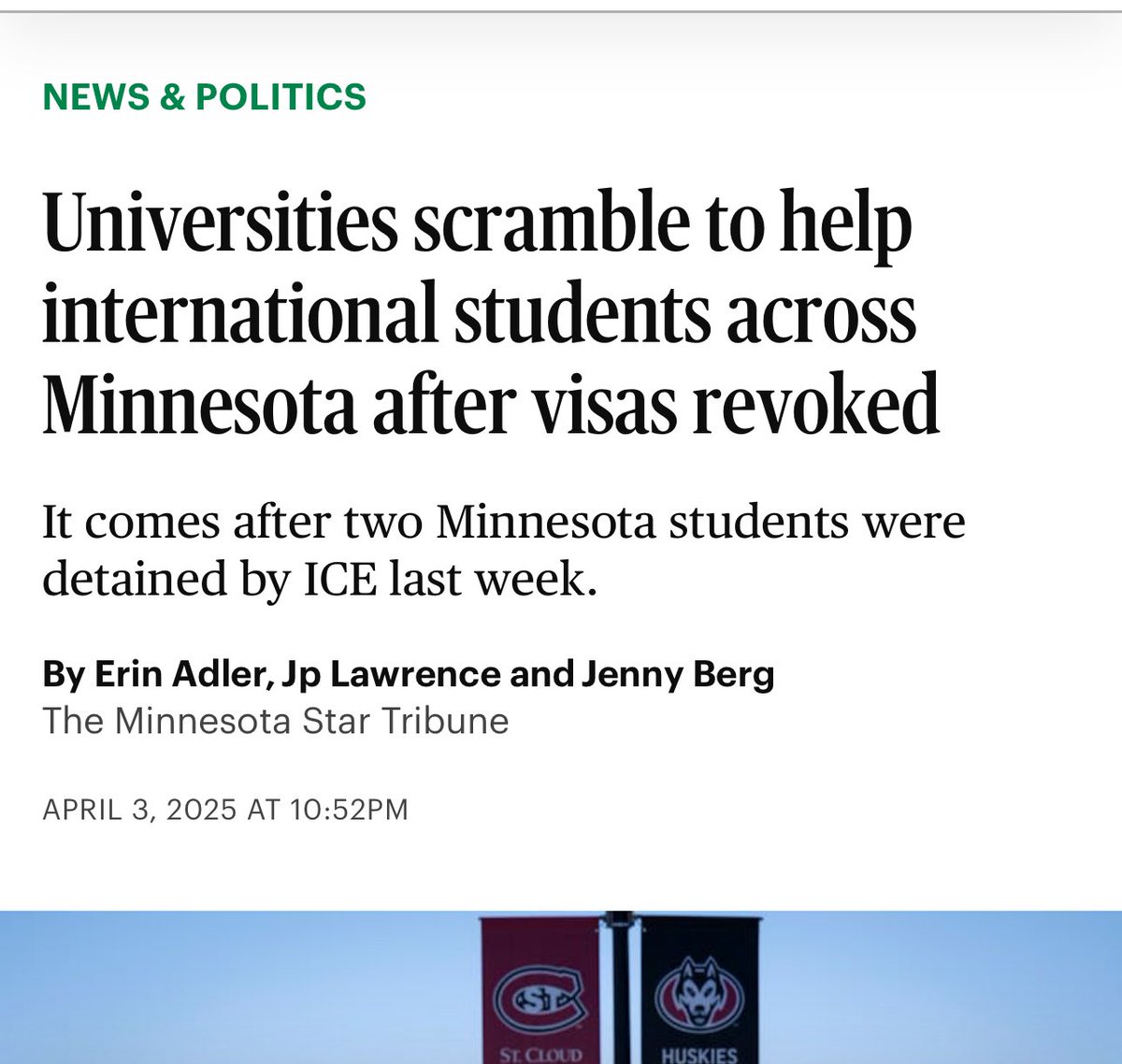
28/ Universities across Minnesota have reported a growing number of international students having their visas revoked. Schools have not disclosed the reasons behind the revocations, and federal authorities have yet to comment on the situation. Here’s what each school has reported:
▪️ Ridgewater College (Hutchinson and Willmar campuses)
– An international student’s visa was revoked recently.
– Details about the exact timing and reason for the revocation have not been provided by Ridgewater College representatives.
▪️ St. Cloud State University
– A “handful” of international students had their records terminated in the Student Exchange Visitor Information System (SEVIS) by the U.S. Department of Homeland Security.
– The university is working directly with the affected students to support them, according to university spokespersons.
– Specific details on the timing and reasons behind the terminations have not been disclosed.
▪️ Metropolitan State University (St. Paul)
– One international student’s SEVIS record was terminated.
– It remains unclear whether the student’s visa was also revoked.
– University spokespeople have not provided further details on the timing or reasoning behind the termination.
▪️ University of Minnesota (details noted earlier in thread)
– At least two international students
▪️ Minnesota State University, Mankato (details noted earlier in thread)
– Five international students had their visas revoked.
▪️ Ridgewater College (Hutchinson and Willmar campuses)
– An international student’s visa was revoked recently.
– Details about the exact timing and reason for the revocation have not been provided by Ridgewater College representatives.
▪️ St. Cloud State University
– A “handful” of international students had their records terminated in the Student Exchange Visitor Information System (SEVIS) by the U.S. Department of Homeland Security.
– The university is working directly with the affected students to support them, according to university spokespersons.
– Specific details on the timing and reasons behind the terminations have not been disclosed.
▪️ Metropolitan State University (St. Paul)
– One international student’s SEVIS record was terminated.
– It remains unclear whether the student’s visa was also revoked.
– University spokespeople have not provided further details on the timing or reasoning behind the termination.
▪️ University of Minnesota (details noted earlier in thread)
– At least two international students
▪️ Minnesota State University, Mankato (details noted earlier in thread)
– Five international students had their visas revoked.
29/ UW-Madison
https://twitter.com/dropsitenews/status/1909416040162877846
UPDATE: At least 50 students at Arizona State University have now had their visas revoked. An attorney representing the students, stated that all affected individuals she has worked with are from India, China, or Muslim-majority countries. She thinks the revocations are related to pro-Palestinian protests.
30/ Harvard University:
The student visas of 3 current students and 2 recent graduates were revoked, as confirmed by the Harvard International Office (HIO). The revocations were discovered during a routine records review. Harvard said it did not receive direct notification from immigration authorities and is unaware of the specific reasons for these actions.
The student visas of 3 current students and 2 recent graduates were revoked, as confirmed by the Harvard International Office (HIO). The revocations were discovered during a routine records review. Harvard said it did not receive direct notification from immigration authorities and is unaware of the specific reasons for these actions.

31/ University of Michigan
Four international students have had their visas revoked by the U.S. Department of Homeland Security, as confirmed by university officials. These students are currently enrolled, and the university has contacted them to discuss potential consequences and available options. One of the affected students has already left the country. The reasons for the revocations remain unclear, though an immigration attorney suggested that minor infractions, such as dismissed legal issues or traffic violations, might be factors.
Four international students have had their visas revoked by the U.S. Department of Homeland Security, as confirmed by university officials. These students are currently enrolled, and the university has contacted them to discuss potential consequences and available options. One of the affected students has already left the country. The reasons for the revocations remain unclear, though an immigration attorney suggested that minor infractions, such as dismissed legal issues or traffic violations, might be factors.
32/ UC Santa Cruz
Trump administration has revoked the visas of three international students without prior notice. Chancellor Cynthia Larive confirmed the cancellations on Sunday, stating that the federal government provided no details about the reasons behind these actions.
Trump administration has revoked the visas of three international students without prior notice. Chancellor Cynthia Larive confirmed the cancellations on Sunday, stating that the federal government provided no details about the reasons behind these actions.

33/ University of Tennessee, Knoxville
Three international students and one former student employed on campus are facing deportation after their immigration statuses were unexpectedly altered. Chancellor Donde Plowman confirmed the changes in an email to the campus community. The alterations were discovered during a university review of the SEVIS database, which tracks international students. Two individuals were flagged due to a judicial diversion for a property offense and a DUI charge, while the reasons for the other two remain unknown.
These changes make the affected individuals ineligible for enrollment or employment at the university.
Three international students and one former student employed on campus are facing deportation after their immigration statuses were unexpectedly altered. Chancellor Donde Plowman confirmed the changes in an email to the campus community. The alterations were discovered during a university review of the SEVIS database, which tracks international students. Two individuals were flagged due to a judicial diversion for a property offense and a DUI charge, while the reasons for the other two remain unknown.
These changes make the affected individuals ineligible for enrollment or employment at the university.

34/ Rutgers University
At Rutgers University, 12 international students recently had their visas terminated, according to an announcement by University President Jonathan Holloway, as reported by The Daily Targum. The reasons for these visa revocations remain unclear, reflecting a broader trend of sudden status changes for international students across U.S. universities.
Rutgers has seen significant pro-Palestinian activism on campus, particularly through the Students for Justice in Palestine (SJP). The group organized a four-day encampment last spring to protest the Israeli genocide. While the protest ended peacefully after negotiations, SJP was later suspended for violating probationary terms. This suspension will last until July 2025.
At Rutgers University, 12 international students recently had their visas terminated, according to an announcement by University President Jonathan Holloway, as reported by The Daily Targum. The reasons for these visa revocations remain unclear, reflecting a broader trend of sudden status changes for international students across U.S. universities.
Rutgers has seen significant pro-Palestinian activism on campus, particularly through the Students for Justice in Palestine (SJP). The group organized a four-day encampment last spring to protest the Israeli genocide. While the protest ended peacefully after negotiations, SJP was later suspended for violating probationary terms. This suspension will last until July 2025.

35/ University of Chicago (UChicago):
Seven students had their F-1 visas revoked, including three current students and four recent graduates. One of the students affected reportedly had received a jaywalking ticket in the past.
Seven students had their F-1 visas revoked, including three current students and four recent graduates. One of the students affected reportedly had received a jaywalking ticket in the past.
https://twitter.com/chicagomaroon/status/1910002678958076028
36/ Southern Illinois University Edwardsville (SIUE):
Eight students, including three undergraduates and five graduate students on Optional Practical Training (OPT) visas, lost their visa status. Another student at Southern Illinois University Carbondale also faced visa cancellation earlier this year.
Eight students, including three undergraduates and five graduate students on Optional Practical Training (OPT) visas, lost their visa status. Another student at Southern Illinois University Carbondale also faced visa cancellation earlier this year.
37/ University of Illinois Urbana-Champaign (UIUC):
The university confirmed that multiple international students were affected but did not disclose the exact number. UIUC is working with impacted students to provide legal resources and exploring alternative learning options, such as online education, for those forced to leave the U.S..
The university confirmed that multiple international students were affected but did not disclose the exact number. UIUC is working with impacted students to provide legal resources and exploring alternative learning options, such as online education, for those forced to leave the U.S..
38/ Northwestern University
Northwestern University has been implicated in the Trump administration’s crackdown on higher education institutions. While specific numbers of visa revocations at Northwestern have not been disclosed, the university is among those targeted due to alleged support for pro-Palestinian protests. The federal government also froze $790 million in funding for Northwestern, primarily affecting grants related to health, education, agriculture, and defense.
Northwestern University has been implicated in the Trump administration’s crackdown on higher education institutions. While specific numbers of visa revocations at Northwestern have not been disclosed, the university is among those targeted due to alleged support for pro-Palestinian protests. The federal government also froze $790 million in funding for Northwestern, primarily affecting grants related to health, education, agriculture, and defense.
39/ University of Utah:
Trump administration has revoked the visas of 18 international students at the University of Utah, including both graduate and undergraduate students, as part of a broader nationwide crackdown. The reasons cited for these include failure to maintain nonimmigrant status and findings from criminal record checks, such as domestic violence allegations or DUIs. Additionally, some records were terminated without prior notice through the Student and Exchange Visitor Information System (SEVIS), leaving students and universities scrambling to respond. University of Utah officials stated that none of their affected students were flagged for protest involvement.
Trump administration has revoked the visas of 18 international students at the University of Utah, including both graduate and undergraduate students, as part of a broader nationwide crackdown. The reasons cited for these include failure to maintain nonimmigrant status and findings from criminal record checks, such as domestic violence allegations or DUIs. Additionally, some records were terminated without prior notice through the Student and Exchange Visitor Information System (SEVIS), leaving students and universities scrambling to respond. University of Utah officials stated that none of their affected students were flagged for protest involvement.

40/ Other Utah schools:
• Utah Tech University: 9 students.
• Southern Utah University: 9 students.
• Weber State University: 5 students.
• Salt Lake Community College: 3 students.
• Utah Valley University: 3 students.
• Snow College: 2 students.
• Utah Tech University: 9 students.
• Southern Utah University: 9 students.
• Weber State University: 5 students.
• Salt Lake Community College: 3 students.
• Utah Valley University: 3 students.
• Snow College: 2 students.

41/ Carnegie Mellon University (CMU)
The U.S. government has revoked the visas of two current students and five recent graduates. Their records in the Student and Exchange Visitor Information System (SEVIS) were also terminated. CMU officials learned about this last week and have since reached out to those affected, offering legal resources and support while safeguarding their privacy.
The reasons for the visa revocations remain unclear.
The U.S. government has revoked the visas of two current students and five recent graduates. Their records in the Student and Exchange Visitor Information System (SEVIS) were also terminated. CMU officials learned about this last week and have since reached out to those affected, offering legal resources and support while safeguarding their privacy.
The reasons for the visa revocations remain unclear.

• • •
Missing some Tweet in this thread? You can try to
force a refresh