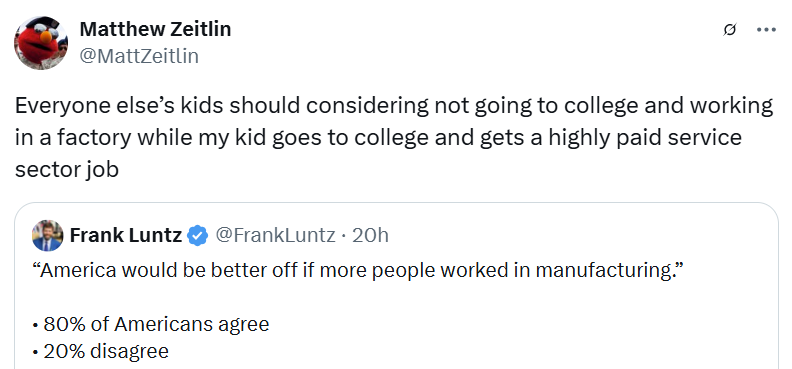
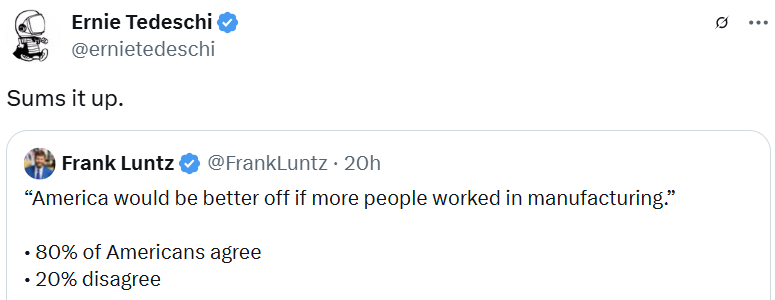
1/ Today's Understanding America, You're So Vain, You Probably Think This Post Is About You, takes a look at the bizarre social media reaction to this @FrankLuntz tweet and what it says about the blinkered innumeracy and elitism of reindustrialization's skeptics.
2/ The Rorschach test here is one separating people who can think rationally and empathetically about the wide range of opportunities their fellow citizens might pursue, and those who lack that basic capacity. @scottlincicome apparently falls in bucket 2.
@scottlincicome 3/ See, if 25% of respondents say they’d prefer a factory job to their current job, that suggests an enormous opportunity for improvement in many lives. But @gtconway3d thinks only people who themselves see a factory job as their best option should support more factory jobs.
@scottlincicome @gtconway3d 4/ We see this same thinking elsewhere in our politics. @MattZeitlin draws one analogy directly, to the idea that there’s something wrong with people who want their own kid to go to college but don’t think we should have an education system oriented toward college for all.
@scottlincicome @gtconway3d @MattZeitlin 5/ This style of virtue-signaling from the elite is so obviously self-interested and socially harmful that it’s hard to believe it passes as virtuous at all. Which, unlikely @ernietedeschi's view from the Yale @The_Budget_Lab, really does sum it all up.
@scottlincicome @gtconway3d @MattZeitlin @ernietedeschi @The_Budget_Lab 6/6 A healthy politics celebrates pluralism and embraces an obligation to advance it. An elite that thinks it is supposed to promote only its own path is helping only itself.
🧵Happy 25th Anniversary of granting permanent normal trade relations to China, for those few who still celebrate!
Today I'm counting down 10 classic examples of the failed consensus that led us off the cliff (h/t @AmerCompass Wrong All Along project).
#10... This [U.S.-China WTO] Agreement will also strengthen our ability to assure fair trade and to defend our agriculture and manufacturing base from import surges and unfair pricing.”
— Lael Brainard, Under Secretary of the Treasury, Clinton admin. (2000)
#9. “This reinforces all the things we want to encourage in China ... If we want to be part of changing that in China, then openness to telecommunications, openness to the Internet is a central piece of that. On the other hand, if we want to repudiate all of those who are working in that direction, repudiate all of those who have reached out in favor of markets, then not taking the PNTR step is the way to do that.”
— Martin Bailey, Chairman, Council of Economic Advisors, Clinton admin. (2000)
1/ Fascinating drama playing out over the past 24 hours as the very good GAIN AI Act from @SenatorBanks comes under fire from @nvidia, which seems happy to shred its credibility for the sake of getting more AI chips into China. 🧵
2/ The Banks bill takes the sensible and modest approach of requiring US chipmakers to offer AI chips to American customers before selling them to China. So it's just blocking sales where more chips for the CCP directly means fewer for American firms. theregister.com/2025/09/04/us_…
3/ Enter Nvidia, which is leveraging every ounce of influence with the administration to get its chips into China, even when there are American firms that want the chips, because it thinks it can gain a permanent toehold there (which never works and won't this time either).
1/10 I say this out of respect, not disrespect, for Sohrab, whose analysis is always careful and thoughtful: This makes no sense at all. If the best effort at constructing a case from within an assumption of U.S. hegemony leaves logical holes this gaping, that era is truly over.
2/ First, Israel is conducting a campaign against a country that has orchestrated unending terrorism against it for decades and called for its destruction. It is not America's place to grant permission for such a campaign, to take responsibility for it, or to stand in its way.
3/ Not having responsibility for the campaign, the U.S. likewise does not have responsibility for the smoldering ruins that Israel may leave behind, no matter how much people rend their garments and complain. Yes, this requires a mindset change. So make it.
1/ In an especially fun bout of market fundamentalism yesterday, @MattHennessey @WSJopinion argued that markets "are governed by the laws of economics the way the physical world is governed by the laws of gravity." I love this for two reasons... wsj.com/opinion/jd-van…
2/ First, because it's disastrously inapt. Economics is nothing like physics. Its principles are not generated from repeatable experiments, nor do they hold consistently across space and time. Believing otherwise is a quite literal example of blind faith and fundamentalism.
3/ Second, though, it's perfect. Yes, the physical world is governed by the laws of gravity. But it is not governed only by the laws of gravity. Indeed, anyone who thought he could reliably predict the motion of bodies with knowledge only of gravity would be quite disappointed.
Tough crowd, sore subject I guess. Deleting tweet and archiving it here. Only point I was trying to make is that I think comparative advantage mostly determines composition of trade, other factors drive level. I was curious how people would describe it. You didn't disappoint...
I particularly appreciated Alex's enthusiastic ALL CAPS confidence that comparative advantage explains the slave trade.
Thanks also to everyone who thinks richer countries always run deficits with poorer countries because the poorer countries can't afford to buy as much. I must have missed that chapter in Ricardo.
1/ If you don't like what Trump did on reciprocity, that's fine. But if you're claiming it's indecipherable, you're not trying very hard.
In February, in Understanding America, I explained exactly how this might look and why:
2/ "Some analysts have taken the threat of 'reciprocal tariffs' to mean literally holding a mirror up to the tariff regimes of other countries... there’s no reason to believe that’s what the administration is pursuing." understandingamerica.co/p/the-one-word…
3/ "Trump’s orders indicate a desire to assess the extent of imbalance in market access between the U.S. and each of its trading partners, and then use a tariff to counteract it."