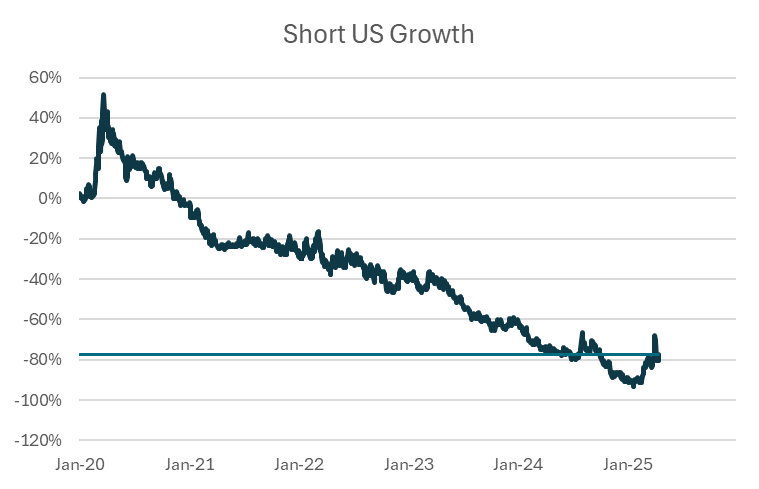
The US Wrecking Ball policy stance still has a long ways to go to before its reflected in asset markets.
Moves so far mostly have mostly just reversed the euphoria around the election of the new admin. It'll take much larger moves to reflect today's policy reality.
Thread.
For a months I've described the combination of the series of negative-growth federal government policies with a Fed that will be behind the curve in response as a Wrecking Ball.
That's because that mix is not only terrible for asset markets, but it is bad for the economy.
And I should note that this doesn't include the very real possibility of a more extreme tail outcome possibilities like loss of faith in the federal reserve independence, a capital war, or a kinetic war. Not something to bet on, but outcomes that would exacerbate these dynamics.
These impacts have yet to be really reflected in markets. Take market based measure of growth here. A short US growth portfolio of long LT nominals and reals and short stocks is merely back to where we were just before the election.
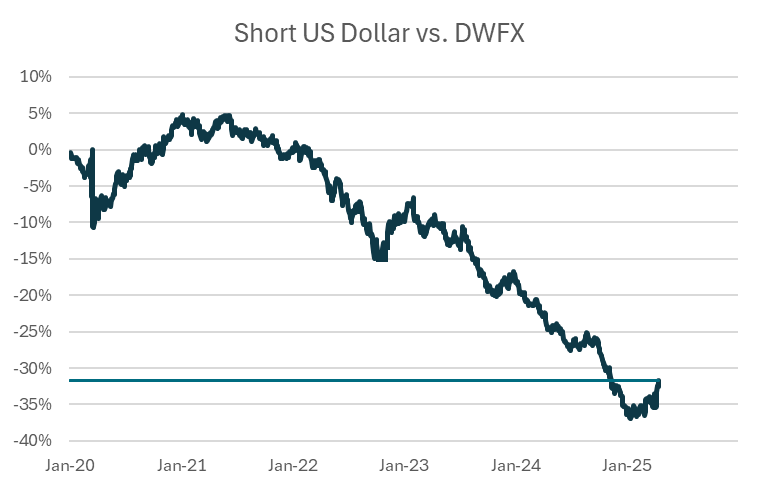
While there has been a lot of talk about foreign investors pulling money out of the US, particularly among our DW world capital partner, the dollar has hardly moved in any longer-term context.
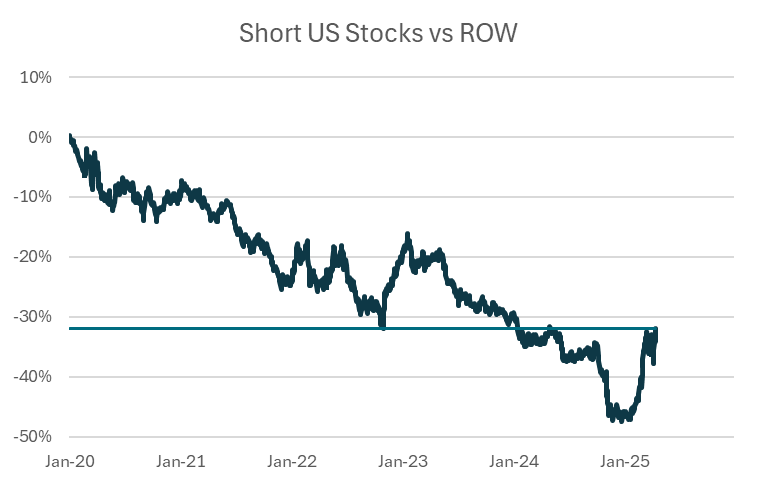
And the reversal of the US exceptionalism trade has merely unwound moves from just after the election. A pretty big move over the short-term but only retracing a small part of the post covid move up until the election.
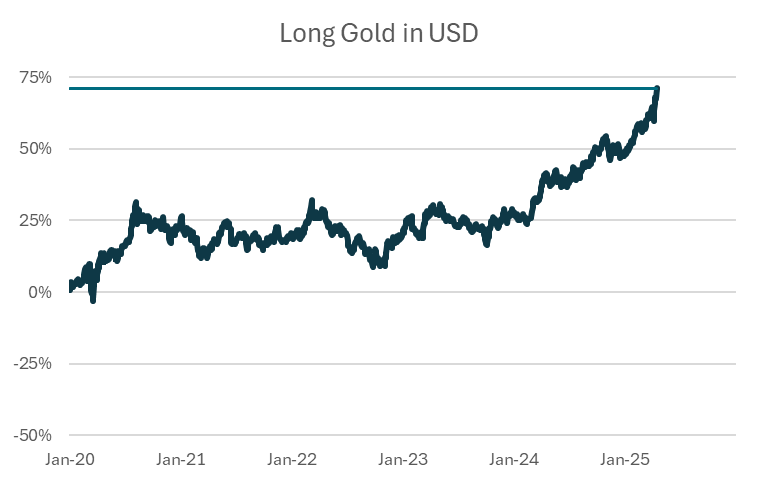
Gold is really the only asset that has had significant moves reflecting these dynamics, up 25% or so since the election. But still in the context of an asset that has in past times of stress doubled or tripled, these are pretty modest moves.
Taken together a "US Wrecking Ball" position mix remains vastly underwater relative to the start of 2020. While the moves have felt large up close, this mix is still only a couple percent higher than in the lead up to the election.
Hardly a scratch given the policy mix today.
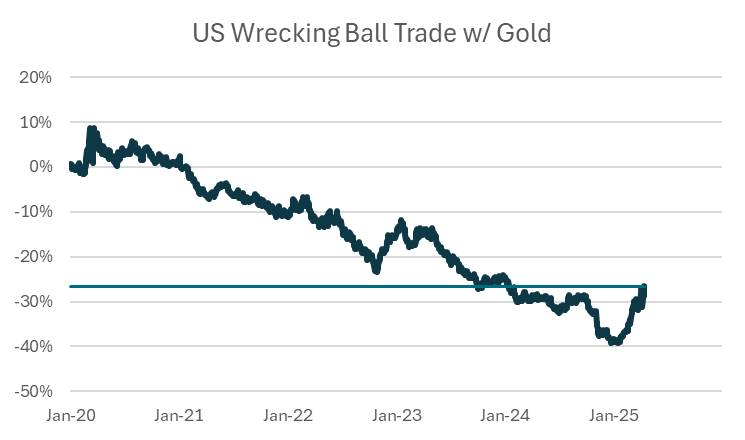
In a high volatility environment you either have to be 1) extremely agile or 2) positioned in a way that is well balanced to reflect the larger trend.
It's very hard to do the first, particularly in size. The Wrecking Ball mix above is likely well positioned for the second.
Financial assets are still trading on high hopes that this policy environment will be short lived even as most signs indicate further entrenchment from all sides.
So while this mix has made for a good trade in recent weeks, it looks like there is still plenty of room to run.
PS - the consolidated portfolio looks roughly like:
- 30% long-term US bonds (equal weighted between TIPS and nominals)
- 30% long equities ex-US
- 15% long gold
- 30% short USD
- 60% short US stocks
(for roughly 10% target vol)
• • •
Missing some Tweet in this thread? You can try to
force a refresh

Seen rising toxicity over the 3yrs I've been active, accelerating post election.
Not just more trolls and politically motivated folks. Sad to see more large accounts focus on scoring points and ginning up mob attacks vs being collaborative & supportive (even with disagreement).
What was a vibrant community of interaction is slowing decaying to individual silos & marketing posts b/c its the rational thing to do. Everyone worse off for it.
Particularly the silent majority of folks who passively consume the content here and learn from the interactions.
I know it creates a feeling of superiority to join (or create) a tribe here & attack when others disagree or have been wrong, sometimes mercilessly.
But for anyone who cares about a vibrant fintwit community, those folks are a destructive cancer dressed up as 'accountability.'
A broad look at the inflation data suggests price pressures continue to rise as disinflationary benefits like housing moderate and price pressures from tariffs flow through.
Thread.
The US still has an inflation problem and the inflation impulse from rising tariffs is not helping the situation. Core PCE numbers reported a couple weeks ago remain almost 100bps above the Fed target and are set to march higher in coming quarters.
The CPI release brought our first read of official inflation data for July. A scan of other inflation triangulations suggests the inflation reality isn't looking good (even though expectations are contained). Will this translate into the actual reported data?
Anyone take a look at this Situation Awareness fund getting all the press? A client asked me so I took a look.
Claims 47% net returns YTD when 2 large 12/31/24 13F positions (MRVL & VRT) were down 44% & 36% and article claims limited short positions.
If you just take their 13F filings and estimate the monthly returns of their holdings you get something that looks like this below, which nets out much closer to 0% return YTD. Seems like an ok proxy since holdings didn't change that much over the quarter.
Portfolio definitely had winners in the 3/31/25 13F mix, but would have had to have way out of the money calls on INTC (making notional near zero value) and flawless timing on the winners (and/or lots of shorts alpha) to get close given disappointing 1Q picks.
Despite the political euphoria that's come from passing the BBB, netting out the impacts of immigration and tariffs under either current or likely policy suggests a negative shock to growth in coming quarters.
Thread.
Federal government policies are typically reactive to underlying conditions in the private sector and so while they can be important influences on growth, they rarely drive substantial growth pressures as a standalone.
The magnitude and direction of the policy suite from the new administration is relatively unusual - creating a large pressure on growth somewhat independent of what was happening in the rest of the economy (which was a pretty boring late cycle deceleration).
When most portfolios are long only, flexible strategies that can go short to cushion negative return periods are uniquely diversifying.
The challenge is finding cash efficient, low cost, positive return strategies that do it. Managed Futures run at 2x is an option.
Thread.
Allocators often face challenges designing portfolios that can help limit losses in down market environments. Despite the need, there are few investment offerings that perform well when other assets underperform but don’t have burdensome drag on the portfolio over time.
Some folks use buffer products, but those are often structured in a way that can limit upside. Others add out of the money puts, but that often results in meaningful negative return drag over time as premiums go unused.
For years the housing market has almost levitated despite drags from high rates and high prices thanks to limited supply and other assets financing demand. But in recent months that's started to flip.
The housing market has been much more resilient in recent years than most had expected in the face of very high rates. The biggest reason for that was that while buying demand dried up following the post-covid surge in rates, so too did supply.
In the last 6 months or so both have shifted to be more negative for prices. Inventory of new and existing homes have picked up while the slowing of asset prices combined with still high mortgage rates has caused buying demand to hit new lows.